
 100% FREE ACCESS
12th Standard Syllabus & Materials
12th Standard
TN 12th Computer Applications மின்னணு தரவு பரிமாற்றம் Sample Question Papers Study Material - QB365 Set A
NEW12th Standard
TN 12th Computer Applications மின் - வணிக பாதுகாப்பு அமைப்புகள் Sample Question Papers Study Material - QB365 Set A
NEW12th Standard
TN 12th Computer Applications மின்னணு செலுத்தல் முறைகள் Sample Question Papers Study Material - QB365 Set A
NEW12th Standard
TN 12th Computer Applications மின் - வணிகம் Sample Question Papers Study Material - QB365 Set A
NEW12th Standard
TN 12th Computer Applications திறந்த மூல கருத்துருக்கள் Sample Question Papers Study Material - QB365 Set A
NEW12th Standard
TN 12th Computer Applications வலையமைப்பு வடமிடல் Sample Question Papers Study Material - QB365 Set A

Published on: 12/10/2026
Download Tamil Nadu 12th Standard Maths question papers, model tests, one-mark questions, important questions, and public exam papers in PDF format. Free study materials and answer keys for TN State Board students.
Questions + Answers key
Take MCQ Maths Test
1.
Find cos-1\((cos(\frac{7\pi}{6}))\)
2.
How many rows are needed for following statement formulae?
(( p ∧ q) ∨ (¬r ∨¬s)) ∧ (¬ t ∧ v))
3.
Evaluate \(\int ^\frac {\pi}{2}_{0} \)( sin2 x + cos4 x ) dx
4.
Assume that the cross section of the artery of human is circular. A drug is given to a patient to dilate his arteries. If the radius of an artery is increased from 2 mm to 2.1 mm, how much is cross-sectional area increased approximately?
5.
Find the differential equation of the curve represented by xy = aex + be−x + x2.
6.
Find the acute angle between the planes \(\vec { r } .(2\hat { i } +2\hat { j } +2\hat { k } )\) and 4x-2y+2z = 15.
7.
Find the principal argument Arg z, when z = \(\frac { -2 }{ 1+i\sqrt { 3 } } \)
8.
If x2+2(k+2)x+9k = 0 has equal roots, find k.
9.
Determine whether x + y − 1 = 0 is the equation of a diameter of the circle x2 + y2 − 6x + 4y + c = 0 for all possible values of c .
10.
Let X be a continuous random variable and f(x) is defined as: \(f(x)= \begin{cases}k x(1-x)^{10} & , 0<x<1 \\ 0 & , \text { Otherwise }\end{cases}\)Find the value of k.
11.
Prove that q ➝ p ≡ ¬p ➝ ¬q
12.
Let W(x, y, z) = x2 - xy + 3 sin z, x, y, z ∈ R. Find the linear approximation for U at (2, -1, 0).
13.
Evaluate the following
\(\int _{ 0 }^{ \frac { \pi }{ 2 } }{ { sin }^{ 3 }\theta { cos }^{ 5 }\theta d\theta } \)
14.
A thermometer was taken from a freezer and placed in a boiling water. It took 22 seconds for the thermometer to raise from −10°C to 100°C. Show that the rate of change of temperature at some time t is 5°C per second.
15.
Prove that \([\vec { a } -\vec { b } ,\vec { b } -\vec { c } ,\vec { c } -\vec { a } ]\) = 0
16.
Find the quotient \(\frac { 2\left( cos\frac { 9\pi }{ 4 } +isin\frac { 9\pi }{ 4 } \right) }{ 4\left( cos\left( \frac { -3\pi }{ 2 } + \right) isin\left( \frac { -3\pi }{ 2 } \right) \right) } \) in rectangular form
17.
Solve sin-1 x > cos-1x
18.
Find the equation of the circle with centre (2, -1) and passing through the point (3, 6) in standard form.
19.
A = \(\left[ \begin{matrix} 1 & \tan { x } \\ -\tan { x } & 1 \end{matrix} \right] \), show that ATA-1 = \(\left[ \begin{matrix} \cos { 2x } & -\sin { 2x } \\ \sin { 2x } & \cos { 2x } \end{matrix} \right] \)
20.
If α, β, γ and \(\delta\) are the roots of the polynomial equation 2x4 + 5x3 − 7x2 + 8 = 0, find a quadratic equation with integer coefficients whose roots are α + β + γ + \(\delta\) and αβ૪\(\delta\).
21.
Verify
(i) closure property
(ii) commutative property
(iii) associative property
(iv) existence of identity and
(v) existence of inverse for the operation ×11 on a subset A = {1, 3, 4, 5, 9} of the set of remainders {0,1, 2, 3, 4, 5, 6, 7, 8, 9,10}
22.
If v(x, y) = log \(\left( \frac { { x }^{ 2 }+{ y }^{ 2 } }{ x+y } \right) \), prove that \(x\frac { \partial v }{ \partial x } +y\frac { \partial u }{ \partial y } \) = 1
23.
Find the area of the region common to the circle x2 + y2 = 16 and the parabola y2 = 6x.
24.
The probability density function of X is given
\(f(x)=\begin{cases} \begin{matrix} { Ke }^{ \frac { -x }{ 3 } } & \begin{matrix} for & x>0 \end{matrix} \end{matrix} \\ \begin{matrix} 0 & \begin{matrix} for & x\le 0 \end{matrix} \end{matrix} \end{cases}\)
Find
(i) the value of k
(ii) the distribution function.
(iii) P(X <3)
(iv) P(5 ≤X)
(v) P(X ≤ 4)
25.
Assume that the rate at which radioactive nuclei decay is proportional to the number of such nuclei that are present in a given sample. In a certain sample 10% of the original number of radioactive nuclei have undergone disintegration in a period of 100 years. What percentage of the original radioactive nuclei will remain after 1000 years?
26.
Find the dimensions of the rectangle with maximum area that can be inscribed in a circle of radius 10 cm.
27.
A ladder 17 metre long is leaning against the wall. The base of the ladder is pulled away from the wall at a rate of 5 m/s. When the base of the ladder is 8 metres from the wall.
(i) How fast is the top of the ladder moving down the wall?
(ii) At what rate, the area of the triangle formed by the ladder, wall and the floor is changing?
28.
Determine the values of λ for which the following system of equations (3λ − 8)x + 3y + 3z = 0, 3x + (3λ − 8)y + 3z = 0, 3x + 3y + (3λ − 8)z = 0. has a non-trivial solution.
29.
Find the parametric form of vector equation and Cartesian equations of the plane containing the line \(\vec { r } =(\hat { i } -\hat { j } +3\hat { k } )+t(2\hat { i } -\hat { j } +4\hat { k } )\) and perpendicular to plane \(\vec { r } .(\hat { i } +2\hat { j } +\hat { k } )=8\)
30.
An engineer designs a satellite dish with a parabolic cross section. The dish is 5 m wide at the opening, and the focus is placed 1.2 m from the vertex
(a) Position a coordinate system with the origin at the vertex and the x -axis on the parabola’s axis of symmetry and find an equation of the parabola.
(b) Find the depth of the satellite dish at the vertex.
31.
Solve \(cos\left( sin^{ -1 }\left( \frac { x }{ \sqrt { 1+{ x }^{ 2 } } } \right) \right) =sin\left\{ cot^{ -1 }\left( \frac { 3 }{ 4 } \right) \right\} \)
32.
If z = x + iy and arg \(\left( \frac { z-i }{ z+2 } \right) =\frac { \pi }{ 4 } \), then show that x2 + y2 + 3x - 3y + 2 = 0
33.
Solve the following equation: x4-10x3+ 26x2-10x + 1 = 0
34.
Prove by vector method that the perpendiculars (altitudes) from the vertices to the opposite sides of a triangle are concurrent.
35.
36.
If cosx is an integrating factor of the differential equation \(\frac{dy}{dx}+Py= Q\), then P = ___________
-cot x
cot x
tan x
-tan x
37.
38.
If u = \((\frac{y}{x})\) then x \(x\frac { \partial u }{ \partial x } +y\frac { \partial u }{ \partial y } \) = .....................
0
1
2u
u
39.
If a compound statement involves 3 simple statements, then the number of rows in the truth table is
9
8
6
3
40.
\(\text { The value of } \int_{0}^{\frac{2}{3}} \frac{d x}{\sqrt{4-9 x^{2}}} \text { is }\)
\(\frac{\pi}{6}\)
\(\frac{\pi}{2}\)
\(\frac{\pi}{4}\)
\({\pi}\)
41.
If u(x, y) = x2+ 3xy + y - 2019, then \(\left.\frac{\partial u}{\partial x}\right|_{(4,-5)}\) is equal to
-4
-3
-7
13
42.
A pair of dice numbered 1, 2, 3, 4, 5, 6 of a six-sided die and 1, 2, 3, 4 of a four-sided die is rolled and the sum is determined. Let the random variable X denote this sum. Then the number of elements in the inverse image of 7 is
1
2
3
4
43.
The degree of the differential equation \(y(x)=1+\frac { dy }{ dx } +\frac { 1 }{ 1.2 } { \left( \frac { dy }{ dx } \right) }^{ 2 }+\frac { 1 }{ 1.2.3 } { \left( \frac { dy }{ dx } \right) }^{ 3 }+....\) is
2
3
1
4
44.
What is the value of the limit \(\lim _{x \rightarrow 0}\left(\cot x-\frac{1}{x}\right) \text { is }\)
0
1
2
∞
45.
The abscissa of the point on the curve \(f\left( x \right) =\sqrt { 8-2x } \) at which the slope of the tangent is -0.25 ?
-8
-4
-2
0
46.
If A = \(\left[ \begin{matrix} 3 & 1 & -1 \\ 2 & -2 & 0 \\ 1 & 2 & -1 \end{matrix} \right] \) and A-1 = \(\left[ \begin{matrix} { a }_{ 11 } & { a }_{ 12 } & { a }_{ 13 } \\ { a }_{ 21 } & { a }_{ 22 } & { a }_{ 23 } \\ { a }_{ 31 } & { a }_{ 32 } & { a }_{ 33 } \end{matrix} \right] \) then the value of a23 is
0
-2
-3
-1
47.
If the volume of the parallelepiped with \(\vec { a } \times \vec { b } ,\vec { b } \times \vec { c } ,\vec { c } \times \vec { a } \) as coterminous edges is 8 cubic units, then the volume of the parallelepiped with \((\vec { a } \times \vec { b } )\times (\vec { b } \times \vec { c } ),(\vec { b } \times \vec { c } )\times (\vec { c } \times \vec { a } )\) and \((\vec { c } \times \vec { a } )\times (\vec { a } \times \vec { b } )\)as coterminous edges is,
8 cubic units
512 cubic units
64 cubic units
24 cubic units
48.
The circle passing through (1, -2) and touching the axis of x at (3, 0) passing through the point
(-5, 2)
(2, -5)
(5, -2)
(-2, 5)
49.
The radius of the circle 3x2 + by2 + 4bx − 6by + b2 = 0 is
1
3
\( \sqrt {10}\)
\( \sqrt {11}\)
50.
\(\sin ^{-1}\left(\tan \frac{\pi}{4}\right)-\sin ^{-1}\left(\sqrt{\frac{3}{x}}\right)=\frac{\pi}{6}\). Then x is a root of the equation
x2−x−6 = 0
x2−x−12 = 0
x2+x−12 = 0
x2+x−6 = 0
51.
\(\sin ^{-1}(\cos x)=\frac{\pi}{2}-x\) is valid for
\(-\pi \le x\le 0\)
\(0 \le x\le \pi\)
\(-\frac { \pi }{ 2 } \le x\le \frac { \pi }{ 2 } \)
\(-\frac { \pi }{ 4 } \le x\le \frac { 3\pi }{ 4 } \)
52.
The value of \(\left( \cfrac { 1+\sqrt { 3 } i}{ 1-\sqrt { 3}i } \right) ^{ 10 }\) is
\(cis\cfrac { 2\pi }{ 3 } \)
\(cis\cfrac { 4\pi }{ 3 } \)
\(-cis\cfrac { 2\pi }{ 3 }\)
\(-cis\cfrac { 4\pi }{ 3 }\)
53.
According to the rational root theorem, which number is not possible rational zero of 4x7 + 2x4 - 10x3 - 5?
-1
\(\frac { 5 }{ 4 } \)
\(\frac { 4 }{ 5 } \)
5
54.
The conjugate of a complex number is \(\cfrac { 1 }{ i-2 } \). Then the complex number is
\(\cfrac { 1 }{ i+2 } \)
\(\cfrac { -1 }{ i+2 } \)
\(\cfrac { -1 }{ i-2 } \)
\(\cfrac { 1 }{ i-2 } \)
1.
It is known that cos-1 x : [-1, 1]\(\rightarrow\)[0, \(\pi\)] is given by
cos−1x = y if and only if x = cos y for -1\(\le x\le1\ and\ 0\le y \le\pi\)
Thus, we have
cos-1\((cos(-\frac{7\pi}{6}))\) = \(\frac{5\pi}{6}\), since cos\((\frac{7x}{6})=cos(\pi+\frac{\pi}{6})=-\frac{\sqrt3}{2}=cos(\frac{5\pi}{6})\in[0, \pi].\)
2.
(( p ∧ q) ∨ (¬r ∨¬s)) ∧ (¬ t ∧ v)) contains 6 variables p, q, r, s, t, and v. Hence the corresponding truth table will contain 26 = 64 rows.
3.
Given that I =\(\int ^\frac {\pi}{2}_{0} \)( sin2x + cos4x)dx =\(\int ^\frac {\pi}{2}_{0} \) sin2x dx+\(\int ^\frac {\pi}{2}_{0} \)cos4x dx\(\frac {1}{2} \times \frac {\pi}{2} + \frac {3}{4} \times \frac {1}{2} \times \frac {\pi}{2} = \frac {7\pi}{16} \)
4.
Given r = 2 mm
dr = (2.1 - 2) = 0.1 mm
Area = πr2
Approximate area dA = 2πr dr
= 2π (2) (0.1)
= 4 π (0.1) = 0.4 π mm2
5.
Given equation of curve is
xy = aex + be−x + x2 ...(1)
where a &b are aribitrary constant. differentiate equation (1) twice successively, because we have two arbitray constant.
\(x \frac{d y}{d x}+y(1)=a \mathrm{e}^{x}-\mathrm{be}^{-x}+2 x\) ...(2)
\(
x \frac{d^{2} y}{d x^{2}}+\frac{d y}{d x}(1)+\frac{d y}{d x}=\mathrm{ae}^{x}+\mathrm{be}^{-x}+2
\)
\( x \frac{d^{2} y}{d x^{2}}+\frac{2 d y}{d x}=\mathrm{ae}^{x}+\mathrm{be}^{-x}+2
\) ...(3)
From (1), we get \(x y-x^{2}=\mathrm{ae}^{x}+\mathrm{be}^{-x}\) ...(4)
Substituting equation (a) in (3), we get
\(\therefore x \frac{d^{2} y}{d x^{2}}+\frac{2 d y}{d x}-x y+x^{2}-2=0\) which is the required differential equaiton.
6.
The normal vectors of the two given planes \(\vec { r } .(2\hat { i } +2\hat { j } +2\hat { k } )\)= 11 and 4x+2y+2z = 15 are \(\vec { { n }_{ 1 } } =2\hat { i } +2\hat { j } +2\hat { k } \) and \(\vec { { n }_{ 2 } } =4\hat { i } -2\hat { j } +2\hat { k } \) respectively.
If θ is the acute angle between the planes, then we have
\(\theta =cos^{ -1 }\left( \frac { |\vec { { n }_{ 1 } } .\vec { { n }_{ 2 } } | }{ |\vec { { n }_{ 1 } } .\vec { { n }_{ 2 } } | } \right) =cos^{ -1 }\left( \frac { |((2\hat { i } +2\hat { j } +2\hat { k } ).(4\hat { i } -2\hat { j } +2\hat { k } ))| }{ |(2\hat { i } +2\hat { j } +2\hat { k } )||4\hat { i } -2\hat { j } +2\hat { k } | } \right) =cos^{ -1 }\left( \frac { \sqrt { 2 } }{ 3 } \right) \).
7.
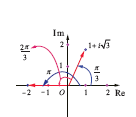
ang \(z=\frac { -2 }{ 1+i\sqrt { 3 } } \)
= arg(-2)-arg \(\left( 1+i\sqrt { 3 } \right) \) \(\left( \because arg\left( \frac { { z }_{ 1 } }{ { z }_{ 2 } } \right) =arg{ z }_{ 1 }=g_{ 2 } \right) \)
= \(\left( \pi -{ tan }^{ -1 }\left( \frac { 0 }{ 2 } \right) \right) -tan^{ -1 }\left( \frac { \sqrt { 3 } }{ 1 } \right) \)
= \(\pi -\frac { \pi }{ 3 } =\frac { 2\pi }{ 3 } \)
This implies that one of the values of arg z is \(\frac { 2\pi }{ 3 } \)
Since \(\frac { 2\pi }{ 3 } \) lies between \(-\pi \), the principal argument Argz is \(\frac { 2\pi }{ 3 } \)
8.
Here Δ = b2−4ac = 0 for equal roots. This implies 4(k + 2)2 = 4(9)k. This implies k = 4 or 1.
9.
Centre of the circle is (3,-2) which lies on x + y − 1 = 0. So the line x + y − 1 = 0 passes through the centre and therefore the line x + y −1 = 0 is a diameter of the circle for all possible values of c .
10.
\(
\int_{-\infty}^{\infty} f(x) \mathrm{dx}=1
\)
\(\int_{-\infty}^{0} 0 \mathrm{dx}+\int_{0}^{1} \mathrm{kx}(1-x)^{10} \mathrm{dx}+\int_{1}^{\infty} 0 \mathrm{dx}=1
\)
\(\int_{0}^{1} k x(1-x)^{10} \mathrm{dx}=1
\)
\(\int_{0}^{1}(1-x)(1-1+x)^{10} \mathrm{dx}=1
\)
\(k \int_{0}^{1}(1-x)(\mathrm{x})^{10} \mathrm{dx}=1
\)
\([\therefore \left.k \int_{0}^{1} \mathrm{f}(\mathrm{x}) \mathrm{dx}=\int_{0}^{10} \mathrm{f}(\mathrm{a}-\mathrm{x}) \mathrm{dx}\right]
\)
\(
k \int_{0}^{1}(1-x)(x)^{10} d x =1
\)
\(k \int_{0}^{1}\left(x^{10}-x^{11}\right) d x =1
\)
\(k\left[\frac{x^{11}}{11}-\frac{x^{12}}{12}\right]_{0}^{1} =1
\)
\(k\left[\frac{1}{11}-\frac{1}{12}\right] =1
\)
\(k\left[\frac{1}{132}\right] =1\)
k = 132
11.
| p | q | q ➝ p | ~p | ~q | ~q ➝ ~p |
| T | T | T | F | F | T |
| T | F | T | F | T | T |
| F | T | F | T | F | F |
| F | F | T | T | T | T |
The entries in the columns corresponding q ➝ p and ~p ➝ ~q are identical and hence they are equivalent.
q ➝ p ≡ ~p ➝ ~q
Hence proved
12.
Given W(x, y, z) = x2 - xy + 3 sin z, x, y, z ∈ R
W(x0, y0, z0) = W (2, -1, 0)
= 22-2(-1)+3 sin 0
\(\frac { \partial W }{ \partial x } \) = 2x - y + 0 = 2x - y
\(\left( \frac { \partial W }{ \partial x } \right) _{(2, -1, 0)}\)= 2(2)-(-1) = 5
\(\frac { \partial W }{ \partial y } \) = 0-x + 0 = -x
\(\left( \frac { \partial W }{ \partial y } \right) _{(2, -1, 0)}\) = -2
\(\frac { \partial W }{ \partial z } \) = 0 - 0 + 3 cos z
\(\left( \frac { \partial W }{ \partial z} \right) _{(2, -1, 0)}\)= 3 cos 0 = 3(1) = 3.
Linear approximation is given by
L(x, y, z) = w(x0, y0, z0) + \(\left( \frac { \partial W }{ \partial x } \right) _{(x_0, y_0, z_0)}\) (x - x0) + \(\left( \frac { \partial W }{ \partial y} \right) _{(x_0, y_0, z_0)}\) (y - y0) + \(\left( \frac { \partial W }{ \partial z} \right) _{(x_0, y_0, z_0)}\)(z0 - z0)
∴ L(x,y,z) = 6 + 5(x - 2) - 2(y+1) + 3(z - 0)
= 6 + 5x - 10 - 2y - 2 + 3z
L (x, y, z) = 5x - 2y + 3z - 6
13.
\(I=\int _{ 0 }^{ \frac { \pi }{ 2 } }{ { sin }^{ 3 }\theta { cos }^{ 5 }\theta d\theta } \)
\( \mathrm{m}=3, \mathrm{n}=5 \)
\( \int_{0}^{\pi / 2} (cos ^5 \theta - cos^7 \theta) sin \theta d\theta\)
\(t = cos \theta\)
\(dt = -sin \theta d\theta\)
\(= \int ^0_1(t^2-t^7)(-dt)\\
= \int ^0_1(t^5-t^7)(dt)= [\frac{t^6}{6}-\frac{t^8}{8}]\)
\(\frac{1}{6}-\frac{1}{8}= \frac{8-6}{48}\)
\( =\frac{1}{24} \)
Aliter method:
\(I=\int _{ 0 }^{ \frac { \pi }{ 2 } }{ { sin }^{ 3 }\theta { cos }^{ 5 }\theta d\theta } \)
Here m = 3, which is odd and n = 5, which is odd
\(I=\int _{ 0 }^{ \frac { \pi }{ 2 } }{ { sin }^{ m }\theta { cos }^{n } }x dx \)
\( \frac{n-1}{m+n} \cdot \frac{n-3}{m+n-2} \cdot \frac{n-5}{m+n-4} \cdots \frac{2}{m+3} \cdot \frac{1}{m+1} \\ \)
\( \int_{0}^{\pi / 2} \sin ^{3} \theta \cos ^{5} \theta d \theta=\frac{A}{8} \times \frac{2}{6} \times \frac{1}{A} \\ =\frac{1}{24} \)
14.
Let f (t) be the temperature at time t. By the mean value theorem, we have
\(f'(c)=\frac{f(b)-f(a)}{b-a}\)
= \(\frac{100-(-10)}{22}\)
= \(\frac{110}{22}\)
= 5°C per second.
Hence the instantaneous rate of change of temperature at some time t should be 5°C per second.
15.
LHS = \([\vec { a } -\vec { b } ,\vec { b } -\vec { c } ,\vec { c } -\vec { a } ]\) = 0
[∵ cross product is distributive]
\((\vec { a } -\vec { b } ).[(\vec { b } -\vec { c } )\times (\vec { c } -\vec { a } )]\)
= \((\vec { a } -\vec { b } ).[(\vec { b } \times \vec { c } -\vec { b } \times \vec { a } -\vec { c } \times \vec { c } +\vec { c } \times \vec { a } )\)
= \((\vec { a } -\vec { b } ).[\vec { b } \times \vec { c } -\vec { b } \times \vec { a } -0+\vec { c } \times \vec { a } ]\)
\([\because \vec { c } \times \vec { c } =0]\)
= \([\vec { a } \vec { b } \vec { c } ]-[\vec { a } \vec { b } \vec { a } ]+[\vec { a } \vec { c } \vec { a } ]-[\vec { b } \vec { b } \vec { c } ]+[\vec { b } \vec { b } \vec { a } ]-[\vec { b } \vec { c } \vec { a } ]\)
= \([\vec { a } \vec { b } \vec { c } ]-0+0-0+0-[\vec { b } \vec { c } \vec { a } ]\)
= \([\because [\vec { a } \vec { b } \vec { a } ]=[\vec { b } \vec { b } \vec { c } ]=0]\)
= \([\vec { a } \vec { b } \vec { c } ]-[\vec { a } \vec { b } \vec { c } ]\)
= 0 = RHS.
16.
\(\frac { 2\left( cos\frac { 9\pi }{ 4 } +isin\frac { 9\pi }{ 4 } \right) }{ 4\left( cos\left( \frac { -3\pi }{ 2 } + \right) sin\left( \frac { -3\pi }{ 2 } \right) \right) } \)
= \(\frac { 1 }{ 2 } \left( cos\left( \frac { 9\pi }{ 4 } -\left( \frac { -3\pi }{ 2 } \right) \right) +isin\left( \frac { 9\pi }{ 4 } -\left( \frac { -3\pi }{ 2 } \right) \right) \right) \)
= \(\frac { 1 }{ 2 } \left( cos\left( \frac { 9\pi }{ 4 } +\frac { 3\pi }{ 2 } \right) +isin\left( \frac { 9\pi }{ 4 } +\frac { 3\pi }{ 2 } \right) \right) \)
= \(\frac { 1 }{ 2 } \left( cos\left( \frac { 15\pi }{ 4 } \right) +isin\left( \frac { 15\pi }{ 4 } \right) \right) =\frac { 1 }{ 2 } \left( cos\left( 4\pi -\frac { \pi }{ 4 } \right) +isin\left( 4\pi -\frac { \pi }{ 4 } \right) \right) \)
= \(\frac { 1 }{ 2 } \left( cos\left( \frac { \pi }{ 4 } \right) -isin\left( \frac { \pi }{ 4 } \right) \right) =\frac { 1 }{ 2 } \left( \frac { 1 }{ \sqrt { 2 } } +i\frac { 1 }{ \sqrt { 2 } } \right) \)
\(\frac { 2\left( cos\frac { 9\pi }{ 4 } +isin\frac { 9\pi }{ 4 } \right) }{ 4\left( cos\left( \frac { -3\pi }{ 2 } + \right) sin\left( \frac { -3\pi }{ 2 } \right) \right) } \) = \(\frac { 1 }{ 2\sqrt { 2 } } -i\frac { 1 }{ 2\sqrt { 2 } } =\frac { \sqrt { 2 } }{ 4 } +i\frac { \sqrt { 2 } }{ 4 } \) Which is in rectangular form.
17.
Given that sin-1x > cos-1x. Note that -1\(\le x\le\)
Adding both sides by sin-1x, we get
sin-1 x + sin-1 x > x cos-1 x + sin-1x, Which resucess to 2 sin-1 x > \(\frac{\pi}{2}\)
As sine function increases in the interval \(\left[ -\frac { \pi }{ 2 }, \frac { \pi }{ 2 } \right] \), we have x > sin\(\frac{\pi}{4} or x> \frac{1}{\sqrt2}\)
Thus, the solution set is the interval \(\left[ \frac { 1 }{ \sqrt { 2 } } ,1 \right] \)
18.
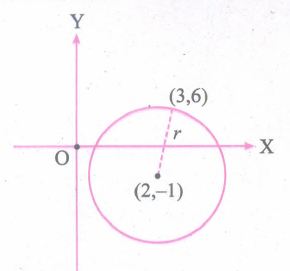
Given centre is (2, -1) and passing through the point (3, 6)
∴ r = distance between (2, -1) and (3, 6)
= \(\sqrt { { (2-3) }^{ 2 }+(-1{ -6) }^{ 2 } } \)
= \(\sqrt { { (-1) }^{ 2 }+({ -7) }^{ 2 } } \)
= \(\sqrt { 1+49 } =\sqrt { 50 } \)
∴ Equation of the circle is
(x - h)2 + (y - k)2 = r2
(x−2)2+(y+1)2 = \({ (\sqrt { 50 } })^{ 2 }\)
(x−2)2+(y+1)2 = 50
19.
Given A = \(\left[ \begin{matrix} 1 & \tan { x } \\ -\tan { x } & 1 \end{matrix} \right] \)
|A| = 1 + tan2 x
∴ A-1 = \(\frac { 1 }{ |A| } \)adjA
= \(\frac { 1 }{ 1+tan^{ 2 } } \left[ \begin{matrix} 1 & -tanx \\ tanx & 1 \end{matrix} \right] \)
[Interchange the elements in the leading diagonal and change the sign of elements in the off diagonal]
AT= \(\\ \left[ \begin{matrix} 1 & -tanx \\ tanx & 1 \end{matrix} \right] \)
∴ ATA-1
=\(\left[ \begin{matrix} 1 & -tanx \\ tanx & 1 \end{matrix} \right] \frac { 1 }{ 1+tan^{ 2 }x } \left[ \begin{matrix} 1 & -tanx \\ tanx & 1 \end{matrix} \right] \)
=\(\frac { 1 }{ 1+tan^{ 2 }x } \left[ \begin{matrix} 1 & -tanx \\ tanx & 1 \end{matrix} \right] \left[ \begin{matrix} 1 & -tanx \\ tanx & 1 \end{matrix} \right] \)
=\(\frac { 1 }{ 1+tan^{ 2 }x } \left[ \begin{matrix} 1-tan^{ 2 }x & -tanx-tanx \\ tanx+tanx & -tan^{ 2 }x+1 \end{matrix} \right] \)
=\(\left[ \begin{matrix} \frac { 1-{ tan }^{ 2 }x }{ 1+{ tan }^{ 2 }x } & \frac { -2tanx }{ 1+{ tan }^{ 2 }x } \\ \frac { 2tanx }{ 1+{ tan }^{ 2 }x } & \frac { 1-{ tan }^{ 2 }x }{ 1+tan^{ 2 }x } \end{matrix} \right] \)
ATA-1 =\(\left[ \begin{matrix} cos2x & -sin2x \\ sin2x & cos2x \end{matrix} \right] \)
Hence proved.
20.
Given polynomial equation is
2x4+ 5x3−7x2 + 8 = 0
Here a = 2, b = 5, c = -7, d = 0, e = 8
By Vieta's formula,
\(\alpha +\beta +\gamma +\delta =\frac { -b }{ a } =\frac { -5 }{ 2 } \)
\(\alpha \beta +\alpha \gamma +\alpha \delta +\beta \gamma +\beta \delta +\gamma \delta =\frac { c }{ a } =\frac { -7 }{ 2 } \)
\(\alpha \beta \gamma +\alpha \beta \delta +\alpha \gamma \delta +\beta \gamma \delta =\frac { -d }{ a } =0\)
\(\alpha \beta \gamma \delta =\frac { e }{ a } =\frac { 8 }{ 2 } =4\)
Given roots of quadratic equation are
∝ + β + ૪ + \(\delta \) and ∝β૪\(\delta \)
∴ sum of the roots = (∝+β+૪+\(\delta \)) (∝β૪\(\delta \))
\(=\left( \frac { -5 }{ 2 } +4 \right) =\frac { -5+8 }{ 2 } =\frac { 3 }{ 2 } \)
\(=\left( \alpha +\beta +\gamma +\delta \right) (\alpha \beta \gamma \delta )\)
\(=\left( \frac { -5 }{ 2 } \right) (4)=\frac { -20 }{ 2 } =-10\)
∴ The required quadratic equation is x2-x
(sum of the roots) + product of the roots = 0
\(\Rightarrow { x }^{ 2 }-x\left( \frac { 3 }{ 2 } \right) -10=0\)
\(\Rightarrow { 2x }^{ 2 }-3x-20=0\)
21.
The table for the operation x11 is as follows.
| x11 | 1 | 3 | 4 | 5 | 9 |
| 1 | 1 | 3 | 4 | 5 | 9 |
| 3 | 3 | 9 | 1 | 4 | 5 |
| 4 | 4 | 1 | 5 | 9 | 3 |
| 5 | 5 | 4 | 9 | 3 | 1 |
| 9 | 9 | 5 | 3 | 1 | 4 |
Following the same kind of procedure as explained in the previous example, a brief outline of the process of verification of the properties of ×11 on A is given below.
(i) Since each box has an unique element of A, ×11 is a binary operation on A.
(ii) The entries are symmetrical about the main diagonal. Hence ×11 has commutative property.
(iii) As usual, the associative property can be seen to be true.
(iv) The entries of both the row and column headed by the element 1 are identical. Hence 1 is the identity element.
(v) Since the identity 1 exists in each row and each column, the existence of inverse property is assured for ×11. The inverse of 1 is 1, that of 3 is 4, that of 4 is 3, 5 is 9, and, that of 9 is 5.
22.
Given v (x, y) = log \(\left( \frac { { x }^{ 2 }+{ y }^{ 2 } }{ x+y } \right) \)
Since log \(\left( \frac { { x }^{ 2 }+{ y }^{ 2 } }{ x+y } \right) \) is not homogeneous,
left f (x, y) = \(\frac { { x }^{ 2 }+{ y }^{ 2 } }{ x+y } \)
⇒ v = log f
⇒ ev = f
Now, f(tx, ty) = \(\frac { { t }^{ 2 }{ x }^{ 2 }+{ t }^{ 2 }{ y }^{ 2 } }{ tx+ty } =\frac { { t }^{ 2 }({ x }^{ 2 }+{ y }^{ 2 }) }{ t(x+y) } \)
= t.f(x, y)
∴ f is a homogeneous function of degree 1.
∴ By Euler's theorem,
⇒ \(x\frac { \partial f }{ \partial x } +y\frac { \partial f }{ \partial y } \) = 1.f
From (1), \(x.\frac { \partial }{ \partial x } \left( { e }^{ v } \right) +y.\frac { \partial }{ \partial y } \left( { e }^{ v } \right) ={ e }^{ v }\) [using (1)]
⇒ \(x.{ e }^{ v }.\frac { \partial }{ \partial x } +y.{ e }^{ v }.\frac { \partial }{ \partial y } ={ e }^{ v }\)
⇒ \(x\frac { \partial u }{ \partial x } +y\frac { \partial u }{ \partial y } \) = 1 [Divided by ev]
23.
Equation of the given circle is x2 + y2 = 16 ...(1)
and the parabola is y2 = 6x. ...(2)
Substituting (2) in (1) we get,
x2 + 6x - 16 = 0 \(\Rightarrow\) (x + 8) (x - 2) = 0
\(\Rightarrow\) (x-4) (x-2) = 0 \(\Rightarrow\) x = 2, 4
\(\Rightarrow\) x = -8, 2
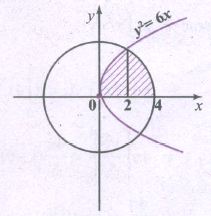
\(\therefore\) Required area = 2
\(\\ \\ \\ \\ \\ \\ \\ \int _{ 0 }^{ 2 }{ Area\ below\ the\ parabola } +\int _{ 2 }^{ 4 }{ Area\ below\ the\ circle } \)
\(=2\left[ \int _{ 0 }^{ 2 }{ \sqrt { 6x } } dx+\int _{ 2 }^{ 4 }{ \sqrt { 16-{ x }^{ 2 } } dx } \right] \)
\(=2\left[ { \left( \frac { \sqrt { 6 } .{ x }^{ \frac { 3 }{ 2 } } }{ \frac { 3 }{ 2 } } \right) }_{ 0 }^{ 2 }+{ \left( \frac { x }{ 2 } \sqrt { 16-{ x }^{ 2 } } +\frac { 16 }{ 2 } { sin }^{ -1 }\left( \frac { x }{ 4 } \right) \right) }_{ 0 }^{ 4 } \right] \)
\(=2\left[ \frac { 2 }{ 3 } \sqrt { 6. } 2\sqrt { 2 } +8{ sin }^{ -1 }\left( \frac { 1 }{ 2 } \right) \right] \)
\(=2\left[ \frac { 4\sqrt { 12 } }{ 3 } +8\left( \frac { \pi }{ 2 } \right) -\sqrt { 12 } -8\left( \frac { \pi }{ 6 } \right) \right] \)
\(=2\left[ \frac { 4\sqrt { 12 } }{ 3 } +4\pi -2\sqrt { 3 } -\frac { 4\pi }{ 3 } \right] \)
\(=2\left[ \frac { 8\sqrt { 3 } -6\sqrt { 3 } }{ 3 } +\frac { 12\pi -4\pi }{ 3 } \right] \)
\(=\left[ \frac { 2\sqrt { 3 } }{ 3 } +\frac { 8\pi }{ 3 } \right] =2\times \frac { 2 }{ 3 } \left[ \sqrt { 3 } +4\pi \right] \)
\(=\frac { 4 }{ 3 } \left[ 4\pi +\sqrt { 3 } \right] \)sq.units
24.
Given
\(f(x)=\begin{cases} \begin{matrix} { Ke }^{ \frac { -x }{ 3 } } & \begin{matrix} for & x>0 \end{matrix} \end{matrix} \\ \begin{matrix} 0 & \begin{matrix} for & x\le 0 \end{matrix} \end{matrix} \end{cases}\)
(i) Since f(x) is a probability density function
\(\int _{ -\infty }^{ \infty }{ f(x) } dx=1\)
\(\Rightarrow \int _{ 0 }^{ \infty }{ K.{ e }^{ \frac { -x }{ 3 } } } dx=1\Rightarrow k\frac { \left[ { e }^{ \frac { -x }{ 3 } } \right] ^{ \infty } }{ -\frac { 1 }{ 3 } } \)
\(\Rightarrow -3k\left[ { e }^{ -\infty }-{ e }^{ 0 } \right] =1\) [∵ e∞ = 0, e0 = 1]
\(\Rightarrow 3k=1\Rightarrow k=\frac { 1 }{ 3 } \)
\(\therefore k=\cfrac { 1 }{ 3 } \)
(ii) The distribution function F(x) = \(\int _{ -\infty }^{ x }{ f(u)du } \)
Case 1: x < 0,
\(F(x)=\int _{ -\infty }^{ x }{ f(x)dx=0 } \)
Case 2: x > 0,
\(f(x)=\int _{ -\infty }^{ x }{ f(x)dx } \)
= \(\int _{ -\infty }^{ 0 }{ f(x)dx+\int _{ 0 }^{ x }{ f(x) } dx } \)
= \(0+k\int _{ 0 }^{ x }{ { e }^{ \frac { -x }{ 3 } } } dx\)
= \(\frac { 1 }{ 3 } \left[ \cfrac { { e }^{ \frac { -x }{ 3 } } }{ -\frac { 1 }{ 3 } } \right] =-\left[ { e }^{ -\frac { x }{ 3 } }-{ e }^{ o } \right] \)
= \(-[{ e }^{ -\frac { x }{ 3 } }-1]\)
= \(1-{ e }^{ -\frac { x }{ 3 } }\)
\(\therefore F(x)=\begin{cases} \begin{matrix} 0 & x\le 0 \end{matrix} \\ \begin{matrix} 1-{ e }^{ \frac { -x }{ 3 } } & x>0 \end{matrix} \end{cases}\)
(iii) p(X < 3)
= \(\int _{ 0 }^{ 3 }{ ke^{ -\frac { x }{ 3 } } } dx=\cfrac { 1 }{ 3 } \int _{ 0 }^{ 3 }{ { e }^{ -\frac { x }{ 3 } }dx } \)
= \(\cfrac { 1 }{ 3 } \left[ \frac { { e }^{ -\frac { x }{ 3 } } }{ \frac { -1 }{ 3 } } \right] \)
= -[e-1-e0] = -[e-1-1]
(iv) \(p(5\le X)=p(X\ge 5)=\int _{ 5 }^{ \infty }{ f(x)dx } \)
= \(\int _{ 5 }^{ \infty }{ ke^{ -\frac { x }{ 3 } } } dx=\cfrac { 1 }{ 3 } \cfrac { \left[ { e }^{ -\frac { x }{ 3 } } \right] _{ 5 }^{ \infty } }{ \frac { -1 }{ 3 } } \)
= \(-\left[ { e }^{ -\infty }-e^{ \frac { -3 }{ 5 } } \right] =\left[ 0-{ e }^{ \frac { -5 }{ 3 } } \right] \)
= \({ e }^{ \frac { -5 }{ 3 } }\)
(v) \(p(X\le 4)=\int _{ -\infty }^{ 4 }{ f(x)dx } \)
= \(\int _{ -\infty }^{ 0 }{ f(x)dx+\int _{ 0 }^{ 4 }{ f(x)dx } } \)
= \(0+\int _{ 0 }^{ 4 }{ { ke }^{ -\frac { x }{ 3 } }dx } =k\left[ \frac { { e }^{ -\frac { x }{ 3 } } }{ -\frac { 1 }{ 3 } } \right] _{ 0 }^{ 4 }\)
= \(\cfrac { 1 }{ 3 } \cfrac { \left[ { e }^{ -\frac { x }{ 3 } } \right] _{ 0 }^{ 4 } }{ -\frac { 1 }{ 3 } } =-\left[ { e }^{ \frac { -4 }{ 3 } }-{ e }^{ o } \right] \)
= \(-\left[ { e }^{ \frac { -4 }{ 3 } }-1 \right] =1-{ e }^{ \frac { -4 }{ 3 } }\)
25.
Let there be N radioactive nuclei in a sample at any time t and let No be the initial number of radioactive nuclei.
Then \(\frac{dN}{dt}\infty N\)
\(\Rightarrow \frac { dN }{ dt } =-\lambda N\)
Where \(\lambda>0\) is a constant
\(\Rightarrow \frac { dN }{ N } =-\lambda dt\)
\(\int { \frac { dN }{ N } } =-\lambda dt\)
\(\int { \frac { dN }{ N } =-\lambda \int { dt } } \)
\(\Rightarrow log\ N=-\lambda t+C\ ...(1)\)
\(T\quad t=0,\ we\ have\ N={ N }_{ 0 }\)
\(\therefore log{ N }_{ 0 }=0+C\)
\(\Rightarrow C=log{ N }_{ 0 }\)
\(\therefore\)(1) becomes, log N = -\(\lambda t+log{ N }_{ 0 }\)
\(\Rightarrow log\frac { N }{ { N }_{ 0 } } =-\lambda t\quad ...(2)\)
It is given that 10% of the original number of nuclei have undergone disintegration in a period of 100 years.
Whent= 100 \(N={ N }_{ 0 }-\frac { 10 }{ 100 } \times { N }_{ 0 }=\frac { { 9N }_{ 0 } }{ 10 } \)
Substituting in (2) we get
\(log\quad \frac { 9 }{ 10 } =-100\lambda \)
\(\Rightarrow \lambda =-\frac { 1 }{ 100 } log\frac { 9 }{ 10 } \)
Substituting in (2) we get,
\(log\frac { N }{ { N }_{ 0 } } =\left( \frac { 1 }{ 100 } log\frac { 9 }{ 10 } \right) t\)
when t = 1000,
\(log\frac { N }{ { N }_{ 0 } } =\frac { 1 }{ 100 } log\left( \frac { 9 }{ 10 } \right) \times 1000\)
\(=10log\left( \frac { 9 }{ 10 } \right) \)
\(\Rightarrow log\frac { N }{ { N }_{ 0 } } ={ \left( \frac { 9 }{ 10 } \right) }^{ 10 }\)
\(\Rightarrow \frac { N }{ { N }_{ 0 } } ={ \left( \frac { 9 }{ 10 } \right) }^{ 10 }\)
\(\Rightarrow \frac { N }{ { N }_{ 0 } } \times 100={ \left( \frac { 9 }{ 10 } \right) }^{ 10 }\times 100=\frac { { 9 }^{ 10 } }{ { 10 }^{ 8 } } \)
Hence, \(\frac { { 9 }^{ 10 } }{ { 10 }^{ 8 } } \%\) of radioactive nuclei will remain after 1000 years,
26.
Let the point on the circle be
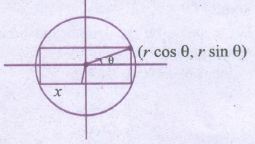
Let the length of the rectangle be 'x' cm
Breadth of the rectangle be 'y' cm
\(
x^{2}+y^{2} =(20)^{2}
\)
\(y^{2} =400-x^{2}\)
[radius of the circle is 10 cm]
\(y=\sqrt{400-x^{2}}\)
Now, Area of the rectangle A = xy
\(
A =x \sqrt{400-x^{2}}
\)
\(\frac{d A}{d x} =x \frac{(-2 x)}{2 \sqrt{400-x^{2}}}+\sqrt{400-x^{2}}
\) .....(1)
\(=\frac{-x^{2}+400-x^{2}}{\sqrt{400-x^{2}}}=\frac{-2 x^{2}+400}{\sqrt{400-x^{2}}}\)
For maximum or minimum,
\(
\frac{d A}{d x} =0 \Rightarrow \frac{-2 x^{2}+400}{\sqrt{400-x^{2}}}=0
\)
\(x^{2} =200 \)
\(x =\pm 10 \sqrt{2}
\)
\(x =-10 \sqrt{2} \) (is not possible)
\(\therefore x =10 \sqrt{2}
\)
Now, \( \frac{d^{2} A}{d x^{2}}=
\frac{\sqrt{400-x^{2}}(-4 x)-\left(-2 x^{2}+400\right)\left(-\frac{2 x}{2 \sqrt{400-x^{2}}}\right)}{400-x^{2}} \)
\(=\frac{2 x^{3}-1200 x}{\left(400-x^{2}\right) \sqrt{400-x^{2}}}\)
At \(x=10 \sqrt{2}, \quad \frac{d^{2} A}{d x^{2}}<0\)
Area of the rectangle is maximum when x \(=10 \sqrt{2}\)
\(y=\sqrt{400-200}=\sqrt{200}=10 \sqrt{2}\)
\(\therefore x=y=10 \sqrt{2}\)
Length of the rectangls = 10\(\sqrt{2}\) cm
Breadth of the rectangls = 10\(\sqrt{2}\) cm
27.
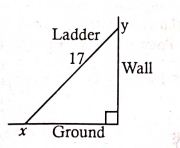
Let AB be the position of the ladder at any time t such that OA = x and OB = y
Then OA2 + OB2 = AB2
⇒ x2 + y2 = 172
Given \(\frac { dx }{ dt } \) = 5 and x = 8
When x = 8, 82 + y2 = 172
⇒ y2 = 289 - 64 = 225
⇒ y = 15
Differentiating (1) with respect to 't' we get,
\(2x\frac { dx }{ dt } +2y\frac { dy }{ dt } =0\)
⇒ 8(5) + 15 \(\frac { dy }{ dt } \) = 0 [∵ x = 8, \(\frac { dx }{ dt } \) = 15, y = 15]
⇒ 40 + 15\(\frac { dy }{ dt } \) = 0
⇒ \(\frac { dy }{ dt } =\frac { -40 }{ 15 } =\frac { -8 }{ 3 } \) m/sec
∴ The rate of top of the ladder moving down the wall is \(\frac{-8}{3}\) m/sec
(ii) The ladder, the wall and the floor forms a right angled triangle.
Area = \(\frac12\)xy
Differentiating with respect to 't' we get,
\(\frac { dA }{ dt } =\frac { 1 }{ 2 } \left[ x\frac { dy }{ dx } +y\frac { dx }{ dt } \right] \)
\(=\frac { 1 }{ 2 } \left[ 8\left( -\frac { 8 }{ 3 } \right) +15(5) \right] \)
= \(\frac { 1 }{ 2 } \left[ \frac { -64 }{ 3 } +75 \right] =\frac { 1 }{ 2 } \)
= \(\frac { 1 }{ 2 } \left[ \frac { -64+225 }{ 3 } \right] =\frac { 1 }{ 2 } \left( \frac { 161 }{ 3 } \right) \)
= \(\frac { dA }{ dt } \) = 26.83 sq.m/sec
28.
Here the number of unknowns is 3. So, if the system is consistent and has a non-trivial solution, then the rank of the coefficient matrix is equal to the rank of the augmented matrix and is less than 3.
So the determinant of the coefficient matrix should be 0.
Hence we get
\(\left| \begin{matrix} 3\lambda -8 & 3 & 3 \\ 3 & 3\lambda -8 & 3 \\ 3 & 3 & 3\lambda -8 \end{matrix} \right| \) = 0 or \(\left| \begin{matrix} 3\lambda -2 & 3\lambda -2 & 3\lambda -2 \\ 3 & 3\lambda -8 & 3 \\ 3 & 3 & 3\lambda -8 \end{matrix} \right| \) = 0 (by applying R1 ➝ R1 + R2 + R3)
or (3λ - 2) \(\left| \begin{matrix} 1 & 1 & 1 \\ 3 & 3\lambda -8 & 3 \\ 3 & 3 & 3\lambda -8 \end{matrix} \right| \) = 0 (by taking out (3λ − 2) from R1)
or (3λ - 2) \(\left| \begin{matrix} 1 & 1 & 1 \\ 3 & 3\lambda -11 & 3 \\ 3 & 3 & 3\lambda -11 \end{matrix} \right| \) = 0 (by applying R2 ➝ R2 - 3R1, R3 ➝ R3 - 3R1)
or (3λ - 2)(3λ - 11)2 0. So λ = \(\frac { 2 }{ 3 } \) and λ = \(\frac { 11 }{ 3 } \).
We now give an application of system of linear homogeneous equations to chemistry. You are already aware of balancing chemical reaction equations by inspecting the number of atoms present on both sides.
29.
The plane containing the line
\(\vec { r } =(\hat { i } -\hat { j } +3\hat { k } )+t(2\hat { i } -\hat { j } +4\hat { k } )\)
∴ The required plane is passing through the point \(\vec { a } =\hat { i } -\hat { j } +3\hat { k } \) and parallel to a vector \(\vec { b } =2\hat { i } -\hat { j } +4\hat { k } \) Also, the plane is perpendicular to the plane
\(\vec { c } =\hat { i } +2\hat { j } +\hat { k } \)
∴ The parametric form of vector equation of the plane passing through one point (\(\vec { a } \)) and parallel to two vectors \(\vec { b } \) and \(\vec { c } \)
\(\vec { r } =\vec { a } +s\vec { b } +t\vec { c } \) where s, t ∈ R
⇒ \(\vec { r } .(\hat { i } -\hat { j } +3\hat { k } )+s(2\hat { i } -\hat { j } +4\hat { k } )+t(\hat { i } +2\hat { j } +\hat { k } )\) s, t ∈ R
Cartesian equation is
\(\left| \begin{matrix} x-{ x }_{ 1 } & y-{ y }_{ 1 } & z-{ z }_{ 1 } \\ { b }_{ 1 } & { b }_{ 2 } & { b }_{ 3 } \\ { c }_{ 1 } & { c }_{ 2 } & { c }_{ 3 } \end{matrix} \right| =0\)
\(\Rightarrow \left| \begin{matrix} x-1 & y+1 & z-3 \\ 2 & -1 & 4 \\ 1 & 2 & 1 \end{matrix} \right| =0\)
⇒ (x - 1)(-1 - 8) - (y + 1)(2 - 4) + (z - 3)(4 + 1) = 0
⇒ (x - 1)(-9) - (y + 1)(-2) + (z - 3)5 = 0
⇒ -9x + 9 +2y + 2 + 5z - 15 = 0
⇒ -9x + 2y + 5z - 4 = 0
⇒ 9x - 2y - 5z + 4 = 0
30.
Let the cross section of the satellite dish be an right open parabola.
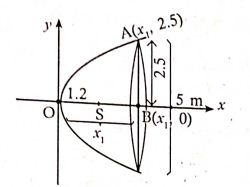
Its equation is y2 = 4ax
Since focus is placed 1.2 m from the vertex OA = 1.2 m and BC = 2.5 m since the width of the dish is 5 m.
From the diagram, a = 1.2 m
∴ y2 = 4(1.2)x
(a) ⇒ y2 = 4.8x ...(1)
(b) Since (x1, 2.5) lines on (1)(2.5)2 = 4.8(x1)
x1 = \(\frac { 2.5\times 2.5 }{ 4.8 } \)
x1 = 1.3 m
∴ Depth of the satellite dish at the vertex is 1.3 m.
31.
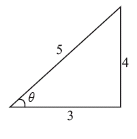
We know that \(sin^{ -1 }\left( \frac { x }{ \sqrt { 1+{ x }^{ 2 } } } \right) =cos^{ -1 }\left( \frac { x }{ \sqrt { 1+{ x }^{ 2 } } } \right) \)
Thus, \(cos\left( sin^{ -1 }\left( \frac { x }{ \sqrt { 1+{ x }^{ 2 } } } \right) \right) =\frac { 1 }{ \sqrt { 1+x^{ 2 } } } \) ...(1)
Let \(\cot ^{-1}\left(\frac{3}{4}\right)=\theta\). Then \(\cot \theta=\frac{3}{4}\) and so \(\theta\) is cute.
From the diagram, we get,
Hence \(\sin \left\{\cot ^{-1}\left(\frac{3}{4}\right)\right\}=\sin \theta=\frac{4}{5}\) ................ (2)
Using (1) and (2) in the given equation, we \(\frac { 1 }{ \sqrt { 1+x^{ 2 } } } =\frac { 4 }{ 5 } \) \(\sqrt{1+x^2}=\frac{5}{4}\)
Thus, x = \(\pm\frac{3}{4}\)
32.
Given z = x + iy and arg\(\left( \frac { z-i }{ z+2 } \right) =\frac { \pi }{ 4 } \)
⇒ arg(z-i) - arg(z+2) = \(\frac { \pi }{ 4 } \)
⇒ arg(x + iy-i) - arg(x+iy+2) = \(\frac { \pi }{ 4 } \)
⇒ arg(x+i(y-1)-arg((x+2)+iy) = \(\frac { \pi }{ 4 } \)
⇒ \(tan^{ -1 }\left( \frac { y-1 }{ x } \right) -tan^{ -1 }\left( \frac { y }{ x+2 } \right) \) = \(\frac { \pi }{ 4 } \)
⇒ \(tan^{ -1 }\left( \frac { \frac { y-1 }{ x } -\frac { y }{ x+2 } }{ 1+\frac { y-1 }{ x } .\frac { y }{ x+2 } } \right) \)
= \(\frac { \pi }{ 4 } \)\(\left[ \because tan^{ -1 }x-tan^{ -1 }y=tan^{ -1 }\left( \frac { x-y }{ 1+xy } \right) \right] \)
\(\Rightarrow \frac{\left(\frac{(x+2)(y-1)- x y}{\not {x (\not x+\not2)}}\right)}{\left(\frac{x(x+2)+y(y-1)}{\not x(\not x+\not 2)}\right)}=\tan \frac{\pi}{4}=1\)
⇒ \(\frac { (x+2)(y-1)-xy }{ x(x+2)+y(y-1) } \) = 1
⇒ -x + 2y-2 = x2+ 2x + y2-y
⇒ x2 + 2x + y2-y + x-2y + 2 = 0
⇒ x2 + y2+3x-3y + 2 = 0
Hence proved.
33.
This equation is Type I even degree reciprocal equation. Hence it can be rewritten as
x2\(\left[ \left( { x }^{ 2 }+\frac { 1 }{ { x }^{ 2 } } \right) -10 \left( x+\frac { 1 }{ x } \right) +26 \right] \)= 0 Since x \(\neq\) 0, we get \(\left(x^{2}+\frac{1}{x^{2}}\right)-10\left(x+\frac{1}{x}\right)+26=0\)
Let y = \(\left( x+\frac { 1 }{ x } \right) \)
[(y2-2)-10y+26] = 0 ⇒ (y2-10y+24) = 0 ⇒ (y-6)(y-4) = 0 ⇒ y = 6 or y = 4
Case (i)
y = 6 ⇒ x +\(\frac{1}{x}\) = 6 ⇒ x = 3+2\(\sqrt{2}\), x = 3 - 2\(\sqrt{2}\)
Case (ii)
y = 4 ⇒ x = 2+\(\sqrt{3}\), x = 2-\(\sqrt{3}\).
Hence, the roots are \(3 \pm 2 \sqrt{2}, 2 \pm \sqrt{3}\)
34.
Consider a triangle ABC in which the two altitudes AD and BE intersect at O. Let CO be produced to meet AB at F. We take O as the origin and let \(\vec { OA } =\vec { a } \), \(\vec { OB } =\vec { b} \) and \(\vec { OC } =\vec { c } \)
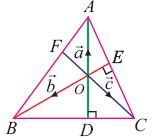
Since \(\vec { AD } \) is perpendicular to \(\vec { BC } \), we have \(\vec { OA } \) is perpendicular to \(\vec { BC } \), and
hence we get \(\vec { OA } \) . \(\vec { BC } \) = 0. That is, \(\vec { a } .(\vec { c } -\vec { b } )=0\), which means
\(\vec { a } .\hat{c}-\hat{a}.\hat{b}=0\)....(1)
Similarly, since \(\vec { BE } \) is perpendicular to \(\vec { CA } \), we have \(\vec { OB } \) is perpendicular to \(\vec { CA } \), and hence we get \(\vec { OB } .\vec { CA } \) = 0.
That is, \(\vec {b } .(\vec {a } -\vec { c } )=0\)
\(\vec { a } .\hat{c}-\hat{b}.\hat{c}=0\).......(2)
Adding equations (1) and (2), gives \(\vec { a } .\hat{c}-\hat{b}.\hat{c}=0\). That is, \(\hat{c}(\hat{a}-\hat{b})=0\)
That is \(\vec { OC } \) . \(\vec { BA } \) = 0.
Therefore, \(\vec { BA } \) is perpendicular to \(\vec { OC} \).
Which implies that \(\vec { CF} \) is perpendicular to \(\vec { AB } \).
Hence, the perpendicular drawn from C to the side AB passes through O. Therefore, the altitudes are concurrent.
35.
(d)
36.
(d)
-tan x
37.
(a)
38.
(a)
0
39.
(b)
8
40.
(a)
\(\frac{\pi}{6}\)
41.
(c)
-7
42.
(d)
4
43.
(c)
1
44.
(a)
0
45.
(b)
-4
46.
(d)
-1
47.
(c)
64 cubic units
48.
(c)
(5, -2)
49.
(c)
\( \sqrt {10}\)
50.
(b)
x2−x−12 = 0
51.
(b)
\(0 \le x\le \pi\)
52.
(a)
\(cis\cfrac { 2\pi }{ 3 } \)
53.
(c)
\(\frac { 4 }{ 5 } \)
54.
(b)
\(\cfrac { -1 }{ i+2 } \)

12th Standard Syllabus & Materials
12th Standard
TN 12th Computer Applications களப்பெயர் முறைமை (DNS) Sample Question Papers Study Material - QB365 Set A
NEW12th Standard
TN 12th Computer Applications வலையமைப்பு எடுத்துக்காட்டுகள் மற்றும் நெறிமுறைகள் Sample Question Papers Study Material - QB365 Set A
NEW12th Standard
TN 12th Computer Applications கணினி வலையமைப்பு ஓர் அறிமுகம் Sample Question Papers Study Material - QB365 Set A



Tamilnadu Stateboard 12th Standard Subjects
Maths

Chemistry

Physics

Biology

Computer Science

Business Maths and Statistics

Economics

Commerce

Accountancy

History

Computer Applications
Biology
Computer Technology
Computer Applications
Computer Science
Business Maths and Statistics
Commerce
Economics
Maths
Chemistry
Physics
Computer Technology
History
Accountancy

Tamil

English

French
Tamilnadu Stateboard Standards


