
 100% FREE ACCESS
12th Standard Syllabus & Materials
12th Standard
TN 12th Computer Applications மின்னணு தரவு பரிமாற்றம் Sample Question Papers Study Material - QB365 Set A
NEW12th Standard
TN 12th Computer Applications மின் - வணிக பாதுகாப்பு அமைப்புகள் Sample Question Papers Study Material - QB365 Set A
NEW12th Standard
TN 12th Computer Applications மின்னணு செலுத்தல் முறைகள் Sample Question Papers Study Material - QB365 Set A
NEW12th Standard
TN 12th Computer Applications மின் - வணிகம் Sample Question Papers Study Material - QB365 Set A
NEW12th Standard
TN 12th Computer Applications திறந்த மூல கருத்துருக்கள் Sample Question Papers Study Material - QB365 Set A
NEW12th Standard
TN 12th Computer Applications வலையமைப்பு வடமிடல் Sample Question Papers Study Material - QB365 Set A

Published on: 28/11/2025
Download Tamil Nadu 12th Standard Maths question papers, model tests, one-mark questions, important questions, and public exam papers in PDF format. Free study materials and answer keys for TN State Board students.
Questions + Answers key
Take MCQ Maths Test
1.
Obtain Maclaurin’s Series expansion for e2x.
2.
Let A =\(\begin{bmatrix} 0 & 1 \\ 1 & 1 \end{bmatrix},B=\begin{bmatrix} 1 & 1 \\ 0 & 1 \end{bmatrix}\)be any two boolean matrices of the same type. Find AvB and A\(\wedge\)B.
3.
Evaluate the following:
\(\int _{ 0 }^{ \infty }{ { x }^{ 5 }{ e }^{ -3x }dx } \)
4.
Compute P(X = k) for the binomial distribution, B(n, p) where
n = 6, \(p=\frac { 1 }{ 3 } \), k = 3
5.
An egg of a particular bird is very nearly spherical. If the radius to the inside of the shell is 5 mm and radius to the outside of the shell is 5.3 mm, find the volume of the shell approximately.
6.
Evaluate: \(\int ^{log 2}_{-log 2} e ^{-|x|}\) dx.
7.
Evaluate the limit \(\underset{x\rightarrow 0^{+}}{lim} (\frac{sin \ x}{x^{2}})\)
8.
Solve \(\frac { dy }{ dx } +2y={ e }^{ -x }\)
9.
Explain why Rolle’s theorem is not applicable to the following functions in the respective intervals.
\(f(x)=|\frac{1}{x}|, x\in [-1,1]\)
10.
For each of the following differential equations, determine its order, degree (if exists)
\({ x }^{ 2 }\frac { { d }^{ 2 }y }{ d{ x }^{ 2 } } +{ \left[ 1+{ \left( \frac { dy }{ dx } \right) }^{ 2 } \right] }^{ \frac { 1 }{ 2 } }=0\)
11.
Find the volume of a sphere of radius a.
12.
Two fair coins are tossed simultaneously (equivalent to a fair coin is tossed twice). Find the probability mass function for number of heads occurred.
13.
Evaluate the following integrals using properties of integration:
\(\int _{ \frac { \pi }{ 8 } }^{ \frac { 3\pi }{ 8 } }{ \frac { 1 }{ 1+\sqrt { tanx } } dx } \)
14.
A sphere is made of ice having radius 10 cm. Its radius decreases from 10 cm to 9.8 cm. Find approximations for the following:
(i) change in the volume
(ii) change in the surface area
15.
Evaluate the following limit, if necessary use l ’Hôpital Rule
\(\underset { x\rightarrow \infty }{ lim } { e }^{ -x }\sqrt { x } \)
16.
Suppose f(x) is a differentiable function for all x with f'(x) ≤ 29 and f(2) = 17. What is the maximum value of f(7)?
17.
Solve \((1+{ x }^{ 2 })\frac { dy }{ dx } =1+{ y }^{ 2 }\)
18.
Find the equation of the tangent and normal to the Lissajous curve given by x = 2cos 3t and y = 3sin 2t, t ∈ R
19.
A person learnt 100 words for an English test. The number of words the person remembers in t days after learning is given by W(t) = 100 × (1− 0.1t)2, 0 ≤ t ≤ 10. What is the rate at which the person forgets the words 2 days after learning?
20.
Find the differential equation of the family of circles passing through the origin and having their centres on the x -axis.
21.
Prove that p➝(¬q V r) ≡ ¬pV(¬qVr) using truth table.
22.
Verify
(i) closure property
(ii) commutative property
(iii) associative property
(iv) existence of identity, and
(v) existence of inverse for following operation on the given set m*n = m + n - mn; m, n ∈Z
23.
If v(x, y) = log \(\left( \frac { { x }^{ 2 }+{ y }^{ 2 } }{ x+y } \right) \), prove that \(x\frac { \partial v }{ \partial x } +y\frac { \partial u }{ \partial y } \) = 1
24.
A multiple choice examination has ten questions, each question has four distractors with exactly one correct answer. Suppose a student answers by guessing and if X denotes the number of correct answers, find
(i) binomial distribution
(ii) probability that the student will get seven correct answers
(iii) the probability of getting at least one correct answer
25.
Find the mean and variance of a random variable X , whose probability density function is \(f(x)=\begin{cases} \begin{matrix} { \lambda e }^{ -2x } & for\ge 0 \end{matrix} \\ \begin{matrix} 0 & otherwise \end{matrix} \end{cases}\)
26.
Find, by integration, the area of the region bounded by the lines 5x − 2y = 15, x + y + 4 = 0 and the x-axis
27.
For each of the following functions find the fx, fy, and show that fxy = fyx
f(x, y) = tan -1 (x/y)
28.
Prove that \(\int ^\frac{\pi}{4}_{0}\) log(1+tan x)dx = \(\frac{\pi}{8}\) log2.
29.
A random variable X has the following probability mass function.
| x | 1 | 2 | 3 | 4 | 5 |
| f(x) | k2 | 2k2 | 3k2 | 2k | 3k |
Find
(i) the value of k
(ii) P(2 \(\le\) X < 5)
(iii) P(3 < X )
30.
A radioactive isotope has an initial mass 200mg, which two years later is 50mg. Find the expression for the amount of the isotope remaining at any time. What is its half-life? (half-life means the time taken for the radioactivity of a specified isotope to fall to half its original value).
31.
32.
Solve the following differential equations
\(\left( 1+3{ e }^{ \frac { y }{ x } } \right) dy+3{ e }^{ \frac { y }{ x } }\left( 1-\frac { y }{ x } \right) dx=0,\) given that y = 0 when x = 1
33.
Prove that the ellipse x2 + 4y2 = 8 and the hyperbola x2-2y2 = 4 intersect orthogonally.
34.
35.
The operation * defined by \(a * b =\frac{ab}{7}\) is not a binary operation on
Q+
Z
R
C
36.
37.
The value of \(\int _{ -\frac { \pi }{ 2 } }^{ \frac { \pi }{ 2 } }{ { sin }^{ 2 }x\ cos \ x \ dx } \) is
\(\frac{3}{2}\)
\(\frac{1}{2}\)
0
\(\frac{2}{3}\)
38.
39.
The value of \(\int _{ 0 }^{ \infty }{ { e }^{ -3x }{ x }^{ 2 }dx } \) is
\(\frac{7}{27}\)
\(\frac{5}{27}\)
\(\frac{4}{27}\)
\(\frac{2}{27}\)
40.
41.
The value of \(\int _{ 0 }^{ 1 }{ x{ (1-x) }^{ 99 }dx } \) is
\(\frac{1}{11000}\)
\(\frac{1}{10100}\)
\(\frac{1}{10010}\)
\(\frac{1}{10001}\)
42.
The area between y2 = 4x and its latus rectum is
\(\frac{2}{3}\)
\(\frac{4}{3}\)
\(\frac{8}{3}\)
\(\frac{5}{3}\)
43.
If \(f(x)=\frac{x}{x+1}\), then its differential is given by
\(\frac { -1 }{ ({ x+1) }^{ 2 } } dx\)
\(\frac { 1 }{ ({ x+1) }^{ 2 } } dx\)
\(\frac { 1 }{ x+1 } dx\)
\(\frac {- 1 }{ x+1 } dx\)
44.
The percentage error of fifth root of 31 is approximately how many times the percentage error in 31?
\(\frac{1}{31}\)
\(\frac15\)
5
31
45.
If \(f(x)=\left\{\begin{array}{ll} 2 x & 0 \leq x \leq a \\ 0 & \text { otherwise } \end{array}\right.\) is a probability density function of a random variable, then the value of a is
1
2
3
4
46.
A pair of dice numbered 1, 2, 3, 4, 5, 6 of a six-sided die and 1, 2, 3, 4 of a four-sided die is rolled and the sum is determined. Let the random variable X denote this sum. Then the number of elements in the inverse image of 7 is
1
2
3
4
47.
The solution of \(\frac{d y}{d x}+p(x) y=0\) is
\(y={ ce }^{ \int { pdx } }\)
\(y={ ce }^{ -\int { pdx } }\)
\(x={ ce }^{ -\int { pdy } }\)
\(x={ce }^{ \int { pdy } }\)
48.
The general solution of the differential equation \(\frac { dy }{ dx } =\frac { y }{ x } \) is
xy = k
y = k log x
y = kx
log y = kx
49.
The differential equation of the family of curves y = Aex + Be−x, where A and B are arbitrary constants is
\(\frac { { d }^{ 2 }y }{ { dx }^{ 2 } } +y=0\)
\(\frac { { d }^{ 2 }y }{ { dx }^{ 2 } } -y=0\)
\(\frac { { d }y }{ { dx } } +y=0\)
\(\frac { { d }y }{ { dx } } -y=0\)
50.
The order and degree of the differential equation \(\frac { { d }^{ 2 }y }{ { dx }^{ 2 } } +{ \left( \frac { dy }{ dx } \right) }^{ 1/3 }+{ x }^{ 1/4 }=0\) are respectively
2, 3
3, 3
2, 6
2, 4
51.
The maximum value of the function \(x^{2} e^{-2 x}, x>0\) is
\(\frac { 1 }{ e } \)
\(\frac { 1 }{ 2e } \)
\(\frac { 1 }{ { e }^{ 2 } } \)
\(\frac { 4 }{ { e }^{ 4 } } \)
52.
Angle between y2 = x and x2 = y at the origin is
\({ tan }^{ -1 }\cfrac { 3 }{ 4 } \)
\({ tan }^{ -1 }\left( \cfrac { 4 }{ 3 } \right) \)
\(\cfrac { \pi }{ 2 } \)
\(\cfrac { \pi }{ 4 } \)
53.
The abscissa of the point on the curve \(f\left( x \right) =\sqrt { 8-2x } \) at which the slope of the tangent is -0.25 ?
-8
-4
-2
0
54.
1.
\({ e }^{ 2x }=1+\frac { 2x }{ 1! } +\frac { \left( 2x \right) ^{ 2 } }{ 2! } +\frac { \left( 3x \right) ^{ 3 } }{ 3! } +...\)
2.
Then A∨ B =\(\begin{bmatrix} 0 & 1 \\ 1 & 1 \end{bmatrix}\vee \begin{bmatrix} 1 & 1 \\ 0 & 1 \end{bmatrix}=\begin{bmatrix} 0\vee 1 & 1\vee 1 \\ 1\vee 0 & 1\vee 1 \end{bmatrix}=\begin{bmatrix} 1 & 1 \\ 1 & 1 \end{bmatrix}\)
\(A\wedge B=\begin{bmatrix} 0 & 1 \\ 1 & 1 \end{bmatrix}\wedge \begin{bmatrix} 1 & 1 \\ 0 & 1 \end{bmatrix}=\begin{bmatrix} 0\wedge 1 & 1\wedge 1 \\ 1\wedge 0 & 1\wedge 1 \end{bmatrix}=\begin{bmatrix} 0 & 1 \\ 0 & 1 \end{bmatrix}\)
3.
\( \because \int _{ 0 }^{ \infty }{ { x }^{ n }{ e }^{ -ax }dx}=\frac { n! }{ { a }^{ n+1 } } \)
\(n=5,\quad a=3 \)
\(=\frac { 5! }{ { 3 }^{ 6 } } \)
4.
Given n = 6, \(p=\frac { 1 }{ 3 }\), k = 3
\(P(X=k)=\left( \begin{matrix} n \\ k \end{matrix} \right) { p }^{ k }\left( 1-p \right) ^{ n-k },\)
n = 0,1,2, ... n
\(\therefore P(X=k)=\left( \begin{matrix} n \\ k \end{matrix} \right) { p }^{ k }(1-p)^{ n-k }\)
n = 0,1,2, ... n
\(P(X=3)=\left( \begin{matrix} 6 \\ 3 \end{matrix} \right) \left( \cfrac { 1 }{ 3 } \right) ^{ 3 }\left( 1-p \right) ^{ 6-3 }\)
= \(\left( \begin{matrix} 6 \\ 3 \end{matrix} \right) \left( \cfrac { 1 }{ 3 } \right) ^{ 3 }\left( \cfrac { 2 }{ 3 } \right) ^{ 2 }\)
\(=\frac{6 \times 5 \times 4}{8 \times 2 \times 1} \times \frac{1}{27} \times \frac{8}{27}\)
\(P(X=3)=\frac { 160 }{ 729 }\)
5.
Volume of sphere = \(\frac43\) πr3
Given r = 5 mm
⇒ dr = (5.3 - 5) = 0.3 mm
\(\text { Approximate volume }=\frac{4}{\not 3} \pi \cdot \not 3 r^{2} d r\)
= 4π (52) (0.3)
= 100 π (0.3)
= 30π mm3
6.
Let f(x) = e-|-x| = e-|x| = f(x)
So f (x) is an even function.
Hence, \(\int ^{log 2}_{-log 2} e ^{-|x|}\)dx = 2\(\int ^{log 2}_{0} e ^{-|x|}\)dx = 2\(\int ^{log 2}_{0} e ^{-x}\) dx
= 2(-e-x)\(^{log2}_{0}\) = 2 (-e-log2 + e0) = 2 \((-e ^{log \frac{1}{2}} + 1)\)
= 2\((-\frac {1}{2}+1)=1\).
7.
If we directly substitute x = 0 we get an indeterminate form \(\frac{0}{0}\) and hence we apply the l’Hôpital’s rule to evaluate the limit as,
\(\underset{x\rightarrow 0^{+}}{lim}(\frac{sin \ x}{x^{2}})=\underset{x\rightarrow 0^{+}}{lim}(\frac{cos \ x}{2x})=\infty\)
\(\underset{x\rightarrow 0^{-}}{lim}(\frac{sin \ x}{x^{2}})=\underset{x\rightarrow 0^{-}}{lim}(\frac{cos \ x}{2x})=\infty\)
As the left limit and the right limit are not the same we conclude that the limit does not exist.
Remark
One may be tempted to use the l’Hôpital’s rule once again in \(\underset{x\rightarrow 0^{+}}{lim} (\frac{cos \ x}{2x})\) to conclude
\(\underset{x\rightarrow 0^{+}}{lim} (\frac{cos \ x}{2x})\)\(\underset{x\rightarrow 0^{+}}{lim} (\frac{-sin \ x}{2})\)=0
which is not true because it was not an indeterminate form.
8.
Given that \(\frac{dy}{dx}+2y\) = e-x
This is a linear differential equation
Here P = 2 ; Q = e−x.
\(\int { pdx } =\int { 2dx } =2x\)
Thus, I.F.\(={ e }^{ \int { pdx } }={ e }^{ 2x }\)
Hence the solution of (1) is \({ ye }^{ \int { pdx } }=\int { { Qe }^{ \int { Pdx } }dx+C } \)
That is, \({ ye }^{ 2x }=\int { { e }^{ -x }{ e }^{ 2x }dx+C } or\quad { ye }^{ 2x }={ e }^{ x }+C\quad or\quad y={ e }^{ -x }+{ Xe }^{ -2x }\) required solution
9.
Given \(f(x)=|\frac{1}{x}|, x\in [-1,1]\)
Rolle's theorem is not applicable since \(f(x)=(\frac{1}{x})\) is not continuous at x = 0 in [-1, 1] and not differentiable in (-1, 1)
10.
\({ x }^{ 2 }\frac { { d }^{ 2 }y }{ d{ x }^{ 2 } } +{ \left[ 1+{ \left( \frac { dy }{ dx } \right) }^{ 2 } \right] }^{ \frac { 1 }{ 2 } }=0\)
The given differential equation is
\({ x }^{ 2 }\left( \frac { { d }^{ 2 }y }{ d{ x }^{ 2 } } \right) \) = -\({ \left[ 1+{ \left( \frac { dy }{ dx } \right) }^{ 2 } \right] }^{ \frac { 1 }{ 2 } }\)
= - \(\sqrt { 1+{ \left( \frac { dy }{ dx } \right) }^{ 2 } } \)
Squaring both sides,
\({ x }^{ 4 }\left( \frac { { d }^{ 2 }y }{ d{ x }^{ 2 } } \right) =1+{ \left( \frac { dy }{ dx } \right) }^{ 2 }\)
The highest derivative is 2 and its power is 2.
∴ Order 2, degree 2.
11.
By revolving the upper semicircular region enclosed between the circle x2 + y2 = a2 and the x-axis, we get a sphere of radius a.
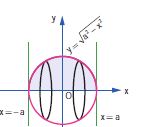
The boundaries of the region are y = \(\\ \\ \\ \\ \\ \\ \\ \sqrt { { a }^{ 2 }-{ x }^{ 2 } } \) x-axis, the lines x = −a and x = a. Hence, the volume of the sphere is given by
\(v=\pi \int _{ -a }^{ a }{ { y }^{ 2 }dx=\pi } \int _{ -a }^{ a }{ \left( { a }^{ 2 }-{ x }^{ 2 } \right) } dx\)
\(=2\pi \int _{ 0 }^{ a }{ ({ a }^{ 2 }-{ x }^{ 2 })dx } \) since the integrand (a2-x2) is an even function
\(=2\pi { \left( { a }^{ 2 }x-\frac { { x }^{ 3 } }{ 3 } \right) }_{ 0 }^{ a }=2\pi \left( { a }^{ 3 }-\frac { { a }^{ 3 } }{ 3 } \right) =\frac { 4 }{ 3 } { \pi a }^{ 3 }\)
12.
The sample space S = {H,T} \(\times\) {H,T}
That is S = {TT, TH, HT, HH}
Let X be the random variable denoting the number of heads.
Therefore
X (TT ) = 0 , X (TH ) = 1,
X (HT) = 1, and X (HH) = 2 .
Then the random variable X takes on the values 0, 1 and 2
| Values of the Random Variable | 0 | 1 | 2 | Total |
| Number of elements in inverse images | 1 | 2 | 1 | 4 |
The probabilities are given by
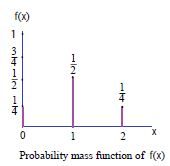
\(f(0)=P(X=0)=\cfrac { 1 }{ 4 } \)
\(f(1)=P(X=1)=\cfrac { 1 }{ 2 } \)
and \(f(2)=P(X=2)=\cfrac { 1 }{ 4 } \)
The function f (x) satisfies the conditions
(i) f (x) ≥ 0 , for x = 0, 1, 2
(ii) \(\underset { x }{ \Sigma } f(x)=\sum _{ x=0 }^{ x=2 }{ f(x) } =f(0)+f(1)+f(2)\)
= \(\cfrac { 1 }{ 4 } +{ \cfrac { 1 }{ 2 } +\cfrac { 1 }{ 4 } =1 }\)
Therefore f (x) is a probability mass function.
The probability mass function is given by
| x | 0 | 1 | 2 |
| f(x) | \(\cfrac { 1 }{ 4 } \) | \(\cfrac { 1 }{ 2 } \) | \(\cfrac { 1 }{ 4 } \) |
(or)
\(f(x)\begin{cases} \begin{matrix} \frac { 1 }{ 4 } & forx=0 \end{matrix} \\ \begin{matrix} \frac { 1 }{ 2 } & forx=1 \end{matrix} \\ \begin{matrix} \frac { 1 }{ 4 } & forx=2 \end{matrix} \end{cases}\)
13.
\(I=\int _{ \frac { \pi }{ 8 } }^{ \frac { 3\pi }{ 8 } }{ \frac { 1 }{ 1+\sqrt { tanx } } dx } \int _{ \frac { \pi }{ 8 } }^{ \frac { 3\pi }{ 8 } }{ \frac { 1 }{ 1+\frac { \sqrt { sin\quad x } }{ \sqrt { cos\quad x } } } dx } \)
\(=\int _{ \frac { \pi }{ 8 } }^{ \frac { 3\pi }{ 8 } }{ \frac { \sqrt { cos\quad x } }{ \sqrt { cos\quad x } +\sqrt { sin\quad x } } dx\quad \quad ..(1) } \)
By the property,\( \int _{ a }^{ b }{ f(x)dx=\int _{ a }^{ b }{ f(a+b-x)dx } } \)
we get \(I=\int _{ \frac { \pi }{ 8 } }^{ \frac { 3\pi }{ 8 } }{ \frac { \sqrt { cos(\frac { \pi }{ 8 } +\frac { 3\pi }{ 8 } -x) } }{ \sqrt { cos(\frac { \pi }{ 8 } +\frac { 3\pi }{ 8 } -x) } +\sqrt { sin(\frac { \pi }{ 8 } +\frac { 3\pi }{ 8 } -x) } } } dx\)
\(=\int _{ \frac { \pi }{ 8 } }^{ \frac { 3\pi }{ 8 } }{ \frac { \sqrt { cos(\frac { \pi }{ 2 } -x) } }{ \sqrt { cos(\frac { \pi }{ 2 } -x) } +\sqrt { sin(\frac { \pi }{ 2 } -x) } } } dx\)
\(=\int _{ \frac { \pi }{ 8 } }^{ \frac { 3\pi }{ 8 } }{ \frac { \sqrt { sin\quad x } }{ \sqrt { sin\quad x } +\sqrt { cos\quad x } } ...(2) } \)
\((1)+(2)\rightarrow \)
\(2I=\int _{ \frac { \pi }{ 8 } }^{ \frac { 3\pi }{ 8 } }{ \frac { \sqrt { cos\quad x } }{ \sqrt { cos\quad x } +\sqrt { sin\quad x } } dx+\int _{ \frac { \pi }{ 8 } }^{ \frac { 3\pi }{ 8 } }{ \frac { \sqrt { sin\quad x } }{ \sqrt { sin\quad x } +\sqrt { sin\quad x } } } } \)
\(=\int _{ \frac { \pi }{ 8 } }^{ 3\frac { \pi }{ 8 } }{ \frac { \sqrt { cos\quad x } +\sqrt { sin\quad x } }{ \sqrt { cos\quad x } +\sqrt { sin\quad x } } dx=\int _{ \frac { \pi }{ 8 } }^{ \frac { 3\pi }{ 8 } }{ dx={ [x] }_{ \frac { \pi }{ 8 } }^{ \frac { 3\pi }{ 8 } } } } \)
\(2I=\frac { 3\pi }{ 8 } -\frac { \pi }{ 8 } =\frac { 2\pi }{ 8 } =\frac { \pi }{ 4 } \)
\(\therefore I=\frac { \pi }{ 8 } \)
14.
Volume of sphere = \(\frac43\)πr2
Given r = 10 cm
\(\frac{dr}{dt}\) = - 0.2
V = \(\frac43\)πr3
Change in Volume
= \(\frac{4}{\not 3} \pi . \not 3 r^{2} \frac{d r}{d t}\)
= 4π(10)2 (-0.2)
= 400 π (-0.2) = -80 πcm3
∴ Volume decreases by 80 π cm3
Surface area of sphere = 4πr2
Change 10 surrace area = 4 π2r\(\frac{dr}{dt}\)
= 8π(10) (-0.2)
= -\(\frac{80π\times2}{10}\) = -16 π cm2
∴ Surface area decreases by 16 π cm2
15.
\(\underset { x\rightarrow \infty }{ lim } { e }^{ -x }\sqrt { x } =\underset { x\rightarrow \infty }{ lim } \frac { { \sqrt { x } } }{ { e }^{ x } } =\frac { \infty }{ \infty } \)
Which is in indeterminate form. Applying L' Hopital rule we get,
\(\underset { x\rightarrow \infty }{ lim } \frac { \frac { 1 }{ 2 } { x }^{ \frac { 1 }{ 2 } -1 } }{ { e }^{ x } } =\frac { 1 }{ 2 } \underset { x\rightarrow \infty }{ lim } \frac { { x }^{ \frac { 1 }{ 2 } -1 } }{ { e }^{ x } } =\frac { 1 }{ 2 } \underset { x\rightarrow \infty }{ lim } \frac { { e }^{ -x } }{ \sqrt { x } } \)
\(\frac { 1 }{ 2 } \underset { x\rightarrow \infty }{ lim } e^{ -x }\sqrt { \frac { 1 }{ x } } =\frac { 1 }{ 2 } { e }^{ -\infty }(0)=0\) [When x ➝ ∞, \(\frac1x\) ➝ 0 e-∞ = 0]
16.
By the mean value theorem we have, there exists 'c'∈(2, 7) such that,
\(\frac { f(7)-f(2) }{ 7-2 } \) = f'(c) ≤ 29
Hence, f(7) ≤ 5× 29 +17 = 162
Therefore, the maximum value of f (7) is 162.
17.
Given that \((1+{ x }^{ 2 })\frac { dy }{ dx } =1+{ y }^{ 2 }\) ..(1)
The given equation is written in the variables separable form
\(\frac { dy }{ { 1+y }^{ 2 } } =\frac { dx }{ { 1+x }^{ x } } \) ...(2)
Integrating both sides of (2), we get tan−1 tan−1x +C.
But tan-1 y - tan-1 x = tan-1 \(\left( \frac { y-x }{ 1+xy } \right) .\) ...(4)
Using (4) in (3) leads to tan-1 \(\left( \frac { y-x }{ 1+xy } \right)\) = C, which implies \(\frac { y-x }{ 1+xy } \) = tan C = a (say).
Thus, y − x = a(1+ xy) gives the required solution
18.
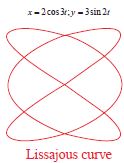
Observe that the given curve is neither a circle nor an ellipse. For your reference the curve is shown in Figure.
Now, \(\frac{dy}{dx}=\frac{\frac{dy}{dt} }{\frac{dx}{dt} } \)
= -\(\frac{6 cos2t}{6sin3t} = -\frac{cos2t}{sin3t} \).
Therefore, the tangent at any point is
\(y-3sin2t= -\frac{cos2t}{sin3t}(x-2cos3t)\)
That is, x cos 2t + y sin 3t = 3sin 2t sin 3t + 2cos 2t cos 3t.
The slope of the normal is the negative of the reciprocal of the tangent which in this case is \(\frac{sin3t}{cos2t}\). Hence, the equation of the normal is \(y-3sin2t=\frac{sin3t}{cos2t}(x-2cos3t)\).
That is, x sin 3t - y cos 2t = 2sin 3t cos3t 3sin 2t cos 2t = sin 6t - \(\frac{3}{2}\) sin 4t.
19.
We have,
\(\frac{d}{dt}W(t)=-20\times(1-0.1t)\)
Therefore at t = 2, \(\frac{d}{dt}W(t)=-16\)
That is, the person forgets at the rate of 16 words after 2 days of studying.
20.
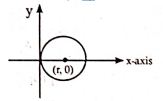
Given the circles centre on r-axis & the circle is passing through the origin.
Let it be (r, 0) & its radius r.
Equation of the circle is
(x - a)2 + (y - b)2 = r2
(x - r)2 + (y - 0)2 = r2
⇒ x2 - 2xr + r2 + y2 = r2
⇒ x2 - 2xr + y2 = 0 ...(1)
defferentiating equation (1) with respect to 'x' we get
⇒ 2x - 2r + 2y \(\frac { dy }{ dx } =0\)
⇒ 2x + 2y \(\frac { dy }{ dx } =2r\)
⇒ x + y \(\frac { dy }{ dx } =r\) ...(2)
Substituting r value in equation (1), we get
x2 - 2x \(\left( x+y\frac { dy }{ dx } \right) +{ y }^{ 2 }=0\)
\(\Rightarrow \ { x }^{ 2 }-{ 2x }^{ 2 }-2xy\frac { dy }{ dx } +{ y }^{ 2 }=0\)
\(\Rightarrow \ { -x }^{ 2 }{ -2x }y\left( \frac { dy }{ dx } \right) { +y }^{ 2 }\)
Multiply by '-', we get
\(\Rightarrow \ { x }^{ 2 }{ +2x }y\left( \frac { dy }{ dx } \right) { -y }^{ 2 }\) which is the required differential equation.
21.
| p | q | r | ~ q | ~q V r | p➝(¬qVr) | ~p | ~pV(~qVr) |
| T | T | T | F | T | T | F | T |
| T | T | F | F | F | F | F | F |
| T | F | T | T | T | T | F | T |
| T | F | F | T | T | T | F | T |
| F | T | T | F | T | T | T | T |
| F | T | F | F | F | T | T | T |
| F | F | T | T | T | T | T | T |
| F | F | F | T | T | T | T | T |
From the table, it is clear that the column of p➝(¬q V ~r) and ~pV(~q V r) are identical
∴ p➝(¬q V ~r) ≡ ~pV(~q V r)
Hence proved.
22.
(i) The output m+ n - mn is clearly an integer and hence∗ is a binary operation on Z.
(ii) m*n = m+ n − mn = n + m − nm = n*m, ∀m,n∈Z. So ∗ has commutative property.
(iii) Consider (m*n)*p = (m+ n −m n)* p= (m+ n −mn) + p − (m+ n −m n) p
= m+ n + p −mn −m p − n p + m n p ... (1)
Similarly m*(n*p) = m*(n + p − n p) = m+ (n + p − n p) −m (n + p − n p)
= m+ n + p − n p −m n −mp + m n p ... (2)
From (1) and (2), we see that m*(n*p) = (m*n)*p. Hence * has associative property.
(iv) An integer e is to be found such that
m*e = e*m = m, ∀m∈Z ⇒ m + e - m e = m
⇒e(1-m) = 0 ⇒ e = 0 or m = 1. But m is an arbitrary integer and hence need not be equal to 1. So the only possibility is e = 0. Also m*0 = 0*m = m, ∀m∈Z. Hence 0 is the identity element and hence the existence of identity is assured.
(v) An element m'∈ Z is to be found such that m*m' = m' * m = e = 0, ∀m∈Z.
m*m' = 0 ⇒ m+m'-m m'= 0⇒ m m' = 0 ⇒ \(\frac{m}{m-1}\). when m = 1, m' is not defined.
When m = 2, m' is an integer. But except m = 2, m′ need not be an integer for all values of m. Hence inverse does not exist in Z.
23.
Given v (x, y) = log \(\left( \frac { { x }^{ 2 }+{ y }^{ 2 } }{ x+y } \right) \)
Since log \(\left( \frac { { x }^{ 2 }+{ y }^{ 2 } }{ x+y } \right) \) is not homogeneous,
left f (x, y) = \(\frac { { x }^{ 2 }+{ y }^{ 2 } }{ x+y } \)
⇒ v = log f
⇒ ev = f
Now, f(tx, ty) = \(\frac { { t }^{ 2 }{ x }^{ 2 }+{ t }^{ 2 }{ y }^{ 2 } }{ tx+ty } =\frac { { t }^{ 2 }({ x }^{ 2 }+{ y }^{ 2 }) }{ t(x+y) } \)
= t.f(x, y)
∴ f is a homogeneous function of degree 1.
∴ By Euler's theorem,
⇒ \(x\frac { \partial f }{ \partial x } +y\frac { \partial f }{ \partial y } \) = 1.f
From (1), \(x.\frac { \partial }{ \partial x } \left( { e }^{ v } \right) +y.\frac { \partial }{ \partial y } \left( { e }^{ v } \right) ={ e }^{ v }\) [using (1)]
⇒ \(x.{ e }^{ v }.\frac { \partial }{ \partial x } +y.{ e }^{ v }.\frac { \partial }{ \partial y } ={ e }^{ v }\)
⇒ \(x\frac { \partial u }{ \partial x } +y\frac { \partial u }{ \partial y } \) = 1 [Divided by ev]
24.
(i) Since X denotes the number of success, X can take the values 0,1, 2, ...10
The probability for success is \(p=\frac { 1 }{ 4 } \) and for failure \(q=1-p=\frac { 3 }{ 4 } \) and n = 10
Therefore X follows a binomial distribution denoted by \(X\sim B\left( 10,\frac { 1 }{ 4 } \right) \)
This gives,\(f(x)=\left( \begin{matrix} 10 \\ x \end{matrix} \right) \left( \cfrac { 1 }{ 4 } \right) ^{ x }\left( \cfrac { 3 }{ 4 } \right) ^{ 10-x }\) x = 0, 1, 2,..,10
(ii) Probability for seven correct answers is
\(P(X=7)=f(7)=\left( \begin{matrix} 10 \\ 7 \end{matrix} \right) \left( \cfrac { 1 }{ 4 } \right) ^{ 7 }\left( \cfrac { 3 }{ 4 } \right) ^{ 10-7 }=120\left( \cfrac { { 3 }^{ 2 } }{ { 4 }^{ 10 } } \right) \)
Probability that the student will get seven correct answers is \(120\left( \cfrac { { 3 }^{ 2 } }{ { 4 }^{ 10 } } \right) \)
(iii) Probability for at least one correct answer is
P(X ≥1) = 1- P(X <1) = 1- P(X = 0)
= \(1-\left( \begin{matrix} 10 \\ 0 \end{matrix} \right) \left( \cfrac { 1 }{ 4 } \right) ^{ 0 }\left( \cfrac { 3 }{ 4 } \right) ^{ 10 }=1-\left( \cfrac { 3 }{ 4 } \right) ^{ 10 }\)
Probability that the student will get for at least one correct answer is \(1-\left( \cfrac { 3 }{ 4 } \right) ^{ 10 }\)
25.
Observe that the given distribution is continuous
By definition \(\mu =E(X)=\int _{ -\infty }^{ \infty }{ xf(x) } dx\) (We can also use integration by parts or Bernoulli’s formula)
= \(\int _{ -\infty }^{ 0 }{ 0\left( \lambda { e }^{ -2x } \right) dx } +\int _{ 0 }^{ \infty }{ x\left( { \lambda e }^{ -\lambda x } \right) } dx\)
= \(0+\lambda \int _{ 0 }^{ \infty }{ x\left( { e }^{ -\lambda x } \right) dx } \)
= \(0+\lambda \left( \frac { 1 }{ { \lambda }^{ 2 } } \right) \) (using Gamma integral for positive integer n,\(\int _{ 0 }^{ \infty }{ { x }^{ n } } { e }^{ -ax }dx=\cfrac { n }{ { a }^{ n+1 } } \))
= \(\frac { 1 }{ \lambda } \)
Variance :
By definition,\(E\left( { X }^{ 2 } \right) =\int _{ -\infty }^{ \infty }{ { x }^{ 2 }f(x) } dx\) (We can also use integration by parts or Bernoulli’s formula)
= \(\int _{ -\infty }^{ 0 }{ 0\left( \lambda { e }^{ -\lambda x } \right) } dx+\int _{ 0 }^{ \infty }{ { x }^{ 2 }\left( \lambda { e }^{ -2x } \right) } dx\)
= \(0+\lambda \int _{ 0 }^{ \infty }{ { x }^{ 2 }\left( { e }^{ -2x } \right) dx } \)
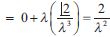 (using Gamma integral for positive integer)
Therefore Var(X ) = E(X2 )- E(X )2
= \(\frac { 2 }{ { \lambda }^{ 2 } } -\left( \frac { 1 }{ \lambda } \right) ^{ 2 }=\frac { 1 }{ { \lambda }^{ 2 } } \)
Hence the mean and variance are respectively \(\frac { 1 }{ \lambda } \) and \(\frac { 1 }{ { \lambda }^{ 2 } } \)
26.
The lines 5x − 2y = 15, x + y + 4 = 0 intersect at (1, −5). The line 5x − 2y =15 meets the x-axis at (3, 0). The line x + y + 4 = 0 meets the x-axis at (−4, 0). The required area is shaded. It lies below the x-axis. It can be computed either by considering vertical strips or horizontal strips.
When we do by vertical strips, the region has to be divided into two sub-regions by the line x = 1. Then, we get
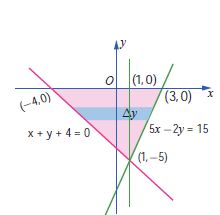
\(A=\left| \int _{ -4 }^{ 1 }{ ydx } \right| +\left| \int _{ 1 }^{ 3 }{ ydx } \right| \)
\(=\left| \int _{ -4 }^{ 1 }{ (-4-x)dx } \right| +\left| \int _{ 1 }^{ 3 }{ \left( \frac { 5x-15 }{ 2 } \right) dx } \right| \)
\(=\left| { \left( -4x-\frac { { x }^{ 2 } }{ 2 } \right) }_{ -4 }^{ 1 } \right| +\left| { \left( \frac { { 5x }^{ 2 } }{ 4 } -\frac { 15x }{ 2 } \right) }_{ 1 }^{ 3 } \right| \)
\(=\left| \left( -\frac { 9 }{ 2 } \right) -\left( 8 \right) \right| +\left| \left( -\frac { 45 }{ 4 } \right) -\left( -\frac { 25 }{ 4 } \right) \right| \)
\(=\frac { 25 }{ 2 } +5\)
\(=\frac { 35 }{ 2 } \)
When we do by horizontal strips, there is no need to subdivide the region. In this case, the area is bounded on the right by the line 5x − 2y = 15 and on the left by x + y + 4 = 0. So, we get
\(A=\int _{ -5 }^{ 0 }{ [{ x }_{ R }-{ x }_{ L }]dy } =\int _{ -5 }^{ 0 }{ \left[ \frac { 15+2y }{ 5 } -(-4-y) \right] dy } \)
\(=\int _{ -5 }^{ 0 }{ \left[ 7+\frac { 7y }{ 5 } \right] dy={ \left[ 7y+\frac { { 7y }^{ 2 } }{ 10 } \right] }_{ -5 }^{ 0 } } \)
\(\\ =0-\left[ -35+\frac { 35 }{ 2 } \right] =\frac { 35 }{ 2 } \)
27.
\({ f }_{ y }=\frac { 1 }{ 1+\frac { { x }^{ 2 } }{ { y }^{ 2 } } } \left( \frac { -x }{ { y }^{ 2 } } \right) =\frac { -\frac { x }{ { y }^{ 2 } } }{ \frac { { x }^{ 2 }+{ y }^{ 2 } }{ { { x }{ x }^{ 2 } } } } \)
= \(\frac { -x }{ { x }^{ 2 }+{ y }^{ 2 } } \)
\({ f }_{ x }=\frac { 1 }{ 1+\frac { { x }^{ 2 } }{ { { y }^{ 2 } } } } \left( \frac { 1 }{ y } \right) =\frac { \frac { 1 }{ y } }{ \frac { { x }^{ 2 }+{ y }^{ 2 } }{ { { y }^{ 2 } } } } \)
\(=\frac { y }{ { { x }^{ 2 }+{ y }^{ 2 } } } \)
\({ f }_{ xy }=\frac { \partial }{ \partial x } ({ f }_{ y })\)
\({ f }_{ xy }=-\left[ \frac { { (x }^{ 2 }+{ y }^{ 2 })(1)-x{ (2x) } }{ { ({ x }^{ 2 }+{ y }^{ 2 }) }^{ 2 } } \right] \)
\(=-\left[ \frac { { x }^{ 2 }+{ y }^{ 2 }-2{ x }^{ 2 } }{ { ({ x }^{ 2 }+{ y }^{ 2 }) }^{ 2 } } \right] \)
\(=-\left[ \frac { { y }^{ 2 }-{ x }^{ 2 } }{ { ({ x }^{ 2 }+{ y }^{ 2 }) }^{ 2 } } \right] \)
\(=\frac { x^{ 2 }-{ y }^{ 2 } }{ { ({ x }^{ 2 }+{ y }^{ 2 }) }^{ 2 } } \) ...(1)
\({ f }_{ xy }=\frac { \partial }{ \partial y } ({ f }_{ x })\)
\({ f }_{ xy }=\frac { ({ x }^{ 2 }+{ y }^{ 2 })(1)-y(2y) }{ ({ x }^{ 2 }+{ { y }^{ 2 }) }^{ 2 } } \)
\(=\frac { { x }^{ 2 }+{ y }^{ 2 }-2{ y }^{ 2 } }{ ({ x }^{ 2 }+{ { y }^{ 2 }) }^{ 2 } } \)
\(=\frac { { x }^{ 2 }-{ y }^{ 2 } }{ ({ x }^{ 2 }+{ { y }^{ 2 }) }^{ 2 } } \) ...(2)
∴ From (1) and (2), fxy = fyz
28.
Let us put I = \(\int ^\frac{\pi}{4}_{0}\) log(1 + tan x) dx
Applying the property \(\int ^{a}_{0}\) f(x) dx =\(\int ^{a}_{0}\)f(a-x) dx in equation (1), we get
I = \(\int ^\frac{\pi}{4}_{0}\) log \([1+tan (\frac{\pi}{4}-x)]\)dx = \(\int ^\frac{\pi}{4}_{0}\) log\([1 + \frac{tan \frac {\pi}{4}- tan x}{1 + tan {\frac {\pi}{4} tan x}}]\) dx
=\(\int ^\frac{\pi}{4}_{0}\) log \([1 + \frac {1 - tan x}{1 + tan x}]\)dx = \(\int ^\frac{\pi}{4}_{0}\) log\([\frac {1+tan x +1 - tan x}{1 + tan x}]\) dx
=\(\int ^\frac{\pi}{4}_{0}\) log \([\frac{2}{1+tanx}]\) dx = \(\int ^\frac{\pi}{4}_{0}\) [log 2 - log (1+tan x)] dx
= log 2 \(\int ^\frac{\pi}{4}_{0}\) dx - \(\int ^\frac{\pi}{4}_{0}\)log (1+tan x)] dx
= \(\frac{\pi}{4}\)log 2 - I
So, we get 2I = \(\frac{\pi}{4}\)log 2.
Hence, we get I = \(\frac{\pi}{8}\)log 2.
29.
Given probability mass function is
| x | 0 | 1 | 2 | 3 | 4 |
| f(x) | \(\frac{1}{36}\) | \(\frac{2}{36}\) | \(\frac{3}{36}\) | \(\frac{2}{36}\) | \(\frac{3}{36}\) |
(i) Since f(x) is a probability mass function.
\(\sum _{ i=1 }^{ 5 }{ f({ x }_{ i }) } =1\)
⇒ k2 + 2k2 + 3k2 + 2k + 3k = 1
⇒ 6k2 + 5k = 1
⇒ 6k2 + 5k - 1 = 0
⇒ (k + 1) (6k - 1) = 0
⇒ k = -1 or ⇒ \(k=\frac { 1 }{ 6 } \)
⇒ \(k=\frac { 1 }{ 6 } \)
(ii) p(2 ≤ x < 5)
= p(x = 2) + p(x = 3) + p(x = 4)
= 2k2 + 3k2 + 2k = 5k2 + 2k
= \(5\left( \frac { 1 }{ 36 } \right) +2\left( \frac { 1 }{ 6 } \right) \)
= \(\frac { 5 }{ 36 } +\frac { 1 }{ 3 } =\frac { 5+12 }{ 36 } \)
= \(\frac { 17 }{ 36 } \)
(iii) p(3 < x) = p(x > 3)
= p(x = 4) + p(x = 5)
= 2k + 3k = 5k
= \(5\left( \frac { 1 }{ 6 } \right) \)
= \(\frac { 5 }{ 6 } \)
30.
Let A be the mass of the isotope remaining after t years, and let −k be the constant of proportionality, where k > 0. Then the rate of decomposition is modeled by \(\frac{da}{dt}=-kA,\) where the minus sign indicates that the mass is decreasing. It is a separable equation. Separating the variables,we get\(\frac{da}{dt}=-kdt\).
Integrating on both sides, we get log |A| = −kt + log |C| or A = Ce−kt.
Given that the initial mass is 200mg. That is, A = 200 when t = 0 and thus, C = 200.
Thus, we get A = − 200e-kt.
Also, A =150when t = 2 and therefore, k = \(\frac{1}{2}log(\frac{4}{3})\)
Hence, A(t) = 200e\(\frac{1}{2}log(\frac{4}{3})\) is the mass of isotope remaining after t years.
The half-life th is the time corresponding to A = 100 mg
Thus, \({ t }_{ k }=\frac { 2log\left( \frac { 1 }{ 2 } \right) }{ log\left( \frac { 3 }{ 4 } \right) } \).
31.
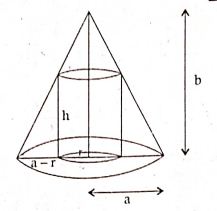
32.
The given differential equation may be written
\(\Rightarrow \frac { dy }{ dx } =\frac { -3{ e }^{ \frac { y }{ x } }\left( 1-\frac { y }{ x } \right) }{ 1+3{ e }^{ \frac { y }{ x } } } ...(1)\)
This is a homogeneous differential equation
\(\therefore put\quad y=vx\Rightarrow \frac { dy }{ dx } =v+x\frac { dv }{ dx }\)
\(v+x\frac { dv }{ dx } =\frac { -3{ e }^{ v }(1-v) }{ 1+3{ e }^{ v } }\)
\(\Rightarrow x\frac { dv }{ dx } =\frac { -3{ e }^{ v }(1-v) }{ 1+3{ e }^{ v } } -v\)
\(\Rightarrow \quad x \frac{d v}{d x}=\frac{-3 e^v+3 x e^v-v-3 v e^v}{1+3 e^v}\)
\(=\frac { -3{ e }^{ v }-v }{ 1+3{ e }^{ v } } =-\left( \frac { -3{ e }^{ v }+v }{ 1+3{ e }^{ v } } \right)\)
Separating the variables we get,
\(\frac { 1+3{ e }^{ v } }{ 3{ e }^{ v }+v } dv=-\frac { dx }{ x }\)
\(\Rightarrow log(3{ e }^{ v }+v)=-log\quad x+log\quad c\)
\(\Rightarrow log(3{ e }^{ v }+v)=log\left( \frac { c }{ x } \right) \Rightarrow { 3e }^{ v }+v=\frac { c }{ x }\)
\({ 3e }^{ \frac { y }{ x } }+\frac { y }{ x } =\frac { c }{ x }\)
\(\Rightarrow \frac { 3x{ e }^{ \frac { y }{ x } }+y }{ x } =\frac { c }{ x }\)
\(\Rightarrow y+3x{ e }^{ \frac { y }{ x } }=c\)
Given that y = 0 when x = 1
3(1)e0+ 0 = c \(\Rightarrow\) c = 3
\(\therefore\) (2) becomes, 3x\({ e }^{ \frac { y }{ x } }\)+ y = 3
33.
Let the point of intersection of the two curves be (a,b) . Hence,
\(a^{2}+4b^{2}=8\) and \(a^{2}-2b^{2}=4\) ...(4)
It is enough if we show that the product of the slopes of the two curves evaluated at (a, b) is −1.
Differentiation of \(x^{2}+4y^{2}=8\) with respect x, gives
\(2x+8y=\frac{dy}{dx}=0\).
Therefore \(\frac{dy}{dx}= -\frac{-x}{4y}\),
\((\frac{dy}{dx})_{(a,b)}=m_{1}= -\frac{a}{4b}\)
Differentiation of x2-2y2 = 4 with respect to x, gives
\(2x-4y\frac{dy}{dx}=0\)
Therefore, \(\frac{dy}{dx}=\frac{x}{2y}\),
at \((a,b)(\frac{dy}{dx})=m_{2}= \frac{a}{4b}\).
Therefore, \(m_{1}\times m_{2}=(-\frac{a}{4b})\times (\frac{a}{2b})= -\frac{a^{2}}{8b^{2}}\) ...(5)
Applying the ratio of proportions in (4), we get
\(\frac{a^{2}}{-16-16}=\frac{b^{2}}{-8+4}=\frac{1}{-2-4}\)
Therefore, \(\frac{a^{2}}{b^{2}}=\frac{32}{4}=8\) Substituting in (5), we get \(m_{1}\times m_{2}=-1\) Hence, the curves cut orthogonally.
34.
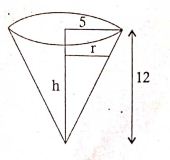
35.
(b)
Z
36.
(c)
37.
(d)
\(\frac{2}{3}\)
38.
(d)
39.
(d)
\(\frac{2}{27}\)
40.
(b)
41.
(b)
\(\frac{1}{10100}\)
42.
(c)
\(\frac{8}{3}\)
43.
(b)
\(\frac { 1 }{ ({ x+1) }^{ 2 } } dx\)
44.
(b)
\(\frac15\)
45.
(a)
1
46.
(d)
4
47.
(b)
\(y={ ce }^{ -\int { pdx } }\)
48.
(c)
y = kx
49.
(b)
\(\frac { { d }^{ 2 }y }{ { dx }^{ 2 } } -y=0\)
50.
(a)
2, 3
51.
(c)
\(\frac { 1 }{ { e }^{ 2 } } \)
52.
(c)
\(\cfrac { \pi }{ 2 } \)
53.
(b)
-4
54.
(b)

12th Standard Syllabus & Materials
12th Standard
TN 12th Computer Applications களப்பெயர் முறைமை (DNS) Sample Question Papers Study Material - QB365 Set A
NEW12th Standard
TN 12th Computer Applications வலையமைப்பு எடுத்துக்காட்டுகள் மற்றும் நெறிமுறைகள் Sample Question Papers Study Material - QB365 Set A
NEW12th Standard
TN 12th Computer Applications கணினி வலையமைப்பு ஓர் அறிமுகம் Sample Question Papers Study Material - QB365 Set A
NEW12th Standard
TN 12th Computer Applications PHP-உடன் MySQL-ஐ இணைத்தல் Sample Question Papers Study Material - QB365 Set A



Tamilnadu Stateboard 12th Standard Subjects
Maths

Chemistry

Physics

Biology

Computer Science

Business Maths and Statistics

Economics

Commerce

Accountancy

History

Computer Applications
Biology
Computer Technology
Computer Applications
Computer Science
Business Maths and Statistics
Commerce
Economics
Maths
Chemistry
Physics
Computer Technology
History
Accountancy

Tamil

English

French
Tamilnadu Stateboard Standards


