
 100% FREE ACCESS
12th Standard Syllabus & Materials
12th Standard
TN 12th Computer Applications மின்னணு தரவு பரிமாற்றம் Sample Question Papers Study Material - QB365 Set A
NEW12th Standard
TN 12th Computer Applications மின் - வணிக பாதுகாப்பு அமைப்புகள் Sample Question Papers Study Material - QB365 Set A
NEW12th Standard
TN 12th Computer Applications மின்னணு செலுத்தல் முறைகள் Sample Question Papers Study Material - QB365 Set A
NEW12th Standard
TN 12th Computer Applications மின் - வணிகம் Sample Question Papers Study Material - QB365 Set A
NEW12th Standard
TN 12th Computer Applications திறந்த மூல கருத்துருக்கள் Sample Question Papers Study Material - QB365 Set A
NEW12th Standard
TN 12th Computer Applications வலையமைப்பு வடமிடல் Sample Question Papers Study Material - QB365 Set A

Published on: 28/11/2025
Download Tamil Nadu 12th Standard Maths question papers, model tests, one-mark questions, important questions, and public exam papers in PDF format. Free study materials and answer keys for TN State Board students.
Questions + Answers key
Take MCQ Maths Test
1.
Solve : \({ e }^{ \frac { dy }{ dx } }=x+1,y(0)=5\)
2.
Using truth table check whether the statements ¬(p V q) V (¬p ∧ q) and ¬p are logically equivalent.
3.
Verify
(i) closure property
(ii) commutative property
(iii) associative property
(iv) existence of identity and
(v) existence of inverse for the operation +5 on Z5 using table corresponding to addition modulo 5.
4.
W(x, y, z) = xy + yz + zx, x = u - v, y = uv, z = u + v, u ∈ R. Find \(\frac { \partial W }{ \partial u } ,\frac { \partial W }{ \partial v } \), and evaluate them at \(\left( \frac { 1 }{ 2 } ,1 \right) \)
5.
The probability density function of X is given
\(f(x)=\begin{cases} \begin{matrix} { Ke }^{ \frac { -x }{ 3 } } & \begin{matrix} for & x>0 \end{matrix} \end{matrix} \\ \begin{matrix} 0 & \begin{matrix} for & x\le 0 \end{matrix} \end{matrix} \end{cases}\)
Find
(i) the value of k
(ii) the distribution function.
(iii) P(X <3)
(iv) P(5 ≤X)
(v) P(X ≤ 4)
6.
A pot of boiling water at 100o C is removed from a stove at time t = 0 and left to cool in the kitchen. After 5 minutes, the water temperature has decreased to 80o C , and another 5 minutes later it has dropped to 65oC. Determine the temperature of the kitchen.
7.
Find the equation of the curve whose slope is \(\frac { y-1 }{ { x }^{ 2 }+x } \) and which passes through the point (1, 0).
8.
Solve \(2{ tan }^{ -1 }(cosx)={ tan }^{ -1 }(2cosec\ x)\)
9.
Find the non-parametric form of vector equation, and Cartesian equation of the plane passing through the point (2, 3, 6) and parallel to the straight lines \(\frac { x-1 }{ 2 } =\frac { y+1 }{ 3 } =\frac { z-3 }{ 1 } \) and \(\frac { x+3 }{ 2 } =\frac { y-3 }{ -5 } =\frac { z+1 }{ -3 } \)
10.
Show that the lines \(\frac { x-3 }{ 3 } =\frac { y-3 }{ -1 } =z-1=0\) and \(\frac { x-6 }{ 2 } =\frac { z-1 }{ 3 } ,y-2=0\) intersect. Also find the point of intersection.
11.
Solve the equation z3+ 27 = 0
12.
Solve tan-1\(\left( \frac { 1-x }{ 1+x } \right) =\frac { 1 }{ 2 } { tan }^{ -1 }\) x for x > 0
13.
If z1, z2, and z3 are three complex numbers such that |z1| = 1, |z2| = 2|z3| = 3 and |z1 + z2 + z3| = 1, show that⏐9z1z2 +4z1z3 +z2z3 ⏐ = 6
14.
By vector method, prove that cos(α + β) = cos α cos β - sin α sin β
15.
If x = r cos \(\theta\), \(y=r \sin \theta, \text { then find } \frac{\partial r}{\partial x}\)
16.
solve: x dy + y dx = xy dx
17.
Use differentials to find \(\sqrt{25.2}\)
18.
Let A =\(\begin{bmatrix} 0 & 1 \\ 1 & 1 \end{bmatrix},B=\begin{bmatrix} 1 & 1 \\ 0 & 1 \end{bmatrix}\)be any two boolean matrices of the same type. Find AvB and A\(\wedge\)B.
19.
The mean and variance of a binomial variate X are respectively 2 and 1.5. Find
(i) P(X = 0)
(ii) P(X =1)
(iii) P(X ≥1)
20.
Solve \(\frac { dy }{ dx } +2y={ e }^{ -x }\)
21.
Find the parametric form of vector equation of the plane passing through the point (1, -1, 2) having 2, 3, 3 as direction ratios of normal to the plane.
22.
Find the value of \({ sin }^{ -1 }(-1)+{ cos }^{ -1 }\left( \frac { 1 }{ 2 } \right) +{ cot }^{ -1 }(2)\)
23.
If the vectors \(a\hat { i } +a\hat { j } +c\hat { k } ,\hat { i } +\hat { k } \) and \(c\hat { i } +c\hat { j } +b\hat { k } \) are coplanar, prove that c is the geometric mean of a and b.
24.
Show that \(\left( 2+i\sqrt { 3 } \right) ^{ 10 }-\left( 2-i\sqrt { 3 } \right) ^{ 10 }\) is purely imaginary
25.
In an algebraic structure the identity element (if exists) must be unique
26.
If X~ B(n, p) such that 4P(X = 4) = P(X = 2) and n = 6. Find the distribution, mean and standard deviation of X.
27.
If U(x, y, z) = log (x3 + y3 + z3), find \(\frac { \partial U }{ \partial x } +\frac { \partial U }{ \partial y } +\frac { \partial U }{ \partial z } \)
28.
Solve the Linear differential equation:
cos x\(\frac{dy}{dx}\)+y sin x = 1
29.
Solve \((1+{ x }^{ 2 })\frac { dy }{ dx } =1+{ y }^{ 2 }\)
30.
Prove that \({ cos }^{ -1 }\left( \frac { 4 }{ 5 } \right) +{ tan }^{ -1 }\left( \frac { 3 }{ 5 } \right) ={ tan }^{ -1 }\left( \frac { 27 }{ 11 } \right) \)
31.
Find the domain of the following
g(x) = 2sin−1(2x−1)−\(\frac{\pi}{4}\)
32.
Show that the points (2, 3, 4),(−1, 4, 5) and (8,1, 2) are collinear.
33.
Find the value of \(\sum _{ k=1 }^{ 8 }{ \left( cos\frac { 2k\pi }{ 9 } +isin\frac { 2k\pi }{ 9 } \right) } \).
34.
A particle is acted upon by the forces \((\hat { 3i } -\hat { 2j } +\hat { 2k } )\) and \((\hat { 2i } +\hat { j } -\hat { k } )\) is displaced from the point (1, 3, -1 ) to the point (4, -1, λ). If the work done by the forces is 16 units, find the value of λ.
35.
36.
37.
If \(\vec{a}\) and \(\vec{b}\) include an angle 120o and their magnitude are 2 and \(\sqrt{3}\) then \(\vec{a} .\vec{b}\) is equal to _____________
\(\sqrt{3}\)
\(-\sqrt{3}\)
2
\(-\frac{\sqrt{3}}{2}\)
38.
39.
The percentage error in the 11th root of the number 28 is approximately .......... times the percentage error in 28.
\(\frac{1}{28}\)
\(\frac{1}{11}\)
11
28
40.
In the set R of real numbers ‘*’ is defined as follows. Which one of the following is not a binary operation on R?
a*b = min (a.b)
a*b = max (a, b)
a*b = a
a*b = ab
41.
If we measure the side of a cube to be 4 cm with an error of 0.1 cm, then the error in our calculation of the volume is
0.4 cu.cm
0.45 cu.cm
2 cu.cm
4.8 cu.cm
42.
A random variable X has binomial distribution with n = 25 and p = 0.8 then standard deviation of X is
6
4
3
2
43.
44.
The differential equation of the family of curves y = Aex + Be−x, where A and B are arbitrary constants is
\(\frac { { d }^{ 2 }y }{ { dx }^{ 2 } } +y=0\)
\(\frac { { d }^{ 2 }y }{ { dx }^{ 2 } } -y=0\)
\(\frac { { d }y }{ { dx } } +y=0\)
\(\frac { { d }y }{ { dx } } -y=0\)
45.
The amplitude of \(\frac{1}{i}\) is equal to _______
0
\(\frac { \pi }{ 2 } \)
-\(\frac { \pi }{ 2 } \)
\(\pi \)
46.
If \(4{ cos }^{ -1 }x+{ sin }^{ -1 }x=\pi \) then x is _____________
\(\frac { 3 }{ 2 } \)
\(\frac { 1 }{ \sqrt { 2 } } \)
\(\frac { \sqrt { 3 } }{ 2 } \)
\(\frac { 2 }{ \sqrt { 3 } } \)
47.
If the distance of the point (1, 1, 1) from the origin is half of its distance from the plane x + y + z + k = 0, then the values of k are
\(\pm 3\)
\(\pm 6\)
-3, 9
3, -9
48.
If the line \(\frac { x-2 }{ 3 } =\frac { y-1 }{ -5 }= \frac {z+2 }{ 2 } \) lies in the plane x + 3y - αz + β = 0, then (α, β) is
(-5, 5)
(-6, 7)
(5, -5)
(6, -7)
49.
If \(\vec { a } .\vec { b } =\vec { b } .\vec { c } =\vec { c } .\vec { a } =0\) , then the value of \([\vec { a } ,\vec { b } ,\vec { c } ]\) is
\(\left| \vec { a } \right| \left| \vec { b } \right| \left| \vec { c } \right| \)
\(\frac{1}{3}\)\(\left| \vec { a } \right| \left| \vec { b } \right| \left| \vec { c } \right| \)
1
-1
50.
If \(x = \frac{1}{5}\), the value of cos (cos-1x+2sin-1x) is
\(-\sqrt { \frac { 24 }{ 25 } } \)
\(\sqrt { \frac { 24 }{ 25 } } \)
\(\frac{1}{5}\)
\(-\frac{1}{5}\)
51.
\(\sin ^{-1} \frac{3}{5}-\cos ^{-1} \frac{12}{13}+\sec ^{-1} \frac{5}{3}-\operatorname{cosec}^{-1} \frac{13}{12}\) is equal to
2\(\pi\)
\(\pi\)
0
tan-1\(\frac{12}{65}\)
52.
53.
54.
If \(\left| z-\frac { 3 }{ z } \right| =2\), then the least value |z| is
1
2
3
5
1.
y=log(x+1)+log(x+1)-x+5
2.
~(p V q) V (~p ∧ q) and ~p
| p | q | p V q | ~(p ∧ q) | ~p | ~p ∧ q | ~(p V q) V (~p ∧ q) |
| T | T | T | F | F | F | F |
| T | F | T | F | F | F | F |
| F | T | T | F | T | T | T |
| F | F | F | T | T | F | T |
The entries in column (5) and column (7) are identical.
∴ ~(p V q) V (~p ∧ q) and ~p are logically equivalent.
3.
It is known that Z5 = {[0], [1], [2], [3], [4]}. The table corresponding to addition modulo 5 is as follows: We take reminders {0,1,2,3,4} to represent the classes {[0], [1], [2], [3], [4]}.
| +5 | 0 | 1 | 2 | 3 | 4 |
| 0 | 0 | 1 | 2 | 3 | 4 |
| 1 | 1 | 2 | 3 | 4 | 0 |
| 2 | 2 | 3 | 4 | 0 | 1 |
| 3 | 3 | 4 | 0 | 1 | 2 |
| 4 | 4 | 0 | 1 | 2 | 3 |
(i) Since each box in the table is filled by exactly one element of Z5, the output a +5 b is unique and hence +5 is a binary operation.
(ii) The entries are symmetrically placed with respect to the main diagonal. So +5 has commutative property
(iii) The table cannot be used directly for the verification of the associative property. So it is to be verified as usual
For instance, (2+53)+5 4 = 0+5 4 = 4(mod 5)
and 2+5(3+54) = 2 +5 2 = 4(mod5)
Hence (2+53)+54 = 2+5(3+54)
Proceeding like this one can verify this for all possible triples and ultimately it can be shown that +5 is associative
(iv) The row headed by 0 and the column headed by 0 are identical. Hence the identity element is 0.
(v) The existence of inverse is guaranteed provided the identity 0 exists in each row and each column. From Table, it is clear that this property is true in this case. The method of finding the inverse of any one of the elements of Z5, say 2 is outlined below.
First find the position of the identity element 0 in the III row headed by 2. Move horizontally along the III row and after reaching 0, move vertically above 0 in the IV column, because 0 is in the III row and IV column. The element reached at the topmost position of IV column is 3. This element 3 is nothing but the inverse of 2, because, 2+5 5+ = 0 (mod5). In this way, the inverse of each and every element of Z5 can be obtained. Note that the inverse of 0 is 0, that of 1 is 4, that of 2 is 3, that of 3 is 2, and, that of 4 is 1.
4.
W(x, y, z) = xy + yz + zx, x =u -v, y = uv, z = u + v; y = uv; z = u
\(\frac { \partial W }{ \partial x }\) = y + z; \(\frac { \partial W }{ \partial y }\) = x + z
∴ \(\frac { \partial W }{ \partial x }\) = uv + u + v;
\(\frac { \partial W }{ \partial y}\) = u - v + u + v;
\(\frac { \partial W }{ \partial z}\) = uv + u - v
\(\frac { dx }{ du } =1;\frac { dy }{ du } =v;\frac { dz }{ du } =1\)
\(\frac { dx }{ dv } =1;\frac { dy }{ dv } =v;\frac { dz }{ dv} =1\)
By chain rule
\(\frac { \partial W }{ \partial u } =\frac { \partial w }{ \partial x } .\frac { dx }{ du } +\frac { \partial w }{ \partial y } .\frac { dy }{ du } +\frac { \partial w }{ \partial z } .\frac { dz }{ du }\)
= (uv +u +v) (1) +2u (v) + (uv +u - v)(1)
\(=u v+u+b+2 u v+u v+u-b\)
\(\frac { \partial W }{ \partial u }\) = 4uv + 2u = 12u (2v + 1)
\({ \left( \frac { \partial W }{ \partial u } \right) }_{ \left( \frac { 1 }{ 2 } ,1 \right) }\) = 2 x \(\frac12\) (2+ 1) = 1(2+ 1) = 3
= (uv + u + v) (-1) + (2u) (u) + (uv + u - v)(1)
\(=-w-u-v+2 u^2+w+u-v\)
= 2u2 - 2v = 2 (u2 - v)
∴ \({ \left( \frac { \partial W }{ \partial v } \right) }_{ \left( \frac { 1 }{ 2 } ,1 \right) }\) = \(2\left( \frac { 1 }{ 4 } -1 \right) =2\left( -\frac { 3 }{ 4 } \right) =-\frac { 3 }{ 2 }\)
5.
Given
\(f(x)=\begin{cases} \begin{matrix} { Ke }^{ \frac { -x }{ 3 } } & \begin{matrix} for & x>0 \end{matrix} \end{matrix} \\ \begin{matrix} 0 & \begin{matrix} for & x\le 0 \end{matrix} \end{matrix} \end{cases}\)
(i) Since f(x) is a probability density function
\(\int _{ -\infty }^{ \infty }{ f(x) } dx=1\)
\(\Rightarrow \int _{ 0 }^{ \infty }{ K.{ e }^{ \frac { -x }{ 3 } } } dx=1\Rightarrow k\frac { \left[ { e }^{ \frac { -x }{ 3 } } \right] ^{ \infty } }{ -\frac { 1 }{ 3 } } \)
\(\Rightarrow -3k\left[ { e }^{ -\infty }-{ e }^{ 0 } \right] =1\) [∵ e∞ = 0, e0 = 1]
\(\Rightarrow 3k=1\Rightarrow k=\frac { 1 }{ 3 } \)
\(\therefore k=\cfrac { 1 }{ 3 } \)
(ii) The distribution function F(x) = \(\int _{ -\infty }^{ x }{ f(u)du } \)
Case 1: x < 0,
\(F(x)=\int _{ -\infty }^{ x }{ f(x)dx=0 } \)
Case 2: x > 0,
\(f(x)=\int _{ -\infty }^{ x }{ f(x)dx } \)
= \(\int _{ -\infty }^{ 0 }{ f(x)dx+\int _{ 0 }^{ x }{ f(x) } dx } \)
= \(0+k\int _{ 0 }^{ x }{ { e }^{ \frac { -x }{ 3 } } } dx\)
= \(\frac { 1 }{ 3 } \left[ \cfrac { { e }^{ \frac { -x }{ 3 } } }{ -\frac { 1 }{ 3 } } \right] =-\left[ { e }^{ -\frac { x }{ 3 } }-{ e }^{ o } \right] \)
= \(-[{ e }^{ -\frac { x }{ 3 } }-1]\)
= \(1-{ e }^{ -\frac { x }{ 3 } }\)
\(\therefore F(x)=\begin{cases} \begin{matrix} 0 & x\le 0 \end{matrix} \\ \begin{matrix} 1-{ e }^{ \frac { -x }{ 3 } } & x>0 \end{matrix} \end{cases}\)
(iii) p(X < 3)
= \(\int _{ 0 }^{ 3 }{ ke^{ -\frac { x }{ 3 } } } dx=\cfrac { 1 }{ 3 } \int _{ 0 }^{ 3 }{ { e }^{ -\frac { x }{ 3 } }dx } \)
= \(\cfrac { 1 }{ 3 } \left[ \frac { { e }^{ -\frac { x }{ 3 } } }{ \frac { -1 }{ 3 } } \right] \)
= -[e-1-e0] = -[e-1-1]
(iv) \(p(5\le X)=p(X\ge 5)=\int _{ 5 }^{ \infty }{ f(x)dx } \)
= \(\int _{ 5 }^{ \infty }{ ke^{ -\frac { x }{ 3 } } } dx=\cfrac { 1 }{ 3 } \cfrac { \left[ { e }^{ -\frac { x }{ 3 } } \right] _{ 5 }^{ \infty } }{ \frac { -1 }{ 3 } } \)
= \(-\left[ { e }^{ -\infty }-e^{ \frac { -3 }{ 5 } } \right] =\left[ 0-{ e }^{ \frac { -5 }{ 3 } } \right] \)
= \({ e }^{ \frac { -5 }{ 3 } }\)
(v) \(p(X\le 4)=\int _{ -\infty }^{ 4 }{ f(x)dx } \)
= \(\int _{ -\infty }^{ 0 }{ f(x)dx+\int _{ 0 }^{ 4 }{ f(x)dx } } \)
= \(0+\int _{ 0 }^{ 4 }{ { ke }^{ -\frac { x }{ 3 } }dx } =k\left[ \frac { { e }^{ -\frac { x }{ 3 } } }{ -\frac { 1 }{ 3 } } \right] _{ 0 }^{ 4 }\)
= \(\cfrac { 1 }{ 3 } \cfrac { \left[ { e }^{ -\frac { x }{ 3 } } \right] _{ 0 }^{ 4 } }{ -\frac { 1 }{ 3 } } =-\left[ { e }^{ \frac { -4 }{ 3 } }-{ e }^{ o } \right] \)
= \(-\left[ { e }^{ \frac { -4 }{ 3 } }-1 \right] =1-{ e }^{ \frac { -4 }{ 3 } }\)
6.
Let T represent the temperature of the boiling water and Tm represents the temperature of the kitchen.
By Newton's law of cooling
\(\Rightarrow \int { \frac { dT }{ T-{ T }_{ m } } =K\int { dt } } \)
\(\Rightarrow log(T-{ T }_{ m })=Kt+logC\)
\(\Rightarrow log(T-{ T }_{ m })-logC=Kt\)
\(\Rightarrow log\left( \frac { T-{ T }_{ m } }{ C } \right) =Kt\)
\(\Rightarrow T-{ T }_{ m }={ Ce }^{ Kt } ...(1)\)
when t=0,T=100
\(\therefore 100-{ T }_{ m }={ Ce }^{ 0 }\)
\(\Rightarrow C=100-{ T }_{ m }\)
\(\Rightarrow becomes,\ T-{ T }_{ m }=(100-{ T }_{ m }){ e }^{ Kt }\)
Also when t = 5, T = 80
\(\therefore 80-{ T }_{ m }=(100-{ T }_{ m }){ e }^{ 5K }\)
\(\Rightarrow { e }^{ 5K }=\frac { 80-{ T }_{ m } }{ 100-{ T }_{ m } } ..(2)\)
When t = 10, T = 65
(2) \(\Rightarrow\) 65 - T = (100-Tm)e10K
= (100-Tm)(e5K)2
\(=(100-{ T }_{ m }){ \left( \frac { 80-{ T }_{ m } }{ 100-{ T }_{ m } } \right) }^{ 2 }\)
[using(2)]
\(\Rightarrow 65-{ T }_{ m }=\frac { { (80-{ T }_{ m } })^{ 2 } }{ 100-{ T }_{ m } } \)
\(\Rightarrow\) 6500-65Tm-100Tm+Tm2 = 6400+Tm2-160Tm
\(\Rightarrow\) 6500-6400 = 165Tm-160Tm
\(\Rightarrow\) 100 = 5Tm
\(\\ \Rightarrow { T }_{ m }=\frac { 100 }{ 5 } ={ 20 }^{ o }C\)
Hence the temperature of the kitchen is 20oC
7.
Given slope curve
\(\Rightarrow \frac { dy }{ dx } =\frac { y-1 }{ { x }^{ 2 }+x } \) ..... (1)
\(\Rightarrow \frac { dy }{ y-1 } =\frac { dx }{ { x }^{ 2 }+x } \)
\(
\Rightarrow \frac{d y}{y-1}=\frac{d x}{x^2+x}=\frac{d x}{x^2+2\left(\frac{x}{2}\right)+\left(\frac{1}{2}\right)^2-\left(\frac{1}{2}\right)^2}
\)
\(ie) \frac{d y}{y-1}=\frac{d x}{\left(x+\frac{1}{2}\right)^2-\left(\frac{1}{2}\right)^2} \)
Integrating on both sides, we get
\( \int \frac{d y}{\log (y-1)}=\int \frac{d x}{\left(x+\frac{1}{2}\right)^2-\left(\frac{1}{2}\right)^2} \\
\text { ie) } \log (y-1)=\left(\frac{1}{2\left(\frac{1}{2}\right)}\right) \log \left[\frac{\left(x+\frac{1}{2}\right)-\left(\frac{1}{2}\right)}{\left(x+\frac{1}{2}\right)+\left(\frac{1}{2}\right)}\right]+\log C \\
\log (y-1)=\log \left(\frac{x}{x+1}\right)+\log C\\
ie) (y-1)=\frac{C x}{x+1}
\)
\(\Rightarrow log(y-1)=log\left( \frac { cx }{ x+1 } \right) \)
\(\Rightarrow y-1=\frac { cx }{ x+1 } \)
Since the curve passes through (1, 0) we get,
\(0-1=\frac { c }{ 2 } \Rightarrow c=-2\)
\(\Rightarrow y-1=\frac { -2x }{ x+1 } \)
\(\Rightarrow y=1-\frac { -2x }{ x+1 } \)
\(\Rightarrow y=\frac { x+1-2x }{ x+1 } =\frac { 1-x }{ x+1 } \)
\(\therefore y=\frac { 1-x }{ 1+x } \)
8.
\(2{ tan }^{ -1 }(cosx)={ tan }^{ -1 }(2cosec\ x)\)
Given \({ 2tan }^{ -1 }(cosx)\quad \left[ \because { tan }^{ -1 }+{ tan }^{ -1 }y={ tan }^{ -1 }\left( \frac { x+y }{ 1-xy } \right) \right] \)
Let us find 2 tan(cos x)
= \({ 2tan }^{ -1 }(cosx)\ \left[ \because { tan }^{ -1 }+{ tan }^{ -1 }y={ tan }^{ -1 }\left( \frac { x+y }{ 1-xy } \right) \right] \)
= \({ tan }^{ -1 }\left( \frac { cosx+cosx }{ 1-{ cos }^{ 2 }x } \right) \)
= \({ tan }^{ -1 }\left( \frac { 2cosx }{ { sin }^{ 2 }x } \right) \)
\(2{ tan }^{ -1 }(cosx)={ tan }^{ -1 }\left( 2cosecx \right) =0\)
\(\Rightarrow { tan }^{ -1 }\left( \frac { 2cosx }{ { sin }^{ 2 }x } \right) -{ tan }^{ -1 }(2cosecx)=0\)
\(\Rightarrow { tan }^{ -1 }\left( \frac { 2cosx }{ { sin }^{ 2 }x } \right) -{ tan }^{ -1 }\left( \frac { 2 }{ sinx } \right) =0\)
\(\Rightarrow { tan }^{ -1 }\left( \frac { \frac { 2cosx }{ { sin }^{ 2 }x } -\frac { 2B }{ sinx } }{ 1+\frac { 2cosx }{ { sin }^{ 2 }x } .\frac { 2 }{ sinx } } \right) =0\)
\(\Rightarrow 2sin\ x\ cosx-2{ sin }^{ 2 }x=0\)
\(\Rightarrow 2sin\ x\left( cosx-sinx \right) =0\)
\(\Rightarrow sinx=0\ or\ cosx=sinx\)
\(\Rightarrow sinx=0\ or\ tanx-1\)
\(\Rightarrow sinx=0\ or\ tanx=tan\cfrac { \pi }{ 4 } \)
The solutions for sin x = 0 is \(x=n\pi ,\theta \varepsilon zd\) and the solution for
\(tan\ x=tan\frac { \pi }{ 4 } \ x=n\pi +\frac { \pi }{ 4 } ,n\varepsilon Z\)
\(\left[ \therefore tan\ x=tan\ \alpha \Rightarrow tan\ x=2n\pi +\alpha ,n\varepsilon Z \right] \)
Hence, the solutions are \(x=n\pi \) or
\(x=n\pi +\frac { \pi }{ 4 } ,n\varepsilon z.\)
9.
The plane passes through the point.
\(\vec { a } =2\hat { i } +3\hat { j } +6\hat { k } \) and parallel to the lines \(\frac{x-1}{2}\)
\(=\frac { y+1 }{ 3 } =\frac { z-3 }{ 1 } and\frac { x+3 }{ 2 } =\frac { y-3 }{ -5 } =\frac { z+1 }{ -3 } \)
\(\Rightarrow \vec { b } =2\hat { i } +3\hat { j } +\hat { k }\ and\ \vec { c } =2\hat { i } -5\hat { j } -3\hat { k } \)
\(\vec { b } \times \vec { c } =\left| \begin{matrix} \hat { i } & \hat { j } & \hat { k } \\ 2 & 3 & 1 \\ 2 & -5 & -3 \end{matrix} \right| \)
\(=\hat { i } (-9+5)-\hat { j } (-6-2)+\hat { k } (-10-6)\)
\(=-4\hat { i } +8\hat { j } -16\hat { k } \)
The non-parametric vector equation of the plane is
\((\vec { r } .\vec { a } ).(\vec { b } \times \vec { c } )=0,\)
\(\Rightarrow [\vec { r } (2\hat { i } +3\hat { j } +16\hat { k } ).(-4\hat { i } +8\hat { j } -16\hat { k } )]=0\)
\(\Rightarrow [\vec { r } .(-4\hat { i } +8\hat { j } -16\hat { k } )]-(-8+24-96)=0\)
\(\Rightarrow \vec { r } .(-4\hat { i } +8\hat { j } -16\hat { k } )=-80\)
\(\div -4,\) We get
\(\vec { r } .(\hat { i } -2\hat { j } +4\hat { k } )=20\)
\(Let\quad \vec { r } =x\hat { i } +y\hat { j } +z\hat { k } \)
\(\Rightarrow (x\hat { i } +y\hat { j } +z\hat { k } ).(\hat { i } -2\hat { j } +4\hat { k } )=20\)
\(\Rightarrow x=2y+4z=20\)
\(\Rightarrow x-2y+4z-20=0\)
10.
Given lines are \(\frac { x-3 }{ 3 } =\frac { y-3 }{ -1 } \)....(1)
and z-1 = 0
\(\Rightarrow\) z = 1
and \(\frac { x-6 }{ 2 } =\frac { z-1 }{ 3 } \) ...(2)
and y-2 = 0\(\Rightarrow\) y = 2
Substituting y = 2 and z = 1 in (1) we get
\(\frac { x-3 }{ 3 } =\frac { 2-3 }{ -1 } =\frac { -1 }{ -1 } =1\Rightarrow x-3=3\Rightarrow x=6\)
The point of intersection is (6, 2, 1)
Let us check whether (6, 2, 1) satisfies (1) and (2)
\((1)\rightarrow \frac { 6-6 }{ 2 } =\frac { 1-1 }{ 3 } \Rightarrow 0=0\)
\((2)\rightarrow \frac { 6-3 }{ 3 } =\frac { 1-3 }{ -1 } \Rightarrow -1=-1\)
Hence, the given two lines intersect and the point of intersection is (6, 2, 1).
11.
z3 = -27 = (-1 \(\times\) 3)3 = -1 \(\times\) 33
z = \((-1)^{ \frac { 1 }{ 3 } }\times 3^{ 3\times \frac { 1 }{ 3 } }=(-1)^{ \frac { 1 }{ 3 } }\)\(\times\) 3
∴ z = 3\(\left[ cos\pi +isin\pi \right] ^{ \frac { 1 }{ 3 } }\)
[∵ cos π = -1 and sin π = 0]
= 3\(\left[ cos\frac { 1 }{ 3 } (2k\pi +\pi )isin\frac { 1 }{ 3 } (2k\pi +\pi ) \right] \)
k = 0, 1, 2
When k = 0,
z = 3\(\left[ cos\frac { 1 }{ 3 } (\pi )isin\frac { 1 }{ 3 } (\pi ) \right] =3cos\frac { \pi }{ 3 } \)
When k = 1
z = 3\(\left[ cos\frac { 1 }{ 3 } (3\pi )isin\frac { 1 }{ 3 } (3\pi ) \right] \)
= 3[cos π + i sin π] = 3(-1+0)
When k = 2
z = 3\(\left[ cos\frac { 1 }{ 3 } (5\pi )isin\frac { 1 }{ 3 } (5\pi ) \right] =3\left[ cos5\frac { \pi }{ 3 } \right] \)
Hence, the roots are 3 cis\(\frac { \pi }{ 3 } \), -3, 3 c is 5\(\frac { \pi }{ 3 } \)
12.
tan-1 \(\left( \frac { 1-x }{ 1+x } \right) =\frac { 1 }{ 2 } { tan }^{ -1 }\)x gives tan-1 1-tan-1 x = \(\frac{1}{2}\)tan-1x.
Therefore, \(\frac{\pi}{4}=\frac{3}{2}tan^{-1}\)x, which in turn reduces to tan−1 = \(\frac{\pi}{6}\)
Thus, x = tan\(\frac{\pi}{6}=\frac{1}{\sqrt3}\)
13.
Given |z1| = 1, |z2|= 2, |z3| = 3, |z1 + z2 + z3| = 1
|z1|2 = 12 ⇒ z1 \(\overline { { z }_{ 1 } } \) = 1 ⇒ z1 = \(\frac { 1 }{ { z }_{ 1 } } \)
|z2|2 = 4 ⇒ z2 \(\overline { { z }_{ 2 } } \) = 1 ⇒ z2 = \(\frac { 4 }{ { z }_{ 2 } } \)
|z3|2 = 9 ⇒ z3 \(\overline { { z }_{ 3 } } \) = 1 ⇒ z3 = \(\frac { 9 }{ { z }_{ 3 } } \)
∴ \(\left| 9,\frac { 1 }{ \overline { { z }_{ 1 } } } .\frac { 4 }{ \overline { { z }_{ 2 } } } +4.\frac { 1 }{ \overline { { z }_{ 1 } } } .\frac { 9 }{ \overline { { z }_{ 3 } } } +\frac { 4 }{ \overline { { z }_{ 2 } } } .\frac { 9 }{ \overline { z_{ 3 } } } \right| \)
\(\left| \frac { 36 }{ \overline { { z }_{ 1 } } \overline { { z }_{ 2 } } } +\frac { 36 }{ \overline { { z }_{ 1 } } \overline { { z }_{ 3 } } } +\frac { 36 }{ \overline { { z }_{ 2 } } \overline { { z }_{ 3 } } } \right| =\left| 36\left( \frac { \overline { { z }_{ 3 } } +\overline { { z }_{ 2 } } +\overline { { z }_{ 1 } } }{ \overline { { z }_{ 1 } } \overline { { z }_{ 2 } } \overline { { z }_{ 3 } } } \right) \right| \)
\(\\ \left[ \because |\overline { z_{ 1 } } +\overline { { z }_{ 2 } } +\overline { { z }_{ 3 } } |=|\overline { { z }_{ 1 }+{ z }_{ 2 }+{ z }_{ 3 } } | \right] \)
=\(\frac { 36|\overline { { z }_{ 1 }+{ z }_{ 2 }+{ z }_{ 3 } } | }{ |\overline { { z }_{ 1 } } ||\overline { { z }_{ 2 } } ||\overline { { z }_{ 3 } } | } =36\frac { |\overline { \overline { { z }_{ 1 } } +\overline { z_{ 2 } } +\overline { z_{ 3 } } | } }{ |\overline { { z }_{ 1 } } ||\overline { { z }_{ 2 } } ||\overline { { z }_{ 3 } } | } \)
\(\left[ \because |\overline { { z }_{ 1 } } |=|{ z }_{ 1 }|,|\overline { { z }_{ 2 } } =|{ z }_{ 21 }|,|\overline { { z }_{ 3 } } |=|\overline { { z }_{ 3 } } | \right] \)
\(=\frac{36(1)}{1(2)(3)}=\frac{\not 36}{\not 6}=6\)
∴ |9z1 + z2 + 4z1z3 + z2z3| = 6
14.
Let \(\hat { a } =\vec { OA } \) and \(\hat { b } =\vec { OB } \) be the unit vectors and which make angles α and β, respectively, with positive x-axis, where A and B are as in the diagram.
Draw AL and BM perpendicular to the x-axis. Then \(\left| \vec { OL } \right| =\left| \vec { OA } \right| \) cos α = cos α, \(\left| \vec { LA } \right| =\left| \vec { OA } \right| \) sin α = sin α
So, \(\vec { OL } =\left| \vec { OL } \right| \)\(\hat { i } \) = cos,α \(\hat { i } \), \(\overrightarrow { LA } \) = sin α (-\(\hat { j } \))
Therefore, \(\hat { a } =\overrightarrow { OA} = \overrightarrow { OL } +\overrightarrow { LA } \) = cos α \(\hat { i } \) - sin α \(\hat { j } \) ..(1)
Similarly \(\hat { b } \) = cos β \(\hat { i } \)+ sin β \(\hat { j } \) ....(2)
The angle between \(\hat { a } \) and \(\hat{b}\) is α + β and so,
\(\hat { a } .\hat { b } =\left| \hat { a } \right| \left| \hat { b } \right| \) cos (α + β) = cos (α + β) ... (3)
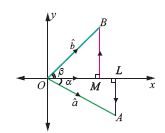
On the other hand, from (1) and (2)
\(\hat { a } .\hat { b } =(cos\alpha \hat { i } -sina\hat { j } )(cos\beta \hat { i } -sin\beta \hat { j } )\) = cos α cos β - sin α sin β....(4)
From (3) and (4), we get cos(α + β) = cos α cos β - sin α sin β
15.
\(
\mathrm{x}^{2}+\mathrm{y}^{2} =\mathrm{r}^{2} \cos ^{2} \theta+\mathrm{r}^{2} \sin ^{2} \theta
\)
\(\mathrm{x}^{2}+\mathrm{y}^{2} =\mathrm{r}^{2}
\)
\(2 \mathrm{x} =2 \mathrm{r} \frac{\partial r}{\partial x}
\)
\(\frac{x}{r} =\frac{\partial r}{\partial x}\)
\(
\frac{r \cos \theta}{r}=\frac{\partial r}{\partial x}
\)
\(\therefore \frac{\partial r}{\partial x}=\cos \theta\)
16.
|xy| = cex
17.
Let y = f(x) = \(\sqrt x\)
Let xo = 25, dx = 25.2 - 25 = 0.2
y = \(\sqrt x\)
dy = \(\frac{1}{2\sqrt{x}}\) dx
dy = \(\frac{1}{2\sqrt{x}}\) (0.2) = 0.02
∴\(\sqrt{25.2}\) = f(x0) + f'(x0) dx
= \(\sqrt{25}\) + 0.02
= 5 + 0.02 = 5.02
18.
Then A∨ B =\(\begin{bmatrix} 0 & 1 \\ 1 & 1 \end{bmatrix}\vee \begin{bmatrix} 1 & 1 \\ 0 & 1 \end{bmatrix}=\begin{bmatrix} 0\vee 1 & 1\vee 1 \\ 1\vee 0 & 1\vee 1 \end{bmatrix}=\begin{bmatrix} 1 & 1 \\ 1 & 1 \end{bmatrix}\)
\(A\wedge B=\begin{bmatrix} 0 & 1 \\ 1 & 1 \end{bmatrix}\wedge \begin{bmatrix} 1 & 1 \\ 0 & 1 \end{bmatrix}=\begin{bmatrix} 0\wedge 1 & 1\wedge 1 \\ 1\wedge 0 & 1\wedge 1 \end{bmatrix}=\begin{bmatrix} 0 & 1 \\ 0 & 1 \end{bmatrix}\)
19.
To find the probabilities, the values of the parameters n and p must be known.
Given that
Mean = np = 2 and variance = npq = 1.5
This gives \(\frac { npq }{ np } =\frac { 1.5 }{ 2 } =\frac { 3 }{ 4 } \)
\(q=\frac { 3 }{ 4 } \) and \(p=1-q=1-3\frac { 4 }{ 4 } =\frac { 1 }{ 4 } \)
np = 2 gives \(n=\frac { 2 }{ p } =8\) . Therefore \(X\sim B\left( 8,\frac { 1 }{ 4 } \right) \)
Therefore probability distribution is
\(P(X=x)=f(x)=\left( \begin{matrix} 8 \\ x \end{matrix} \right) \left( \cfrac { 1 }{ 4 } \right) ^{ x }\left( \cfrac { 3 }{ 4 } \right) ^{ 8-x }\)
(i) \(P(X=0)=f(0)=\left( \begin{matrix} 8 \\ 0 \end{matrix} \right) \left( \cfrac { 1 }{ 4 } \right) ^{ 0 }\left( \cfrac { 3 }{ 4 } \right) ^{ 8-0 }=\left( \cfrac { 3 }{ 4 } \right) ^{ 8 }\)
(ii) \(P(X=1)=f(1)=\left( \begin{matrix} 8 \\ 1 \end{matrix} \right) \left( \cfrac { 1 }{ 4 } \right) \left( \cfrac { 3 }{ 4 } \right) ^{ 8-1 }=2\left( \cfrac { 3 }{ 4 } \right) ^{ 2 }\)
(iii) P(X≥1) = 1-P(X<1) = 1-P(X = 0) = \(1-\left( \frac { 3 }{ 4 } \right) ^{ 8 }\)
20.
Given that \(\frac{dy}{dx}+2y\) = e-x
This is a linear differential equation
Here P = 2 ; Q = e−x.
\(\int { pdx } =\int { 2dx } =2x\)
Thus, I.F.\(={ e }^{ \int { pdx } }={ e }^{ 2x }\)
Hence the solution of (1) is \({ ye }^{ \int { pdx } }=\int { { Qe }^{ \int { Pdx } }dx+C } \)
That is, \({ ye }^{ 2x }=\int { { e }^{ -x }{ e }^{ 2x }dx+C } or\quad { ye }^{ 2x }={ e }^{ x }+C\quad or\quad y={ e }^{ -x }+{ Xe }^{ -2x }\) required solution
21.
Since the plane passing through the point \(\overset { \rightarrow }{ a } =\overset { \wedge }{ i } -\overset { \wedge }{ j } +2\overset { \wedge }{ k } \) and is normal to the vector \(\overset { \rightarrow }{ n } =2\overset { \wedge }{ i } +3\overset { \wedge }{ j } +2\overset { \wedge }{ k } \)
the vector equation of the plane is \(\overset { \rightarrow }{ r } .\overset { \rightarrow }{ n } =\overset { \rightarrow }{ a } .\overset { \rightarrow }{ n } \)
\(\Rightarrow { \overset { \rightarrow }{ r } }.\left( 2\overset { \wedge }{ i } +3\overset { \wedge }{ j } +2\overset { \wedge }{ k } \right) =\left( \overset { \wedge }{ i } -\overset { \wedge }{ j } +2\overset { \wedge }{ k } \right) .\left( 2\overset { \wedge }{ i } +3\overset { \wedge }{ j } +2\overset { \wedge }{ k } \right) \)
\(\Rightarrow { \overset { \rightarrow }{ r } }.\left( 2\overset { \wedge }{ i } +3\overset { \wedge }{ j } +2\overset { \wedge }{ k } \right) \)= 2 - 3 + 4 = 3
\(\therefore { \overset { \rightarrow }{ r } }.\left( 2\overset { \wedge }{ i } +3\overset { \wedge }{ j } +2\overset { \wedge }{ k } \right) \)= 3
22.
\({ sin }^{ -1 }(-1)+{ cos }^{ -1 }\left( \frac { 1 }{ 2 } \right) +{ cot }^{ -1 }(2)\)
Let \({ sin }^{ -1 }\left( -1 \right) =x\)
\(\Rightarrow -1=sin\ x\)
\(\Rightarrow sin\ x=-1=-sin\frac { \pi }{ 2 } =sin\left( \frac { -\pi }{ 2 } \right) \)
\(\Rightarrow x=\frac { -\pi }{ 2 } \)
\(\Rightarrow x=\frac { -\pi }{ 2 } \)
\(\Rightarrow \frac { 1 }{ 2 } =cos\ y\Rightarrow cos\frac { \pi }{ 3 } \)
\(\Rightarrow y=\frac { \pi }{ 3 } \)
\(\therefore { sin }^{ -1 }\left( -1 \right) +{ cos }^{ -1 }\left( \frac { 1 }{ 2 } \right) +{ cot }^{ -1 }\left( 2 \right) \)
\(\frac { -\pi }{ 2 } +\frac { \pi }{ 3 } +{ cot }^{ -1 }\left( 2 \right) \)
\({ cot }^{ -1 }(2)+\frac { -3\pi +2\pi }{ 0 } ={ cot }^{ -1 }\left( 2 \right) -\frac { \pi }{ 6 } \)
23.
\(\vec { a } \)= \(a\hat { i } +a\hat { j } +c\hat { k } , \vec{b}=\hat { i } +\hat { k } \), \(\vec { c } \)= \(c\hat { i } +c\hat { j } +b\hat { k } \)
Given \(\vec { a } ,\vec { b } \) and \(\vec { c } \) are co-planar
\(\vec { a } .(\vec { b } \times \vec { c } )\) = 0
⇒ \(\left| \begin{matrix} a & a & c \\ 1 & 0 & 1 \\ c & c & b \end{matrix} \right| \) = 0
⇒ \(a\left| \begin{matrix} 0 & 1 \\ c & b \end{matrix} \right| -a\left| \begin{matrix} 1 & 1 \\ c & b \end{matrix} \right| +c\left| \begin{matrix} 1 & 0 \\ c & c \end{matrix} \right| \) = 0
⇒ a(0-c)-a(b-c)+c(c-0) = 0
\(\Rightarrow-\not a c-a b+\not a c+c^{2}=0\)
⇒ c2 = ab ⇒ c =\(\sqrt { ab } \).
Hence c is the geometric mean of a and b.
24.
\(\overline { (2-i)^{ 12 }+(2+i)^{ 12 } } =\overline { (2-i)^{ 12 } } +\overline { (2+i)^{ 12 } } \)
\(\left( 2+i\sqrt { 3 } \right) ^{ 10 }-\left( 2-i\sqrt { 3 } \right) ^{ 10 }\)
Now \(\overline { z } \) = \(\overline { (2+\sqrt { 3 } )^{ 10 }-(2-i\sqrt { 3 } )^{ 10 } } \)
\(\overline { z } \) = \(\overline { (2+i\sqrt { 3 } )^{ 10 } } -(2-i\sqrt { 3 } )^{ 10 }\)
[∵ \(\overline { { z }_{ 1 }-{ z }_{ 2 } } =\overline { { z }_{ 1 } } -\overline { { z }_{ 2 } } \)]
= \((2-i\sqrt { 3 } )^{ 10 }-(2+i\sqrt { 3 } )^{ 10 }\)
= -\(\left[ (2-i\sqrt { 3 } )^{ 10 }-(2+i\sqrt { 3 } )^{ 10 } \right] \)
∴ \(\overline { z } \) = -\(\ { z } \) ⇒ z is purely imaginary
Hence \((2-i\sqrt { 3 } )^{ 10 }-(2+i\sqrt { 3 } )^{ 10 }\)is purely imaginary
25.
Let (S, *) be an algebraic structure. Assume that the identity element of S exists in S .
It is to be proved that the identity element is unique. Suppose that e1 and e2 be any two identity elements of S .
First treat e1 as the identity and e2 as an arbitrary element of S.
Then by the existence of identity property \(e_{2} * e_{1}=e_{1} * e_{2}=e_{2}\) ..........(1)
Interchanging the role of e1 and e2 \(e_{2}, e_{1} * e_{2}=e_{2} * e_{1}=e_{1}\) ..........(2)
From (1) and (2), e1 = e2. Hence the identity element is unique which completes the proof.
26.
X B(n, p)
Given 4P(X = 4) = P(X = 2) and n = 6.
4. [6C4p4 (1 - p)2] = 6C2p2 q4
⇒ 4p2 = q2
⇒ 4(1-q2) = q2
4(1-2q+q2) = q2
⇒ 3q2 - 8q +4 = 0
⇒ (q - 2)(3q - 2) = 0
\( -q=\frac { 2 }{ 3 } \ \ \ (q\neq2)\)
\(p = 1- q=\cfrac { 1 }{ 3 } \)
Distribution
P(X = x) = nCxpx (1- p)n-x, x = 0, 1,2, ... n
(i) \(P(X=x)= ^6C_{ x }\left( \frac { 1 }{ 3 } \right) ^{ x }\left( \frac { 2 }{ 3 } \right) ^{ 6-x }\) , x = 0,1,2..n
(ii) \(mean=np=6\times \frac { 1 }{ 3 } =2\)
(iii) standard deviation = \(\sqrt { npq } =\sqrt { 2 \times \frac {2}{ 3 } } \)
= \( { \frac { 2 }{ \sqrt 3 } } \)
27.
Given (x, y, z) = log (x3 + y3 + z3)
\(\frac { \partial U }{ \partial x } =\frac { 1 }{ { x }^{ 3 }+{ y }^{ 3 }+{ z }^{ 3 } } { (3x }^{ 2 });\)
\(\frac { \partial U }{ \partial y } =\frac { { 3y }^{ 2 } }{ { x }^{ 3 }+{ y }^{ 3 }+{ z }^{ 3 } } \) and
\(\frac { \partial U }{ \partial z } =\frac { { 3z }^{ 2 } }{ { x }^{ 3 }+{ y }^{ 3 }+{ z }^{ 3 } } \)
\(\therefore \frac { \partial U }{ \partial x } +\frac { \partial U }{ \partial y } +\frac { \partial U }{ \partial z } =\frac { { 3x }^{ 2 } }{ { x }^{ 3 }+{ y }^{ 3 }+{ z }^{ 3 } } +\frac { { 3y }^{ 2 } }{ { x }^{ 3 }+{ y }^{ 3 }+{ z }^{ 3 } } +\frac { { 3z }^{ 2 } }{ { x }^{ 3 }+{ y }^{ 3 }+{ z }^{ 3 } } \)
\(=\frac { { 3({ x }^{ 2 }+y }^{ 2 }+{ z }^{ 2 }) }{ { x }^{ 3 }+{ y }^{ 3 }+{ z }^{ 3 } } \)
28.
The given differential equation can be written as
\(\frac{\cos x}{\cos x} \frac{d y}{d x}+y \frac{\sin x}{\cos x} =\frac{1}{\cos x} \)
\(\frac{d y}{d x}+\left(\frac{\sin x}{\cos x}\right) y =\sec x \)
\(\frac{d y}{d x}+(\tan x) y =\sec x\)
This is of the form \(\frac{d y}{d x}+P y=Q \)
where
\(\mathrm{P} =\tan x \)
\(\mathrm{Q} =\sec x\)
Thus, the given differential equation is linear.
\(I.F=e^{\int \operatorname{Pdx}}=e^{\int \operatorname{Lin} x d x}=e^{\log (\sec x)}=\sec x\)
So, the required solution is given by
\({[\mathrm{y} \times \mathrm{I} . \mathrm{F}] } =\int[Q \times I F] d x+c \)
\(\mathrm{y} \times \sec x =\int \sec x \times \sec x d x+c \)
\(\mathrm{y} \sec x =\int \sec ^2 x d x+c \\ \mathrm{y} \sec x =\tan x+\mathrm{c} \)
\(\div \sec x, \frac{y \sec x}{\sec x} =\frac{\tan x}{\sec x}+\frac{c}{\sec x} \)
\(\mathrm{y} =\frac{\sin x}{\cos x} \times \frac{1}{\sec x}+\frac{c}{\sec x} \)
\(\mathrm{y} =\frac{\sin x}{\cos x} \times \cos x+c \cos x \)
\(=\sin x+c \cos x\)
29.
Given that \((1+{ x }^{ 2 })\frac { dy }{ dx } =1+{ y }^{ 2 }\) ..(1)
The given equation is written in the variables separable form
\(\frac { dy }{ { 1+y }^{ 2 } } =\frac { dx }{ { 1+x }^{ x } } \) ...(2)
Integrating both sides of (2), we get tan−1 tan−1x +C.
But tan-1 y - tan-1 x = tan-1 \(\left( \frac { y-x }{ 1+xy } \right) .\) ...(4)
Using (4) in (3) leads to tan-1 \(\left( \frac { y-x }{ 1+xy } \right)\) = C, which implies \(\frac { y-x }{ 1+xy } \) = tan C = a (say).
Thus, y − x = a(1+ xy) gives the required solution
30.

Let \({ cos }^{ -1 }\left( \frac { 4 }{ 5 } \right) =\theta \Rightarrow cos\theta =\frac { 4 }{ 5 } \)
\(\therefore tan\theta =\frac { opp }{ adj } =\frac { 3 }{ 4 } \)
\(\Rightarrow \theta ={ tan }^{ -1 }\left( \frac { 3 }{ 4 } \right) \)
LHS = \({ cos }^{ -1 }\left( \frac { 4 }{ 5 } \right) +{ tan }^{ -1 }\left( \frac { 3 }{ 5 } \right) \)
= \({ tan }^{ -1 }\left( \frac { 3 }{ 4 } \right) +{ tan }^{ -1 }\left( \frac { 3 }{ 5 } \right) \)
\(\left[ \because { tan }^{ -1 }x+tan^{ -1 }y={ tan }^{ -1 }\left( \frac { x+y }{ 1-xy } \right) \right] \)
= \({ tan }^{ -1 }\left( \cfrac { \frac { 3 }{ 4 } +\frac { 3 }{ 5 } }{ 1-\left( \frac { 3 }{ 4 } \right) \left( \frac { 3 }{ 5 } \right) } \right) \)
= \({ tan }^{ -1 }\left( \cfrac { \frac { 15+12 }{ 20 } }{ \frac { 20-9 }{ 20 } } \right) ={ tan }^{ -1 }\left( \frac { 27 }{ 20 } \times \frac { 20 }{ 11 } \right) \)
= \({ tan }^{ -1 }\left( \frac { 27 }{ 11 } \right) =RHS\)
Hence proved
31.
g(x) = 2sin−1(2x−1)−\(\frac{\pi}{4}\)
From the definition of sin-1x,
\(-1\le 2x-1\le 1\)
\(\Rightarrow 1+1\le 2x\le 1+1\)
\(\Rightarrow 0\le 2x\le 2\)
\(\Rightarrow 0\le x\le 1\)
\(\therefore \) Domain = [0, 1]
32.
Let the points be A (2, 3, 4), B (-1, 4, 5) and C (8, 1, 2)
Equation of the line joining A and B is
\(\frac { x-{ x }_{ 1 } }{ { x }_{ 2 }-{ x }_{ 1 } } =\frac { y-{ y }_{ 1 } }{ { y }_{ 2 }-{ y }_{ 1 } } =\frac { z-{ z }_{ 1 } }{ { z }_{ 2 }-{ z }_{ 1 } } \)
⇒ \(\frac { x-2 }{ -1-2 } =\frac { y-3 }{ 4- } =\frac { z-4 }{ 5-4 } \)
⇒ \(\frac { x-2 }{ -3 } =\frac { y-3 }{ 1 } =\frac { z-4 }{ 1 } \)
Substitute the point C (8, 1, 2) in line (1),
\(\frac { 8-2 }{ -3 } =\frac { 1-3 }{ 1 } =\frac { 2-4 }{ 1 } \)
⇒ -2 = -2 = -2
Since the point C satisfies the equation of line joining A and B, all the three points lie on the same line.
Hence the given points are collinear.
33.
\(c\ is\frac { 2\pi }{ 9 } +c\ is\frac { 4\pi }{ 9 } +c\ is\frac { 6\pi }{ 9 } +c\ is\frac { 8\pi }{ 9 } +c\ is\left( \frac { 10\pi }{ 9 } \right) +c\ is\frac { 12\pi }{ 9 } +c\ is\frac { 14\pi }{ 9 } +c\ is\frac { 16\pi }{ 9 } \)
=\(\ c\ is\left( \frac { 2\pi }{ 9 } +\frac { 4\pi }{ 9 } +\frac { 6\pi }{ 9 } +\frac { 8\pi }{ 9 } +\frac { 10\pi }{ 9 } +\frac { 12\pi }{ 9 } +\frac { 14\pi }{ 9 } +\frac { 16\pi }{ 9 } \right) \)

= \(\left[ \because 1+2+3+....+n=\frac { n(n+1) }{ 2 } \right] \)
= c is 8π = [cos(8π)+i sin 8π]
= -1 + i(0) [∴ cos8π = -1 and sin 8π = 0 = -1
34.
Resultant of the given forces is \(\vec { F } \) = \((\hat { 3i } -\hat { 2j } +\hat { 2k } )\) + \((\hat { 2i } +\hat { j } -\hat { k } )\) = \(\hat { 5i } -\hat { j } +\hat { k } \)
The displacement of the particle is given by
\(\vec { d } \) = \((\hat { 4i } -\hat { j } +\hat { \lambda k } )-(\hat { i } +3\hat { j } -\hat { k } )\) = \((3\hat { i } -\hat { 4j } +(\lambda +1)\hat { k } )\)
As the work done by the forces is 16 units, we have
\(\vec { F } \).\(\vec { d } \) = 16
That is \((\hat { 5i } -\hat { j } +\hat { k } ).(3\hat { i } -\hat { 4j } +(\lambda +1))\hat { k } \) = 16 ⇒ λ + 20 = 16
So, λ = - 4
35.
(d)
36.
(c)
37.
(b)
\(-\sqrt{3}\)
38.
(b)
39.
(b)
\(\frac{1}{11}\)
40.
(d)
a*b = ab
41.
(d)
4.8 cu.cm
42.
(d)
2
43.
(c)
44.
(b)
\(\frac { { d }^{ 2 }y }{ { dx }^{ 2 } } -y=0\)
45.
(c)
-\(\frac { \pi }{ 2 } \)
46.
(c)
\(\frac { \sqrt { 3 } }{ 2 } \)
47.
(d)
3, -9
48.
(b)
(-6, 7)
49.
(a)
\(\left| \vec { a } \right| \left| \vec { b } \right| \left| \vec { c } \right| \)
50.
(d)
\(-\frac{1}{5}\)
51.
(c)
0
52.
(b)
53.
(b)
54.
(a)
1

12th Standard Syllabus & Materials
12th Standard
TN 12th Computer Applications களப்பெயர் முறைமை (DNS) Sample Question Papers Study Material - QB365 Set A
NEW12th Standard
TN 12th Computer Applications வலையமைப்பு எடுத்துக்காட்டுகள் மற்றும் நெறிமுறைகள் Sample Question Papers Study Material - QB365 Set A
NEW12th Standard
TN 12th Computer Applications கணினி வலையமைப்பு ஓர் அறிமுகம் Sample Question Papers Study Material - QB365 Set A
NEW12th Standard
TN 12th Computer Applications PHP-உடன் MySQL-ஐ இணைத்தல் Sample Question Papers Study Material - QB365 Set A



Tamilnadu Stateboard 12th Standard Subjects
Maths

Chemistry

Physics

Biology

Computer Science

Business Maths and Statistics

Economics

Commerce

Accountancy

History

Computer Applications
Biology
Computer Technology
Computer Applications
Computer Science
Business Maths and Statistics
Commerce
Economics
Maths
Chemistry
Physics
Computer Technology
History
Accountancy

Tamil

English

French
Tamilnadu Stateboard Standards


