
 100% FREE ACCESS
12th Standard Syllabus & Materials
12th Standard
TN 12th Computer Applications மின்னணு தரவு பரிமாற்றம் Sample Question Papers Study Material - QB365 Set A
NEW12th Standard
TN 12th Computer Applications மின் - வணிக பாதுகாப்பு அமைப்புகள் Sample Question Papers Study Material - QB365 Set A
NEW12th Standard
TN 12th Computer Applications மின்னணு செலுத்தல் முறைகள் Sample Question Papers Study Material - QB365 Set A
NEW12th Standard
TN 12th Computer Applications மின் - வணிகம் Sample Question Papers Study Material - QB365 Set A
NEW12th Standard
TN 12th Computer Applications திறந்த மூல கருத்துருக்கள் Sample Question Papers Study Material - QB365 Set A
NEW12th Standard
TN 12th Computer Applications வலையமைப்பு வடமிடல் Sample Question Papers Study Material - QB365 Set A

Published on: 28/11/2025
Download Tamil Nadu 12th Standard Maths question papers, model tests, one-mark questions, important questions, and public exam papers in PDF format. Free study materials and answer keys for TN State Board students.
Questions + Answers key
Take MCQ Maths Test
1.
Show that y = a cos bx is a solution of the differential equation \(\frac { { d }^{ 2 }y }{ { dx }^{ 2 } } +{ b }^{ 2 }y=0\).
2.
For each of the following differential equations, determine its order, degree (if exists)
\({ { \left( \frac { { d }^{ 2 }y }{ d{ x }^{ 2 } } \right) } }^{ 2 }+{ \left( \frac { dy }{ dx } \right) }^{ 2 }=xsin\left( \frac { { d }^{ 2 }y }{ d{ x }^{ 2 } } \right) \)
3.
Verify whether the line \(\frac { x-3 }{ -4 } =\frac { y-4 }{ -7 } =\frac { z+3 }{ 12 } \) lies in the plane 5x-y+z = 8.
4.
Find the square root of 6−8i .
5.
Find the vertices, foci for the hyperbola 9x2−16y2 = 144.
6.
Find the value of sec−1\(\left( -\frac { 2\sqrt { 3 } }{ 3 } \right) \)
7.
8.
Show that the equation 2x2− 6x +7 = 0 cannot be satisfied by any real values of x.
9.
Is cos-1(-x) = \(\pi\)-cos−1(x) true? Justify your answer.
10.
If α and β are the roots of the quadratic equation 2x2−7x+13 = 0 , construct a quadratic equation whose roots are α2 and β2.
11.
12.
Solve: \(\frac{dv}{dx}+2y\ cot\ x=3x^2 cosec^2x\)
13.
If F is the constant force generated by the motor of an automobile of mass M, its velocity is given by M \(\frac{dV}{dt}\)= F-kV, where k is a constant. Express V in terms of t given that V = 0 when t = 0.
14.
Find the vector parametric, vector non-parametric and Cartesian form of the equation of the plane passing through the points (-1, 2, 0), (2, 2, -1)and parallel to the straight line \(\frac { x-1 }{ 1 } =\frac { 2y+1 }{ 2 } =\frac { z+1 }{ -1 } \)
15.
Solve the equation z3+ 8i = 0, where \(z \in \mathbb{C}\)
16.
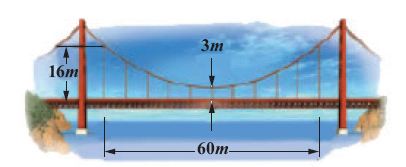
Parabolic cable of a 60m portion of the roadbed of a suspension bridge are positioned as shown below. Vertical Cables are to be spaced every 6m along this portion of the roadbed. Calculate the lengths of first two of these vertical cables from the vertex.
17.
Find the number of solution of the equation tan-1(x-1) + tan-1x + tan-1(x + 1) = tan-1(3x)
18.
If a1, a2, a3, ... an is an arithmetic progression with common difference d, prove that tan\( \left[ tan^{ -1 }\left( \frac { d }{ 1+{ a }_{ 1 }{ a }_{ 2 } } \right) +tan^{ -1 }\left( \frac { d }{ 1+{ a }_{ 2 }{ a }_{ 3 } } \right) +....tan^{ -1 }\left( \frac { d }{ 1+{ a }_{ n }{ a }_{ n-1 } } \right) \right] =\frac { { a }_{ n }-{ a }_{ 1 } }{ 1+{ a }_{ 1 }{ a }_{ n } } \)
19.
If z = x + iy and arg \(\left( \frac { z-i }{ z+2 } \right) =\frac { \pi }{ 4 } \), then show that x2 + y2 + 3x - 3y + 2 = 0
20.
Solve the following equation: x4-10x3+ 26x2-10x + 1 = 0
21.
Find the centre, foci, and eccentricity of the hyperbola 11x2 − 25y2 −44x + 50y −256 = 0
22.
Prove by vector method that the perpendiculars (altitudes) from the vertices to the opposite sides of a triangle are concurrent.
23.
Find all zeros of the polynomial x6- 3x5- 5x4 + 22x3- 39x2- 39x + 135, if it is known that 1+2i and \(\sqrt{3}\) are two of its zeros.
24.
25.
Express ecos \(\theta\) + i sin \(\theta\) in a + ib form.
26.
Solve the following differential equations:
\(\frac { dy }{ dx } ={ e }^{ x+y }+{ x }^{ 3 }{ e }^{ y }\)
27.
Solve \((1+{ x }^{ 2 })\frac { dy }{ dx } =1+{ y }^{ 2 }\)
28.
Find the vector and Cartesian equations of the plane passing through the point with position vector \(4\hat { i } +2\hat { j } -3\hat { k } \) and normal to vector \(2\hat { i } -\hat { j } +\hat { k } \)
29.
If the two lines \(\frac { x-1 }{ 2 } =\frac { y+1 }{ 3 } =\frac { z-1 }{ 4 } \) and \(\frac { x-3 }{ 1 } =\frac { y-m }{ 2 } =z\) intersect at a point, find the value of m
30.
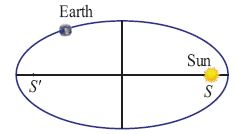
The maximum and minimum distances of the Earth from the Sun respectively are 152 × 106 km and 94.5 × 10⁶ km. The Sun is at one focus of the elliptical orbit. Find the distance from the Sun to the other focus.
31.
Prove that \([\vec { a } \times \vec { b } ,\vec { b } \times \vec { c } ,\vec { c } \times \vec { a } ]\) = \([{ \vec { a } ,\vec { b } ,\vec { c } }]^{ 2 }\)
32.
Find the equation of the parabola in each of the cases given below:
end points of latus rectum (4, -8) and(4, 8)
33.
If \(\frac { 1+z }{ 1-z } =cos2\theta +isin2\theta \), show that z = i tan\(\theta\)
34.
Solve the following equations,
sin2x - 5 sinx + 4 = 0
35.
The solution of \(\frac{d y}{d x}+p(x) y=0\) is
\(y={ ce }^{ \int { pdx } }\)
\(y={ ce }^{ -\int { pdx } }\)
\(x={ ce }^{ -\int { pdy } }\)
\(x={ce }^{ \int { pdy } }\)
36.
The general solution of the differential equation \(\frac { dy }{ dx } =\frac { y }{ x } \) is
xy = k
y = k log x
y = kx
log y = kx
37.
38.
39.
If \(\sqrt { a+ib } \) = x + iy, then possible value of \(\sqrt { a-ib }\) is ___________
x2+y2
\(\sqrt { { x }^{ 2 }+{ y }^{ 2 } } \)
x+iy
x-iy
40.
41.
If \(\vec { a } =\hat { i } +\hat { j } +\hat { k } \), \(\vec { b } =\hat { i } +\hat { j } \), \(\vec { c } =\hat { i } \) and \((\vec { a } \times \vec { b } )\times\vec { c } \) = \(\lambda \vec { a } +\mu \vec { b } \), then the value of \(\lambda +\mu \) is
0
1
6
3
42.
43.
If a vector \(\vec { \alpha } \) lies in the plane of \(\vec { \beta } \) and \(\vec { \gamma } \), then
\([\vec { \alpha } ,\vec { \beta } ,\vec { \gamma } ]\) = 1
\([\vec { \alpha } ,\vec { \beta } ,\vec { \gamma } ]\) = -1
\([\vec { \alpha } ,\vec { \beta } ,\vec { \gamma } ]\) = 0
\([\vec { \alpha } ,\vec { \beta } ,\vec { \gamma } ]\) = 2
44.
45.
If the normals of the parabola y2 = 4x drawn at the end points of its latus rectum are tangents to the circle (x − 3)2 + (y + 2)2 = r2 , then the value of r2 is
2
3
1
4
46.
47.
The length of the diameter of the circle which touches the x - axis at the point (1, 0) and passes through the point (2, 3).
\(\frac { 6 }{ 5 } \)
\(\frac { 5 }{ 3 } \)
\(\frac { 10 }{ 3 } \)
\(\frac { 3 }{ 5 } \)
48.
If the function f(x) = sin-1(x2 - 3), then x belongs to
[-1, 1]
[\(\sqrt2\), 2]
\(\\ \\ \\ \left[ -2,-\sqrt { 2 } \right] \cup \left[ \sqrt { 2 } ,2 \right] \)
\([-2,-\sqrt{2}]\)
49.
If sin-1 x+sin-1 y+sin-1 \(z = \frac{3\pi}{2}\), the value of x2017+y2018+z2019\(-\frac { 9 }{ { x }^{ 101 }+{ y }^{ 101 }+{ z }^{ 101 } } \)is
0
1
2
3
50.
The polynomial x3 + 2x + 3 has
one negative and two imaginary zeros
one positive and two imaginary zeros
three real zeros
no zeros
51.
The polynomial x3 - kx2 + 9x has three real zeros if and only if, k satisfies
|k| ≤ 6
k = 0
|k| > 6
|k| ≥ 6
52.
If z is a non zero complex number, such that 2iz2 = \(\bar { z } \) then |z| is
\(\cfrac { 1 }{ 2 } \)
1
2
3
53.
The conjugate of a complex number is \(\cfrac { 1 }{ i-2 } \). Then the complex number is
\(\cfrac { 1 }{ i+2 } \)
\(\cfrac { -1 }{ i+2 } \)
\(\cfrac { -1 }{ i-2 } \)
\(\cfrac { 1 }{ i-2 } \)
54.
in+in+1+in+2+in+3 is
0
1
-1
i
1.
Given y = a cos bx ...(1)
Differentiating equation (1) w.r.t 'x', we get
\(\frac{d y}{d x}=\mathrm{a}(-\sin \mathrm{b} x) \mathrm{b}=-\mathrm{ab} \sin \mathrm{b} x\)
Again differentiating, we get
\(\frac{d^2 y}{d x^2} =-\mathrm{ab} \cos \mathrm{b} x \cdot \mathrm{b}
\)
\(\frac{d^2 y}{d x^2} =-\mathrm{ab}^2 \cos \mathrm{b} x=-\mathrm{b}^2(\mathrm{a} \cos \mathrm{b} x)
\)
\(\frac{d^2 y}{d x^2} =-\mathrm{b}^2 \mathrm{y}
\)
\(\frac{d^2 y}{d x^2}+\mathrm{b}^2 \mathrm{y} =0\)
Therefore, y = a cos bx is a solution of the differential equation \(\frac { { d }^{ 2 }y }{ { dx }^{ 2 } } +{ b }^{ 2 }y=0\)
2.
\({ { \left( \frac { { d }^{ 2 }y }{ d{ x }^{ 2 } } \right) } }^{ 2 }+{ \left( \frac { dy }{ dx } \right) }^{ 2 }=xsin\left( \frac { { d }^{ 2 }y }{ d{ x }^{ 2 } } \right) \)
The highest derivative is 2
∴ Order 2
The given differential equation is not a polynomial equation in its derivative and so its degree is not defined.
3.
Here (x1, y1, z1) = (3, -4, -3) and direction ratios of the given straight line are (a, b, c) = (-4, -7, 12).
Direction ratios of the normal to the given plane are (A, B, C) = (5, -1, 1).
We observe that, the given point (x1, y1, z1) = (3, 4, -3) satisfies the given plane 5x-y+z = 8
Next, aA+bB+cC = (-4)(5)+(-7)(-1)+(12)(1) = -1 \(\neq \) 0.
So, the normal to the plane is not perpendicular to the line.
Hence, the given line does not lie in the plane.
4.
We compute \(\left| 6-8i \right| =\sqrt { { 6 }^{ 2 }+\left( -8 \right) ^{ 2 } } =10\)
and applying the formula for square root, we get
\(\sqrt { 6-8i } =\pm \left( \sqrt { \frac { 10+6 }{ 2 } } -i\sqrt { \frac { 10-6 }{ 2 } } \right) \) (\(\therefore\) b is negative\( \frac{b}{|b|}=-1 \))
= \(\pm \left( \sqrt { 8 } +i\sqrt { 2 } \right) \)
= \(\pm \left( 2\sqrt { 2 } -i\sqrt { 2 } \right) \)
5.
Reducing 9x2-16y2 = 144 to the standard form,
we have, \(\frac { { x }^{ 2 } }{ 16 }- \frac { { y }^{ 2 } }{ 9 } =1\)
With the transverse axis is along x-axis vertices are (−4, 0) and (4, 0); and c2 = a2+b2 = 16 + 9 = 25, c = 5
Hence the foci are (−5, 0) and (5, 0)
6.
Let sec-1\(\left( -\frac { 2\sqrt { 3 } }{ 3 } \right) =\theta \).
Then, sec\(\theta\) = \(-\frac{2}{\sqrt3}\) where \(\theta\in[0,\pi]\)\{\(\frac{\pi}{2}\)}.
Thus, cos \(\theta =-\frac{\sqrt{3}}{2}\).
Now, \(cos\frac { 5\pi }{ 6 } =cos\left( \pi -\frac { \pi }{ 6 } \right) =-cos\left( \frac { \pi }{ 6 } \right) =-\frac { \sqrt { 3 } }{ 2 } .\)
Hence, Sec-1 \(\left( -\frac { 2\sqrt { 3 } }{ 3 } \right) =\frac { 5\pi }{ 6 } \)
7.
8.
Δ = b2- 4ac = -20 < 0. The roots are imaginary numbers.
9.
cos-1(-x) = \(\pi\)-cos−1(x)
Let cos-1(-x) = \(\theta \) ..(1)
\(\Rightarrow -x=cos\theta \)
\(\Rightarrow x=-cos\theta =cos\theta =cos\left( \pi -\theta \right) \)
\(\Rightarrow \pi -\theta ={ cos }^{ -1 }\left( x \right) \)
\(\Rightarrow \theta =\pi -{ cos }^{ -1 }x\) ...(2)
From (1) & (2) \({ cos }^{ -1 }\left( -x \right) =\pi -{ cos }^{ -1 }\left( x \right) \)
\({ cos }^{ -1 }\left( -x \right) =\pi -{ cos }^{ -1 }\left( x \right) \) is true.
10.
Since α and β are the roots of the quadratic equation, we have α + β =\(\frac { 7 }{ 2 } \) and αβ = \(\frac { 13 }{ 2 } \).
Thus, to construct a new quadratic equation,
Sum of the roots = α2+β2 = (α+β)2-2αβ =\(\frac { -3 }{ 4 } \)
Product of the roots = α2β2 = (αβ)2 = \(\frac { 169 }{ 4 }\)
Thus a required quadratic equation is x2+\(\frac { 3 }{ 4 } x+\frac { 169 }{ 4 } \)= 0.
From this we see that 4x2+3x+169 = 0 is a quadratic equation with roots α2 and β2.
11.
12.
Given that the equation is \(\frac{dv}{dx}+2y\ cot\ x=3x^2 cosec^2x\)
This is a linear differential equation. Here, P = 2 cot x ; Q = 3x2cosec2x.
\(\int { Pdx=\int { 2cot\quad xdx=2log|sin\quad x|=log|sin\quad x{ | }^{ 2 } } =log{ sin }^{ 2 }x } \)
Thus, \(I.F={ e }^{ \int { Pdx } }={ e }^{ log{ sin }^{ 2 } }x={ sin }^{ 2 }x\)
Hence, the solution is \({ ye }^{ \int { Pdx } }={ \int { Qe } }^{ \int { Pdx } }dx+C\)
That is, \(y{ sin }^{ 2 }x=\int { { 3x }^{ 2 }cose{ c }^{ 2 }x.{ sin }^{ 2 }xdx+C=\int { { 3x }^{ 2 }dx+C={ x }^{ 3 }+C } } \)
Hence, \(y{ sin }^{ 2 }x={ x }^{ 3 }+C\) is the required solution
13.
Given equation is m \(\frac{dV}{dt}\) = F- kv
The given equation can be written as
\(\frac { dv }{ F-kv } =\frac { dt }{ m } \)
Now Integrating, we get
\(\int { \frac { dv }{ F-kv } } =\int { \frac { dt }{ m } } \)
\(\int \frac{d V}{F-k V}=\int \frac{d t}{M}
\frac{\log (F-k V)}{-k}=\frac{t}{M}+C_1 \\
\log [\mathrm{F}-\mathrm{kV}]=-\frac{k t}{M}-k C_1 \\
\log [\mathrm{F}-\mathrm{kV}]=-\frac{k t}{M}+\log \mathrm{C} \\
\log [\mathrm{F}-\mathrm{kV}]-\log \mathrm{C}=-\frac{k t}{M} \\
\log \left(\frac{F-k V}{C}\right)=-\frac{k t}{M} \\
\frac{F-k V}{C}=e^{\frac{-k t}{M}} \\
\frac{F-k V}{e^{\frac{-t}{M}}}=\mathrm{C} \Rightarrow \mathrm{C}=e^{\frac{k t}{M}}(F-k V) \\\)
Initial condition:
Given V = 0 when t = 0
\(\mathrm{C}=e^{\frac{k(0)}{M}}[\mathrm{~F}-\mathrm{k}(0)] \\
=\mathrm{e}^0[\mathrm{~F}-0] \\
\mathrm{C}=\mathrm{F} \\
\therefore \mathrm{F}=(F-k V) e^{\frac{k t}{M}}\)
14.
The required plane is parallel to the given line and so it is parallel to the vector \(\vec { c } =\hat { i } +\hat { j } -\hat { k } \) and the plane passes through the points \(\vec { a } =-\hat { i } +2\hat { j } ,\vec { b } =2\hat { i } +2\hat { j } -\hat { k } \)
(i) vector equation of the plane in parametric form is \(\vec { r } =\vec { a } +s(\vec { b } -\vec { a } )+t\vec { c } \), where s, t ∈ R
which implies that \(\vec { r } =(-\hat { i } +2\hat { j } )+s(3\hat { i } -\hat { k } )+t(\hat { i } +\hat { j } -\hat { k } )\), where s, t ∈ R
(ii) vector equation of the plane in non-parametric form is \((\vec { r } -\vec { a } ).(\vec { b } -\vec { a } )\times \vec { c } )\) = 0
Now, \((\vec { b } -\vec { a } )\times \vec { c } =\left| \begin{matrix} \hat { i } & \hat { j } & \hat { k } \\ 3 & 0 & -1 \\ 1 & -1 & -1 \end{matrix} \right| =\hat { i } +2\hat { j } +3\hat { k } \)
we have \((\vec { r } -(-\hat { i } +2\hat { j } ).(\hat { i } +2\hat { j } +3\hat { k } )\) = 0 ⇒ \(\vec { r } .(\hat { i } +2\hat { j } +3\hat { k } )\) = 3
If \(\vec { r } .(\hat { i } +2\hat { j } +3\hat { k } )\) is the position vector of an arbitrary point on the plane, then from the above equation, we get the Cartesian equation of the plane as x + 2y + 3z = 3
15.
Let \({ z }^{ 3 }+8i=0\)
\(\Rightarrow\) z3 = -8i
= \(8(-i)=8\left( cos\left( -\frac { \pi }{ 2 } +2k\pi \right) isin\left( -\frac { \pi }{ 2 } +2k\pi \right) \right) \),k\(\in Z\)
\(z=\sqrt [ 3 ]{ 8 } \left( cos\left( \frac { -\pi +4k\pi }{ 6 } \right) +isin\left( \frac { -\pi +4k\pi }{ 6 } \right) \right) \)
Taking k = 0, 1, 2 we get,
k = 0, \(z=2\left( cos\left( -\frac { \pi }{ 6 } \right) +isin\left( -\frac { \pi }{ 6 } \right) \right) =2\left( -\frac { 1 }{ 2 } -i\frac { \sqrt { 3 } }{ 2 } \right) =2\left( \frac { \sqrt { 3 } }{ 2 } -i\frac { 1 }{ 2 } \right) \)
k = 1, \(z=2\left( cos\left( \frac { \pi }{ 2 } \right) +isin\left( \frac { \pi }{ 2 } \right) \right) =2=\left( 0+i \right) =0+2i=2i\)
k = 2,\(z=2\left( xcos\left( \frac { 7\pi }{ 6 } \right) +isim\left( \frac { 7\pi }{ 6 } \right) \right) =2\left( cos\left( \pi +\frac { \pi }{ 6 } \right) \right) +isin\left( \pi +\frac { \pi }{ 6 } \right) \)
= \(2\left( -cos\left( \frac { \pi }{ 6 } \right) -isin\left( \frac { \pi }{ 6 } \right) \right) =2\left( -\frac { \sqrt { 3 } }{ 2 } -i\frac { 1 }{ 2 } \right) =-\sqrt { 3 } -i\)
The values of z are \(\sqrt { 3 } -i,2i\) and \(-\sqrt { 3 } -i\)
16.
Let the of the parbola be x2 = 4ay (1)
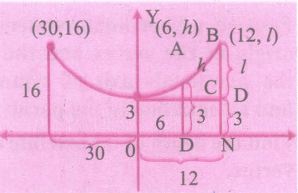
Since (30, 16) is a point on (1),
we get 302 = 4 \(\times\) a \(\times\) 16
⇒ a = \(\frac { 30\times 30 }{ 4\times 16 } =\frac { 225 }{ 16 } \)
∴ becomes, x2 = \({ x }^{ 2 }=\frac { 4\times 225 }{ 16 } y=\frac { 225 }{ 4 } y\)
Let AC = h m and BD = lm
∴ A(6, h) is a point on the parabola [∵ OD = 6]
∴ \({ 6 }^{ 2 }=\frac { 225 }{ 4 } \times h\)
⇒ \(h=\frac { 36\times 4 }{ 225 } \Rightarrow h=0.52\)
∴ AD = 3 + h = 3 + 0.52 = 3.52 m
Also (12, 1) is a point on the parabola
[∵ ON = 6 + 6 = 12]
∴ \({ 12 }^{ 2 }=\frac { 225 }{ 4 } \times l\)
⇒ l = \(\frac { 12\times 12\times 4 }{ 225 } =\frac { 576 }{ 225 } =2.08\) = 5.08 m
Hence the length of first two vertical cables are 3.52 m and 5.08 m.
17.
Consider \({ tan }^{ -1 }\left( x-1 \right) +{ tan }^{ -1 }\left( x+1 \right) \)
= \({ tan }^{ -1 }\left( \frac { x-1+x+1 }{ 1-(x-1)(x+1) } \right) ={ tan }^{ -1 }\left( \frac { 2x }{ 1-\left( { x }^{ 2 }-1 \right) } \right) \)
= \({ tan }^{ -1 }\left( \frac { x-1+x+1 }{ 1-(x-1)(x+1) } \right) ={ tan }^{ -1 }\left( \frac { 2x }{ 1-\left( { x }^{ 2 }-1 \right) } \right) \)
= \({ tan }^{ -1 }\left( \frac { 2x }{ 1-{ x }^{ 2 }+1 } \right) \)
= \({ tan }^{ -1 }\left( \frac { 2x }{ 2-{ x }^{ 2 } } \right) \)
\(\therefore { tan }^{ -1 }\left( \frac { 2x }{ 2-{ x }^{ 2 } } \right) +{ tan }^{ -1 }\left( x \right) ={ tan }^{ -1 }\left( 3x \right) \)
\(\Rightarrow { tan }^{ -1 }\left( \frac { 2x }{ 2-{ x }^{ 2 } } \right) ={ tan }^{ -1 }\left( 3x \right) -{ tan }^{ -1 }\left( x \right) \)
\(\Rightarrow { tan }^{ -1 }\left( \frac { 2x }{ 2-{ x }^{ 2 } } \right) ={ tan }^{ -1 }\left( \frac { 3xx }{ 1+3x^{ 2 } } \right) \)
\(\Rightarrow \frac { 2x }{ 2-{ x }^{ 2 } } =\frac { 2x }{ 1+{ 3x }^{ 2 } } \)
x(1+ 3x2) = x(2-x2)
x[1+ 3x2-2 + x2] = 0
x(4x2-1) = 0
x(2x+ 1) (2x-1) = 0
x = 0, x = \(\frac{1}{2}\), x = -\(\frac{1}{2}\) are the roots
Hence, there are 3 solutions
18.
Now, \(tan^{ -1 }\left( \frac { d }{ 1+{ a }_{ 1 }{ a }_{ 2 } } \right) =tan^{ -1 }\frac { { a }_{ n }-{ a }_{ 1 } }{ 1+{ a }_{ 1 }{ a }_{ n } } =tan^{ -1 }{ a }_{ 2 }-tan^{ -1 }{ a }_{ 1 }\)
Similarly, \(tan^{ -1 }\left( \frac { d }{ 1+{ a }_{ 1 }{ a }_{ 2 } } \right) =tan^{ -1 }\left( \frac { { a }_{ n }-{ a }_{ 1 } }{ 1+{ a }_{ 1 }{ a }_{ n } } \right) =tan^{ -1 }{ a }_{ 3 }-tan^{ -1 }{ a }_{ 2 }\)
Continuing inductively, we get
\(tan^{ -1 }\left( \frac { d }{ 1+{ a }_{ n }{ a }_{ n-1 } } \right) =tan^{ -1 }\left( \frac { { a }_{ n }-{ a }_{ n-1 } }{ 1+{ a }_{ n }{ a }_{ n-1 } } \right) =tan^{ -1 }{ a }_{ n }-tan^{ -1 }{ a }_{ n-1 }\)
Adding vertically, we get
\(tan^{ -1 }\left( \frac { d }{ 1+{ a }_{ 1 }{ a }_{ 2 } } \right) +tan^{ -1 }\left( \frac { d }{ 1+{ a }_{ 2 }{ a }_{ 3 } } \right) +....+tan^{ -1 }\left( \frac { d }{ 1+{ a }_{ n }{ a }_{ n-1 } } \right) tan[tan^{ -1 }{ a }_{ n }-{ tan }^{ -1 }{ a }_{ 1 }]\\ \)
\(tan\left[ tan^{ -1 }\left( \frac { d }{ 1+{ a }_{ 1 }{ a }_{ 2 } } \right) +tan^{ -1 }\left( \frac { d }{ 1+{ a }_{ 2 }{ a }_{ 3 } } \right) +...+tan^{ -1 }\left( \frac { d }{ 1+{ a }_{ n }{ a }_{ n-1 } } \right) \right] =tan\left[ tan^{ -1 }{ a }_{ n }-tan^{ -1 }a_{ 1 } \right] \)\(=\left[ tan^{ -1 }\left( \frac { { a }_{ n }-{ a }_{ 1 } }{ 1+{ a }_{ 1 }{ a }_{ n } } \right) \right] =\frac { { a }_{ n }-{ a }_{ 1 } }{ 1+{ a }_{ 1 }{ a }_{ n } } \)
19.
Given z = x + iy and arg\(\left( \frac { z-i }{ z+2 } \right) =\frac { \pi }{ 4 } \)
⇒ arg(z-i) - arg(z+2) = \(\frac { \pi }{ 4 } \)
⇒ arg(x + iy-i) - arg(x+iy+2) = \(\frac { \pi }{ 4 } \)
⇒ arg(x+i(y-1)-arg((x+2)+iy) = \(\frac { \pi }{ 4 } \)
⇒ \(tan^{ -1 }\left( \frac { y-1 }{ x } \right) -tan^{ -1 }\left( \frac { y }{ x+2 } \right) \) = \(\frac { \pi }{ 4 } \)
⇒ \(tan^{ -1 }\left( \frac { \frac { y-1 }{ x } -\frac { y }{ x+2 } }{ 1+\frac { y-1 }{ x } .\frac { y }{ x+2 } } \right) \)
= \(\frac { \pi }{ 4 } \)\(\left[ \because tan^{ -1 }x-tan^{ -1 }y=tan^{ -1 }\left( \frac { x-y }{ 1+xy } \right) \right] \)
\(\Rightarrow \frac{\left(\frac{(x+2)(y-1)- x y}{\not {x (\not x+\not2)}}\right)}{\left(\frac{x(x+2)+y(y-1)}{\not x(\not x+\not 2)}\right)}=\tan \frac{\pi}{4}=1\)
⇒ \(\frac { (x+2)(y-1)-xy }{ x(x+2)+y(y-1) } \) = 1
⇒ -x + 2y-2 = x2+ 2x + y2-y
⇒ x2 + 2x + y2-y + x-2y + 2 = 0
⇒ x2 + y2+3x-3y + 2 = 0
Hence proved.
20.
This equation is Type I even degree reciprocal equation. Hence it can be rewritten as
x2\(\left[ \left( { x }^{ 2 }+\frac { 1 }{ { x }^{ 2 } } \right) -10 \left( x+\frac { 1 }{ x } \right) +26 \right] \)= 0 Since x \(\neq\) 0, we get \(\left(x^{2}+\frac{1}{x^{2}}\right)-10\left(x+\frac{1}{x}\right)+26=0\)
Let y = \(\left( x+\frac { 1 }{ x } \right) \)
[(y2-2)-10y+26] = 0 ⇒ (y2-10y+24) = 0 ⇒ (y-6)(y-4) = 0 ⇒ y = 6 or y = 4
Case (i)
y = 6 ⇒ x +\(\frac{1}{x}\) = 6 ⇒ x = 3+2\(\sqrt{2}\), x = 3 - 2\(\sqrt{2}\)
Case (ii)
y = 4 ⇒ x = 2+\(\sqrt{3}\), x = 2-\(\sqrt{3}\).
Hence, the roots are \(3 \pm 2 \sqrt{2}, 2 \pm \sqrt{3}\)
21.
Rearranging terms in the equation of hyperbola to bring it to standard form,
we have, 11(x2-4x)-25(y2-2y)-256 = 0
11(x− 2)2−25(y−1)2 = 256−44+25
11(x−2 )2− 25 (y−1)2 = 275
\(\frac { { \left( x-2 \right) }^{ 2 } }{ 25 } -\frac { { \left( y-1 \right) }^{ 2 } }{ 11 } =1\)
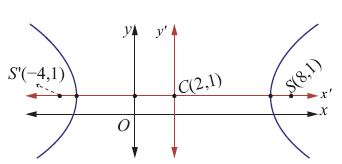
Centre (2, 1) a2 = 25, b2 = 11
c2 = a2 +b2
= 25 +11 = 36
Therefore, c = ±6
and e = \(\frac { c }{ a } =\frac { 6 }{ 5 } \)and the coordinates of foci are(8, 1) and(-4, 1) from figure.
22.
Consider a triangle ABC in which the two altitudes AD and BE intersect at O. Let CO be produced to meet AB at F. We take O as the origin and let \(\vec { OA } =\vec { a } \), \(\vec { OB } =\vec { b} \) and \(\vec { OC } =\vec { c } \)
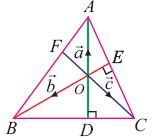
Since \(\vec { AD } \) is perpendicular to \(\vec { BC } \), we have \(\vec { OA } \) is perpendicular to \(\vec { BC } \), and
hence we get \(\vec { OA } \) . \(\vec { BC } \) = 0. That is, \(\vec { a } .(\vec { c } -\vec { b } )=0\), which means
\(\vec { a } .\hat{c}-\hat{a}.\hat{b}=0\)....(1)
Similarly, since \(\vec { BE } \) is perpendicular to \(\vec { CA } \), we have \(\vec { OB } \) is perpendicular to \(\vec { CA } \), and hence we get \(\vec { OB } .\vec { CA } \) = 0.
That is, \(\vec {b } .(\vec {a } -\vec { c } )=0\)
\(\vec { a } .\hat{c}-\hat{b}.\hat{c}=0\).......(2)
Adding equations (1) and (2), gives \(\vec { a } .\hat{c}-\hat{b}.\hat{c}=0\). That is, \(\hat{c}(\hat{a}-\hat{b})=0\)
That is \(\vec { OC } \) . \(\vec { BA } \) = 0.
Therefore, \(\vec { BA } \) is perpendicular to \(\vec { OC} \).
Which implies that \(\vec { CF} \) is perpendicular to \(\vec { AB } \).
Hence, the perpendicular drawn from C to the side AB passes through O. Therefore, the altitudes are concurrent.
23.
Let f(x) x6-3x5-5x4+22x3-39x2-39x+135
Given (1+2i) is a root \(\Rightarrow\)(-2i) is also a root
Also \(\sqrt3\) is a root \(\Rightarrow\)-\(\sqrt3\) is also a root.
Hence, the factors of f(x) are [x - (1 + 2i)]
[x-(1-2i)] [x\(\sqrt3\)] [x+\(\sqrt3\)]
[(x-1)-2i] [(x-1)+2i] [x-\(\sqrt3\)][x+\(\sqrt3\)]
((x-1)2+22)(x2-3) = (x2-2x+1+4)(x2-3)
\(\Rightarrow\) factor of f(x) is (x2-2x+5)(x2-3)
\(\Rightarrow\)x4-3x2-2x3+6x+5x2-15
\(\Rightarrow\)(x4-3x2-2x3+6x-15) is a factor of f(x)
To find the other factor, let us divide f(x) by
x4 - 2x3 + 2x2 + 6x - 15
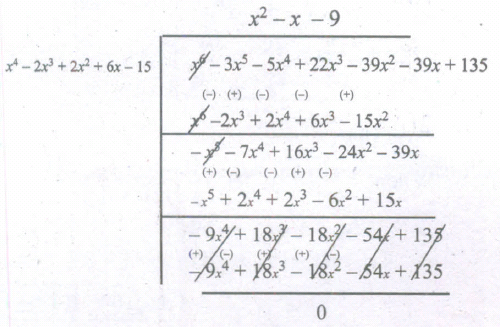
The other factor is x2 - x - 9
\(\Rightarrow x=\frac { 1\pm \sqrt { { (-1) }^{ 2 }-4(1)(-9) } }{ 2 } \left[ \because x=\frac { -b\pm \sqrt { { b }^{ 2 }-4ac } }{ 2a } \right] \)
\(\Rightarrow x=\frac { 1\pm \sqrt { 37 } }{ 2 } \)
Hence the roots are
1 - 2i, 1 + 2i, \(\sqrt { 3 }, -\sqrt { 3 }, \frac { 1+\sqrt { 37 } }{ 2 } ,\frac { 1-\sqrt { 37 } }{ 2 } \).
24.
25.
\(
\frac{1}{1-\cos \theta+i \sin \theta} \\
=\frac{1}{1-\cos \theta+i \sin \theta} \times \frac{(1-\cos \theta)-i \sin \theta}{(1-\cos \theta)-i \sin \theta} \\
=\frac{(1-\cos \theta)-i \sin \theta}{(1-\cos \theta)^2+\sin ^2 \theta} \\
=\frac{(1-\cos \theta)-i \sin \theta}{1-2 \cos \theta+\cos ^2 \theta+\sin ^2 \theta} \\
=\frac{(1-\cos \theta)-i \sin \theta}{1-2 \cos \theta+1} \text { where } \cos ^2 \theta+\sin ^2 \theta=1 \\
=\frac{(1-\cos \theta)-i \sin \theta}{2+2 \cos \theta}
\)
\(=\frac{1}{2}-i \frac{2 \sin \frac{\theta}{2} \cos \frac{\theta}{2}}{4 \sin ^2 \frac{\theta}{2}} \\
=\frac{1}{2}-i \frac{\cos \frac{\theta}{2}}{2 \sin \frac{\theta}{2}} \\
=\frac{1}{2}-\frac{i}{2} \cot \frac{\theta}{2}
\)
26.
\(\frac { dy }{ dx } ={ e }^{ x }{ e }^{ y }+{ x }^{ 3 }(e^y)={ e }^{ y }({ e }^{ x }+{ x }^{ 3 })\)
\(\Rightarrow \frac { dv }{ { e }^{ y } } =({ e }^{ x }+{ x }^{ 3 })dx\)
The equation can be written as
\(\Rightarrow \frac { dv }{ { e }^{ y } } =({ e }^{ x }+{ x }^{ 3 })dx\)
Taking integration on both sides, we get
\(\therefore \int { { e }^{ -y } } dy=\int { ({ e }^{ x }+{ x }^{ 3 })dx } \)
\(\frac{e^{-y}}{-1}=e^x+\frac{x^4}{4}+C\)
\(\Rightarrow { e }^{ x }+{ e }^{ -y }+\frac { { x }^{ 4 } }{ 4 } =-C=C\)
[which is also a constant]
\(\Rightarrow { e }^{ x }+{ e }^{ -y }+\frac { { x }^{ 4 } }{ 4 } = C\)
27.
Given that \((1+{ x }^{ 2 })\frac { dy }{ dx } =1+{ y }^{ 2 }\) ..(1)
The given equation is written in the variables separable form
\(\frac { dy }{ { 1+y }^{ 2 } } =\frac { dx }{ { 1+x }^{ x } } \) ...(2)
Integrating both sides of (2), we get tan−1 tan−1x +C.
But tan-1 y - tan-1 x = tan-1 \(\left( \frac { y-x }{ 1+xy } \right) .\) ...(4)
Using (4) in (3) leads to tan-1 \(\left( \frac { y-x }{ 1+xy } \right)\) = C, which implies \(\frac { y-x }{ 1+xy } \) = tan C = a (say).
Thus, y − x = a(1+ xy) gives the required solution
28.
If the position vector of the given point is \(\vec { a } =4\hat { i } +2\hat { j } -3\hat { k } \) and \(\vec { n } =2\hat { i } -\hat { j } +\hat { k } \), then the equation of the plane passing through a point and normal to a vector is given by \((\vec { r } -\vec { a } ).\vec { n } =0\) or \(\vec { r } .\vec { n } =\vec { a } .\vec { n } \)
Substituting \(\vec { a } =4\hat { i } +2\hat { j } -3\hat { k } \) and \(\vec { n } =2\hat { i } -\hat { j } +\hat { k } \) in the above equation, we get
\(\vec { r } .(2\hat { i } -\hat { j } +\hat { k } )=(4\hat { i } +2\hat { j } -3\hat { k } ).(2\hat { i } -\hat { j } +\hat { k } )\)
Thus, the required vector equation of the plane is \(\vec { r } .(2\hat { i } -\hat { j } +\hat { k } )\)= 3. If \(\vec { r } =x\hat { i } +y\hat { j } +z\hat { k } \) then
we get the Cartesian equation of the plane 2x − y + z = 3.
29.
Given lines are
\(\frac { x-1 }{ 2 } =\frac { y+1 }{ 3 } =\frac { z-1 }{ 4 } \)
\(\vec { a } =\hat { i } -\hat { j } +\hat { k } \vec { b } \quad and\quad \vec { b } =2\hat { i } +3\hat { j } +4\hat { k } \)
\(\frac { x-3 }{ 1 } =\frac { y-m }{ 2 } =\frac{z-0}{1}\)\(\Rightarrow \vec { c } =3\hat { i } +m\hat { j } \)
\(\vec { d } =\hat { i } +2\hat { j } +\hat { k } \quad \)
\(\vec { c } -\vec { a } =(3\hat { i } +m\hat { j } )-(\hat { i } -\hat { j } +\hat { k } )\)
\(=2\hat { i } +(m,+1)\hat { j } -\hat { k } \)
\(\vec { b } \times \vec { d } =\left| \begin{matrix} \hat { i } & \hat { j } & \hat { k } \\ 2 & 3 & 4 \\ 1 & 2 & 1 \end{matrix} \right| =\hat { i } (3-8)-\hat { j } (2-4)+\hat { k } (4-3)\)
\(=-5\hat { i } +2\hat { j } +\hat { k } \)
Since the lines intersect at a point, \((\vec { c } -\vec { a } ).(\vec { b } \times \vec { d } )=0,\)
\(\Rightarrow (2\hat { i } +(m+1)\hat { j } -\hat { k } ).(-5\hat { i } +2\hat { j } +\hat { k } )=0\)
\(\Rightarrow -10+2(m+1)-1=0\Rightarrow -10+2m+2-1=0\)
\(\Rightarrow 2m-9=0\Rightarrow 2m=9\Rightarrow m=\frac { 9 }{ 2 } \)
\(\therefore m=\frac { 9 }{ 2 } \)
30.
AS = 94.5 × 10⁶ km,
SA' = 152 × 106 km
a+c = 152 × 106
a-c = 94.5 × 10⁶
Subtracting 2c = 57.5 × 106 = 575 × 105 km
Distance of the Sun from the other focus is SS' = 575 × 105 km.
31.
Using the definition of the scalar triple product, we get
\([\vec { a } \times \vec { b } ,\vec { b } \times \vec { c } ,\vec { c } \times \vec { a } ]\) = \((\vec { a } \times \vec { b } ).[(\vec { b } \times \vec { c } )\times (\vec { c } \times \vec { a } )]\) ....(1)
By treating \((\vec { b } \times \vec { c } )\) as the first vector in the vector triple product, we find
\((\vec { b } \times \vec { c } )\times (\vec { c } \times \vec { a } )\) = \(((\vec { b } \times \vec { c } ).\vec { a } )\vec { c } \) - \(((\vec { b } \times \vec { c } ).\vec { c } )\vec { a } )\) = \([{ \vec { a } ,\vec { b } ,\vec { c } }]\vec { c } \)
Using this value in (1), we get
\([\vec { a } \times \vec { b } ,\vec { b } \times \vec { c } ,\vec { c } \times \vec { a } ]\) = \((\vec { a } \times \vec { b } ).([\vec { a } ,\vec { b } ,\vec { c } ]\vec { c } )=[\vec { a } ,\vec { b } ,\vec { c } ](\vec { a } \times \vec { b } ).\vec { c } ={ [\vec { a } ,\vec { b } ,\vec { c } ] }^{ 2 }\)
32.
End points of latus rectum are (4, -8) and (4, 8)
Focus is the mid-point of (4, -8) and (4, 8)
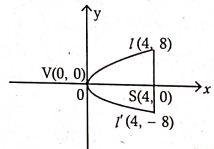
∴ Focus = \(\left( \frac { 4+4 }{ 2 } ,\frac { -8+8 }{ 2 } \right) \) = (4, 0)
∴ a = 4 and vertex is (0, 0)
Equation of the parabola is y2 = 4ax
⇒ y2 = 4(4)x
⇒ y2 = 16x
33.
Let z = x + iy
Then \(\frac { 1+z }{ 1-z } \) = cos2θ + i sin 2θ
⇒ \(\frac { 1+x+iy }{ 1-x-iy } \) = cos 2θ + i sin 2θ ....(1)
Taking modulus,
\(\left| \frac { 1+x+iy }{ 1-x-iy } \right| \) = |cos 2θ+i sin 2θ| ⇒ \(\frac { |1+x+iy| }{ |1-x-iy| } \)
=\(\sqrt { cos^{ 2 }2\theta +sin^{ 2 }2\theta } \) = 1
⇒ |1 + x + iy| = |1 - x - iy|
⇒ \(\sqrt { (1+x)^{ 2 }+{ y }^{ 2 } } =\sqrt { (1+x)^{ 2 }+{ y }^{ 2 } } \)
⇒ (1 + x)2+ y2 = (1-x)2+ y2

⇒ 4x = 0 ⇒ x = 0
From (1) \(\frac { (1+x)+iy }{ (1-x)-iy } \times \frac { (1-x)+iy }{ (1-x)+iy } \)
= cos2θ + isin 2θ
Choosing the imaginary part alone we get,
\(\frac { y(1+x)+y(1-x) }{ (1-x)^{ 2 }+{ y }^{ 2 } } \)= sin 2θ
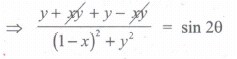
\(\frac { 2y }{ 1+y^{ 2 } } \) = sin 2θ
⇒ \(\frac { 2tan\theta }{ 1+tan^{ 2 }\theta } \) = sin 2θ
∴ y must be equal to tan θ
⇒ y = tan θ
z = x+ iy
∴ z = 0 + i tan θ
⇒ z = tan θ
34.
sin2x - 5 sinx + 4 = 0
put y = sin x
⇒ y2-5y+4 = 0
⇒ (y-4)(y-1) = 0
⇒ y = 4, 1
Case (i)
When y = 4, sin x = 4 and no solution for sin x = 4 since the range the sin function is [-1, 1]
Case (ii)
When y = 1, sin x = 1
⇒ sin x = sin \(\frac{\pi}{2}\) [\(\because sin \frac {\pi}{2}=1\)]
\(x=n \pi+(-1)^{n} \frac{\pi}{2} \forall n \in z\).
35.
(b)
\(y={ ce }^{ -\int { pdx } }\)
36.
(c)
y = kx
37.
(a)
38.
(c)
39.
(d)
x-iy
40.
(b)
41.
(a)
0
42.
(d)
43.
(c)
\([\vec { \alpha } ,\vec { \beta } ,\vec { \gamma } ]\) = 0
44.
(a)
45.
(a)
2
46.
(b)
47.
(c)
\(\frac { 10 }{ 3 } \)
48.
(c)
\(\\ \\ \\ \left[ -2,-\sqrt { 2 } \right] \cup \left[ \sqrt { 2 } ,2 \right] \)
49.
(a)
0
50.
(a)
one negative and two imaginary zeros
51.
(d)
|k| ≥ 6
52.
(a)
\(\cfrac { 1 }{ 2 } \)
53.
(b)
\(\cfrac { -1 }{ i+2 } \)
54.
(a)
0

12th Standard Syllabus & Materials
12th Standard
TN 12th Computer Applications களப்பெயர் முறைமை (DNS) Sample Question Papers Study Material - QB365 Set A
NEW12th Standard
TN 12th Computer Applications வலையமைப்பு எடுத்துக்காட்டுகள் மற்றும் நெறிமுறைகள் Sample Question Papers Study Material - QB365 Set A
NEW12th Standard
TN 12th Computer Applications கணினி வலையமைப்பு ஓர் அறிமுகம் Sample Question Papers Study Material - QB365 Set A
NEW12th Standard
TN 12th Computer Applications PHP-உடன் MySQL-ஐ இணைத்தல் Sample Question Papers Study Material - QB365 Set A



Tamilnadu Stateboard 12th Standard Subjects
Maths

Chemistry

Physics

Biology

Computer Science

Business Maths and Statistics

Economics

Commerce

Accountancy

History

Computer Applications
Biology
Computer Technology
Computer Applications
Computer Science
Business Maths and Statistics
Commerce
Economics
Maths
Chemistry
Physics
Computer Technology
History
Accountancy

Tamil

English

French
Tamilnadu Stateboard Standards


