
 100% FREE ACCESS
12th Standard Syllabus & Materials
12th Standard
TN 12th Computer Applications மின்னணு தரவு பரிமாற்றம் Sample Question Papers Study Material - QB365 Set A
NEW12th Standard
TN 12th Computer Applications மின் - வணிக பாதுகாப்பு அமைப்புகள் Sample Question Papers Study Material - QB365 Set A
NEW12th Standard
TN 12th Computer Applications மின்னணு செலுத்தல் முறைகள் Sample Question Papers Study Material - QB365 Set A
NEW12th Standard
TN 12th Computer Applications மின் - வணிகம் Sample Question Papers Study Material - QB365 Set A
NEW12th Standard
TN 12th Computer Applications திறந்த மூல கருத்துருக்கள் Sample Question Papers Study Material - QB365 Set A
NEW12th Standard
TN 12th Computer Applications வலையமைப்பு வடமிடல் Sample Question Papers Study Material - QB365 Set A

Published on: 22/08/2026
Download Tamil Nadu 12th Standard Maths question papers, model tests, one-mark questions, important questions, and public exam papers in PDF format. Free study materials and answer keys for TN State Board students.
Questions + Answers key
Take MCQ Maths Test
1.
If \(\mathrm{F}(\mathrm{x})=\frac{1}{\pi}\left(\frac{\pi}{2}+\tan ^{-1} x\right),-\infty<\mathrm{x}<\infty\) is a distribution function of a continuos variable x, find \(\mathrm{P}(0 \leq \mathrm{x} \leq 1)\)
2.
Let \(*\) be defined on R by (a \(*\) b) = a + b + ab - 7. Is \(*\) binary on R? If so, find 3 \(*\)\(\left( \frac { -7 }{ 15 } \right) \).
3.
How many rows are needed for following statement formulae?
\(p \vee \neg t \wedge(p \vee \neg s)\)
4.
The mean and variance of a binomial variate X are respectively 2 and 1.5. Find
(i) P(X = 0)
(ii) P(X =1)
(iii) P(X ≥1)
5.
Compute P(X = k) for the binomial distribution, B(n, p) where
n = 9, \(p=\frac { 1 }{ 2 } \), k = 7
6.
Find the differential equation for the family of all straight lines passing through the origin.
7.
For each of the following differential equations, determine its order, degree (if exists)
\({ { \left( \frac { { d }^{ 2 }y }{ d{ x }^{ 2 } } \right) } }^{ 2 }+{ \left( \frac { dy }{ dx } \right) }^{ 2 }=xsin\left( \frac { { d }^{ 2 }y }{ d{ x }^{ 2 } } \right) \)
8.
If a continuous random variable X has the p.d.f. f(x) = 4x(x-1)3, then find P(1 ≤ X ≤ 2).
9.
Prove that q ➝ p ≡ ¬p ➝ ¬q
10.
Find the binomial distribution function for each of the following.
(i) Five fair coins are tossed once and X denotes the number of heads.
(ii) A fair die is rolled 10 times and X denotes the number of times 4 appeared.
11.
The probability density function of X is given by \(f(x)=\begin{cases} \begin{matrix} kxe^{ -2x } & forx>0 \end{matrix} \\ \begin{matrix} 0 & for\quad x\le 0 \end{matrix} \end{cases}\) Find the value of k.
12.
Suppose X is the number of tails occurred when three fair coins are tossed once simultaneously. Find the values of the random variable X and number of points in its reverse images.
13.
Solve \((1+{ 2e }^{ x/y })dx+2{ e }^{ x/y }\left( 1-\frac { x }{ y } \right) dy=0\)
14.
Solve the following differential equations or show that the solution of
\(\\ \\ \\ \frac { dy }{ dx } =\sqrt { \frac { 1-{ y }^{ 2 } }{ 1-{ x }^{ 2 } } } \)
15.
For the probability density function \(f(x)=\left\{\begin{array}{c}
k(1-x)^{3}, 0<x<1 \\
0, \text { elsewhere }
\end{array}\right.\). Find
(i) The constant k
(ii) \(P\left(X<\frac{2}{3}\right)\)
16.
Define a binary operation on the set A = {0, 1, 2, 3, 4, 5} as a* b = \(\left\{\begin{array}{ll} a+b, & \text { if } a+b<6 \\ a+b-6 & \text { if } a+b \geq 6 \end{array}\right\}\) Show that zero is the identity for this operation and each element of the set is invertible with (6-a) being the inverse of a.
17.
Define an operation \(*\)on Q as follows: a * b =\(\left( \frac { a+b }{ 2 } \right) \); a,b ∈Q. Examine the closure, commutative, and associative properties satisfied by \(*\)on Q.
18.
Find the constant C such that the function
\(f(x)= \begin{cases}C x^2, & 1<x<4 \\ 0, & \text { otherwise }\end{cases}\)
is a density function, and compute
(i) P(1.5 < X < 3.5)
(ii) P(X ≤ 2)
(iii) P(3 < X )
19.
Suppose a person deposits 10,000 Indian rupees in a bank account at the rate of 5% per annum compounded continuously. How much money will be in his bank account 18 months later?
20.
Solve the differential equation:
x cos y dy = ex(x log x + 1)dx
21.
The differential equation of x2y = k is _________.
\({ x }^{ 2 }\frac { dy }{ dx } =0\)
\({ x }^{ 2 }\frac { dy }{ dx } +y=0\)
\({ x }\frac { dy }{ dx } +2y=0\)
\(y\frac { dy }{ dx } +2x=0\)
22.
The dual of ᄀ(p V q) V [p V (p ∧ ᄀr)] is
ᄀ(p ∧ q) ∧ [p V (p ∧ ᄀr)]
(p ∧ q) ∧ [p ∧ (p V ᄀr)]
ᄀ(p ∧ q) ∧ [p ∧ (p ∧ r)]
ᄀ(p ∧ q) ∧ [p ∧ (pV ᄀr)]
23.
Which one of the following is a binary operation on N?
Subtraction
Multiplication
Division
All the above
24.
25.
If the function \(f(x)=\frac { 1 }{ 12 } \) for a < x < b, represents a probability density function of a continuous random variable X, then which of the following cannot be the value of a and b?
0 and 12
5 and 17
7 and 19
16 and 24
26.
A random variable X has binomial distribution with n = 25 and p = 0.8 then standard deviation of X is
6
4
3
2
27.
28.
The solution of \(\frac{d y}{d x}+p(x) y=0\) is
\(y={ ce }^{ \int { pdx } }\)
\(y={ ce }^{ -\int { pdx } }\)
\(x={ ce }^{ -\int { pdy } }\)
\(x={ce }^{ \int { pdy } }\)
29.
The differential equation of the family of curves y = Aex + Be−x, where A and B are arbitrary constants is
\(\frac { { d }^{ 2 }y }{ { dx }^{ 2 } } +y=0\)
\(\frac { { d }^{ 2 }y }{ { dx }^{ 2 } } -y=0\)
\(\frac { { d }y }{ { dx } } +y=0\)
\(\frac { { d }y }{ { dx } } -y=0\)
30.
The order and degree of the differential equation \(\frac { { d }^{ 2 }y }{ { dx }^{ 2 } } +{ \left( \frac { dy }{ dx } \right) }^{ 1/3 }+{ x }^{ 1/4 }=0\) are respectively
2, 3
3, 3
2, 6
2, 4
1.
\(
\mathrm{F}(\mathrm{x}) =\frac{1}{\pi}\left(\frac{\pi}{2}+\tan ^{-1} x\right)
\)
\(\mathrm{P}(0 \leq \mathrm{x} \leq 1) =\mathrm{F}(1)-\mathrm{F}(0)
\)
\( =\frac{1}{\pi}\left(\frac{\pi}{2}+\tan ^{-1} 1\right)-\frac{1}{\pi}\left(\frac{\pi}{2}+\tan ^{-1} 0\right)
\)
\( =\frac{1}{\pi}\left(\frac{\pi}{2}+\frac{\pi}{4}\right)-\frac{1}{\pi}\left(\frac{\pi}{2}+0\right)
\)
\( =\frac{1}{\pi}\left(\frac{\pi}{2}+\frac{\pi}{4}-\frac{\pi}{2}\right)=\frac{1}{4}\)
2.
Given a*b = a + b + ab -7, ∀ a,b ∈R
If a ∈R, b∈R then ab ∈ R
(a*b) = a +b+ ab - 7 ∈R
For example, let 1, 2 ∈ R
(1*2) = 1+2+(1)(2)-7
= 2 ∈ R
* a binary operation on R
\(3 *\left(\frac{-7}{15}\right)=3-\frac{7}{15}+\gamma^1\left(\frac{-7}{15_5}\right)-7\)
[Here a = 3, b = \(\frac{-7}{15}\)]
\(=3-\frac { 7 }{ 15 } -\frac { 21 }{ 15 } -7\)
\(\therefore 3*\left( \frac { -7 }{ 15 } \right) =\frac { -88 }{ 15 }\)
3.
p ∨ ¬ t ( p ∨ ¬s) contains 3 variables p, s, and t. Hence the corresponding truth table will contain 23 = 8 rows
4.
To find the probabilities, the values of the parameters n and p must be known.
Given that
Mean = np = 2 and variance = npq = 1.5
This gives \(\frac { npq }{ np } =\frac { 1.5 }{ 2 } =\frac { 3 }{ 4 } \)
\(q=\frac { 3 }{ 4 } \) and \(p=1-q=1-3\frac { 4 }{ 4 } =\frac { 1 }{ 4 } \)
np = 2 gives \(n=\frac { 2 }{ p } =8\) . Therefore \(X\sim B\left( 8,\frac { 1 }{ 4 } \right) \)
Therefore probability distribution is
\(P(X=x)=f(x)=\left( \begin{matrix} 8 \\ x \end{matrix} \right) \left( \cfrac { 1 }{ 4 } \right) ^{ x }\left( \cfrac { 3 }{ 4 } \right) ^{ 8-x }\)
(i) \(P(X=0)=f(0)=\left( \begin{matrix} 8 \\ 0 \end{matrix} \right) \left( \cfrac { 1 }{ 4 } \right) ^{ 0 }\left( \cfrac { 3 }{ 4 } \right) ^{ 8-0 }=\left( \cfrac { 3 }{ 4 } \right) ^{ 8 }\)
(ii) \(P(X=1)=f(1)=\left( \begin{matrix} 8 \\ 1 \end{matrix} \right) \left( \cfrac { 1 }{ 4 } \right) \left( \cfrac { 3 }{ 4 } \right) ^{ 8-1 }=2\left( \cfrac { 3 }{ 4 } \right) ^{ 2 }\)
(iii) P(X≥1) = 1-P(X<1) = 1-P(X = 0) = \(1-\left( \frac { 3 }{ 4 } \right) ^{ 8 }\)
5.
\(\mathrm{n}=9, \mathrm{p}=\frac{1}{2}, \mathrm{k}=7
\)
\(
\mathrm{P}(X=x)={ }^{n} C_{x} p^{x} q^{n-x}, x=0,1,2, \ldots, n
\)
\(p =\frac{1}{2}
\)
\(q =1-p=\frac{1}{2} \)
\(P(X=7) ={ }^{9} C_{7}\left(\frac{1}{2}\right)^{7}\left(\frac{1}{2}\right)^{2}
\)
\( =\frac{9 \times 8}{2} \times \frac{1}{2^{9}} \)
\( =36 \times \frac{1}{512}=\frac{9}{128}
\)
6.
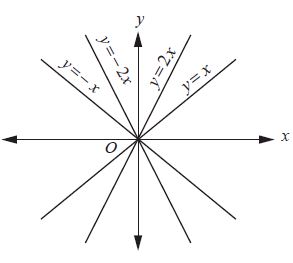
The family of straight lines passing through the origin is y = mx, where m is an arbitrary constant.
Differentiating both sides with respect to x, we get \(\frac{dy}{dx}=m\)
From (1) and (2), we get y = x\(\frac{dy}{dx}\). This is the required differential equation.
Observe that the given equation y = mx contains only one arbitrary constant and thus we get the differential equation of order one.
7.
\({ { \left( \frac { { d }^{ 2 }y }{ d{ x }^{ 2 } } \right) } }^{ 2 }+{ \left( \frac { dy }{ dx } \right) }^{ 2 }=xsin\left( \frac { { d }^{ 2 }y }{ d{ x }^{ 2 } } \right) \)
The highest derivative is 2
∴ Order 2
The given differential equation is not a polynomial equation in its derivative and so its degree is not defined.
8.
Given f(x) = 4k (x-1)2, 1 ≤ x ≤ 3.
Since f(x) is a p.d.f\(\int_{1}^{3} f(x) d x=1\)
\( \Rightarrow \int_{1}^{3} 4 k(x-1)^{3} d x =1 \)
\(\Rightarrow 4 k\left[\frac{(x-1)^{4}}{4}\right]_{1}^{3} =1 \)
\(\Rightarrow \ k\left[2^{4}-0^{4}\right] =1 \)
\(\Rightarrow \ 16 k =1 \)
\(\Rightarrow \ k =\frac{1}{16} \)
\(\therefore \mathrm{P}(1 \leq \mathrm{X} \leq 2) =\int_{+1}^{2} f(x) d x \)
\(\Rightarrow \ =\int_{1}^{2} \frac{1}{4}(x-1)^{3} d x \)
\(\Rightarrow 1{ }^{2} =\frac{1}{4}\left[\frac{(x-1)^{4}}{4}\right]_{1}^{2} \)
\( =\frac{1}{16}\left(1^{4}-0^{4}\right)=\frac{1}{16} \)
9.
| p | q | q ➝ p | ~p | ~q | ~q ➝ ~p |
| T | T | T | F | F | T |
| T | F | T | F | T | T |
| F | T | F | T | F | F |
| F | F | T | T | T | T |
The entries in the columns corresponding q ➝ p and ~p ➝ ~q are identical and hence they are equivalent.
q ➝ p ≡ ~p ➝ ~q
Hence proved
10.
(i) Given that five fair coins are tossed once. Since the coins are fair coins the probability of getting an head in a single coin is
\(p=\frac { 1 }{ 2 } \) and \(q=1-p=\frac { 1 }{ 2 } \)
Let X denote the number of heads that appear in five coins. X is binomial random variable that takes on the values 0, 1, 2, 3, 4 and 5 and \(p=\frac { 1 }{ 2 } \) That is \(X\sim B\left( 5,\cfrac { 1 }{ 2 } \right) \)
Therefore the binomial distribution is
\(f(x)=\left( \begin{matrix} n \\ x \end{matrix} \right) p*\left( 1-p \right) ^{ n-x }\), x = 0, 1, 2,..,n
becomes
\(f(x)=\left( \begin{matrix} 5 \\ x \end{matrix} \right) \left( \cfrac { 1 }{ 2 } \right) ^{ x }\left( \cfrac { 1 }{ 2 } \right) ^{ n-x }\), x = 0, 1, 2,..,5
That is
\(f(x)=\left( \begin{matrix} 5 \\ x \end{matrix} \right) \left( \cfrac { 1 }{ 2 } \right) ^{ n }\), x = 0, 1, 2...,n
(ii) A fair die is rolled ten times and X denotes the number of times 4 appeared. X is binomial
random variable that takes on the values 0, 1, 2, 3,...10 , with n = 10 and \(p=\cfrac { 1 }{ 6 } \). That is \(X\sim B\left( 10,\cfrac { 1 }{ 6 } \right) \)
Probability of getting a four in a die is \(p=\frac { 1 }{ 2 } \) and \(q=1-p=\frac { 5 }{ 6 } \)
Therefore the binomial distribution is
\(f(x)=\left( \begin{matrix} 10 \\ x \end{matrix} \right) \left( \cfrac { 1 }{ 6 } \right) ^{ x }\left( \cfrac { 5 }{ 6 } \right) ^{ 10-x }\) x = 0, 1, 2,...,10
11.
Given \(f(x)=\begin{cases} \begin{matrix} kxe^{ -2x } & forx>0 \end{matrix} \\ \begin{matrix} 0 & for\quad x\le 0 \end{matrix} \end{cases}\)
Since the given function is a probability density function
\(\int _{ -\infty }^{ \infty }{ f(x)dx } \) = 1
\(\Rightarrow k\int _{ 0 }^{ \infty }{ { xe }^{ -2x }dx=1 } \)
\(\Rightarrow k \frac { 1! }{ \left( 2 \right) ^{ 2 } } =1\)
[\(\int _{ 0 }^{ \infty }{ { x }^{ n }e^{ -ax } } =\frac { n! }{ { a }^{ +1 } } \), Here a = 2, n = 1]
\(\Rightarrow \frac { k }{ 4 } =1\\ \Rightarrow k=4\)
12.
Let X be the random variable of number of tails when three coins tossed.
S = {HHH, HHT, THH, HTH, HTT, THT, TTH,TTT}
n(S) = 8
Let X denote the number of tarits occured.
X-1 (0) {HHH} = 1
X-1 (1) = {HHT, THT, HTH} = 3
X-1 (2) =, {HTT, THT, TTH} = 3
X-1 (3) = {TTT} = 1
ஃ X takes the values 0, 1, 2, 3.
Values of random variable X | 0 | 1 | 2 | 3 | Total |
Number of elements in reverse images | 1 | 3 | 3 | 1 | 8 |
13.
The given equation can be written as \(\frac { dx }{ dy } =\frac { \left( \frac { x }{ y } -1 \right) { 2e }^{ x/y } }{ 1+2{ e }^{ x/y } } =g\left( \frac { x }{ y } \right) ..(1)\)
The appearance of \(\frac{x}{y}\) in equation (1), suggests that the appropriate substitution is x = vy.
Put x = vy . Then, we have \(y\frac { dv }{ dy } =-\frac { 2{ e }^{ v }+v }{ 1+2{ e }^{ v } } \)
By separating the variables, we have \(-\frac { 1+2{ e }^{ v } }{ v+2{ e }^{ v } } dv=-\frac { dy }{ y } \)
On integration, we obtain
log |2ev + v| = −log |y| + log |C| or log |2yev+vy| = log |C| or 2yev+ vy = ±C.
Replace v by \(\frac{x}{y}\) to get, 2yex/y+x = k, where k =土C, Which gives the required solution.
14.
Separating the variables we get,
\(\frac { dy }{ \sqrt { 1-{ y }^{ 2 } } } \frac { dx }{ \sqrt { 1-{ x }^{ 2 } } } \)
Taking Integration on both sides, we get
\(\int \frac{d y}{\sqrt{1-y^{2}}}=\int \frac{d x}{\sqrt{1-x^{2}}}\)
sin-1y = sin-1 x + c
15.
(i) Since f is a p.d.f. \(\int_{0}^{1} f(x) d x=1\)
\(
k \int_{0}^{1}(1-x)^{3} d x=1
\)
\( k\left[\frac{(1-x)^{4}}{-4}\right]_{0}^{1}=1\)
\(
-\frac{k}{4}\left[(1-x)^{4}\right]_{0}^{1} =1
\)
\(-\frac{k}{4}(0-1) =1
\)
\(\frac{k}{4} =1\)
(ii) \(P\left(X<\frac{2}{3}\right)\)
\(
\mathrm{P}\left(\mathrm{X}<\frac{2}{3}\right) =\int_{0}^{3 / 2} k(1-x)^{3} d x
\)
\( =4\left[\frac{(1-x)^{4}}{-4}\right]_{0}^{1 / 3}
\)
\( =-\left[(1-x)^{4}\right]_{0}^{2 / 3}
\)
\( =-\left(\left(1-\frac{2}{3}\right)^{4}-1^{4}\right)
\)
\( =\left(\frac{1}{81}-1\right)^{3} \)
\( =\frac{80}{81}
\)
16.
(i) We know that 'e' is the identity element
if
a* e = e * a = a
a * 0 = a + 0 = a
0 * a = 0 + a = a
a * 0 = 0 * a = a
Hence 0 is the identity for this operation.
(ii) An element a \(\in\) A is said to be invertible with respect to the operation * if there exists an element b in A such that b is called the inverse of a.
a * (6-a) = a + (6-a) - 6 = 0
(6-a) * a = (6-a) + a-6 = 0
Hence, each 'a' of the set {0, 1 , 2, 3 , 4, 5} is invertible with (6 - a) being the inverse of 'a'.
17.
Given \(a*b=\frac { a+b }{ 2 } \forall \in Q\)
i) Closure property:
Let a, b ∈ Q
∴ a*b = \(\frac{a+b}{2}\)∈Q
[∵ addition and division are closed on Q]
* is closed on Q.
(ii) Commutative property:
Let a, b ∈ Q
Then a+b \(=\frac { a+b }{ 2 } =\frac { b+a }{ 2 } =b*a\)
∴ a*b = b*a ∀a,b∈Q
∴ * is commutative on Q.
(iii) Associative property :
Let a, b, c ∈ Q
a*(b*c) = (a*b)*c
Let a = 2, b = 3, c-5
∴ a*(b*c) = 2*(3*-5)
\(=*\left( \frac { 3-5 }{ 2 } \right) \)
\(=2*(-1)=\frac { 2+(-1) }{ 2 } \)
\(=\frac { 1 }{ 2 } \quad \quad ...(1)\)
Now (a*b)*c = (2*3)*(-5)
\(=\left( \frac { 2+3 }{ 2 } \right) *(-5)\)
\(=\frac { 5 }{ 2 } *-5=\frac { \frac { 5 }{ 2 } +(-5) }{ 2 } \)
\(=\frac { 5-10 }{ 4 } =\frac { -5 }{ 4 } ...(2)\)
From (1) & (2), a*(b*c) ≠ (a*b)*c
∴ * is not associative on Q.
18.
Since the given function is a probability density function

\(\int _{ -\infty }^{ \infty }{ f(x) } dx=1\)
That is \(\int _{ -\infty }^{ 1 }{ f(x) } dx+\int _{ 1 }^{ 4 }{ f(x) } dx+\int _{ 4 }^{ \infty }{ f(x) } dx=1\)
From the given information
\(\int _{ -\infty }^{ 1 }{ 0dx } +\int _{ 1 }^{ 4 }{ { Cx }^{ 2 }dx } +\int _{ 4 }^{ \infty }{ 0dx } =1\)
\(0+C\left[ \cfrac { { x }^{ 3 } }{ 3 } \right] _{ 1 }^{ 4 }+0=1\Rightarrow C\left[ \cfrac { 64-1 }{ 3 } \right] =1\Rightarrow 21C\Rightarrow C=\cfrac { 1 }{ 21 }\)
Therefore the probability density function is
\(\)\(f(x)=\left\{C x^2, \quad x>1\right.\)
Since f (x) is continuous, the probability that X is equal to any particular value is zero. Therefore when the random variable is continuous, either or both of the signs < by ≤ and > by ≥ can be interchanged. Thus
(i) P(1.5 < X < 3.5) = P(1.5 ≤ X< 3.5)= P(1.5 < X ≤3.5) = P(1.5 ≤X ≤ 3.5)
Therefore
\(P(1.5<X<3.5)=\int_{1.5}^{3.5} f(x) d x\)

\(\begin{aligned} & =\frac{1}{21}\left(\frac{x^3}{3}\right)=\frac{1}{21}\left(\frac{(3.5)^3-(1.5)^3}{3}\right) \\ & =\frac{79}{126} \end{aligned}\)
(ii) \(P(X \leq 2)=\int_{-\infty}^2 f(x) d x=\int_{-\infty}^1 f(x) d x+\int_1^2 f(x) d x\)
Therefore
\(\begin{aligned} & P(X \leq 2)=0+\frac{1}{21} \int_1^2 x^2 d x=\frac{1}{21}\left(\frac{x^3}{3}\right)_1^2 \\ & =\frac{1}{21}\left(\frac{2^3-1^3}{3}\right)=\frac{7}{63} \end{aligned}\)
(iii) P(3 < X )

\(\begin{aligned} & =\frac{1}{21} \int_3^4 x^2 d x+0=\frac{1}{21}\left(\frac{x^3}{3}\right)_3^4 \\ & =\frac{1}{21}\left(\frac{4^3-3^3}{3}\right)=\frac{37}{63} \end{aligned}\)
19.
Let P be the Principal at time t.
Given ratio = 5%
\(\therefore \frac { dP }{ dt } =P\left( \frac { 5 }{ 100 } \right) =0.05P\)
\(\Rightarrow \frac { dP }{ dt } =0.05dt\)
[separating the variable]
Integrating, \(\int { \frac { dP }{ P } =0.05\int { dt } } \)
\(\Rightarrow logP=0.05t+logC\)
\(\Rightarrow logP-logC=0.05t\)
\(\Rightarrow log\left( \frac { P }{ C } \right) =0.05t\)
\(\Rightarrow \frac { P }{ C } ={ e }^{ 0.05t }\)
\(\Rightarrow P=C{ e }^{ 0.05t }..(1)\)
Given when t = 0, P = Rs.10,000
Substituting in(1) we get,
\(\Rightarrow\) 10,000 = Ce0
\(\Rightarrow\) C = 10,000
\(\therefore\) (1) becomes, P = 10,000 e0.05t
When t = 18months = 1 1/2years = \(\frac{3}{2}\) years we get
P = 10,000 e0.05\((\frac{3}{2})\)
\(\therefore\) P = 10,000 e0.075
20.
x cos y dy = ex(x log x + 1)dx
\(\Rightarrow cos\ y\ dy={ e }^{ x }\frac { (x\ log+1) }{ x } dx\)
\(=\left[ { e }^{ x }\left( log\quad x+\frac { 1 }{ x } \right) \right] dx\)
\(\Rightarrow \int { cos\quad y\quad dy } =\int { { e }^{ x }\left( log\quad x+\frac { 1 }{ x } \right) dx } \)
Taking integration on both sides, we get
\( \int \cos y d y=\int e^x\left[\log x+\frac{1}{x}\right] d x \)
RHS
\( \int e^x\left[\log x+\frac{1}{x}\right] d x\)
Take \(\mathrm{f}(x)=\log x \Rightarrow f^{\prime}(x)=\frac{1}{x} \)
This of the form \(\int e^x\left[f(x)+f^{\prime}(x)\right] d x=e^x f(x)+C \)
\(\therefore \int e^x\left[\log x+\frac{1}{x}\right] d x=\mathrm{e}^x \log x+\mathrm{C}\)
Substituting in (1), we get
\(\sin y=e^x \log x+C \)
21.
(b)
\({ x }^{ 2 }\frac { dy }{ dx } +y=0\)
22.
(d)
ᄀ(p ∧ q) ∧ [p ∧ (pV ᄀr)]
23.
(b)
Multiplication
24.
(c)
25.
(d)
16 and 24
26.
(d)
2
27.
(d)
28.
(b)
\(y={ ce }^{ -\int { pdx } }\)
29.
(b)
\(\frac { { d }^{ 2 }y }{ { dx }^{ 2 } } -y=0\)
30.
(a)
2, 3

12th Standard Syllabus & Materials
12th Standard
TN 12th Computer Applications களப்பெயர் முறைமை (DNS) Sample Question Papers Study Material - QB365 Set A
NEW12th Standard
TN 12th Computer Applications வலையமைப்பு எடுத்துக்காட்டுகள் மற்றும் நெறிமுறைகள் Sample Question Papers Study Material - QB365 Set A
NEW12th Standard
TN 12th Computer Applications கணினி வலையமைப்பு ஓர் அறிமுகம் Sample Question Papers Study Material - QB365 Set A
NEW12th Standard
TN 12th Computer Applications PHP-உடன் MySQL-ஐ இணைத்தல் Sample Question Papers Study Material - QB365 Set A



Tamilnadu Stateboard 12th Standard Subjects
Maths

Chemistry

Physics

Biology

Computer Science

Business Maths and Statistics

Economics

Commerce

Accountancy

History

Computer Applications
Biology
Computer Technology
Computer Applications
Computer Science
Business Maths and Statistics
Commerce
Economics
Maths
Chemistry
Physics
Computer Technology
History
Accountancy

Tamil

English

French
Tamilnadu Stateboard Standards


