
 100% FREE ACCESS
12th Standard Syllabus & Materials
12th Standard
TN 12th Computer Applications மின்னணு தரவு பரிமாற்றம் Sample Question Papers Study Material - QB365 Set A
NEW12th Standard
TN 12th Computer Applications மின் - வணிக பாதுகாப்பு அமைப்புகள் Sample Question Papers Study Material - QB365 Set A
NEW12th Standard
TN 12th Computer Applications மின்னணு செலுத்தல் முறைகள் Sample Question Papers Study Material - QB365 Set A
NEW12th Standard
TN 12th Computer Applications மின் - வணிகம் Sample Question Papers Study Material - QB365 Set A
NEW12th Standard
TN 12th Computer Applications திறந்த மூல கருத்துருக்கள் Sample Question Papers Study Material - QB365 Set A
NEW12th Standard
TN 12th Computer Applications வலையமைப்பு வடமிடல் Sample Question Papers Study Material - QB365 Set A

Published on: 28/11/2025
Download Tamil Nadu 12th Standard Maths question papers, model tests, one-mark questions, important questions, and public exam papers in PDF format. Free study materials and answer keys for TN State Board students.
Questions + Answers key
Take MCQ Maths Test
1.
Let p: Jupiter is a planet and q: India is an island be any two simple statements. Give verbal sentence describing each of the following statements.
(i) ¬p
(ii) p ∧ ¬q
(iii) ¬p ∨ q
(iv) p➝ ¬q
(v) p↔q
2.
3.
Evaluate the following:
\(\int _{ 0 }^{ \infty }{ { x }^{ 5 }{ e }^{ -3x }dx } \)
4.
Compute P(X = k) for the binomial distribution, B(n, p) where
n = 6, \(p=\frac { 1 }{ 3 } \), k = 3
5.
For the random variable X with the given probability mass function as below, find the mean and variance.
\(f(x)=\begin{cases} \begin{matrix} \cfrac { 1 }{ 2 } e^{ -\frac { x }{ 2 } } & for\quad x>0 \end{matrix} \\ \begin{matrix} 0 & otherwise \end{matrix} \end{cases}\)
6.
Let \(f(x,y)=\frac { { y }^{ 2 }-xy }{ \sqrt { x } -\sqrt { y } } \) for (x, y) ≠ (0, 0). Show that \(\begin{matrix} lim \\ (x,y)\rightarrow (0,0) \end{matrix}\) f(x, y) = 0
7.
Evaluate the limit \(\underset{x\rightarrow 0^{+}}{lim} (\frac{sin \ x}{x^{2}})\)
8.
Explain why Rolle’s theorem is not applicable to the following functions in the respective intervals.
\(f(x)=|\frac{1}{x}|, x\in [-1,1]\)
9.
Find value of m so that the function y = emx is a solution of the given differential equation.
y '+ 2y = 0
10.
For each of the following differential equations, determine its order, degree (if exists)
\(y\left( \frac { dy }{ dx } \right) =\frac { x }{ \left( \frac { dy }{ dx } \right) +{ \left( \frac { dy }{ dx } \right) }^{ 3 } } \)
11.
Prove that q ➝ p ≡ ¬p ➝ ¬q
12.
Let X be a random variable denoting the life time of an electrical equipment having probability density function
\(f(x)=\begin{cases} \begin{matrix} { ke }^{ -2x } & forx>0 \end{matrix} \\ \begin{matrix} 0 & forx\le 0 \end{matrix} \end{cases}\)
Find
(i) the value of k
(ii) Distribution function
(iii) P(X < 2)
(iv) calculate the probability that X is at least for four unit of time
(v) P(X = 3)
13.
If U(x, y, z) = log (x3 + y3 + z3), find \(\frac { \partial U }{ \partial x } +\frac { \partial U }{ \partial y } +\frac { \partial U }{ \partial z } \)
14.
Evaluate \(\int _{ b }^{ \infty }{ \frac { 1 }{ { a }^{ 2 }+{ x }^{ 2 } } dx,a>0,b\in R } \)
15.
Evaluate \(\int ^{3}_{2} \frac{\sqrt {x}}{\sqrt {5-x}+\sqrt {x}}\)dx.
16.
The probability density function of X is given by \(f(x)=\begin{cases} \begin{matrix} kxe^{ -2x } & forx>0 \end{matrix} \\ \begin{matrix} 0 & for\quad x\le 0 \end{matrix} \end{cases}\) Find the value of k.
17.
Use the linear approximation to find approximate values of \({ (123) }^{ \frac { 2 }{ 3 } }\)
18.
Evaluate: \(\underset{x\rightarrow \infty}{lim}(\frac{e^{x}}{x^{m}}), m\in N\)
19.
Solve \((1+{ 2e }^{ x/y })dx+2{ e }^{ x/y }\left( 1-\frac { x }{ y } \right) dy=0\)
20.
Solve the following differential equations or show that the solution of
\(\\ \\ \\ \frac { dy }{ dx } =\sqrt { \frac { 1-{ y }^{ 2 } }{ 1-{ x }^{ 2 } } } \)
21.
A particle moves so that the distance moved is according to the law s(t) = \(s(t)=\frac{t^{3}}{3}-t^{2}+3\). At what time the velocity and acceleration are zero.
22.
Prove p⟶(q⟶r) ☰ (p ∧ q)⟶r without using truth table.
23.
Verify
(i) closure property
(ii) commutative property
(iii) associative property
(iv) existence of identity, and
(v) existence of inverse for following operation on the given set m*n = m + n - mn; m, n ∈Z
24.
If w(x,y, z) = log \(\left( \frac { { 5x }^{ 3 }{ y }^{ 4 }+7{ y }^{ 2 }{ xz }^{ 4 }-{ 75y }^{ 3 }{ z }^{ 4 } }{ { x }^{ 2 }+{ y }^{ 2 } } \right) \) find \(x\frac { \partial w }{ \partial x } +y\frac { \partial w }{ \partial y } +z\frac { \partial w }{ \partial z } \)
25.
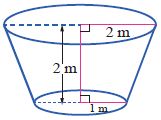
Find, by integration, the volume of the container which is in the shape of a right circular conical frustum.
26.
Find the volume of the solid formed by revolving the region bounded by the ellipse \(\frac { { x }^{ 2 } }{ { a }^{ 2 } } +\frac { { y }^{ 2 } }{ { b }^{ 2 } } =1\), a>b about the major axis.
27.
The probability density function random variable X is given by \(f(x)=\begin{cases} \begin{matrix} { 16xe }^{ -4x } & for\quad x>0 \end{matrix} \\ \begin{matrix} 0 & for\quad x\le 0 \end{matrix} \end{cases}\) find the mean and variance of X.
28.
Evaluate \(\int _{ 0 }^{ 2a }{ { x }^{ 2 }\sqrt { 2ax-{ x }^{ 2 } } } dx\)
29.
If U(x, y, z) = \(\frac { { x }^{ 2 }+{ y }^{ 2 } }{ xy } +3{ z }^{ 2 }y\), find \(\frac { \partial U }{ \partial x } ;\frac { \partial U }{ \partial y } \) and \(\frac { \partial U }{ \partial z } \)
30.
The probability density function of X is given
\(f(x)=\begin{cases} \begin{matrix} { Ke }^{ \frac { -x }{ 3 } } & \begin{matrix} for & x>0 \end{matrix} \end{matrix} \\ \begin{matrix} 0 & \begin{matrix} for & x\le 0 \end{matrix} \end{matrix} \end{cases}\)
Find
(i) the value of k
(ii) the distribution function.
(iii) P(X <3)
(iv) P(5 ≤X)
(v) P(X ≤ 4)
31.
A pot of boiling water at 100o C is removed from a stove at time t = 0 and left to cool in the kitchen. After 5 minutes, the water temperature has decreased to 80o C , and another 5 minutes later it has dropped to 65oC. Determine the temperature of the kitchen.
32.
The equation of electromotive force for an electric circuit containing resistance and self inductance is E = Ri + L\(\frac{di}{dt},\) Where E is the electromotive force is given to the circuit, R the resistance and L, the coefficient of induction. Find the current i at time t when E = 0.
33.
Solve the Linear differential equation \((1+x+{ xy }^{ 2 })\frac { dy }{ dx } +(y+{ y }^{ 3 })=0\)
34.
Prove that among all the rectangles of the given perimeter, the square has the maximum area.
35.
A particle moves along a horizontal line such that its position at any time t ≥ 0 is given by s(t) = t3 − 6t2 +9 t +1, where s is measured in metres and t in seconds?
(1) At what time the particle is at rest?
(2) At what time the particle changes its direction?
(3) Find the total distance travelled by the particle in the first 2 seconds.
1.
Given p : Jupiter is a planet and
q : India is an island.
(i) ¬p : Jupiter is not a planet.
(ii) p ∧ ¬q : Jupiter is a planet and India is not an island.
(iii) ¬p ∨ q : Jupiter is not a planet or India is an island.
(iv) p➝ ¬q : If Jupiter is a planet then India is not an island.
(v) p↔q : Jupiter is a planet if and only if India is an island.
2.
3.
\( \because \int _{ 0 }^{ \infty }{ { x }^{ n }{ e }^{ -ax }dx}=\frac { n! }{ { a }^{ n+1 } } \)
\(n=5,\quad a=3 \)
\(=\frac { 5! }{ { 3 }^{ 6 } } \)
4.
Given n = 6, \(p=\frac { 1 }{ 3 }\), k = 3
\(P(X=k)=\left( \begin{matrix} n \\ k \end{matrix} \right) { p }^{ k }\left( 1-p \right) ^{ n-k },\)
n = 0,1,2, ... n
\(\therefore P(X=k)=\left( \begin{matrix} n \\ k \end{matrix} \right) { p }^{ k }(1-p)^{ n-k }\)
n = 0,1,2, ... n
\(P(X=3)=\left( \begin{matrix} 6 \\ 3 \end{matrix} \right) \left( \cfrac { 1 }{ 3 } \right) ^{ 3 }\left( 1-p \right) ^{ 6-3 }\)
= \(\left( \begin{matrix} 6 \\ 3 \end{matrix} \right) \left( \cfrac { 1 }{ 3 } \right) ^{ 3 }\left( \cfrac { 2 }{ 3 } \right) ^{ 2 }\)
\(=\frac{6 \times 5 \times 4}{8 \times 2 \times 1} \times \frac{1}{27} \times \frac{8}{27}\)
\(P(X=3)=\frac { 160 }{ 729 }\)
5.
\(f(x)=\begin{cases} \begin{matrix} \frac { 1 }{ 2 } e^{ -\frac { x }{ 2 } } & for\quad x>0 \end{matrix} \\ \begin{matrix} 0 & otherwise \end{matrix} \end{cases}\)
\(\int _{ 0 }^{ \infty }{ x.f(x)dx } =\frac { 1 }{ 2 } \int _{ 0 }^{ \infty }{ x.{ e }^{ \frac { -x }{ 2 } } } dx\)
\(\left[ \int _{ 0 }^{ \infty }{ { e }^{ -ax }.{ x }^{ n }dx=\cfrac { n! }{ { a }^{ n+1 } } } \right] \)
= \(\frac { 1 }{ 2 } \times \frac { 1! }{ \left( \frac { 1 }{ 2 } \right) ^{ 2 } } =\frac { 1 }{ 2 } \times \frac { 1 }{ \frac { 1 }{ 4 } } \)
= \(\frac { 1 }{ 2 } \times \frac { 4 }{ 1 } =2\)
\(E({ X }^{ 2 })=\int _{ 0 }^{ \infty }{ { x }^{ 2 }.f(x) } dx\)
= \(\int _{ 0 }^{ \infty }{ { x }^{ 2 }.\frac { 1 }{ 2 } { e }^{ -\frac { x }{ 2 } } } dx\)
= \(\frac { 1 }{ 2 } \int { { x }^{ 2 }.{ e }^{ -\frac { x }{ 2 } }dx } \)
= \(\frac { 1 }{ 2 } \times \frac { 2! }{ \left( \frac { 1 }{ 3 } \right) ^{ 3 } } =\frac { 1 }{ 2 } \times \frac { 2 }{ \frac { 1 }{ 8 } } \)
= \(\frac { 1 }{ 2 } \times 2\times 8=8\)
ஃVar(X)=E(X2) - [E(x)]2
= 8-22
= 8 - 4 = 4
6.
\(\begin{matrix} lim \\ (x,y)\rightarrow (0,0) \end{matrix}=\left| \frac { { y }^{ 2 }-xy }{ \sqrt { x } -\sqrt { y } } -0 \right| \)
= \(\left| \frac { { y }^{ 2 }-xy }{ \sqrt { x } -\sqrt { y } } \right| =\frac { \left| y \right| \left| y-x \right| }{ \left| \sqrt { x } -\sqrt { y } \right| } \)
= \(\frac { \left| y \right| \left| \sqrt { x } +\sqrt { y } \right| |\sqrt { y } -\sqrt { x } | }{ \left| -\sqrt { y } -\sqrt { x } \right| } \)
\(=\frac{|y||\sqrt{x}+\sqrt{y}| \sqrt{y}-\sqrt{\not x} \mid}{|\sqrt{y}-\sqrt{\not x}|}\)
= \(|y||\sqrt { x } +\sqrt { y } |\)
\(\therefore \begin{matrix} lim \\ (x,y)\rightarrow (0,0) \end{matrix}=\begin{matrix} lim \\ (x,y)\rightarrow (0,0) \end{matrix}|y||\sqrt { x } +\sqrt { y } |=0\)
7.
If we directly substitute x = 0 we get an indeterminate form \(\frac{0}{0}\) and hence we apply the l’Hôpital’s rule to evaluate the limit as,
\(\underset{x\rightarrow 0^{+}}{lim}(\frac{sin \ x}{x^{2}})=\underset{x\rightarrow 0^{+}}{lim}(\frac{cos \ x}{2x})=\infty\)
\(\underset{x\rightarrow 0^{-}}{lim}(\frac{sin \ x}{x^{2}})=\underset{x\rightarrow 0^{-}}{lim}(\frac{cos \ x}{2x})=\infty\)
As the left limit and the right limit are not the same we conclude that the limit does not exist.
Remark
One may be tempted to use the l’Hôpital’s rule once again in \(\underset{x\rightarrow 0^{+}}{lim} (\frac{cos \ x}{2x})\) to conclude
\(\underset{x\rightarrow 0^{+}}{lim} (\frac{cos \ x}{2x})\)\(\underset{x\rightarrow 0^{+}}{lim} (\frac{-sin \ x}{2})\)=0
which is not true because it was not an indeterminate form.
8.
Given \(f(x)=|\frac{1}{x}|, x\in [-1,1]\)
Rolle's theorem is not applicable since \(f(x)=(\frac{1}{x})\) is not continuous at x = 0 in [-1, 1] and not differentiable in (-1, 1)
9.
Given = emx is the solution of
y' + 2y = 0 ...(1)
y = emx ...... (2)
\(\frac{dy}{dx} = e^{mx}. m\)
\(\frac{dy}{dx} = ym\)
\(\frac{dy}{dx} - my=0\)
⇒ y' - my = 0 ...(3)
Comparing equation (1) & (3),
we get m = -2
10.
\(y\left( \frac { dy }{ dx } \right) =\frac { x }{ \left( \frac { dy }{ dx } \right) +{ \left( \frac { dy }{ dx } \right) }^{ 3 } } \)
is the given differential equation.
\(\Rightarrow y{ \left( \frac { dy }{ dx } \right) }^{ 2 }+{ \left( \frac { dy }{ dx } \right) }^{ 4 }=x\)
The highest derivative is 1 and its maximum power is 4.
∴ Order 1, degree 4.
11.
| p | q | q ➝ p | ~p | ~q | ~q ➝ ~p |
| T | T | T | F | F | T |
| T | F | T | F | T | T |
| F | T | F | T | F | F |
| F | F | T | T | T | T |
The entries in the columns corresponding q ➝ p and ~p ➝ ~q are identical and hence they are equivalent.
q ➝ p ≡ ~p ➝ ~q
Hence proved
12.
(i) Since f (x) is a probability density function, f (x) ≥ 0 and \(\int _{ - }^{ \infty }{ f(x) } dx=1\)
That is \(\int _{ -\infty }^{ 0 }{ 0dx } +\int _{ 0 }^{ \infty }{ k{ e }^{ -2x }dx } =1\)
\(0+k\left( \frac { { e }^{ -2x } }{ -2 } \right) =1\Rightarrow k\left( \frac { { e }^{ -\infty }-{ e }^{ 0 } }{ -2 } \right) =1\Rightarrow k=2\)
Therefore the probability density function is
\(f\left( x \right) =\begin{cases} \begin{matrix} 2{ e }^{ -2x } & forx>0 \end{matrix} \\ \begin{matrix} 0 & forx \end{matrix}\le 0 \end{cases}\)
(ii) Distribution function
By definition the distribution function \(F(x)=P\left( x\le x \right) =\int _{ -\infty }^{ x }{ f(u) } du\)
When x≤0 \(F(x)=\int _{ -\infty }^{ x }{ F(u) } du=\int _{ -\infty }^{ x }{ odu=0 } \)
When x > 0 \(F(x)=\int _{ -\infty }^{ x }{ f(u) } du\int _{ -\infty }^{ x }{ 0du } +\int _{ 0 }^{ x }{ { 2e }^{ -2x }du\left( \frac { { e }^{ -2x } }{ -2 } \right) } =1-{ e }^{ 2x }\)
This gives \(F(x)=\begin{cases} \begin{matrix} 0 & forx\le 0 \end{matrix} \\ \begin{matrix} 1-{ e }^{ 2x } & forx>0 \end{matrix} \end{cases}\)
(iii) P(X < ) = P(X ≤2 ) = F(2 ) = 1-e2\(\times\)2 (since F(x) is continuous)
(iv) The probability that X is at least equal to four unit of time is
P(X ≥ 4 ) = 1 - P(X < 4 ) = 1- F( 4) = 1 - ( 1-e-2\(\times\)4) = e8
(v) In the continuous case, f (x) at x = a is not the probability that X takes the value a, that is f (x) at x = a is not equal to P( X ) a. If X is continuous type, P(X = a) = 0 for a ∈ R. Therefore P(x = 3) = 0.
13.
Given (x, y, z) = log (x3 + y3 + z3)
\(\frac { \partial U }{ \partial x } =\frac { 1 }{ { x }^{ 3 }+{ y }^{ 3 }+{ z }^{ 3 } } { (3x }^{ 2 });\)
\(\frac { \partial U }{ \partial y } =\frac { { 3y }^{ 2 } }{ { x }^{ 3 }+{ y }^{ 3 }+{ z }^{ 3 } } \) and
\(\frac { \partial U }{ \partial z } =\frac { { 3z }^{ 2 } }{ { x }^{ 3 }+{ y }^{ 3 }+{ z }^{ 3 } } \)
\(\therefore \frac { \partial U }{ \partial x } +\frac { \partial U }{ \partial y } +\frac { \partial U }{ \partial z } =\frac { { 3x }^{ 2 } }{ { x }^{ 3 }+{ y }^{ 3 }+{ z }^{ 3 } } +\frac { { 3y }^{ 2 } }{ { x }^{ 3 }+{ y }^{ 3 }+{ z }^{ 3 } } +\frac { { 3z }^{ 2 } }{ { x }^{ 3 }+{ y }^{ 3 }+{ z }^{ 3 } } \)
\(=\frac { { 3({ x }^{ 2 }+y }^{ 2 }+{ z }^{ 2 }) }{ { x }^{ 3 }+{ y }^{ 3 }+{ z }^{ 3 } } \)
14.
\(\int _{ b }^{ \infty }{ \frac { 1 }{ { a }^{ 2 }+{ x }^{ 2 } } dx } ={ \left[ \frac { 1 }{ a } { tan }^{ -1 }\frac { x }{ a } \right] }_{ b }^{ \infty }=\frac { 1 }{ a } { tan }^{ -1 }\infty -\frac { 1 }{ a } { tan }^{ -1 }\frac { b }{ a } =\frac { 1 }{ a } \left[ \frac { \pi }{ 2 } -{ tan }^{ -1 }\frac { b }{ a } \right] \)
15.
Let us put I = \(\int ^{3}_{2} \frac{\sqrt {x}}{\sqrt {5-x}+\sqrt {x}}\) dx --- (1)
Applying the formula \(\int ^{a}_{b}\) f(x) dx =\(\int ^{a}_{b}\) f(a+b -x) dx, we get
I = \(\int ^{3}_{2} \frac{\sqrt {(2+3-x)}}{\sqrt {5-(2+3-x)}+\sqrt { {(2+3-x)}}}\) dx = \(\int ^{3}_{2} \frac{\sqrt {(5-x)}}{\sqrt {x}+\sqrt { {(5-x}}}\) dx -- (2)
Adding (1) and (2), we get
2I = \(\int ^{3}_{2} \frac{\sqrt {x} + \sqrt {5-x} }{\sqrt {x}+\sqrt { {5-x}}}\) dx =\(\int ^{3}_{2} \) dx = \([x]^{3}_{2}\) = 3 - 2 = 1
Hence, we get I = \(\frac{1}{2}\)
16.
Given \(f(x)=\begin{cases} \begin{matrix} kxe^{ -2x } & forx>0 \end{matrix} \\ \begin{matrix} 0 & for\quad x\le 0 \end{matrix} \end{cases}\)
Since the given function is a probability density function
\(\int _{ -\infty }^{ \infty }{ f(x)dx } \) = 1
\(\Rightarrow k\int _{ 0 }^{ \infty }{ { xe }^{ -2x }dx=1 } \)
\(\Rightarrow k \frac { 1! }{ \left( 2 \right) ^{ 2 } } =1\)
[\(\int _{ 0 }^{ \infty }{ { x }^{ n }e^{ -ax } } =\frac { n! }{ { a }^{ +1 } } \), Here a = 2, n = 1]
\(\Rightarrow \frac { k }{ 4 } =1\\ \Rightarrow k=4\)
17.
Let f(x) = \(f(x)={ x }^{ \frac { 2 }{ 3 } },{ x }_{ 0 }=125,\triangle x=-2\)
∴ (123)\(\frac23\) = f(125) +1'(125) (-2) ... (1)
\(f(125)={ (125) }^{ \frac { 2 }{ 3 } }={ { (5 }^{ 3 }) }^{ \frac { 2 }{ 3 } }\) = 52 = 25
\({ f }^{ ' }(x)={ \frac { 2 }{ 3 } x }^{ \frac { 2 }{ 3 } -1 }={ \frac { 2 }{ 3 } x }^{ \frac { 1 }{ 3 } }=\frac { 2 }{ { 3x }^{ \frac { 1 }{ 3 } } } \)
\({ f }^{ ' }(125)=\frac { 2 }{ { 3(125)x }^{ \frac { 1 }{ 3 } } } =\frac { 2 }{ { 3{ (5 }^{ 3 } })^{ \frac { 1 }{ 3 } } } =\frac { 2 }{ 3(5) } =\frac { 2 }{ 15 } \)
∴ \({ (123) }^{ \frac { 2 }{ 3 } }=25+\frac { 2 }{ 15 } (-2)\)
\(=25-\frac { 4 }{ 15 } =25-0.27\)
\({ (123) }^{ \frac { 2 }{ 3 } }=24.73\)
18.
This is an indeterminate of the form \((\frac{\infty}{\infty})\)
To evaluate this limit, we apply l’Hôpital Rule m times
\(\underset{x\rightarrow \infty}{lim}\frac{e^{x}}{x^{m}}=\underset{x\rightarrow \infty}{lim}\frac{e^{x}}{m!} = \infty\)
19.
The given equation can be written as \(\frac { dx }{ dy } =\frac { \left( \frac { x }{ y } -1 \right) { 2e }^{ x/y } }{ 1+2{ e }^{ x/y } } =g\left( \frac { x }{ y } \right) ..(1)\)
The appearance of \(\frac{x}{y}\) in equation (1), suggests that the appropriate substitution is x = vy.
Put x = vy . Then, we have \(y\frac { dv }{ dy } =-\frac { 2{ e }^{ v }+v }{ 1+2{ e }^{ v } } \)
By separating the variables, we have \(-\frac { 1+2{ e }^{ v } }{ v+2{ e }^{ v } } dv=-\frac { dy }{ y } \)
On integration, we obtain
log |2ev + v| = −log |y| + log |C| or log |2yev+vy| = log |C| or 2yev+ vy = ±C.
Replace v by \(\frac{x}{y}\) to get, 2yex/y+x = k, where k =土C, Which gives the required solution.
20.
Separating the variables we get,
\(\frac { dy }{ \sqrt { 1-{ y }^{ 2 } } } \frac { dx }{ \sqrt { 1-{ x }^{ 2 } } } \)
Taking Integration on both sides, we get
\(\int \frac{d y}{\sqrt{1-y^{2}}}=\int \frac{d x}{\sqrt{1-x^{2}}}\)
sin-1y = sin-1 x + c
21.
Distance moved in time 't' is s = \(\frac{t^{3}}{3}-t^{2}+3\)
Velocity at time 't ' is V = \(\frac{ds}{dt}=t^{2}-2t\)
Acceleration at time 't ' is a(t) = \(\frac{dV}{dt}=2t-2\)
Therefore, the velocity is zero when t2 − 2t = 0, that is t = 0, 2. The acceleration is zero when 2t − 2 = 0 . That is at time at time t = 1
22.
Prove that p⟶(q⟶r) = (p ∧ q)⟶r without using truth table. From example we know that p⟶ q = ~p V q
Consider LHS = p⟶(q⟶r)
= p ⟶ (~q V r) [Implication Law]
= ~p V (~q V r) [Implication Law]
= (~p V ~q) V r [associative property]
= ~(p ∧ q) V r [using Demorgan's law]
= (p ∧ q) ⟶ r [Implication Law]
Hence proved.
23.
(i) The output m+ n - mn is clearly an integer and hence∗ is a binary operation on Z.
(ii) m*n = m+ n − mn = n + m − nm = n*m, ∀m,n∈Z. So ∗ has commutative property.
(iii) Consider (m*n)*p = (m+ n −m n)* p= (m+ n −mn) + p − (m+ n −m n) p
= m+ n + p −mn −m p − n p + m n p ... (1)
Similarly m*(n*p) = m*(n + p − n p) = m+ (n + p − n p) −m (n + p − n p)
= m+ n + p − n p −m n −mp + m n p ... (2)
From (1) and (2), we see that m*(n*p) = (m*n)*p. Hence * has associative property.
(iv) An integer e is to be found such that
m*e = e*m = m, ∀m∈Z ⇒ m + e - m e = m
⇒e(1-m) = 0 ⇒ e = 0 or m = 1. But m is an arbitrary integer and hence need not be equal to 1. So the only possibility is e = 0. Also m*0 = 0*m = m, ∀m∈Z. Hence 0 is the identity element and hence the existence of identity is assured.
(v) An element m'∈ Z is to be found such that m*m' = m' * m = e = 0, ∀m∈Z.
m*m' = 0 ⇒ m+m'-m m'= 0⇒ m m' = 0 ⇒ \(\frac{m}{m-1}\). when m = 1, m' is not defined.
When m = 2, m' is an integer. But except m = 2, m′ need not be an integer for all values of m. Hence inverse does not exist in Z.
24.
Given w(x, y, z) = \(\left( \frac { { 5x }^{ 3 }{ y }^{ 4 }+7{ y }^{ 2 }{ xz }^{ 4 }-{ 75y }^{ 3 }{ z }^{ 4 } }{ { x }^{ 2 }+{ y }^{ 2 } } \right) \)
Let (x, y, z) = \(\frac { { 5x }^{ 3 }{ y }^{ 4 }+7{ y }^{ 2 }{ xz }^{ 4 }-{ 75y }^{ 3 }{ z }^{ 4 } }{ { x }^{ 2 }+{ y }^{ 2 } } \)
⇒ w = log f ...(1)
⇒ ew = f
f(λx, λy, λz) = \(\frac { { 5\lambda }^{ 3 }{ x }^{ 3 }{ \lambda }^{ 4 }{ y }^{ 4 }+7{ \lambda }^{ 2 }{ y }^{ 2 }\lambda x{ \lambda }^{ 4 }{ z }^{ 4 }-75{ \lambda }^{ 3 }{ y }^{ 3 }{ \lambda }^{ 4 }{ z }^{ 4 }{ }^{ } }{ { \lambda }^{ 2 }{ x }^{ 2 }+{ \lambda }^{ 2 }{ y }^{ 2 } } \)
= \(\frac { { \lambda }^{ 7 }(5{ x }^{ 3 }{ y }^{ 4 }+7{ y }^{ 2 }{ xz }^{ 4 }-{ 75 }y^{ 3 }{ z }^{ 4 } }{ { \lambda }^{ 2 }({ x }^{ 2 }+{ y }^{ 2 }) } ={ \lambda }^{ 5 }f(x,y,z)\)
∴ f(x, y, z) is a homogeneous function of degree 5.
∴ By Euler's theorem,
\(x.\frac { \partial f }{ \partial x } +y\frac { \partial f }{ \partial y } +z\frac { \partial f }{ \partial z } =5.f\)
⇒ \(x.\frac { \partial }{ \partial x } ({ e }^{ w })+y.\frac { \partial }{ \partial y } ({ e }^{ w })+z.\frac { \partial }{ \partial z } ({ e }^{ w })=5.{ e }^{ w }\) [using (1)]
⇒ \(x.{ e }^{ w }\frac { \partial w }{ \partial x } +y.{ e }^{ w }\frac { \partial w }{ \partial y } +z.{ e }^{ w }\frac { \partial w }{ \partial z } ({ e }^{ w })=5{ e }^{ w }\)
⇒ \(x\frac { \partial w }{ \partial x } +y\frac { \partial w }{ \partial y } +z\frac { \partial w }{ \partial z } \) [Divided by ew]
25.
Volume of the right circular conical frustum is obtained by revolving the line y = x between x = a and x = b around the x - axis
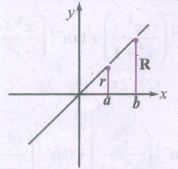
\(\therefore\) Height of the frustum h = b - a
\(\therefore\)Volume \(=\pi \int _{ a }^{ b }{ { x }^{ 2 }dx } =\pi { \left[ \frac { { x }^{ 3 } }{ 3 } \right] }_{ a }^{ b }\)
\(=\frac { \pi }{ 3 } [{ b }^{ 3 }-{ a }^{ 3 }]\)
\(=\frac { \pi }{ 3 } (b-a)({ b }^{ 2 }+ab+{ a }^{ 2 })\)
Now, substitute h = b - a, r = a and R = b we get Volume of the conical frustum
\(\frac { \pi }{ 3 } [h({ R }^{ 2 }+rR+{ r }^{ 2 })]\)
Given h = 2 m, r = 1 m, R = 2 m we get
Required volume \(=\frac { \pi }{ 3 } [2(4+2+1)]\)
\(=\frac { \pi }{ 3 } (14)\)
\(=\frac { 14\pi }{ 3 } \)
26.
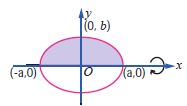
The ellipse is symmetric about both the axes. The major axis lies along x-axis. The region to be revolved is sketched
Hence, the required volume is given by
\(V=\pi \int _{ -a }^{ a }{ { y }^{ 2 }dx } =\pi \int _{ -a }^{ a }{ \frac { { b }^{ 2 } }{ { a }^{ 2 } } \left( { a }^{ 2 }-{ x }^{ 2 } \right) dx } \)
\(=\frac { 2\pi { b }^{ 2 } }{ { a }^{ 2 } } \int _{ 0 }^{ a }{ ({ a }^{ 2 }-{ x }^{ 2 })dx } \) since the integrand is an even function
\(=\frac { { 2\pi b }^{ 2 } }{ { a }^{ 2 } } { \left( { a }^{ 2 }x-\frac { { x }^{ 3 } }{ 3 } \right) }_{ 0 }^{ a }=\frac { 2\pi { b }^{ 2 } }{ 3 } ={ \left( { a }^{ 2 }-\frac { { a }^{ 3 } }{ 3 } \right) }_{ 0 }^{ a }=\frac { 2\pi { b }^{ 2 } }{ 3 } \left( \frac { { 2a }^{ 3 } }{ 3 } \right) =\frac { 4\pi { ab }^{ 2 } }{ 3 } \)
27.
Given \(f(x)=\begin{cases} \begin{matrix} 16{ xe }^{ -4x } & foex>0 \end{matrix} \\ \begin{matrix} 0 & forx\le 0 \end{matrix} \end{cases}\)
Mean :
= \(E(x)=\int _{ 0 }^{ \infty }{ x.f(x)dx } \)
= \(\int _{ 0 }^{ \infty }{ x.16.xe^{ -4x }dx } \)
= \(16\int _{ 0 }^{ \infty }{ { x }^{ 2 } } .{ e }^{ -4x }dx=16\times \frac { 2! }{ { 4 }^{ 3 } } \) \(\left[ \because \int _{ 0 }^{ \infty }{ { x }^{ n }{ e }^{ -ax }dx=\frac { n! }{ { a }^{ n+1 } } } \right] \)
= \(16\times \frac { 2 }{ 64 } \)
\(=\frac { 1 }{ 2 } \)
Variance :
\(E({ x }^{ 2 })=\int _{ 0 }^{ \infty }{ { x }^{ 2 }.f(x)dx } \)
= \(\int _{ 0 }^{ \infty }{ { x }^{ 2 }.{ e }^{ -4x } } dx\)
= \(16\int _{ 0 }^{ \infty }{ { x }^{ 3 }{ e }^{ -4x }dx } \)
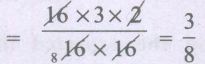
ஃ Var(X) = E(X2) - [E(x)]2
\(
=\frac{3}{8}-\frac{1}{4}
\)
\(=\frac{1}{8}
\)
∴ Var(X) \(=\frac{1}{8}
\)
28.
Put x = 2a cos2\(\theta\).
Then, dx = -4a cos \(\theta\) sin \(\theta\)d\(\theta\)
when x = 0, 2a cos2\(\theta\) = 0 and so \(\theta\) = \(\frac{\pi}{2}\)
When x = 2a, 2a cos2\(\theta\) = 2a and so \(\theta\) = 0
Hence, we get
\(I=\int _{ 0 }^{ 2a }{ { x }^{ 2 }\sqrt { 2ax-{ x }^{ 2 } } dx } \)
\(\int _{ \frac { \pi }{ 2 } }^{ 0 }{ { 4a }^{ 2 }{ cos }^{ 2 }\theta \sqrt { { 4a }^{ 2 }{ cos }^{ 2 }\theta -4{ a }^{ 2 }{ cos }^{ 4 }\theta } } (-4a\ cos\theta sin\ \theta )d\theta \)
\(=\int _{ 0 }^{ \frac { \pi }{ 2 } }{ { 4a }^{ 2 }{ cos }^{ 2 }\theta\ 2a\ cos\ \theta sin\ \theta (4a\ cos\ \theta sin\theta )d\theta } \)
\(=32{ a }^{ 4 }\int _{ 0 }^{ \frac { \pi }{ 2 } }{ { cos }^{ 4 }\theta { sin }^{ 2 }\theta d\theta } \)
\(=32{ a }^{ 4 }\times \frac { 1 }{ 6 } \times \frac { 3 }{ 4 } \times \frac { 1 }{ 2 } \times \frac { \pi }{ 2 } =\pi { a }^{ 4 }\)
29.
Given U(x, y, z) = \(\frac { { x }^{ 2 }+{ y }^{ 2 } }{ xy } +3{ z }^{ 2 }y\)
\(\frac { \partial U }{ \partial x } =\frac { xy(2x)-({ x }^{ 2 }+{ y }^{ 2 })(y) }{ { x }^{ 2 }{ y }^{ 2 } } +0\)
\(=\frac { 2{ x }^{ 2 }y-{ x }^{ 2 }y-{ y }^{ 3 } }{ { x }^{ 2 }{ y }^{ 2 } } =\frac { { x }^{ 2 }y-{ y }^{ 3 } }{ { x }^{ 2 }{ y }^{ 2 } } \)
\(=\frac { y({ x }^{ 2 }-{ y }^{ 2 }) }{ { x }^{ 2 }{ y }^{ 2 } } =\frac { { x }^{ 2 }-{ y }^{ 2 } }{ { x }^{ 2 }y } \)
\(\frac { \partial U }{ \partial y } =\frac { xy(2y)-({ x }^{ 2 }+{ y }^{ 2 })(x) }{ { x }^{ 2 }{ y }^{ 2 } } +3{ z }^{ 2 }\)
= \(\frac { { 2xy }^{ 2 }-{ x }^{ 3 }-{ xy }^{ 2 } }{ { x }^{ 2 }{ y }^{ 2 } } +3{ z }^{ 2 }\)
\(=\frac { { xy }^{ 2 }-{ x }^{ 3} }{ { x }^{ 2 }{ y }^{ 2 } } +3{ z }^{ 2 }\)
\(=\frac { { y }^{ 2 }-{ x }^{ 2 } }{ x{ y }^{ 2 } } +3{ z }^{ 2 }\)
\(\frac { \partial U }{ \partial z } =0+3y(2z)=6yz\)
30.
Given
\(f(x)=\begin{cases} \begin{matrix} { Ke }^{ \frac { -x }{ 3 } } & \begin{matrix} for & x>0 \end{matrix} \end{matrix} \\ \begin{matrix} 0 & \begin{matrix} for & x\le 0 \end{matrix} \end{matrix} \end{cases}\)
(i) Since f(x) is a probability density function
\(\int _{ -\infty }^{ \infty }{ f(x) } dx=1\)
\(\Rightarrow \int _{ 0 }^{ \infty }{ K.{ e }^{ \frac { -x }{ 3 } } } dx=1\Rightarrow k\frac { \left[ { e }^{ \frac { -x }{ 3 } } \right] ^{ \infty } }{ -\frac { 1 }{ 3 } } \)
\(\Rightarrow -3k\left[ { e }^{ -\infty }-{ e }^{ 0 } \right] =1\) [∵ e∞ = 0, e0 = 1]
\(\Rightarrow 3k=1\Rightarrow k=\frac { 1 }{ 3 } \)
\(\therefore k=\cfrac { 1 }{ 3 } \)
(ii) The distribution function F(x) = \(\int _{ -\infty }^{ x }{ f(u)du } \)
Case 1: x < 0,
\(F(x)=\int _{ -\infty }^{ x }{ f(x)dx=0 } \)
Case 2: x > 0,
\(f(x)=\int _{ -\infty }^{ x }{ f(x)dx } \)
= \(\int _{ -\infty }^{ 0 }{ f(x)dx+\int _{ 0 }^{ x }{ f(x) } dx } \)
= \(0+k\int _{ 0 }^{ x }{ { e }^{ \frac { -x }{ 3 } } } dx\)
= \(\frac { 1 }{ 3 } \left[ \cfrac { { e }^{ \frac { -x }{ 3 } } }{ -\frac { 1 }{ 3 } } \right] =-\left[ { e }^{ -\frac { x }{ 3 } }-{ e }^{ o } \right] \)
= \(-[{ e }^{ -\frac { x }{ 3 } }-1]\)
= \(1-{ e }^{ -\frac { x }{ 3 } }\)
\(\therefore F(x)=\begin{cases} \begin{matrix} 0 & x\le 0 \end{matrix} \\ \begin{matrix} 1-{ e }^{ \frac { -x }{ 3 } } & x>0 \end{matrix} \end{cases}\)
(iii) p(X < 3)
= \(\int _{ 0 }^{ 3 }{ ke^{ -\frac { x }{ 3 } } } dx=\cfrac { 1 }{ 3 } \int _{ 0 }^{ 3 }{ { e }^{ -\frac { x }{ 3 } }dx } \)
= \(\cfrac { 1 }{ 3 } \left[ \frac { { e }^{ -\frac { x }{ 3 } } }{ \frac { -1 }{ 3 } } \right] \)
= -[e-1-e0] = -[e-1-1]
(iv) \(p(5\le X)=p(X\ge 5)=\int _{ 5 }^{ \infty }{ f(x)dx } \)
= \(\int _{ 5 }^{ \infty }{ ke^{ -\frac { x }{ 3 } } } dx=\cfrac { 1 }{ 3 } \cfrac { \left[ { e }^{ -\frac { x }{ 3 } } \right] _{ 5 }^{ \infty } }{ \frac { -1 }{ 3 } } \)
= \(-\left[ { e }^{ -\infty }-e^{ \frac { -3 }{ 5 } } \right] =\left[ 0-{ e }^{ \frac { -5 }{ 3 } } \right] \)
= \({ e }^{ \frac { -5 }{ 3 } }\)
(v) \(p(X\le 4)=\int _{ -\infty }^{ 4 }{ f(x)dx } \)
= \(\int _{ -\infty }^{ 0 }{ f(x)dx+\int _{ 0 }^{ 4 }{ f(x)dx } } \)
= \(0+\int _{ 0 }^{ 4 }{ { ke }^{ -\frac { x }{ 3 } }dx } =k\left[ \frac { { e }^{ -\frac { x }{ 3 } } }{ -\frac { 1 }{ 3 } } \right] _{ 0 }^{ 4 }\)
= \(\cfrac { 1 }{ 3 } \cfrac { \left[ { e }^{ -\frac { x }{ 3 } } \right] _{ 0 }^{ 4 } }{ -\frac { 1 }{ 3 } } =-\left[ { e }^{ \frac { -4 }{ 3 } }-{ e }^{ o } \right] \)
= \(-\left[ { e }^{ \frac { -4 }{ 3 } }-1 \right] =1-{ e }^{ \frac { -4 }{ 3 } }\)
31.
Let T represent the temperature of the boiling water and Tm represents the temperature of the kitchen.
By Newton's law of cooling
\(\Rightarrow \int { \frac { dT }{ T-{ T }_{ m } } =K\int { dt } } \)
\(\Rightarrow log(T-{ T }_{ m })=Kt+logC\)
\(\Rightarrow log(T-{ T }_{ m })-logC=Kt\)
\(\Rightarrow log\left( \frac { T-{ T }_{ m } }{ C } \right) =Kt\)
\(\Rightarrow T-{ T }_{ m }={ Ce }^{ Kt } ...(1)\)
when t=0,T=100
\(\therefore 100-{ T }_{ m }={ Ce }^{ 0 }\)
\(\Rightarrow C=100-{ T }_{ m }\)
\(\Rightarrow becomes,\ T-{ T }_{ m }=(100-{ T }_{ m }){ e }^{ Kt }\)
Also when t = 5, T = 80
\(\therefore 80-{ T }_{ m }=(100-{ T }_{ m }){ e }^{ 5K }\)
\(\Rightarrow { e }^{ 5K }=\frac { 80-{ T }_{ m } }{ 100-{ T }_{ m } } ..(2)\)
When t = 10, T = 65
(2) \(\Rightarrow\) 65 - T = (100-Tm)e10K
= (100-Tm)(e5K)2
\(=(100-{ T }_{ m }){ \left( \frac { 80-{ T }_{ m } }{ 100-{ T }_{ m } } \right) }^{ 2 }\)
[using(2)]
\(\Rightarrow 65-{ T }_{ m }=\frac { { (80-{ T }_{ m } })^{ 2 } }{ 100-{ T }_{ m } } \)
\(\Rightarrow\) 6500-65Tm-100Tm+Tm2 = 6400+Tm2-160Tm
\(\Rightarrow\) 6500-6400 = 165Tm-160Tm
\(\Rightarrow\) 100 = 5Tm
\(\\ \Rightarrow { T }_{ m }=\frac { 100 }{ 5 } ={ 20 }^{ o }C\)
Hence the temperature of the kitchen is 20oC
32.
Given E = Ri + L \(\frac{di}{dt}\)
\(\frac { E }{ L } =\frac { Ri }{ L } +\frac { di }{ dt } \)
\(\Rightarrow \frac { Ri }{ L } +\frac { di }{ dt } =\frac { E }{ L } \)
This is a linear differential equation
\(Here\quad P=\frac { R }{ L } and\quad Q=\frac { E }{ L } \)
\(\therefore \int { pdt } =\int { \frac { R }{ L } dt } =\frac { R }{ L } t\)
\(\therefore I.F={ e }^{ \int { pdt } }={ e }^{ \frac { Rt }{ L } }\)
\(\therefore\) Solution is i\({ e }^{ \int { pdt } }=\int { Q{ e }^{ \int { pdt } }dt+C } \)
\(\Rightarrow i{ e }^{ \frac { Rt }{ L } }=\int { \frac { E }{ L } . } { e }^{ \frac { Rt }{ L } }dt+C\)
\(\therefore i{ e }^{ \frac { Rt }{ L } }=\frac { E }{ L } \frac { { e }^{ \frac { Rt }{ L } } }{ \frac { R }{ L } } dt+C\)
\(i=\frac { E }{ R } { e }^{ \frac { Rt }{ L } }+C\)
\(i=\frac { E }{ R } +c{ e }^{ -\frac { Rt }{ L } }\)
When E = 0,
\(i=0+c{ e }^{ -\frac { Rt }{ L } }\)
\(\Rightarrow i=c{ e }^{ -\frac { Rt }{ L } }\)
33.
The given differential cquation may be written as
\(\left(1+x+x y^2\right) \frac{d y}{d x}+\left(y+y^3\right)=0 \)
\(\left(1+x+x y^2\right) \frac{d y}{d x}=-\left(y+y^3\right) \)
\(\left(1+x+x y^2\right)=-1\left(y^2+1\right) \frac{d x}{d y} \)
\(y\left(y^2+1\right) \frac{d x}{d y}+1+x\left(y^2+1\right)=0\)
Divided by \( y\left(y^2+1\right) ,\)
\(\frac{d x}{d y}+\frac{1}{y\left(y^2+1\right)}+\frac{x\left(y^2+1\right)}{y\left(y^2+1\right)} =0 \)
\(\frac{d x}{d y}+\frac{x}{y} =-\frac{1}{y\left(y^2+1\right)}\)
This is the form of \( \frac{d x}{d y}+\mathrm{Px}=\mathrm{Q} \) where \( \mathrm{P}=\frac{1}{y} and \mathrm{Q}=\frac{-1}{y\left(1+y^2\right)}\)
\(\text { I.F }=e^{\int P d y}=e^{\int \frac{1}{y} d y}=e^{\log y}=y\)
So, the solution of the equation is given by
\(x \times \mathrm{I} . \mathrm{F} =\int(Q \times I . F) d y+c \)
\(x \times \mathrm{y} =\int \frac{-1}{y\left(1+y^2\right)} \times y \times d y+c \)
\(x \mathrm{y} =\int \frac{-1}{1+y^2} d y+c=-\int \frac{1}{1+y^2} d y+c\)
xy = -tan-1y + c
xy + tan-1y = c
Which is the required solution.
34.
Let x and y be the length and breadth of the rectangle.
ஃ Perimeter P = 2x + 2y
\(\Rightarrow 2y=P-2x\Rightarrow y=\frac { P-2x }{ 2 } \)
Let \(f(x)=Area=xy=x\left( \frac { P-2x }{ 2 } \right) \)
\(f(x)=\frac { Px-{ 2x }^{ 2 } }{ 2 } \)
\(f'(x)=\frac { 1 }{ 2 } \left[ P-4x \right] \)
f'(x) = 0
\(\Rightarrow \frac { 1 }{ 2 } \left[ P-4x \right] =0\)
\(\Rightarrow P=4x\)
\(\Rightarrow x=\frac { P }{ 4 } \)
∴The critical number is \(\frac { P }{ 4 } \)
Now,\(f''\left( \frac { P }{ 4 } \right) =-2<0\)
ஃf(x) is maximum when \(x=\frac { P }{ 4 } \)
When \(x=\frac { P }{ 4 } \)
\(\Rightarrow y=\frac { P-2\left( \frac { P }{ 4 } \right) }{ 2 } =\frac { P-\frac { P }{ 2 } }{ 2 } =\frac { P }{ 4 } \)
\(\therefore x=y=\frac { P }{ 4 } \)
ஃThe rectangle is a square when the area is maximum for a given perimeter.
35.
Given that s(t) = t3 − 6t2 + 9t + 1. On differentiating, we get v(t) = 3t2 -12t + 9 and a(t) = 6t −12.
(i) The particle is at rest when v(t) = 0 . Therefore, v(t) = 3(t −1)(t − 3) = 0 gives t = 1 and t = 3.
(ii) The particle changes direction when v (t) changes its sign. Now.
if 0 ≤ t < 1 then both (t −1) and (t − 3) < 0 and hence, v(t) > 0.
If 1< t < 3 then (t −1) > 0 and (t − 3) < 0 and hence, v(t) < 0.
If t > 3 then both (t −1) and (t − 3) > 0 and hence, v(t) > 0.
Therefore, the particle changes direction when t = 1 and t = 3.
(iii) The total distance travelled by the particle from time t = 0 to t = 2 is given by,
|s(0) − s(1)| + |s(1) − s(2)| = |1− 5 | + | 5 − 3| = 6 metres.

12th Standard Syllabus & Materials
12th Standard
TN 12th Computer Applications களப்பெயர் முறைமை (DNS) Sample Question Papers Study Material - QB365 Set A
NEW12th Standard
TN 12th Computer Applications வலையமைப்பு எடுத்துக்காட்டுகள் மற்றும் நெறிமுறைகள் Sample Question Papers Study Material - QB365 Set A
NEW12th Standard
TN 12th Computer Applications கணினி வலையமைப்பு ஓர் அறிமுகம் Sample Question Papers Study Material - QB365 Set A
NEW12th Standard
TN 12th Computer Applications PHP-உடன் MySQL-ஐ இணைத்தல் Sample Question Papers Study Material - QB365 Set A



Tamilnadu Stateboard 12th Standard Subjects
Maths

Chemistry

Physics

Biology

Computer Science

Business Maths and Statistics

Economics

Commerce

Accountancy

History

Computer Applications
Biology
Computer Technology
Computer Applications
Computer Science
Business Maths and Statistics
Commerce
Economics
Maths
Chemistry
Physics
Computer Technology
History
Accountancy

Tamil

English

French
Tamilnadu Stateboard Standards


