
 100% FREE ACCESS
12th Standard Syllabus & Materials
12th Standard
TN 12th Computer Applications மின்னணு தரவு பரிமாற்றம் Sample Question Papers Study Material - QB365 Set A
NEW12th Standard
TN 12th Computer Applications மின் - வணிக பாதுகாப்பு அமைப்புகள் Sample Question Papers Study Material - QB365 Set A
NEW12th Standard
TN 12th Computer Applications மின்னணு செலுத்தல் முறைகள் Sample Question Papers Study Material - QB365 Set A
NEW12th Standard
TN 12th Computer Applications மின் - வணிகம் Sample Question Papers Study Material - QB365 Set A
NEW12th Standard
TN 12th Computer Applications திறந்த மூல கருத்துருக்கள் Sample Question Papers Study Material - QB365 Set A
NEW12th Standard
TN 12th Computer Applications வலையமைப்பு வடமிடல் Sample Question Papers Study Material - QB365 Set A

Published on: 28/11/2025
Download Tamil Nadu 12th Standard Maths question papers, model tests, one-mark questions, important questions, and public exam papers in PDF format. Free study materials and answer keys for TN State Board students.
Questions + Answers key
Take MCQ Maths Test
1.
Construct the truth table for the following statements.
(¬p ⟶ r) ∧ ( p ↔️ q)
2.
In a binomial distribution consisting of 5 independent trials, the probability of 1 and 2 successes are 0.4096 and 0.2048 respectively. Find the mean and variance of the random variables.
3.
A retailer purchases a certain kind of electronic device from a manufacturer. The manufacturer, indicates that the defective rate of the device is 5%. The inspector of the retailer randomly picks 10 items from a shipment. What is the probability that there will be
(i) at least one defective item
(ii) exactly two defective items.
4.
If μ and σ2 are the mean and variance of the discrete random variable X, and E(X + 3) =10 and E(X + 3)2 = 116, find μ and \(\sigma\)2
5.
A six sided die is marked '2' on one face, '3' on two ofits faces, and '4' on remaining three faces. The die is thrown twice. If X denotes the total score in two throws, find the values of the random variable and number of points in its inverse images.
6.
Show that p ➝ q and q ➝ p are not equivalent
7.
Let M = \(\left\{ \left( \begin{matrix} x & x \\ x & x \end{matrix} \right) :x\in R-\{ 0\} \right\} \) and let ∗ be the matrix multiplication. Determine whether M is closed under ∗ . If so, examine the existence of identity, existence of inverse properties for the operation ∗ on M.
8.
Let M = \(\left\{ \left( \begin{matrix} x & x \\ x & x \end{matrix} \right) :x\in R-\{ 0\} \right\} \) and let * be the matrix multiplication. Determine whether M is closed under ∗. If so, examine the commutative and associative properties satisfied by ∗ on M.
9.
Verify whether the following compound propositions are tautologies or contradictions or contingency
( p ⟶ q) ↔️ (~ p ⟶ q)
10.
Construct the truth table for \((p\overset { \_ \_ }{ \vee } q)\wedge (p\overset { \_ \_ }{ \vee } \neg q)\)
11.
A multiple choice examination has ten questions, each question has four distractors with exactly one correct answer. Suppose a student answers by guessing and if X denotes the number of correct answers, find
(i) binomial distribution
(ii) probability that the student will get seven correct answers
(iii) the probability of getting at least one correct answer
12.
Two balls are chosen randomly from an urn containing 8 white and 4 black balls. Suppose that we win Rs. 20 for each black ball selected and we lose Rs. 10 for each white ball selected. Find the expected winning amount and variance
13.
If X is the random variable with probability density function f(x) given by,
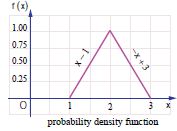
\(f(x)=\begin{cases} \begin{matrix} x-1 & 1\le x<2 \end{matrix} \\ \begin{matrix} -x+3 & 2\le x<3 \end{matrix} \\ \begin{matrix} 0 & Otherwise \end{matrix} \end{cases}\)
find
(i) the distribution function F(x)
(ii) P(1.5 ≤ X ≤ 2.5)
14.
A random variable X has the following probability mass function
| x | 1 | 2 | 3 | 4 | 5 | 6 |
| f(x) | k | 2k | 6k | 5k | 6k | 10k |
Find
(i) P(2 < X < 6)
(ii) P(2 ≤ X < 5)
(iii) P(X ≤4)
(iv) P(3 < X )
15.
The mean and standard deviation of a binomial variate X are respectively 6 and 2.
Find
(i) the probability mass function
(ii) P(X = 3)
(iii) P(X\(\ge \)2).
16.
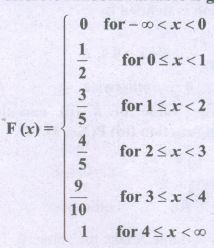
The cumulative distribution function of a discrete random variable is given by
Find
(i) the probability mass function
(ii) P(X < 3) and
(iii) P(X \(\ge \)2).
17.
Consider the binary operation ∗ defined on the set A = {a, b, c, d} by the following table:
| * | a | b | c | d |
| a | a | c | b | d |
| b | d | a | b | c |
| c | c | d | a | a |
| d | d | b | a | c |
Is it commutative and associative?
18.
Let p: Jupiter is a planet and q: India is an island be any two simple statements. Give verbal sentence describing each of the following statements.
(i) ¬p
(ii) p ∧ ¬q
(iii) ¬p ∨ q
(iv) p➝ ¬q
(v) p↔q
19.
How many rows are needed for following statement formulae?
(( p ∧ q) ∨ (¬r ∨¬s)) ∧ (¬ t ∧ v))
20.
Write the statements in words corresponding to ¬p, p ∧ q , p ∨ q and q ∨ ¬p, where p is ‘It is cold’ and q is ‘It is raining'.
21.
Using binomial distribution find the mean and variance of X for the following experiments
(i) A fair coin is tossed 100 times, and X denote the number of heads.
(ii) A fair die is tossed 240 times, and X denote the number of times that four appeared.
22.
For the random variable X with the given probability mass function as below, find the mean and variance.
\(f(x)=\begin{cases} \begin{matrix} \cfrac { 1 }{ 2 } e^{ -\frac { x }{ 2 } } & for\quad x>0 \end{matrix} \\ \begin{matrix} 0 & otherwise \end{matrix} \end{cases}\)
23.
For the random variable X with the given probability mass function as below, find the mean and variance
\(f(x)=\left\{\frac{4-x}{6} x=1,2,3\right.\)
1.
Truth Table for (~p ⟶ r) ∧ ( p ↔️ q)
| p | q | r | ~ p | ~ p ⟶ r | p ↔️ q | (~p ⟶ r) ∧ ( p ↔️ q) |
| T | T | T | F | T | T | T |
| T | T | F | F | T | T | T |
| T | F | T | F | T | F | F |
| T | F | F | F | T | F | F |
| F | T | T | T | T | F | F |
| F | T | F | T | F | F | F |
| F | F | T | T | T | T | T |
| F | F | F | T | F | F | F |
2.
n = 5, X B{n, p)
P(X = 1) = 0.4096
P(X = 2) 0.2048
P(X = x) = nCx px qn-x, x = 0, 1, 2, .., n
ஃnC1,p1q4 0.4096
5C1, p2q4 = 0.4096
5C2 p2q3 = 0.2048
5pq4 = 0.4096 .....(1)
10 p2 q3 = 0.2048 ....(2)
Dividing (2) by (1) we get
\(\cfrac { 5{ pq }^{ 4 } }{ 10{ p }^{ 2 }{ q }^{ 3 } } =2\)
q = 4p
q = 4(1- q)
q = 4 - 4q
5q = 4
q = 4/5
\(p=1-q= p=\frac { 1 }{ 5 } \)
\(Mean=np=5\times \frac { 1 }{ 5 } =1\)
\( Variance =n p q=\not 5 \times \frac{1}{\not 5} \times \frac{4}{5}=\frac{4}{5}\)
Distribution
(i) \(P(X=x)= ^5C_{ x }\left( \frac { 1 }{ 5 } \right) ^{ x }\left( \frac { 4 }{ 5 } \right) ^{ 5-x }\) , x = 0,1,2..n
3.
Let p be the probability that indicates the defective rate of an electronic device
n = 10
\(P=5\%=0.05 \)
q = 1 - p
n = 10, p = 0.05, X ~ B(n, p)
P(X = x) = nCx px qn-x, x = 0, 1,2, .., n
(i) Atleast 1 defective item
P(X ≥ 1) = 1 - P(X < 1)
= 1-P(X = 0)
= 1-10C0 (0.05)0 (0.95)10
P(X ≥1) = 1 - (0.95)10
(ii) Exactly two defective items
P(X = 2) =10C2(0.05)2 (0.95)8
4.
Given E(X + 3) = 10
E(aX + b) = aE(X) + b
⇒ E(X) + 3 = 10
E(X) + 3 = 10
⇒ E(X) = 7
⇒μ = 7 ...(1)
E(X + 3)2 = 116
E(X2 + 6x + 9) 116
E(X2) + 6E(X) + 9 = 116 [ஃ E(9) = 9]
E(X2) + 6(7) + 9 = 116
E(X2) + 116 - 42 - 9 116 - 51
E(X2) = 65 ...(2)
Var(X) = E(X2) - [E(X)2]
65 - 72 = 65 - 49 = 16
ஃμ = 7 and σ2 = 16.
5.
Let X be the random variable denotes the total C score is two throws of a die.
Sample space S
| II | 2 | 3 | 3 | 4 | 4 | 4 |
| I | ||||||
| 2 | 4 | 5 | 5 | 6 | 6 | 6 |
| 3 | 5 | 6 | 6 | 7 | 7 | 7 |
| 3 | 5 | 6 | 6 | 7 | 7 | 7 |
| 4 | 6 | 7 | 7 | 8 | 8 | 8 |
| 4 | 6 | 7 | 7 | 8 | 8 | 8 |
| 4 | 6 | 7 | 7 | 8 | 8 | 8 |
n (S) = 36
X = {4,5,6,7,8}
From the sample space
| Values of random variable | 4 | 5 | 6 | 7 | 8 | Total |
| No of points in inverse image | 1 | 4 | 10 | 12 | 9 | 36 |
6.
| p | q | p ➝ q | q ➝ p |
| T | T | T | T |
| T | F | F | T |
| F | T | T | F |
| F | F | T | T |
The entries in column (3) and column (4) are not identical.
7.
Given M = \(\left\{ \left( \begin{matrix} x & x \\ x & x \end{matrix} \right) :x\in R-\{ 0\} \right\} \) and ∗ be the matrix multiplication.
Let A = \(\left( \begin{matrix} x & x \\ x & x \end{matrix} \right) \)and
B = \(\left( \begin{matrix} y & y \\ y & y \end{matrix} \right) \)∈M
Where x, y ∈R-{0}.
\(A*B=\left( \begin{matrix} x & x \\ x & x \end{matrix} \right) \left( \begin{matrix} y & y \\ y & y \end{matrix} \right) \)
\(=\left( \begin{matrix} xy+xy & xy+xy \\ xy+xy & xy+xy \end{matrix} \right) \)
\(=\left( \begin{matrix} 2xy & xy \\ 2xy & 2xy \end{matrix} \right) \in M\\ \)
[∵ 2xy∈R-{0}]
∴ M is closed under M
Identity:
Since identity of 2\(\times\)2 matrices is I =\(\left( \begin{matrix} 1 & 0 \\ 0 & 1 \end{matrix} \right) \)∉M
∴ M has no identity under *.
Inverse:
Since it has no identity, it won't have inverse also.
8.
Given M = \(\left\{ \left( \begin{matrix} x & x \\ x & x \end{matrix} \right) :x\in R-\{ 0\} \right\} \) and * be the matrix multipilication.
Let A \(=\left( \begin{matrix} x & x \\ x & x \end{matrix} \right) \) and B = \(\left( \begin{matrix} y & y \\ y & y \end{matrix} \right) \in M\)
Where x, y ∈R-{0}.
\(A*B=\left( \begin{matrix} x & x \\ x & x \end{matrix} \right) \left( \begin{matrix} y & y \\ y & y \end{matrix} \right) \)
\(\\ =\left( \begin{matrix} 2xy & 2xy \\ 2xy & 2xy \end{matrix} \right) \in M\)
[∵ 2xy ∈R-{0}]
∴ M is closed under *.
Commutative property:
we know A*B =\(\left( \begin{matrix} 2xy & 2xy \\ 2xy & 2xy \end{matrix} \right) ..(1)\)
Let x,y∈R-{0}
Now B + A \(=\left( \begin{matrix} y & y \\ y & y \end{matrix} \right) \left( \begin{matrix} x & x \\ x & x \end{matrix} \right) \)
\(=\left( \begin{matrix} xy+xy & xy+xy \\ xy+xy & xy+xy \end{matrix} \right) \)
\(=\left( \begin{matrix} 2xy & 2xy \\ 2xy & 2xy \end{matrix} \right) \\ \)
From (1) &(2), A*B = B*A
∴ *has commutative property on M
Associative property:
Let A = \(\left( \begin{matrix} x & x \\ x & x \end{matrix} \right) \)
B =\(\left( \begin{matrix} y & y \\ y & y \end{matrix} \right) \) and
C = \(\left( \begin{matrix} z & z \\ z & z \end{matrix} \right) \)
for x, y, z ∈R-{0}
\((A*B)*C=\left( \begin{matrix} 2xy & 2xy \\ 2xy & 2xy \end{matrix} \right) *\left( \begin{matrix} z & z \\ z & z \end{matrix} \right) \)
\(=\left( \begin{matrix} 2xyz+2xyz & 2xyz+2xyz \\ 2xyz+2xyz & 2xyz+2xyz \end{matrix} \right) \)
\(=\left( \begin{matrix} 4xyz & 4xyz \\ 4xyz & 4xyz \end{matrix} \right) ...(1)\)
Now\(A*(B*C)=A*\left( \begin{matrix} 2yz & 2yz \\ 2yz & 2yz \end{matrix} \right) \)
\(=\left( \begin{matrix} x & x \\ x & x \end{matrix} \right) *\left( \begin{matrix} 2yz & 2yz \\ 2yz & 2yz \end{matrix} \right) \)
\(=\left( \begin{matrix} 4xyz & 4xyz \\ 4xyz & 4xyz \end{matrix} \right) ...(2)\\ \)
From (1)&(2), (a*B)*C = A*B*C)
Since matrix multiplication is associative, this axiom holds good for M.
9.
| p | q | p ⟶ q | ~p | ~p ⟶ q | ( p ⟶ q) ↔️ (~p ⟶ q) |
| T | T | T | F | T | T |
| T | F | F | F | T | F |
| F | T | T | T | T | T |
| F | F | T | T | F | F |
Since this is neither a tautology not a contradiction
( p ⟶ q) ↔️ (~p ⟶ q) is a contingency.
10.
| p | q | ¬ q | \(r:(p\overset { \_ \_ }{ \vee } q)\) | s:\((p\overset { \_ \_ }{ \vee } \neg q)\) | r ∧ s |
| T | T | F | F | T | F |
| T | F | T | T | F | F |
| F | T | F | T | F | F |
| F | F | T | F | T | F |
Also the above result can be proved without using truth tables. This proof will be provided after studying the logical equivalence
11.
(i) Since X denotes the number of success, X can take the values 0,1, 2, ...10
The probability for success is \(p=\frac { 1 }{ 4 } \) and for failure \(q=1-p=\frac { 3 }{ 4 } \) and n = 10
Therefore X follows a binomial distribution denoted by \(X\sim B\left( 10,\frac { 1 }{ 4 } \right) \)
This gives,\(f(x)=\left( \begin{matrix} 10 \\ x \end{matrix} \right) \left( \cfrac { 1 }{ 4 } \right) ^{ x }\left( \cfrac { 3 }{ 4 } \right) ^{ 10-x }\) x = 0, 1, 2,..,10
(ii) Probability for seven correct answers is
\(P(X=7)=f(7)=\left( \begin{matrix} 10 \\ 7 \end{matrix} \right) \left( \cfrac { 1 }{ 4 } \right) ^{ 7 }\left( \cfrac { 3 }{ 4 } \right) ^{ 10-7 }=120\left( \cfrac { { 3 }^{ 2 } }{ { 4 }^{ 10 } } \right) \)
Probability that the student will get seven correct answers is \(120\left( \cfrac { { 3 }^{ 2 } }{ { 4 }^{ 10 } } \right) \)
(iii) Probability for at least one correct answer is
P(X ≥1) = 1- P(X <1) = 1- P(X = 0)
= \(1-\left( \begin{matrix} 10 \\ 0 \end{matrix} \right) \left( \cfrac { 1 }{ 4 } \right) ^{ 0 }\left( \cfrac { 3 }{ 4 } \right) ^{ 10 }=1-\left( \cfrac { 3 }{ 4 } \right) ^{ 10 }\)
Probability that the student will get for at least one correct answer is \(1-\left( \cfrac { 3 }{ 4 } \right) ^{ 10 }\)
12.
Let X denote the winning amount. The possible events of selection are
(i) both balls are black, or
(ii) one white and one black or
(iii) both are white
Therefore X is a random variable that can be defined as
X (both are black balls) = Rs. 2(20) = Rs. 40
X (one black and one white ball) = Rs. 20 − Rs. 10 = Rs. 10
X (both are white balls) = (Rs. 20) = - Rs. 20
Therefore X takes on the values 40,10 and −20
Total number of balls n = 12
Total number of ways of selecting 2 balls = \(\left( \begin{matrix} 12 \\ 2 \end{matrix} \right) =\frac { 12\times 11 }{ 1\times 2 } =66\)
Number of ways of selecting 2 black balls = \(\left( \begin{matrix} 4 \\ 2 \end{matrix} \right) =6\)
Number of ways of selecting one black ball and one white ball = \(\left( \begin{matrix} 8 \\ 1 \end{matrix} \right) \left( \begin{matrix} 4 \\ 1 \end{matrix} \right) =32\)
Number of ways of selecting 2 white balls = \(\left( \begin{matrix} 8 \\ 2 \end{matrix} \right) =28\)
| Values of Random Variable X | 40 | 10 | -20 | Total |
| Number of elements in inverse images | 6 | 32 | 28 | 66 |
Probability mass function is
| X | 40 | 10 | -20 | Total |
| f (x) | \(\cfrac { 6 }{ 66 } \) | \(\cfrac { 32 }{ 66 } \) | \(\cfrac { 28 }{ 66 } \) | 1 |
Mean :
\(E(X)\Sigma xf(x)=40.\left( \frac { 6 }{ 66 } \right) +10.\left( \frac { 32 }{ 66 } \right) +\left( -20 \right) .\left( \frac { 28 }{ 66 } \right) =\frac { 4000 }{ 11 } \)
That is expected winning amount is 0
Variance :
\(\Sigma x^{ 2 }=\Sigma { x }^{ 2 }f(x)=40^{ 2 }.\left( \frac { 6 }{ 66 } \right) +10^{ 2 }.\left( \frac { 32 }{ 66 } \right) +\left( -20 \right) ^{ 2 }.\left( \frac { 28 }{ 66 } \right) =\frac { 4000 }{ 11 } \)
(E(X )2 = 02 = 0
This gives \(V(X)=E({ X }^{ 2 })-\left( E(X))^{ 2 } \right) =\frac { 4000 }{ 11 } -0=\frac { 4000 }{ 11 } \)
Therefore E(X ) = 0 and \(V(x)=\frac { 4000 }{ 11 } \)
13.
(i) By definition \(F(x)=\le x)=\int _{ -\infty }^{ x }{ f(u)dx } \)
When x < 1 \(F(x)=P\left( x\le x \right) =\int _{ 1 }^{ x }{ odu+\int _{ 1 }^{ 0 }{ (u-1) } du } \)
When 1 ≤ x < 2 \(F(x)=P(X\le x)=\int _{ -\infty }^{ x }{ odu } =0\)
When 1 ≤ x < 2 \(F(x)=P\left( x\le x \right) =\int _{ 1 }^{ x }{ odu+\int _{ 1 }^{ 0 }{ (u-1) } du } \)
= \(0+\left[ \frac { \left( u-1 \right) ^{ 2 } }{ 2 } \right] =\frac { \left( x-1 \right) ^{ 2 } }{ 2 } \)
When 2 ≤ x <3 \(F(x)=P(X\le x)=\int _{ -\infty }^{ 1 }{ du } +\int _{ 1 }^{ 2 }{ \left( u-1 \right) du } +\int _{ 2 }^{ x }{ \left( 3-u \right) du } \)
= \(0+\left[ \frac { \left( u-1 \right) ^{ 2 } }{ 2 } \right] +\left[ \frac { (3-u)^{ 2 } }{ 2 } \right] \)
= \(\frac { { 1 }^{ 2 }-0 }{ 2 } +\frac { 1-(3-x)^{ 2 } }{ 2 } =1\frac { \left( 3-x \right) ^{ 2 } }{ 2 } \)
When x ≥ 3, \(F(x)=P\left( X\le x \right) =\int _{ -\infty }^{ 1 }{ odu } +\int _{ 1 }^{ 3 }{ (u-1) } +\int _{ 2 }^{ 1 }{ (3-u) } +\int _{ 3 }^{ x }{ odu } \)
= \(\int _{ -\infty }^{ 1 }{ 0du } +\int _{ 1 }^{ 2 }{ (u-1)du } +\int _{ 2 }^{ 3 }{ (3-u) } du+\int _{ 3 }^{ x }{ 0du } \)
= \(0+\left[ \frac { \left( u-1 \right) ^{ 2 } }{ 2 } \right] +\left[ \frac { \left( 3-u \right) ^{ 2 } }{ 2 } \right] _{ 2 }^{ 3 }+0\)
= \(\cfrac { 1 }{ 2 } +\cfrac { 1 }{ 2 } =1\)
These give
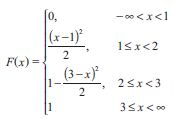
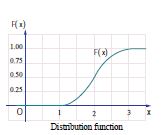
(ii) P(1.5 ≤ X ≤ 2.5) = F(2.5) − F(1.5)
= \(\left( 1-\frac { \left( 3-2.5 \right) ^{ 2 } }{ 2 } \right) -\left( \frac { \left( 1.5-1 \right) ^{ 2 } }{ 2 } \right) \)
= \(\cfrac { 1.75-0.25 }{ 2 } =0.75\)
\(P\left( 1.5\le X\le \right) =\int _{ 1.5 }^{ 2.5 }{ f(x)dx } =\int _{ 1.5 }^{ 2 }{ (x-1) } dx+\int _{ 2 }^{ 2.5 }{ (-x+3) } dx=0.75\)
14.
Since the given function is a probability mass function, the total probability is one. That is \(\underset { x }{ \Sigma } f(x)=1\)
From the given data k + 2k + 6k + 5k + 6k +10k+1
\(30k=1\Rightarrow k=\frac { 1 }{ 30 } \)
Therefore the probability mass function is
| x | 1 | 2 | 3 | 4 | 5 | 6 |
| f(x) | \(\cfrac { 1 }{ 30 } \) | \(\cfrac { 2 }{ 30 } \) | \(\cfrac { 6 }{ 30 } \) | \(\cfrac { 5 }{ 30 } \) | \(\cfrac { 6 }{ 30 } \) | \(\cfrac { 10 }{ 30 } \) |
(i) P(2 < X < 6) = f(3)+ f(4)+ f(5) = \(\frac { 6 }{ 30 } +\frac { 5 }{ 30 } +\frac { 6 }{ 30 } =\frac { 17 }{ 30 } \)
(ii) P(2≤X≤5) = f(2)+f(3)+f(4) = \(\frac { 2 }{ 30 } +\frac { 6 }{ 30 } +\frac { 5 }{ 30 } =\frac { 13 }{ 30 } \)
(iii) P(2≤4) = f(1)+f(2)+f(3)+f(4) = \(\frac { 1 }{ 30 } +\frac { 2 }{ 30 } +\frac { 6 }{ 30 } +\frac { 5 }{ 30 } =\frac { 14 }{ 30 } \)
(iv) P(3>X) = f(4)+f(5)+f(6) = \(\frac { 5 }{ 30 } +\frac { 6 }{ 30 } +\frac { 10 }{ 30 } =\frac { 21 }{ 30 } \)
15.
X~ B(n, p)
Given mean np = 6
\(S.D=\sqrt { npq } =2\)
\(\Rightarrow npq=4\)
\( \rightarrow \frac { npq }{ np } =\frac { 4 }{ 6 } =\frac { 2 }{ 3 } \)
\(\Rightarrow q=\frac { 2 }{ 3 } \)
\(\Rightarrow 1-P=\frac { 2 }{ 3 } \)
\(\Rightarrow 1-\frac { 2 }{ 3 } =P\)
\(\therefore P=\frac { 1 }{ 3 } \)
\(n\times \frac { 1 }{ 3 } =6\Rightarrow n=18\)
(i) The probability mass function
P(X = x) nCx px (1 - p )n-x,
X = 0,1,2, ... , n
\(\therefore P(X=x)=\ ^{18}{ C }_{ x }\left( \frac { 1 }{ 3 } \right) ^{ x }\left( \frac { 2 }{ 3 } \right) ^{ 18-x }\)
x=0,1,2...,8
(ii) \(P(X=3)=\ ^{ 18}{C }_{ 3 }\left( \frac { 1 }{ 3 } \right) ^{ 3 }\left( \frac { 2 }{ 3 } \right) ^{ 18-3 }\)
= \(^{ 18}{C }_{ 3 }\left( \frac { 1 }{ 3 } \right) ^{ 3 }\left( \frac { 2 }{ 3 } \right) ^{ 15 }\)
(iii) P(X ≥ 2)
P(X ≥ 2) 1 -P(X < 2)
= 1 - [P(X = 0) + P(X = 1)]
= \(1-\left[ ^{18}{ C }_{ 0 }\left( \frac { 1 }{ 3 } \right) ^{ 0 }\left( \frac { 2 }{ 3 } \right) ^{ 18 }+^{ 18}{C }_{ 1 }\left( \frac { 1 }{ 3 } \right) ^{ 1 }\left( \frac { 2 }{ 3 } \right) ^{ 17 } \right] \)
= \(1-\left[ \left( \frac { 2 }{ 3 } \right) ^{ 18 }+6\left( \frac { 2 }{ 3 } \right) ^{ 17 } \right] \)
= \(1-\left( \frac { 2 }{ 3 } \right) ^{ 17 }\left[ \frac { 2 }{ 3 } +6 \right] \)
= \(1-\left( \frac { 2 }{ 3 } \right) ^{ 17 }\left( \frac { 20 }{ 3 } \right) \)
= \(1-\frac { 20 }{ 3 } \left( \frac { 2 }{ 3 } \right) ^{ 17 }\)
16.
(i) Probability mass function
For a discrete random variable we have
f(x) = p(X = x)
\(\therefore f(0)=F(0)=\frac { 1 }{ 2 } \)
f(1) = F(1) - F(0)
= \(\frac { 3 }{ 5 } -\frac { 1 }{ 2 } =\frac { 6-5 }{ 10 } =\frac { 1 }{ 10 } \)
f(2) = F(2)-F(1)
= \(\frac { 4 }{ 5 } -\frac { 3 }{ 5 } =\frac { 1 }{ 5 } \)
f(3) = F(3) - F(2)
\(\frac { 9 }{ 10 } -\frac { 4 }{ 5 } =\frac { 9-8 }{ 10 } =\frac { 1 }{ 10 } \)
f(4) = F(4)-F(3)
= \(1-\frac { 9 }{ 10 } =\frac { 1 }{ 10 } \)
ஃThe probability mass function is
| X | 0 | 1 | 2 | 3 | 4 |
| f(x) | \(\cfrac { 1 }{ 2 } \) | \(\cfrac { 1 }{ 10 } \) | \(\cfrac { 1 }{ 5 } \) | \(\cfrac { 1 }{ 10 } \) | \(\cfrac { 1 }{ 10 } \) |
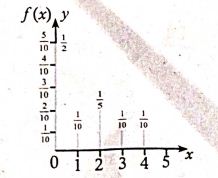
(ii) p(x < 3) = p(x = 0) + p(x = 1) + p(x = 2)
= \(\frac { 1 }{ 2 } +\frac { 1 }{ 10 } +\frac { 1 }{ 5 } =\frac { 5+1+2 }{ 10 } =\frac { 8 }{ 10 } \)
= \(\frac { 4 }{ 5 } \)
(iii) p(x≥2) = p(x = 2) + p(x = 3) + p(x = 4)
= \(\frac { 1 }{ 5 } +\frac { 1 }{ 10 } +\frac { 1 }{ 10 } =\frac { 2+1+1 }{ 10 } =\frac { 4 }{ 10 } \)
= \(\frac { 2 }{ 5 } \)
17.
Given A = {a, b, c, d} and * is defined as follows.
| * | a | b | c | d |
| a | a | c | b | d |
| b | c | d | a | a |
| c | c | d | a | a |
| d | d | b | a | c |
1) Commulative Property:
\(a * b=c\) but \(b \times a=d \Rightarrow a * b \neq b * a\)
\(a * c=b\) but \(c * a=c \Rightarrow a * c \neq c * a\)
\(\therefore\) \(\text { * }\) is not commutative on A..
2) Associative Property:
\((a+b) * c=c * c=a\)
\(a *(b * c)=a * b=c\)
\(\therefore(a * b) * c \neq a *(b * c)\)
\(\text { * }\) is not associative on A.
18.
Given p : Jupiter is a planet and
q : India is an island.
(i) ¬p : Jupiter is not a planet.
(ii) p ∧ ¬q : Jupiter is a planet and India is not an island.
(iii) ¬p ∨ q : Jupiter is not a planet or India is an island.
(iv) p➝ ¬q : If Jupiter is a planet then India is not an island.
(v) p↔q : Jupiter is a planet if and only if India is an island.
19.
(( p ∧ q) ∨ (¬r ∨¬s)) ∧ (¬ t ∧ v)) contains 6 variables p, q, r, s, t, and v. Hence the corresponding truth table will contain 26 = 64 rows.
20.
(1) ¬p: It is not cold.
(2) p ∧ q: It is cold and raining.
(3) p ∨ q: It is cold or raining.
(4) q ∨ ¬p: It is raining or it is not cold
Observe that the statement formula ¬ p has only 1 variable p and its truth table has 2 = ( 21 ) rows. Each of the statement formulae p ∧ q and p ∨ q has two variables p and q. The truth table corresponding to each of them has 4 = (22 ) rows. In general, it follows that if a statement formula involves n variables, then its truth table will contain 2n rows.
21.
Let p be the probability of getting heads
q = 1-p
\(p=\frac { 1 }{ 2 } \)
\(Mean=np=100\times \frac { 1 }{ 2 } =50\)
\(Variance=npq=100\times \frac { 1 }{ 2 } \times \frac { 1 }{ 2 } =25\)
(ii)Let p be the probability of getting 4 when a die is thrown
n = 240
\(p=\frac { 1 }{ 6 } \) [ஃ 4 appears only one]
\(\therefore Mean=np =240\times \frac { 1 }{ 6 } =40\)
\(Variance=npq= 40\times \frac { 5 }{ 6 } \)
\(Variance=\frac { 100 }{ 3 } \)
22.
\(f(x)=\begin{cases} \begin{matrix} \frac { 1 }{ 2 } e^{ -\frac { x }{ 2 } } & for\quad x>0 \end{matrix} \\ \begin{matrix} 0 & otherwise \end{matrix} \end{cases}\)
\(\int _{ 0 }^{ \infty }{ x.f(x)dx } =\frac { 1 }{ 2 } \int _{ 0 }^{ \infty }{ x.{ e }^{ \frac { -x }{ 2 } } } dx\)
\(\left[ \int _{ 0 }^{ \infty }{ { e }^{ -ax }.{ x }^{ n }dx=\cfrac { n! }{ { a }^{ n+1 } } } \right] \)
= \(\frac { 1 }{ 2 } \times \frac { 1! }{ \left( \frac { 1 }{ 2 } \right) ^{ 2 } } =\frac { 1 }{ 2 } \times \frac { 1 }{ \frac { 1 }{ 4 } } \)
= \(\frac { 1 }{ 2 } \times \frac { 4 }{ 1 } =2\)
\(E({ X }^{ 2 })=\int _{ 0 }^{ \infty }{ { x }^{ 2 }.f(x) } dx\)
= \(\int _{ 0 }^{ \infty }{ { x }^{ 2 }.\frac { 1 }{ 2 } { e }^{ -\frac { x }{ 2 } } } dx\)
= \(\frac { 1 }{ 2 } \int { { x }^{ 2 }.{ e }^{ -\frac { x }{ 2 } }dx } \)
= \(\frac { 1 }{ 2 } \times \frac { 2! }{ \left( \frac { 1 }{ 3 } \right) ^{ 3 } } =\frac { 1 }{ 2 } \times \frac { 2 }{ \frac { 1 }{ 8 } } \)
= \(\frac { 1 }{ 2 } \times 2\times 8=8\)
ஃVar(X)=E(X2) - [E(x)]2
= 8-22
= 8 - 4 = 4
23.
Given
\(f(x)=\cfrac { 4-x }{ 6 } \)
\(f(x)=\cfrac { 4-1 }{ 6 } =\cfrac { 3 }{ 6 } =\cfrac { 1 }{ 2 } \)
\(f(2)=\cfrac { 4-2 }{ 6 } =\cfrac { 2 }{ 6 } =\cfrac { 1 }{ 3 } \)
\(f(3)=\cfrac { 4-3 }{ 6 } =\cfrac { 1 }{ 6 } \)
ஃ The probability mass function is
| x | 1 | 2 | 3 |
| f(x) | \(\cfrac { 1 }{ 2 } \) | \(\cfrac { 1 }{ 3 } \) | \(\cfrac { 1 }{ 6 } \) |
Mean \(E(X)=\Sigma xf(x)\)
= \(1\left( \cfrac { 1 }{ 2 } \right) +2\left( \cfrac { 1 }{ 3 } \right) +3\left( \cfrac { 1 }{ 6 } \right) \)
= \(\cfrac { 1 }{ 2 } +\cfrac { 2 }{ 3 } +\cfrac { 3 }{ 6 } =\cfrac { 3+4+6 }{ 6 } \)
= \(\cfrac { 10 }{ 6 } =\cfrac { 5 }{ 3 } =1.67\)
\(E({ x }^{ 2 })=\Sigma { x }^{ 2 }f(x)\)
= \({ 1 }^{ 2 }\left( \cfrac { 1 }{ 2 } \right) +{ 2 }^{ 2 }\left( \cfrac { 1 }{ 3 } \right) +3^{ 2 }\left( \cfrac { 1 }{ 6 } \right) \)
= \(\cfrac { 1 }{ 2 } +\cfrac { 4 }{ 9 } +\cfrac { 9 }{ 6 } =\cfrac { 3+8+9 }{ 6 } \)
= \(\cfrac { 20 }{ 6 } =\cfrac { 10 }{ 3 } =3.33\)
var(X) E(X2) - [E(X)]2
= \(\cfrac { 10 }{ 3 } -\left( \cfrac { 5 }{ 3 } \right) ^{ 2 }=\cfrac { 10 }{ 3 } -\cfrac { 25 }{ 9 } \)
= \(\cfrac { 30-25 }{ 9 } =\cfrac { 5 }{ 9 } =0.54\)

12th Standard Syllabus & Materials
12th Standard
TN 12th Computer Applications களப்பெயர் முறைமை (DNS) Sample Question Papers Study Material - QB365 Set A
NEW12th Standard
TN 12th Computer Applications வலையமைப்பு எடுத்துக்காட்டுகள் மற்றும் நெறிமுறைகள் Sample Question Papers Study Material - QB365 Set A
NEW12th Standard
TN 12th Computer Applications கணினி வலையமைப்பு ஓர் அறிமுகம் Sample Question Papers Study Material - QB365 Set A
NEW12th Standard
TN 12th Computer Applications PHP-உடன் MySQL-ஐ இணைத்தல் Sample Question Papers Study Material - QB365 Set A



Tamilnadu Stateboard 12th Standard Subjects
Maths

Chemistry

Physics

Biology

Computer Science

Business Maths and Statistics

Economics

Commerce

Accountancy

History

Computer Applications
Biology
Computer Technology
Computer Applications
Computer Science
Business Maths and Statistics
Commerce
Economics
Maths
Chemistry
Physics
Computer Technology
History
Accountancy

Tamil

English

French
Tamilnadu Stateboard Standards


