
 100% FREE ACCESS
12th Standard Syllabus & Materials
12th Standard
TN 12th Computer Applications மின்னணு தரவு பரிமாற்றம் Sample Question Papers Study Material - QB365 Set A
NEW12th Standard
TN 12th Computer Applications மின் - வணிக பாதுகாப்பு அமைப்புகள் Sample Question Papers Study Material - QB365 Set A
NEW12th Standard
TN 12th Computer Applications மின்னணு செலுத்தல் முறைகள் Sample Question Papers Study Material - QB365 Set A
NEW12th Standard
TN 12th Computer Applications மின் - வணிகம் Sample Question Papers Study Material - QB365 Set A
NEW12th Standard
TN 12th Computer Applications திறந்த மூல கருத்துருக்கள் Sample Question Papers Study Material - QB365 Set A
NEW12th Standard
TN 12th Computer Applications வலையமைப்பு வடமிடல் Sample Question Papers Study Material - QB365 Set A

Published on: 22/08/2026
Download Tamil Nadu 12th Standard Physics question papers, model tests, one-mark questions, important questions, and public exam papers in PDF format. Free study materials and answer keys for TN State Board students.
Questions + Answers key
Take MCQ Physics Test
1.
Derive the equation for thin lens and obtain its magnification.
2.
Explain the importance of Maxwell’s correction.
3.
4.
Obtain Einstein’s photoelectric equation with necessary explanation.
5.
Discuss the process of nuclear fusion and how energy is generated in stars?
6.
Obtain lens maker’s formula and mention its significance.
7.
Derive the equation for refraction at single spherical surface.
8.
Obtain the equation for lateral displacement of light passing through a glass slab.
9.
Obtain the equation for radius of illumination (or) Snell’s window.
10.
Derive the mirror equation and the equation for lateral magnification.
11.
Obtain an expression for average power of AC over a cycle. Discuss its special cases.
12.
1.
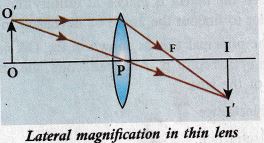
Let us consider an object OO, of height h, placed h1 principal on the principal axis with its height perpendicular to the principal has shown in- Figure' The ray OP passing through the pole of the lens go rated. The inverted real image II' formed has a height h,' The lateral or transverse magnification m is defined as the ratio of the height of the image to that of the object.
\(\mathrm{m}=\frac{\mathrm{II}^{\prime}}{\mathrm{OO}^{\prime}}\) ........................(1)
From the two similar uiangles POO' and PII, we can write,
\(\frac{\mathrm{II}^{\prime}}{\mathrm{OO}^{\prime}}=\frac{\mathrm{PI}}{\mathrm{PC}}\) ....................(2)
Applying sign convention,
\(\frac{-\mathrm{h}_{2}}{\mathrm{~h}_{1}}=\frac{\mathrm{v}}{-\mathrm{u}}\)
Substituting this in the equation for magnification,
\(\mathrm{m}=\frac{-\mathrm{h}_{2}}{\mathrm{~h}_{1}}=\frac{\mathrm{v}}{-\mathrm{u}}\)
After rearranging,
\(\mathrm{m}=\frac{\mathrm{h}_{2}}{\mathrm{~h}_{1}}=\frac{\mathrm{v}}{\mathrm{u}}\) ........................(3)
The magnification is negative for real images and positive for virtual images- In the case of a concave lens, the magnification is always positive and less than one.
We can also have the equations for magnification by combining the lens equation with the formula for magnification as
\(\mathrm{m}=\frac{\mathrm{h}_{2}}{\mathrm{~h}_{1}}=\frac{\mathrm{f}}{\mathrm{f}+\mathrm{u}}=\frac{\mathrm{f}-\mathrm{v}}{\mathrm{f}}\) ......................(4)
2.
Importance of Maxwell's correction:
(i) Earth receives radiation from Sun and other stars. These radiations travel through empty space where there are no electric charges and hence no electric current. Ampere's law says that only electric current can produce a magnetic field. If Ampere's law alone is true, there will not be any radiation.
(ii) Maxwell's correction term \(\left(\mu_{0} \varepsilon_{0} \frac{d \phi_{E}}{d t}\right)\)in Ampere's law ensures that time-varying electric field or displacement current can also produce a magnetic field. Though conduction current is zero in an empty space displacement current does exist.
\(\oint_{l} \vec{B} \cdot \overrightarrow{d l}=\mu_{0} \varepsilon_{0} \frac{d \phi_{E}}{d t} \)
(iii) In stars, due to thermal excitation of atoms, time-varying electric field is produced which in turn, produces time-varying magnetic field. According to Faraday's law, this time-varying magnetic field produces again time-varying electric field and so on. The coupled time-varying electric and magnetic fields travel through empty space with the speed of light and is called electromagnetic wave.
(iv) Even though Maxwell initially started with purely symmetry argument, his correction term explains one of the important aspects of the universe, namely the existence of electromagnetic waves.
3.
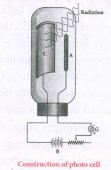
4.
(i) When a photon of energy hv is incident on a metal surface, it is completely absorbed by a single electron and the electron is ejected.
(ii) In this process, a part of the photon energy is used for the ejection of the electrons from the metal surface (photoelectric work function Φ0) and the remaining energy as the kinetic energy of the ejected electron. From the law of conservation of energy,
\(\\ \\ \\ hv=\phi { _{ 0 }+\cfrac { 1 }{ 2 } { mv }^{ 2 } }\) ......(1)
(iii) where m is the mass of the electron and v its velocity.
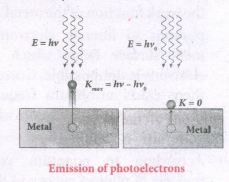
(iv) If we reduce the frequency of the incident light is reduced, the speed or kinetic energy of photo electrons is also reduced. At some frequency v0 of incident radiation, the photo electrons are ejected with almost zero kinetic energy.
Then the equation becomes.
\({ hv }_{ 0 }=\phi _{ 0 }\) ......(2)
(v) Where v0 is the threshold frequency. B rewriting the equation, we get
\(hv={ hv }_{ o }+\cfrac { 1 }{ 2 } { { mv }^{ 2 } }\) ......(3)
The equation is known as einstein's photoelectric equation.
(vi) If the electron does not lose energy by internal collisions, then it is emitted with maximum kinetic energy Kmax. Then
\({ K }_{ max }=\cfrac { 1 }{ 2 } { mv }^{ 2 }_{ max }\) ......(4)
(vii) where vmaxis the maximum velocity of max the electron ejected. The equation (1) is rearranged as follows:
\({ K }_{ max }=hv-{ \phi }_{ 0 }\)
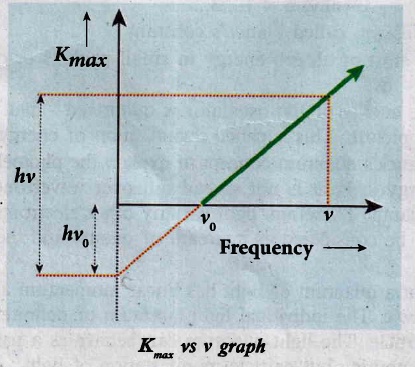
A graph between maximum kinetic energy Kmax of the photoelectron and frequency v of the incident light is a straight line.
5.
(i) Nuclear fusion is the reaction in which two or more light nuclei (A < 20) combine to form a heavier nucleus.
(ii) In the nuclear fusion, the mass of the resultant nucleus is less than the sum of the masses of original light nuclei. This mass difference appears as energy.
(iii) At room temperature if two light nuclei come closer, is strongly repelled by the coulomb repulsive force.
(iv) If the temperature is increased in order of 107 K, the light nuclei have enough kinetic energy to move closer such that the nuclear force becomes effective.
(v) Then lighter nuclei start fusing to form heavier nuclei.
(vi) So it is called thermonuclear fusion reaction.
Energy generation in stars:
(i) Then natural place where nuclear fusion occurs is the core of the stars.
(ii) The energy of star is due to thermonuclear fusion.
(iii) Most of the stars including our Sun fuse hydrogen into helium and some stars even fuse helium into heavier elements.
(iv) The early stage of a star is in the form of cloud and dust.
(v) Due to their own gravitational pull, these clouds fall inward.
(vi) As a result, its gravitational potential energy is converted to kinetic energy and finally into heat.
(vii) When the temperature is high enough to initiate the thermonuclear fusion, they start to release enormous energy which tends to stabilize the star and prevents it from further collapse.
(viii) The sun's interior temperature is around 1.5 x 10⁷ K.
(ix) The sun is converting 6 x 10¹¹kg hydrogen into helium every second
(x) When the hydrogen is burnt out, the sun will enter into new phase called red giant where helium will fuse to become carbon.
(xi) During this stage, sun will expand greatly in size and all its planets will be engulfed in it.
(xii) The energy source of sun is proton-proton cycle of fusion reaction.
This cycle consists of three steps and the first two steps are as follows:
\(_{ 1 }^{ 1 }{ H+ }_{ 1 }^{ 1 }{ H }\rightarrow _{ 1 }^{ 2 }{ H }+{ e }^{ + }+v\)
\(_{ 1 }^{ 1 }{ H+ }_{ 1 }^{ 2 }{ H }\rightarrow _{ 2 }^{ 3 }{ He }+\gamma \)
A number of reactions are possible in the third step. But the dominant one is
\(_{ 2 }^{ 3 }{ He+ }_{ 2 }^{ 3 }{ He }\rightarrow _{ 2 }^{ 4 }{ He }+_{ 1 }^{ 1 }{ H+ }_{ 1 }^{ 1 }{ H }\)
(xiii) The overall energy production in the above reactions is about 27 MeV. The radiation energy we received from the sun is due to these fusion reactions.
6.
(i) Let us consider a thin lens made up of a medium of refractive index n2 is placed in a medium of refractive index n1. Let R1 and R2 be the radii of curvature of two spherical surfaces (1) and (2) respectively and P be the pole.
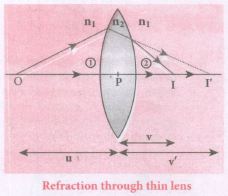
(ii) Consider a point object 'O' on the principal axis. A paraxial ray from 'O' which falls very close to P, after refraction at the surface (1) forms image at 1'.
(iii) Before it does so, it is again refracted by the surface (2). Therefore the final image is formed at I.
(iv) The general equation for the refraction at a single spherical surface is given from Equation,
\(\cfrac { { n }_{ 2 } }{ v } -\cfrac { { n }_{ 1 } }{ v} =\cfrac { \left( { n }_{ 2 }-{ n }_{ 1 } \right) }{ { R } } \)
For the refracting surface (1), the light goes from n1 to n2
\(\cfrac { { n }_{ 2 } }{ v' } -\cfrac { { n }_{ 1 } }{ u } =\cfrac { \left( { n }_{ 2 }-{ n }_{ 1 } \right) }{ { R }_{ 1 } } \) .....(1)
For the refracting surface (2), the light goes from n2 to n1
\(\frac{n_{1}}{v}+\frac{n_{2}}{v^{\prime}}=\frac{\left(n_{1}-n_{2}\right)}{R_{2}}\) ......(2)
For surface (2) I' acts as virtual object.
Adding the above two equations (1) and (2)
\(\cfrac { { n }_{ 1 } }{ v } -\cfrac { { n }_{ 1 } }{ u } =\left( { n }_{ 2 }-{ n }_{ 1 } \right) \left( \cfrac { 1 }{ { R }_{ 1 } } -\cfrac { 1 }{ { R }_{ 2 } } \right) \)
on further simplifying and rearranging,
\(\cfrac { 1 }{ v } -\cfrac { 1 }{ u } =\left( \cfrac { { n }_{ 2 }-{ n }_{ 1 } }{ { n }_{ 1 } } \right) \left( \cfrac { 1 }{ { R }_{ 1 } } -\cfrac { 1 }{ { R }_{ 2 } } \right) \)
\(\cfrac { 1 }{ v } -\cfrac { 1 }{ u } =\left( \cfrac { { n }_{ 2 } }{ n_{ 1 } } -1 \right) \left( \cfrac { 1 }{ { R }_{ 1 } } -\cfrac { 1 }{ { R }_{ 2 } } \right) \) ....(3)
If the object is at infinity, the image is formed at the focus of the lens. Thus, for u = \(\infty\), v = f. Then the equation becomes.
\(\cfrac { 1 }{ f } -\cfrac { 1 }{ \infty } =\left( \cfrac { { n }_{ 2 } }{ { { n }_{ 1 } } } -1 \right) \left( \cfrac { 1 }{ { R }_{ 1 } } -\cfrac { 1 }{ { R }_{ 2 } } \right) \)
\(\cfrac { 1 }{ f } =\left( \cfrac { { n }_{ 2 } }{ { n }_{ 1 } } -1 \right) \left( \cfrac { 1 }{ { R }_{ 1 } } -\cfrac { 1 }{ { R }_{ 2 } } \right) \) ......(4)
If the lens is kept in air, then we can take n2 = n and n1 = 1. So the equation (4) becomes,
\(\\ \cfrac { 1 }{ f } =\left( n-1 \right) \left( \cfrac { 1 }{ { R }_{ 1 } } -\cfrac { 1 }{ { R }_{ 2 } } \right) \) ..(5)
The above equation is called the lens maker's formula.
Significance:
It tells the lens manufacturers what curvature is needed to make a lens of desired focal length with a material of particular refractive index to make a lens of desired focal length. This formula holds good also for a concave lens.
7.
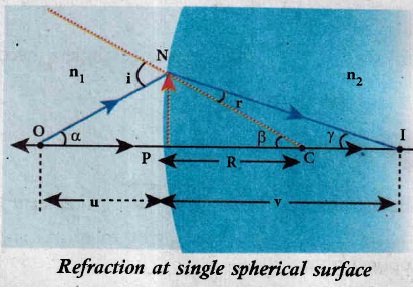
(i) Let us consider two transparent media with refractive indices n, and n, which are separated by a spherical surface. Let C be the centre of curvature of the spherical surface. Let a point object O be in the medium n.
(ii) The line OC cuts the spherical surface at the pole P of the surface. As the rays considered are paraxial rays, the perpendicular dropped for the point of incidence to the principal axis is very close to the pole (or) passes through the pole itself.
(iii) Light from O falls on the refracting surface at N. The normal drawn at the point of incidence passes through the centre of curvature C.
(iv) As n2 > n1 light in the denser medium deviates towards the normal and meets the principal axis at I where the image is formed.
(v) Snell's law in product form for the refraction at the point N can be written from the cquation,
n1 sin i = n2 sin r ...(1)
(vi) As the angles are small, sine of the angle could be approximated to the angle itself,
n1 i = n2r .........(2)
Let the angles be,
\(\angle NOP=\alpha ,\angle NCP=\beta ,\angle NIP=\gamma \)
From the right angle triangles, ∆NOP, ∆NCP and ∆NIP
\(tan\alpha =\cfrac { PN }{ PO } ;tan\beta =\cfrac { PN }{ PC } ;tan\gamma =\cfrac { PN }{ PI } \)
As these angles are small, tan of the angle could be approximated to the angle itself.
\(\alpha =\cfrac { PN }{ PO } ;\beta =\cfrac { PN }{ PC } ;\gamma =\cfrac { PN }{ PI } \) ................(3)
For the triangle, ΔONC,
\(i=\alpha +\beta \) ......(4)
For the triangle, ΔINC,
\(\beta =r+\gamma (or)r=\beta -\gamma \) ...............(5)
Substituting for i and r from equations (4) and (5) in equation (2),
\({ n }_{ 1 }(\alpha +\beta )={ n }_{ 2 }\left( { \beta -\gamma } \right) \)
After rearranging,
\({ n }_{ 1 }a+{ n }_{ 2 }\gamma =\left( { n }_{ 2 }-{ n }_{ 1 } \right) \beta \)
Substituting for α, β and y from equation
\({ n }_{ 1 }\left( \cfrac { PN }{ PO } \right) +{ n }_{ 2 }\left( \cfrac { PN }{ PI } \right) ={ (n }_{ 2 }-{ n }_{ 1 })\left( \cfrac { PN }{ PC } \right) \)
Further simplifying by cancelling PN,
\(\cfrac { { n }_{ 1 } }{ PO } +\cfrac { { n }_{ 2 } }{ PI } =\cfrac { { n }_{ 2 }-{ n }_{ 1 } }{ PC } \) .............(6)
Following sign conventions, PO = -u, PI = +v and PC = +R in equation (6)
\(\cfrac { { n }_{ 1 } }{ -u } +\cfrac { { n }_{ 2 } }{ v } =\cfrac { \left( { n }_{ 2 }-{ { n }_{ 1 } } \right) }{ R } \)
After rearranging, finally we get,
\(\cfrac { { n }_{ 1 } }{ -u } +\cfrac { { n }_{ 2 } }{ v } =\cfrac { \left( { n }_{ 2 }-{ { n }_{ 1 } } \right) }{ R } \) ..................(7)
(vii) If the first medium is air then, n1 = 1 and the second medium is taken just as n2 = n, then the equation (7) is reduced to,
\(\cfrac { n }{ v } -\cfrac { 1 }{ u } =\cfrac { \left( n-1 \right) }{ R } \) ....(8)
8.
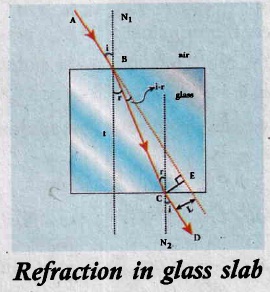
(i) Consider a glass slab of thickness t and refractive index n is kept in air medium.
(ii) If path of the light is ABCD and the refractions occur at two points B and C in the glass slab.
(iii) The angles of incidence i and refraction r are measured with respect to the normal N1 and N2 at the two points Band C respectively. The lateral displacement 'L' is the perpendicular distance CE drawn between the path of light and the undeviated light at point C. In the right angle triangle ΔBCE,
\(sin(i-r)=\frac{1}{BC};BC=\cfrac { L }{ sin(i-r) } \) ..(1)
In the right angle triangle ΔBCF,
\(cos(r)=\cfrac { t }{ BC } ;BC=\cfrac { t }{ cos(r) } \)
Equating equation (1) and (2),
\(\cfrac { L }{ sin(i-r) } =\cfrac { t }{ cos(r) } \)
After rearranging,
\(L=t\left( \cfrac { sin(i-r) }{ cos(r) } \right) \)
(iv) Lateral displacement depends upon
(a) the thickness of the slab
(b) the angle of incidence
(c) the refractive index of the slab.
(v) Thicker the slab, larger will be the lateral displacement. Greater the angle of incidence, larger will be the lateral displacement.
(vi) Higher the refractive index, larger will be the lateral displacement.
9.
(i) The angle of view for water animals is restricted to twice the critical angle 2ic. The critical angle for water is 48.6°. Thus the angle of view is 97.2°.
(ii) The radius R of the circular area depends on the depth d from which it is seen and also the refractive indices of the media.
(iii) The radius R of Snell's window can be deduced with the illustration as shown in Figure.
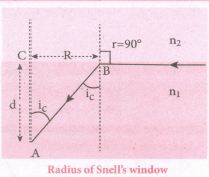
(iv) Light is seen from a point A at a depth 'd'.
(v) From the Snell's law in product form, n1 sini = n2 sinr
(vi) The equation for the refraction happening at the point B on the boundary between the two media is,
n1 sin ic = n2 sin90o ..(1)
n1sinic = n2 (∵ sin90o = 1)
\(sin{ i }_{ c }=\cfrac { { n }_{ 2 } }{ { n }_{ 1 } } \) ...(2)
From the right angle triangle ΔABC,
\({ sini }_{ c }=\cfrac { CB }{ AB } =\cfrac { R }{ \sqrt { { d }^{ 2 }+{ R }^{ 2 } } } \) ....(3)
Equating the above two equation
\(\cfrac { R }{ \sqrt { { d }^{ 2 }+{ R }_{ 2 } } } =\cfrac { { n }_{ 2 } }{ { n }_{ 1 } } \)
Squaring on both sides
\(\cfrac { { R }^{ 2 } }{ { R }^{ 2 }+d^{ 2 } } \left( \cfrac { { n }_{ 2 } }{ { n }_{ 1 } } \right) ^{ 2 }\)
Taking reciprocal,
\(\cfrac { { R }^{ 2 }+{ d }^{ 2 } }{ { R }^{ 2 } } =\left( \cfrac { { n }_{ 1 } }{ { n }_{ 2 } } \right) ^{ 2 }\)
On further simplifying
\(1+\cfrac { { d }^{ 2 } }{ { R }^{ 2 } } =\left( \cfrac { { n }_{ 1 } }{ { n }_{ 2 } } \right) ^{ 2 };\cfrac { { d }^{ 2 } }{ { R }^{ 2 } } =\left( \cfrac { { n }_{ 1 } }{ { n }_{ 2 } } \right) ^{ 2 }-1;\)
\(\cfrac { { d }^{ 2 } }{ { R }^{ 2 } } =\cfrac { { n }_{ 1 }^{ 2 } }{ { n }_{ 1 }^{ 2 } } -1=\cfrac { { n }_{ 1 }^{ 2 }-{ n }_{ 2 }^{ 2 } }{ { n }_{ 2 }^{ 2 } } \)
Again taking reciprocal and rearranging
\(\cfrac { { R }^{ 2 } }{ { d }^{ 2 } } =\cfrac { { { n }_{ 2 }^{ 2 } } }{ { n }_{ 1 }^{ 2 }-{ n }_{ 2 }^{ 2 } } { R }^{ 2 }={ d }^{ 2 }\left( \cfrac { { n }_{ 2 }^{ 2 } }{ { n }_{ 1 }^{ 2 }-{ n }_{ 2 }^{ 2 } } \right) \)
∴ The radius of illumination is,
\(R=d\sqrt { \cfrac { { n }_{ 2 }^{ 2 } }{ \left( n_{ 1 }^{ 2 }-{ n }_{ 2 }^{ 2 } \right) } } \) ...(4)
If the rarer medium outside is air, then, n2 = 1, and we can take n1 = n
\(R=d\left( \cfrac { 1 }{ \sqrt { { n }^{ 2 }-1 } } \right) \) or \(R=\cfrac { d }{ \sqrt { { n }^{ 2 }-1 } } \) ....(5)
10.
Mirror Equation :
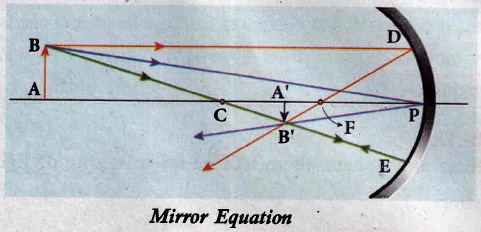
(i) AB is an object which is placed on the principal axis of a concave mirror beyond the center of curvature C. A' B' is an image which is formed between the point pole P, and the centre of curvature.
(ii) From the figure As per law of reflection, the angle of incidence ∠BPA is equal to the angle of reflection ∠B'PA'.
(iii) The triangles ∠BPA and ∠B'PA' are similar. Thus, from the rule of similar triangles,
\(\cfrac { { A }^{ ' }{ B }^{ ' } }{ AB } =\cfrac { { PA }^{ ' } }{ PA } \) ................(1)
(iv) The other set of similar triangles are, ΔDPF and ΔB'A'F. (PD is almost a straight vertical line)
\(\cfrac { { A }^{ ' }B' }{ PD } =\cfrac { A'F }{ PF } \)
(v) As, PD = AB the above equation becomes,
\(\cfrac { A'B' }{ AB } =\cfrac { A'F }{ PF } \) ......(2)
(vi) From equations (1) and (2) we can write,
\(\cfrac { PA' }{ PA } =\cfrac { A'F }{ PF } \)
(vii) As, A'F = PA' - PF, the above equation becomes,
\(\cfrac { PA' }{ PA } =\cfrac { PA'-PF }{ PF } \) .....(3)
(viii) We can apply the sign conventions for the various distances in the above equation
PA = - u, PA' = -v, PF = - f
(ix) All the three distances are negative as per sign convention, because they are measured to the left of the pole. Now, the equation (3) becomes,
\(\cfrac { -v }{ -u } =\cfrac { -v-\left( -f \right) }{ -f } \)
On further simplification,
\(\cfrac { v }{ u } =\cfrac { v-f }{ f } ;\cfrac { v }{ u } =\cfrac { v }{ f } -1 \)
Dividing either side with v,
\(\cfrac { 1 }{ u } =\cfrac { 1 }{ f } -\cfrac { 1 }{ v } \)
After rearranging,
\(\cfrac { 1 }{ v } +\cfrac { 1 }{ u } =\cfrac { 1 }{ f } \)
The above equation is called mirror equation.
Lateral magnification:
The lateral or transverse magnification is defined as the ratio of the height of the image to the height of the object. The height of the object and image are measured perpendicular to the principal axis.
Magnification (m) \(=\frac{\text { height of the image }\left(h^{\prime}\right)}{\text { height of the image }(h)} \)
\(m=\frac{h^{\prime}}{h} \) ....(1)
Applying proper sign conventions for equation,
\(\frac{A^{\prime} B^{\prime}}{A B}=\frac{P A^{\prime}}{P A} \)
\(A^{\prime} B^{\prime}=-h^{\prime}, A B=h, P A^{\prime}=-v, P A=-u \)
\(-\frac{h}{h}=\frac{-v}{-u} \)
On simplifying we get,
\(\mathrm{m}=\frac{\mathrm{h}^{\prime}}{\mathrm{h}}=-\frac{\mathrm{v}}{\mathrm{u}}\) ...(2)
Using mirror equation, we can further write the magnification as,
\(m=\frac{h^{\prime}}{h}=\frac{f-v}{f}=\frac{f}{f-u}\) ..(3)
11.
(i) Power of a circuit is defined as the rate of consumption of electric energy in that circuit. It is given by the product of the voltage and current.
In an AC circuit, the voltage and current vary continuously with time. Let us first calculate the power at an instant and then it is averaged over a complete cycle.
(ii) The alternating voltage and alternating current in the series inductive RLC circuit at an instant are given by
v=Vm sinωt and i=Im=(ωωt+\(\phi \))t+\(\phi \))
(iii) where \(\phi \) is the phase angle between v and i. The instantaneous power is then written as
P=vi =VmIm sinωt sin(ωt + \(\phi \))
=VmIm sinωt [sin ωt cos\(\phi \) - cosωt sin\(\phi \)]
P=VmIm [cos\(\phi \) sin2ωt - sinωt cosωt sin\(\phi \)] ....(1)
(iv) Here the average of sin2ωt over a cycle is\(\frac{1}{2}\)and that of sin ωt cos ωt is zero. Substituting these values, we obtain average power over a cycle.
Pav =VmIm cos\(\phi \) x \(\frac { 1 }{ 2 } \)
=\(\frac { { V }_{ m } }{ \sqrt { 2 } } \frac { { I }_{ m } }{ \sqrt { 2 } } cos\phi\)
Pav = VRMS IRMS cos\(\phi \) ....(2)
(v) where VRMS IRMS is called apparent power and cos\(\phi \) is power factor. The average power of an AC circuit is also known as the true power of the circuit.
Special Cases:
(i) For a purely resistive circuit, the phase angle between voltage and current is zero and cos\(\phi \)=1
∴ Pav =VRMS IRMS
(ii) For a purely inductive or capacitive circuit, the phase angle is ± \(\frac { \pi }{ 2 } \) and cos\(\left( \pm \frac { \pi }{ 2 } \right) \)=0
∴ Pav =0
(iii) For series RLC circuit, the phase angle
\(\phi \) =tan-1\(\left( \frac { { X }_{ L }-{ X }_{ C } }{ R } \right) \)
∴ Pav =VRMS IRMS cos\(\phi \)
(iv) For series RLC circuit at resonance, the phase angle is zero and cos\(\phi \)=1
∴ Pav =VRMS IRMS
12.

12th Standard Syllabus & Materials
12th Standard
TN 12th Computer Applications களப்பெயர் முறைமை (DNS) Sample Question Papers Study Material - QB365 Set A
NEW12th Standard
TN 12th Computer Applications வலையமைப்பு எடுத்துக்காட்டுகள் மற்றும் நெறிமுறைகள் Sample Question Papers Study Material - QB365 Set A
NEW12th Standard
TN 12th Computer Applications கணினி வலையமைப்பு ஓர் அறிமுகம் Sample Question Papers Study Material - QB365 Set A
NEW12th Standard
TN 12th Computer Applications PHP-உடன் MySQL-ஐ இணைத்தல் Sample Question Papers Study Material - QB365 Set A



Tamilnadu Stateboard 12th Standard Subjects

Maths

Chemistry
Physics

Biology

Computer Science

Business Maths and Statistics

Economics

Commerce

Accountancy

History

Computer Applications
Biology
Computer Technology
Computer Applications
Computer Science
Business Maths and Statistics
Commerce
Economics
Maths
Chemistry
Physics
Computer Technology
History
Accountancy

Tamil

English

French
Tamilnadu Stateboard Standards


