
 100% FREE ACCESS
12th Standard Syllabus & Materials
12th Standard
TN 12th Computer Applications மின்னணு தரவு பரிமாற்றம் Sample Question Papers Study Material - QB365 Set A
NEW12th Standard
TN 12th Computer Applications மின் - வணிக பாதுகாப்பு அமைப்புகள் Sample Question Papers Study Material - QB365 Set A
NEW12th Standard
TN 12th Computer Applications மின்னணு செலுத்தல் முறைகள் Sample Question Papers Study Material - QB365 Set A
NEW12th Standard
TN 12th Computer Applications மின் - வணிகம் Sample Question Papers Study Material - QB365 Set A
NEW12th Standard
TN 12th Computer Applications திறந்த மூல கருத்துருக்கள் Sample Question Papers Study Material - QB365 Set A
NEW12th Standard
TN 12th Computer Applications வலையமைப்பு வடமிடல் Sample Question Papers Study Material - QB365 Set A

Published on: 22/08/2026
Download Tamil Nadu 12th Standard Physics question papers, model tests, one-mark questions, important questions, and public exam papers in PDF format. Free study materials and answer keys for TN State Board students.
Questions + Answers key
Take MCQ Physics Test
1.
Two polaroids P1 and P2 are placed with their optic axes perpendicular to each other. If an unpolarised light of intensity I, isincident on the first polaroid P1 then the intensity of transmitted light through the second polaroidP2 will be:
\(\mathrm{I}_{\mathrm{o}} / 2\)
\(\mathrm{I}_0 / 4\)
0
\(\mathrm{I}_0 / 8\)
2.
Which colour of light has the highest speed?
Violet
Red
Green
All have same speed
3.
An object is placed, 40 cm from a concave mirror of focal length 20 cm, the image formed is ______________.
Real, inverted and same in size
Real, inverted and smaller
Virtual, erect and larger
Virtual, erect and smaller
4.
The energy of a photon of light is 3eV. Then the wavelength of photon must be _____________.
4125 nm
41250 nm
412.5 nm
4 nm
5.
Emission of electrons by the absorption of heat energy is called ______ emission.
photoelectric
field
thermionic
secondary
6.
The threshold wavelength for a metal surface whose photoelectric work function is 3.313 eV is _____.
4125 \(\mathring { A } \)
3750\(\mathring { A } \)
6000\(\mathring { A } \)
2062.5\(\mathring { A } \)
7.
The wavelength λe of an electron and λp of a photon of same energy E are related by _____.
λp ∝ λe
\({ \lambda }_{ p }∝ \sqrt { { \lambda }_{ e } } \)
\({ \lambda }_{ p }∝ \frac { 1 }{ \sqrt { { \lambda }_{ e } } } \)
\({ \lambda }_{ p }∝ { \lambda }_{ e }^{ 2 }\)
8.
9.
10.
Two coherent monochromatic light beams of intensities I and 4I are superposed. The maximum and minimum possible intensities in the resulting beam are _____.
5I and I
5I and 3I
9I and I
9I and 3I
11.
A plane glass is placed over a various coloured letters (violet, green, yellow, red) The letter which appears to be raised more is _____.
red
yellow
green
violet
12.
An air bubble in glass slab of refractive index 1.5 (near normal incidence) is 5 cm deep when viewed from one surface and 3 cm deep when viewed from the opposite face. The thickness of the slab is ______.
8 cm
10 cm
12 cm
16 cm
13.
Stars twinkle due to, ______.
reflection
total internal reflection
refraction
polarisation
14.
15.
The speed of light in an isotropic medium depends on, ______.
its intensity
its wavelength
the nature of propagation
the motion of the source w.r.t medium
16.
List out the laws of photoelectric effect. (or) Write any three Laws of Photoelectric Effect
17.
Calculate the momentum and the de Broglie wavelength in the following cases:
i) an electron with kinetic energy 2 eV.
ii) a bullet of 50 g fired from rifle with a speed of 200 m/s
iii) a 4000 kg car moving along the highways at 50 m/s
Hence show that the wave nature of matter is important at the atomic level but is not really relevant at macroscopic level.
18.
Derive an expression for de Broglie wavelength of electrons.
19.
Light travels from air into a glass slab of thickness 50 cm and refractive index 1.5.
(i) What is the speed of light in the glass?
(ii) What is the time taken by the light to travel through the glass slab?
(iii) What is the optical path of the glass slab?
20.
List the uses of polaroids.
21.
State and obtain Malus’ law. (or) State Malus' Law.
22.
What is Fresnel’s distance? Obtain the equation for Fresnel’s distance.
23.
Derive the relation between f and R for a spherical mirror.
24.
Obtain the equation for apparent depth.
25.
A radiation of wavelength 300 nm is incident on a silver surface. Will photoelectrons be observed? [work function of silver = 4.7 eV]
26.
How will you define threshold frequency?
27.
Define work function of a metal. Give its unit.
28.
A monochromatic light of wavelength of 500 nm strikes a grating and produces fourth order maximum at an angle of 30°. Find the number of slits per centimeter.
29.
The angle of minimum deviation for an equilateral prism is 37o . Find the refractive index of the material of the prism.
30.
Differentiate between Fresnel and Fraunhofer diffraction.
31.
Define wavefront.
32.
Why does sky appear blue?
33.
What are critical angle and total internal reflection?
34.
Obtain the equation for resolving power of microscope.
35.
Discuss diffraction at single slit and obtain the condition for nth minimum.
36.
37.
Obtain Einstein’s photoelectric equation with necessary explanation.
38.
What do you mean by electron emission? Explain briefly various methods of electron emission.
39.
Obtain the equation for bandwidth in Young’s double slit experiment.
40.
Obtain the equation for resultant intensity due to interference of light.
41.
Derive the equation for angle of deviation produced by a prism and thus obtain the equation for refractive index of material of the prism.
42.
43.
Derive the mirror equation and the equation for lateral magnification.
1.
(c)
0
2.
(b)
Red
3.
(a)
Real, inverted and same in size
4.
(a)
4125 nm
5.
(c)
thermionic
6.
\(\lambda_0 =\frac{h c}{\phi} \)
\(=\frac{6.626 \times 10^{-34} \times 3 \times 10^8}{3.313 \times 1.6 \times 10^{-19}} \)
\( =\frac{19.8782400}{5.3} \times 10^{-7} \)
\(\lambda_0 =3.750 \times 10^{-7} \simeq 3750 \stackrel{o}A\)
7.
\(\mathrm{E}_{\mathrm{p}} =\frac{\mathrm{hc}}{\lambda_{\mathrm{p}}} \)
\(\mathrm{E}_{\mathrm{e}} =\frac{\mathrm{h}^2}{2 \mathrm{~m} \lambda_{\mathrm{e}}^2} \)
\(\frac{\mathrm{hc}}{\lambda_{\mathrm{p}}} =\frac{\mathrm{h}^2}{2 \mathrm{~m} \lambda_{\mathrm{e}}^2} \)
\(\lambda_{\mathrm{p}} \propto \lambda_{\mathrm{e}}^{{ }^2}\)
8.
(d)
9.
(b)
10.
I = l1 + l2 + 2\(\sqrt{I_1I_2}\)cos θ
If cos θ = cos 0 = l, I is max
= I+ 4I + 2\(\sqrt{41^2}\) cos 0
= 5I + 4I = 91
If cos π = -1, I is min
Imin = I + 4I + 2\(\sqrt{41^2}\) cos π
= 5I + 4I(-1)
= 5I + 4I = I
(Imax, Imin)= (9I, I)
11.
Refractive index for violet is more and wavelength for violet is very low comparing other colours. So, the letter which appears to be raised more is violet.
12.
Apparent depth = 3 + 5 = 8 cm
Real depth = thickness of the slab = t
n = 1.5
\(n=\frac{Real \ depth}{Apparent \ depth}\)
\(\therefore 1.5=\frac{t}{8}\)
t = 1.5 x 8
t = 12 cm
13.
(c)
refraction
14.
(a)
15.
v = nג
In an isotropic medium, there is no change in the frequency of the light. So, the speed of light depends on wavelength of light.
16.
Laws of photoelectric effect:
(i) For a given surface, the emission of photoelectrons takes place only if the frequency of incident light is greater than a certain minimum frequency called the threshold frequency.
(ii) For a given frequency of incident light, the number of photoelectrons emitted is directly proportional to the intensity of the incident light. The saturation current is also directly proportional to the intensity of incident light.
(iii) Maximum kinetic energy of the photoelectrons is independent of the intensity of the incident light.
(iv) Maximum kinetic energy of the photoelectrons from a given metal is directly proportional to the frequency of incident light.
(v) There is no time lag between the incidence of light and the ejection of photoelectrons.
17.
i) Momentum of the electron is
p = \(\sqrt { 2mK } =\sqrt { 2\times 9.1\times { 10 }^{ -31 }\times 2\times 1.6\times 10^{ -19 } } \)
= 7.63 x 10⁻²⁵ kg ms-1
Its de Broglie wavelength is
\(\lambda=\frac { h }{ p } =\frac { 6.626\times { 10 }^{ -34 } }{ 7.63\times { 10 }^{ -25 } } \) = 0.868 x 10⁻⁹ m
= 8.68 \(\mathring { A }\)
ii) Momentum of the bullet is
p = m\({ \upsilon }\) = 0.050 x 200 = 10 kg ms-1
It's de Broglie wavelength is
\(\lambda=\frac { h }{ p } =\frac { 6.626\times { 10 }^{ -34 } }{ 10 } \) = 6.626 x 10⁻³⁵ m
iii) Momentum of the car is
p = mv = 4000 x 50 = 2 x 10⁵ kg ms-1
Its de Broglie wavelength is
\(\lambda=\frac { h }{ p } =\frac { 6.626\times { 10 }^{ -34 } }{ 2\times { 10 }^{ 5 } } \) = 3.313 x 10-39 m
From these calculations, we notice that electron has a significant value of de Broglie wavelength (≈10-9m which can be measured from diffraction studies) but the bullet and car have negligibly small de Broglie wavelengths associated with them (≈10-33m and 10-39m respectively, which are not measurable by any experiment). This implies that the wave nature of matter is important at the atomic level but it is not really relevant at the macroscopic level.
18.
(i) An electron of mass m is accelerated through a potential difference of V volt. The kinetic energy acquired by the electron is given by
\(\cfrac { 1 }{ 2 } { mv }^{ 2 }=ev\)
(ii) Therefore, the speed v of the electron is
\(v=\sqrt { \cfrac { 2ev }{ m } } \)
Hence, the de Broglie wavelength of the matter waves associated with electron is
\(\lambda =\cfrac { h }{ mv } =\cfrac { h }{ \sqrt { 2mev } } \)
(iii) Substituting the known values in the above equation, we get
\(\lambda =\cfrac { 6.26\times { 10 }^{ -34 } }{ \sqrt { 2V\times 1.6\times { 10 }^{ -19 }\times 9.11\times { 10 }^{ -31 } } } \)
= \(\cfrac { 12.27\times { 10 }^{ -10 } }{ \sqrt { V } } m\)
\(\lambda =\cfrac { 12.27 }{ \sqrt { V } } \overset { o }{ A } \)
(iv) Since the kinetic energy of the electron, K = eV, then the de Broglie wavelength associated with electron can be also written as
\(\lambda =\cfrac { h }{ \sqrt { 2mK } } \)
19.
Given, thickness of glass slab, d = 50 cm = 0.5 m, refractive index, n = 1.5
refractive index, \(n=\cfrac { c }{ v } \)
(a) speed of light in the glass slab is,
\(v=\cfrac { c }{ n } =\cfrac { 3\times { 10 }^{ 8 } }{ 1.5 } =2\times { 10 }^{ 8 }{ ms }^{ -1 }\)
(b) time taken by light to travel through the glass slab is,
\(t=\cfrac { d }{ v } =\cfrac { 0.5 }{ 2\times { 10 }^{ 8 } } =2.5\times { 10 }^{ -9 }{ s }\)
(c) optical path,
d' = nd = 1.5 x 0.5 = 0.75 m = 75 cm
Light would have traveled an additional 25 cm (75 cm – 50 cm) in vacuum at the same time had there been no glass slab in its path.
20.
(i) Polaroids are used in goggles and cameras to avoid glare of light.
(ii) Polaroids are useful in 3D pictures i.e., in holography.
(iii) Polaroids are used to improve contrast in old oil paintings.
(iv) Polaroids are used in optical stress analysis.
(v) Polaroids are used as window glasses to control the intensity of incoming light.
(vi) Polarised laser beam acts as needle to read/ write in compact discs (CDs).
(vii) Polarised lights is used in liquid crystal display (LCD).
21.
When a beam of plane polarised light of intensity (Io) is incident on an analyser, the intensity of light (I) transmitted from the analyser varies directly as the square of the cosine of angle between the transmission axes of polariser and analyser.
\(I={ I }_{ o }cos^{ 2 }\theta \)
Consider the plane of polariser and analyser are inclined to each other at an angle ፀ. Let Io be the intensity and 'a' be the amplitude of the electric vector transmitted by the polariser. The amplitude 'a' of the incident light has two rectangular components, (acosθ) and (asinθ) which are the parallel and perpendicular components to the axis of transmission of the analyser. Only the component (acosθ) will be transmitted by the analyzer.
According to Malus's law
\(I\propto \left( acos\theta \right) ^{ 2 }\)
\(I=k\left( acos\theta \right) ^{ 2 }\)
Where k is constant of proportionality,
I = ka2 cos2 θ
I = Io = cos2 θ
Where Io = ka2 is the maximum intensity of light transmitted from the analyser.
22.
Fresnel's distance is the distance upto which the ray optics is valid in terms of rectilinear propagation of light.
(or)
Fresnel's distance is the distance upto which ray optics is obeyed and beyond which ray optics is not obeyed but, wave optics becomes significant,
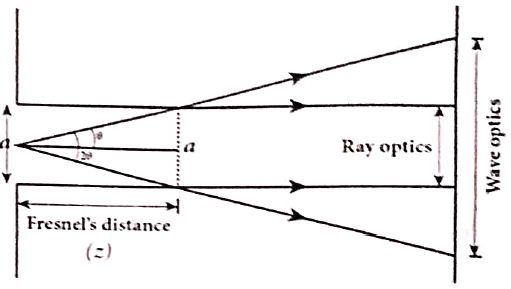
The diffraction equation for first minimum is, sinθ \(=\frac{ \lambda}{2};\)
When θ is small, θ \(=\frac{ \lambda}{2}\)
From the definition of Fresnel's distance, 2θ\(=\frac{a}{z}\) (or) θ \(=\frac{a}{2z}\)
Equating the above two equation for θ gives, \(\frac{\lambda}{a}=\frac{a}{2z}\)
After rearranging, we get Fresnel's distance z as,
\(z=\cfrac { { a }^{ 2 } }{ 2\lambda } \)
23.
Relation between f and R:
C ⇒ Center of curvature
F ⇒ Principal focus
i ⇒ Angle of incidence
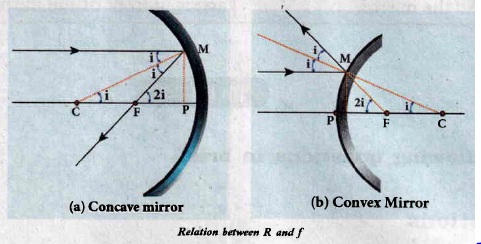
The angles
\(\tan i=\frac{P M}{P C} \text { and } \tan 2 i=\frac{P M}{P F}\)
As the angles are small, tan i = i and tan 2i = 2i.
\(\mathrm{i}=\frac{\mathrm{PM}}{\mathrm{PC}} \text { and } 2 \mathrm{i}=\frac{\mathrm{PM}}{\mathrm{PF}}\)
Simplifying further,
\(2 \frac{\mathrm{PM}}{\mathrm{PC}}=\frac{\mathrm{PM}}{\mathrm{PF}} ; 2 \mathrm{PF}=\mathrm{PC}, \mathrm{R}=2 \mathrm{f}\)
PF is focal length f and PC is the radius of curvature R.
R = 2f (or) f = R/2
24.
(i) Light from the object O at the bottom of the tank passes from denser medium (water) to rarer medium (air) to reach our eyes for viewing the object.
(ii) It deviates away from the normal in the rarer medium at the point of incidence B as shown in Figure.
(iii) The refractive index of the denser medium is n1 and that of rarer medium is n2. Here, n1 > n2.
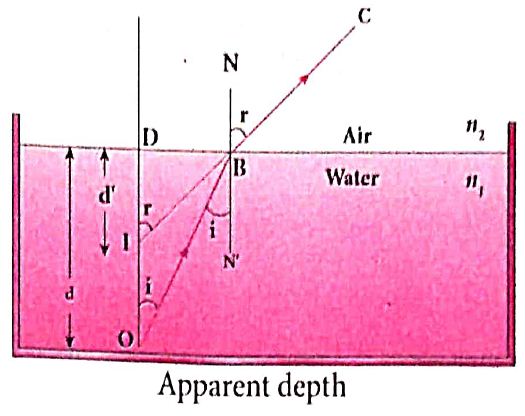
The angle of incidence in the denser medium is i and the angle of refraction in the rarer medium is r. The lines NN'and OD are parallel. Thus, the angle ∠DIB is also r. The angles i and r are very small as the diverging light from O entering the eye is very narrow. The Snell's law in product form for this refraction from equation is,
n1 sin i = n2 sin r
As the angles i and r are small, we can approximate, sin i = tan i and sin r tan r.
n1 tan i = n2 tan r
In triangles ∆DOB and ∆DIB,
\(tan \ i=\frac{DB}{DO}and \ tan \ r=\frac{DB}{DI}\)
\(n_1\frac{DB}{DO}=n_2\frac{DB}{DI}\)
DB is cancelled both sides. Now, DO is the actual depth d and DI is the apparent depth d'.
\(n_1\frac{1}{d}=n_2\frac{1}{d'}\)
After rearranging, \(\frac{d'}{d}=\frac{n_2}{n_1}\)
Rewriting the above equation for the apparent depth d', d' = \(=\frac{n_2}{n_1}d\)
As the rarer medium is air, its refractive index n, can be taken as 1, (n2 = 1) and the refractive index n1 of denser medium could then be taken as n itself, (n1 = n). Now, the equation for apparent depth becomes,
\(d'=\frac{d}{n}\)
The bottom appears to be elevated by d-d',
\(d-d'=d-\frac{d}{n}(or)d-d'=d(1-\frac{1}{n})\)
25.
Energy of the incident photon is
E = hv = \(\frac { hc }{ \lambda } \) (in joules)
E = \(\frac { hc }{ \lambda e } \) (in eV)
Substituting the known values, we get
E = \(\frac { 6.626\times { 10 }^{ -34 }\times 3\times 10^{ 8 } }{ 300\times { 10 }^{ -9 }\times 1.6\times { 10 }^{ -19 } } \)
E = 4.14 eV
The work function of silver = 4.7 eV. Since the energy of the incident photon is less than the work function of silver, photoelectrons are not observed in this case.
26.
For a given metallic Surface, the emission of photo electrons takes place only if the frequency of incident light is greater than a certain minimum frequency called the threshold frequency.
27.
The minimum energy needed for an electron to escape from the metal surface is called work function of that metal.
Unit: electron volt (eV).
28.
λ = 500 nm = 500 x 10-9 m; m = 4;
θ = 30°; number of lines per cm = ?
Equation for diffraction maximum in grating is, sin θ = Nm λ
Rewriting, \(N=\cfrac { sin\theta }{ m\lambda } \)
Substituting,
\(N=\frac{0.5}{4 \times 500 \times 10^{-9}}\)
= 2.5 x 10⁵ m-1
= 2.5 x 103 cm-1
29.
Given, A = 60°; D = 37°
Equation for refractive index is,
\(n=\cfrac { \sin\left( \frac { A+D }{ 2 } \right) }{ \sin\left( \frac { A }{ 2 } \right) } \)
Substituting the values,
\(n=\cfrac { \sin\left( \frac { 60^{ o }+37^{ o } }{ 2 } \right) }{ \sin\left( \cfrac { { 60 }^{ o } }{ 2 } \right) } =\cfrac { \sin\left( 48.5^{ o } \right) }{ \sin\left( { 30 }^{ o } \right) } =1.5\)
The refractive index of the material of the prism is, n = 1.5
30.
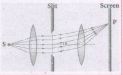
| S.No | Fresnel diffraction | Fraunhofer diffraction |
| (i) | Spherical or cylindrical wave front undergoes diffraction. | Plane wavefront undergoes diffraction. |
| (ii) | Light wave is from a source at finite distance. | Light wave is from a source at infinity. |
| (iii) | For laboratory conditions, convex lenses need not be used. | In laboratory conditions, convex lenses are to be used. |
| (iv) | Difficult to observe and analyse. | Easy to observe and analyse. |
| (v) | 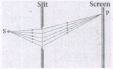 |
 |
31.
A wavefront is the locus of points which are in the same state or phase of vibration.
32.
\(\mathrm{I} ∝ \frac{1}{\lambda^{4}}\)
According to Rayleigh's scattering equation, violet colour which has the shortest wavelength gets much scattered during day time. The next scattered colour is blue. As our eyes are more sensitive to blue colour than violet colour the sky appears blue during day time.
33.
Critical angle:
The angle of incidence in the denser medium for which the angle reflection is 90o or the reflected ray graces the boundary between the two media is called critical angle.
Total Internal reflection:
For any angle of incidence greater than the critical angle, the center light is reflected back into the denser medium itself. This phenomenon is called Total internal reflection.
34.
(i) A microscope is used to see the details of the object under observation.
(ii) Good microscope should not only magnify the object but also resolve the two points on an object which are separated by the smallest distance dmin. Actually, dmin is the resolution and its reciprocal is the resolving power.
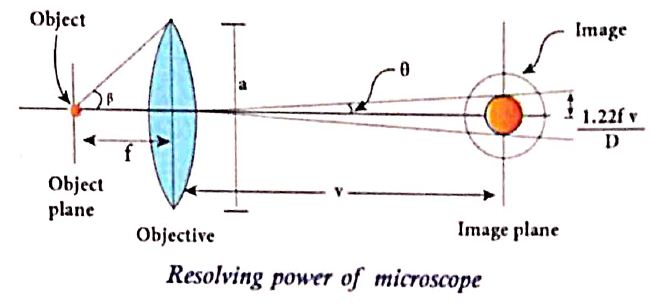
Resolving power of a microscope
The spatial resolution (radius of central maxima) is
\(r_{0}=\frac{1.22 \lambda f}{a}\) .......(1)
where 'a' is width of the aperture/slit.
In microscope, the object distance is just more than the focal length f and the image is formed at v as shown in the Figure. Hence, f in equation is replaced by v.
\(r_{0}=\frac{1.22 \lambda v}{a}\) ......(2)
In the place of focal length f we have the image distance v. If the difference between the two points on the object to be resolved is dmin. Then the magnification m is,
\(m=\frac{r_{0}}{d_{\min }}\) ........(3)
\(\mathrm{d}_{\min }=\frac{\mathrm{r}_{0}}{\mathrm{~m}}=\frac{1.22 \lambda \mathrm{v}}{\mathrm{am}}=\frac{1.22 \lambda \mathrm{v}}{\mathrm{a}(\mathrm{v} / \mathrm{u})}=\frac{1.22 \lambda \mathrm{u}}{\mathrm{a}}\) [∴ m = v/u]
\(\mathrm{d}_{\min }=\frac{1.22 f\lambda}{\mathrm{a}}[\therefore \mathrm{u} \approx \mathrm{f}]\) ..............(4)
On the other side,
\(2 \tan \beta \approx 2 \sin \beta=\frac{a}{f} \therefore[a=f 2 \sin \beta]\) .........(5)
\(\mathrm{d}_{\min }=\frac{1.22 \lambda}{2 \sin \beta}\) .................(6)
To further reduce the value of dmin the optical path of the light is increased by immersing the objective of the microscope into a bath containing oil of refractive index n.
\(\mathrm{d}_{\min }=\frac{1.22 \lambda}{2 \mathrm{n} \sin \beta}\) ...............(7)
Such an objective is called the oil-immersed objective. The term n sin β is called numerical aperture NA.
\(\mathrm{d}_{\min }=\frac{1.22 \lambda}{2(\mathrm{NA})}\) ...................(8)
The resolvins power RM of microscope is
\(\mathrm{R}_{M }=\frac{1}{d_{min}}\frac{2(NA)}{1.22\lambda}\)
35.
(i) Let a parallel beam of light (plane wavefront) fall normally on a single slit AB of width a as shown in figure. The diffracted beam falls on a screen kept at a distance D from the slit. The center of the slit is C.
(ii) A straight line through C perpendicular to the plane of slit meets the center of the screen at O. Consider any point P on the screen. All the light reaching the point P from different points on the slit make an angle \(\theta\) with the normal CO.
(iii) All the light waves coming from different points on the slit interfere at point P (and other points) on the screen to give the resultant intensities. The point P is in the geometrically shadowed region, up to which the central maximum is spread due to diffraction as shown Figure.
(iv) We need to give the condition for the point P to be of various minima.
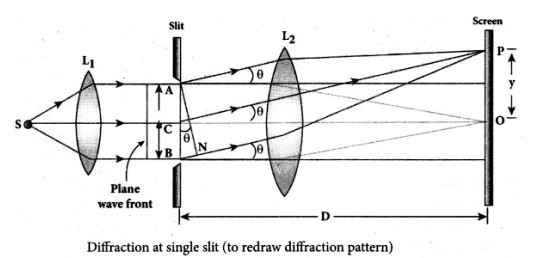
(v) The basic idea is to divide the slit into much smaller even number of parts. Then, add their contributions at P with the proper path difference to show that destructive interference takes place at that point to make it minimum. To explain maximum, the slit is divided into odd number of parts.
Condition for P to the nth order minimum:
(i) Dividing the slit into 2n number of (even number of) equal parts makes the light produced by one of the corresponding points to be cancelled by its counterpart. Thus, the condition for nth order minimum is, \(\frac{a}{2 n} \sin \theta=\frac{\lambda}{2}\)
\(a \sin \theta=n \lambda\) (nth minimum)
Where, n = 1,2,3... is the order of diffraction minimum.
36.
37.
(i) When a photon of energy hv is incident on a metal surface, it is completely absorbed by a single electron and the electron is ejected.
(ii) In this process, a part of the photon energy is used for the ejection of the electrons from the metal surface (photoelectric work function Φ0) and the remaining energy as the kinetic energy of the ejected electron. From the law of conservation of energy,
\(\\ \\ \\ hv=\phi { _{ 0 }+\cfrac { 1 }{ 2 } { mv }^{ 2 } }\) ......(1)
(iii) where m is the mass of the electron and v its velocity.
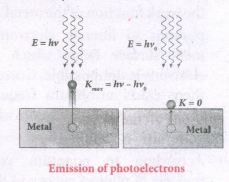
(iv) If we reduce the frequency of the incident light is reduced, the speed or kinetic energy of photo electrons is also reduced. At some frequency v0 of incident radiation, the photo electrons are ejected with almost zero kinetic energy.
Then the equation becomes.
\({ hv }_{ 0 }=\phi _{ 0 }\) ......(2)
(v) Where v0 is the threshold frequency. B rewriting the equation, we get
\(hv={ hv }_{ o }+\cfrac { 1 }{ 2 } { { mv }^{ 2 } }\) ......(3)
The equation is known as einstein's photoelectric equation.
(vi) If the electron does not lose energy by internal collisions, then it is emitted with maximum kinetic energy Kmax. Then
\({ K }_{ max }=\cfrac { 1 }{ 2 } { mv }^{ 2 }_{ max }\) ......(4)
(vii) where vmaxis the maximum velocity of max the electron ejected. The equation (1) is rearranged as follows:
\({ K }_{ max }=hv-{ \phi }_{ 0 }\)
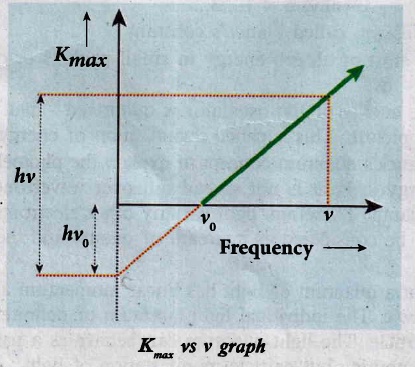
A graph between maximum kinetic energy Kmax of the photoelectron and frequency v of the incident light is a straight line.
38.
(i) In metals, the electrons in the outer most shells are loosely bound to the nucleus. Even at room temperature, there are a large number of free electrons which are moving inside the metal in a random manner. Through they move freely inside the metal they cannot leave the surface of the metal. The reason is that when free electrons reach the surface of the metal they are attracted by the positive nuclei of the metal. It is attractive pull which will not allow free electrons to leave the metallic surface at room temperature.
(ii) In order to leave the metallic surface, the free electrons must cross a potential barrier created by the positive nuclei of the metal. The potential barrier. which prevents free electrons from leading the metallic surface is called surface barrier.
(iii) Whenever an additional energy is given to the free electrons, they will have sufficient energy to cross the surface barrier. And they escape from the metallic surface. The liberation of electrons from any surface of a substance is called electron emission.
(iv) The minimum energy needed for an electron to escape from the metal surface is called work function of that metal.
(a) Thermionic emission
(i) When a metal is heated to a high temperature, the free electrons on the surface of the metal get sufficient energy in the form of thermal energy so that they are emitted from the metallic surface. This type of emission is known a thermonic emission.
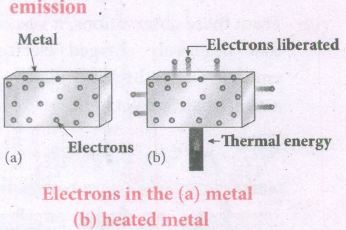
(ii) The intensity of the thermionic emission (the number of electrons emitted) depends on the metal used and its temperature.
(iii) Examples: cathode ray tubes, electron microscopes, X-ray tubes etc.
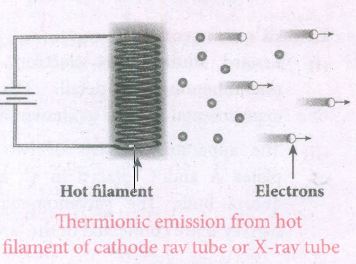
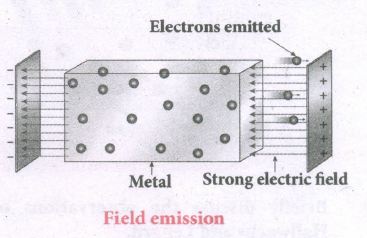
(b) Field emission
(i) Electric field emission occurs when a very strong electric field is applied across the metal.
(ii) This strong field pulls the free electrons and helps them to overcome the surface barrier of the metal.
(iii) Ex: Field ermssion scanning electron microscopes, Field-emission display etc.
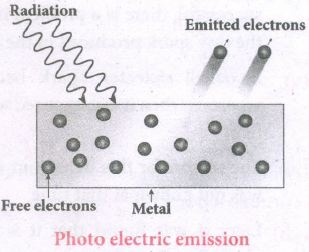
(c) Photo electric emission
(i) When an electromagnetic radiation of suitable frequency is incident on the surface of the metal, the energy is transferred from the radiation to the free electrons.
(ii) Hence, the free electrons get sufficient energy to cross the surface barrier and the photo electric emission takes place.
(iii) The number of electrons emitted depend on the intensity of the incident radiation.
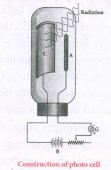
(iv) Examples: Photo diodes, photo electric cells etc.
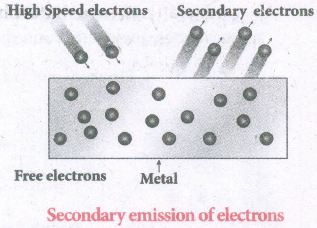
(d) Secondary emission
(i) When a beam of fast-moving electrons strikes the surface of the metal, the kinetic energy of the striking electrons is transferred to the free electrons on the metal surface.
(ii) Thus the free electrons get sufficient kinetic energy so that the secondary emission of electron occurs.
(iii) Examples: Image intensifiers, photo multiplier tubes etc.
39.
Condition for bright fringe (or) maxima :
The condition for the point P to have a constructive interference (or) be a bright fringe Is,
Path diference, δ = nλ Where, n = 0, 1, 2,....
\(\therefore\frac{dy}{D}=n\lambda\)
\(y=n\frac{\lambda D}{d}(or)y_n=n\frac{\lambda D}{d}\) .....(4)
This is the condition for the point P to have a bright fringe. The distance yn is the distance or the nth bright fringe from the point O.
Condition for dark fringe (or) minima:
The condition for the point P to have a destructive interference (or) be a dark fringe is,
Path difference, δ = \((2n-1)\frac{\lambda}{2}\) Where, n = 1, 2, 3....
\(\therefore\frac{dy}{D}=(2n-1)\frac{\lambda}{2}\)
\(y=\left(\frac{(2n-1)}{2} \frac{\lambda D}{d}\right)(or)\left(\frac{(2 n-1)}{2} \frac{\lambda D}{d}\right) \) .....(5)
This is the condition for the point P to have a dark fringe. The distance yn is the distance of the nth dark fringe from the point O
Bandwidth:
The bandwidth \((\beta)\) is defined as the distance between any two consecutive bright or dark fringes.
\(\beta=y_{(n+1)}-y_{n}=\left((n+1) \frac{\lambda D}{d}\right)-\left(n \frac{\lambda D}{d}\right) \)
\(\beta=\frac{\lambda D}{d} \) .....(6)
Bright and Dark tinges are of same width equally spaced on either side of the central bright fringe.
40.
Let us Consider two light waves from the two sources SI and S2 meeting at a point P as shown in figure
The wave from SI at an instant t at P is,
y1= a1 sin ω t ...................(1)
The wave form S2 at an instant t at P is,
y2= a2 sin (ωt + Φ) .............(2)
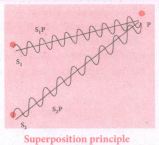
The two waves have different amplitudes al and a2 , same angular frequency ω, and a phase difference of \(\phi\)
y = y1 + y2 = a1 = a\sin ωt + a1sin2 (ωt + Φ) ............(3)
The simplification of the above equation by using trigonometric identities,
\(y=Asin\left( \omega t+\theta \right) \) ..............(4)
where, \(A=\sqrt { { a }_{ 1 }^{ 2 }+{ a }_{ 2 }^{ 2 }+2{ a }_{ 1 }{ a }_{ 2 }cos\phi } \) ..................(5)
\(\theta ={ tan }^{ -1 }\cfrac { { a }_{ 2 }sin\phi }{ { a }_{ 1 }+{ a }_{ 2 }cos\phi } \) ..................(6)
The resultant amplitude is maximum,
\({ A }_{ max }=\sqrt { \left( { a }_{ 1 }+{ a }_{ 2 } \right) ^{ 2 } } \) ; When Φ = 0,± 2π , ± 4π... ................(7)
The resultant amplitude is minimum
\({ A }_{ min }=\sqrt { \left( { a }_{ 1 }+{ a }_{ 2 } \right) ^{ 2 } } \); When Φ = ±π, ± 3π, ± 5π..., ............(8)
The intensity of light is proportional to square of amplitude,
I ∝ A2 ...........(9)
Now, equation (5) becomes,
\(1\infty { I }_{ 1 }+I_{ 2 }+2\sqrt { { I }_{ 1 }{ { I }_{ 2 } } } cos\phi \) ..........(10)
In equation (10) if the phase difference, f = 0, ± 2π, ± 4π ... , it corresponds to the condition for maximum intensity of light called as constructive interference.
The resultant maximum intensity is
\({ I }_{ max }\propto \left( { a }_{ 1 }+{ a }_{ 2 } \right) ^{ 2 }\propto { I }_{ 1 }{ I }_{ 2 }+2\sqrt { { \quad I }_{ 1 }{ I }_{ 2 } } \) ...............(11)
In equation (10) if the phase difference, Φ = ±π, ±3π, ± 5π ... , it corresponds to the condition for minimum intensity of light called destructive interference.
The resultant minimum intensity is,
\({ I }_{ min }\propto \left( { a }_{ 1 }+{ a }_{ 2 } \right) \propto { I }_{ 1 }+{ I }_{ 2 }2\sqrt { { I }_{ 1 }{ I }_{ 2 } } \) ................(12)
As a special case, if a1 = a2 = a, then equation (5) becomes
\(A=\sqrt{2 a^{2}+2 a^{2} \cos \phi} =\sqrt{2 a^{2}(1+\cos \theta)} \)
\(=\sqrt{2 a^{2} 2 \cos ^{2}\left(\frac{\phi}{2}\right)} \)
\(\mathrm{A}=2 \mathrm{a} \cos (\phi / 2) \) ........(13)
\(\mathrm{I} \alpha 4 \mathrm{a}^{2} \cos ^{2}(\phi / 2)\left[\therefore \mathrm{I} \alpha \mathrm{A}^{2}\right] \) ..............(14)
\(\mathrm{I}=4 \mathrm{I}_{0} \cos ^{2}(\phi / 2)\left[\therefore \mathrm{I}_{0} \alpha \mathrm{a}^{2}\right] \) ...............(15)
\(\mathrm{I}_{\max }=4 \mathrm{I}_{0} \text { when, } \phi=0, \pm 2 \pi, \pm 4 \pi \ldots . \) ...............(16)
\(\mathrm{I}_{\min }=0 \text { when, } \phi=\pm \pi, \pm 3 \pi, \pm 5 \pi \ldots . \) .............(17)
41.
Angle of deviation Produced by Prism:
(i) Let light ray PQ is incident on one of the refracting faces of the prism.
(ii) The angles of incidence and refraction at the first face AB are i1 and rl. The path of the light inside the prism is QR.
(iii) The angle of incidence and refraction at the second face AC is r2 and i2 respectively.
(iv) RS is the ray emerging from the second face. Angle i2 is also caned angle of emergence.
(v) The angle between the direction of the incident ray PQ and the emergent ray RS is called the angle of deviation d.
(vi) The two normals drawn at the point of incidence Q and emergence R meet at point N. They meet at point N.
(vii) The extended incident ray and the emergent ray meet at a point M.
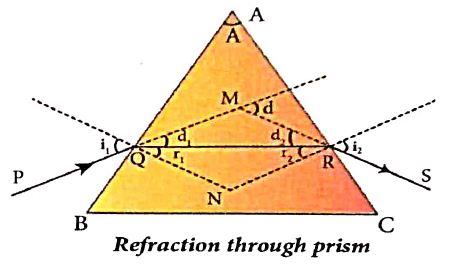
The angle of deviation d1 at the surface AB is,
ㄥRQM = d = i1 - r1 ...(1)
The angle of deviation d2 at the surface AC is
ㄥQRM = d2 = i2 - r2 .......(2)
Total angle of deviation d produced is,
d = d1 + d2 .....(3)
Substituting for d1 and d2 in equation (3)
d = (i1 - r1) + (i2 - r2)
After rearranging,
d = (i1 - r1) + (i2 - r2) ........(4)
In the quadrilateral AQNR, two of the angles (at the vertices Q and R) are right angles. Therefore, the sum of the other angles of the quadrilateral is 180°.
\(\angle A+\angle QNR={ 180 }^{ 0 }\) .........(5)
From the triangle ΔQNR
\({ r }_{ 1 }+{ r }_{ 2 }+\angle QNR={ 180 }^{ o }\) ......(6)
Comparing these two equations (5) and (6) we get,
r1 + r2 = A .......(7)
Substituting this in equation (4) for angle of deviation,
d = i1+ i2 - A .............(8)
(viii) Thus, the angle of deviation depends on the angle of incidence i1, angle of emergence i2 and the angle for the prism A.
(ix) For a given angle of incidence the angle of emergence is decided by the refractive index of the material of the prism. Hence the angle of deviation depends on these following factors.
(i) the angle of incidence
(ii) the angle of the prism.
(iii) the refractive index of the material of the prism (which decides the angle of emergence).
Refractive index of the material of the prism:
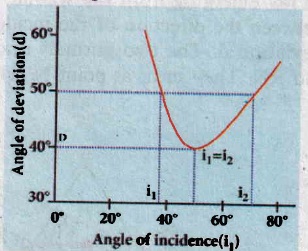
At minimum deviation, i1 = i2 = i and r1 = r2 = r
Now, the equation (8) becomes,
D - i1 + i2 - A = 2i - A (or) \(i=\cfrac { \left( A+D \right) }{ 2 } \)
The equation (7) becomes
r1 + r2 = A ⇒ 2r = A (or) \(r=\cfrac { A }{ 2 } \)
Substituting i and r in Snell's law
\(n=\cfrac { sini }{ sinr } \)
\(n=\cfrac{\cfrac{sin(A+D)}{2}}{sin(A/2)}\)
42.
43.
Mirror Equation :
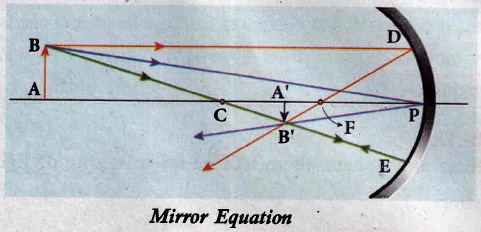
(i) AB is an object which is placed on the principal axis of a concave mirror beyond the center of curvature C. A' B' is an image which is formed between the point pole P, and the centre of curvature.
(ii) From the figure As per law of reflection, the angle of incidence ∠BPA is equal to the angle of reflection ∠B'PA'.
(iii) The triangles ∠BPA and ∠B'PA' are similar. Thus, from the rule of similar triangles,
\(\cfrac { { A }^{ ' }{ B }^{ ' } }{ AB } =\cfrac { { PA }^{ ' } }{ PA } \) ................(1)
(iv) The other set of similar triangles are, ΔDPF and ΔB'A'F. (PD is almost a straight vertical line)
\(\cfrac { { A }^{ ' }B' }{ PD } =\cfrac { A'F }{ PF } \)
(v) As, PD = AB the above equation becomes,
\(\cfrac { A'B' }{ AB } =\cfrac { A'F }{ PF } \) ......(2)
(vi) From equations (1) and (2) we can write,
\(\cfrac { PA' }{ PA } =\cfrac { A'F }{ PF } \)
(vii) As, A'F = PA' - PF, the above equation becomes,
\(\cfrac { PA' }{ PA } =\cfrac { PA'-PF }{ PF } \) .....(3)
(viii) We can apply the sign conventions for the various distances in the above equation
PA = - u, PA' = -v, PF = - f
(ix) All the three distances are negative as per sign convention, because they are measured to the left of the pole. Now, the equation (3) becomes,
\(\cfrac { -v }{ -u } =\cfrac { -v-\left( -f \right) }{ -f } \)
On further simplification,
\(\cfrac { v }{ u } =\cfrac { v-f }{ f } ;\cfrac { v }{ u } =\cfrac { v }{ f } -1 \)
Dividing either side with v,
\(\cfrac { 1 }{ u } =\cfrac { 1 }{ f } -\cfrac { 1 }{ v } \)
After rearranging,
\(\cfrac { 1 }{ v } +\cfrac { 1 }{ u } =\cfrac { 1 }{ f } \)
The above equation is called mirror equation.
Lateral magnification:
The lateral or transverse magnification is defined as the ratio of the height of the image to the height of the object. The height of the object and image are measured perpendicular to the principal axis.
Magnification (m) \(=\frac{\text { height of the image }\left(h^{\prime}\right)}{\text { height of the image }(h)} \)
\(m=\frac{h^{\prime}}{h} \) ....(1)
Applying proper sign conventions for equation,
\(\frac{A^{\prime} B^{\prime}}{A B}=\frac{P A^{\prime}}{P A} \)
\(A^{\prime} B^{\prime}=-h^{\prime}, A B=h, P A^{\prime}=-v, P A=-u \)
\(-\frac{h}{h}=\frac{-v}{-u} \)
On simplifying we get,
\(\mathrm{m}=\frac{\mathrm{h}^{\prime}}{\mathrm{h}}=-\frac{\mathrm{v}}{\mathrm{u}}\) ...(2)
Using mirror equation, we can further write the magnification as,
\(m=\frac{h^{\prime}}{h}=\frac{f-v}{f}=\frac{f}{f-u}\) ..(3)

12th Standard Syllabus & Materials
12th Standard
TN 12th Computer Applications களப்பெயர் முறைமை (DNS) Sample Question Papers Study Material - QB365 Set A
NEW12th Standard
TN 12th Computer Applications வலையமைப்பு எடுத்துக்காட்டுகள் மற்றும் நெறிமுறைகள் Sample Question Papers Study Material - QB365 Set A
NEW12th Standard
TN 12th Computer Applications கணினி வலையமைப்பு ஓர் அறிமுகம் Sample Question Papers Study Material - QB365 Set A
NEW12th Standard
TN 12th Computer Applications PHP-உடன் MySQL-ஐ இணைத்தல் Sample Question Papers Study Material - QB365 Set A



Tamilnadu Stateboard 12th Standard Subjects

Maths

Chemistry
Physics

Biology

Computer Science

Business Maths and Statistics

Economics

Commerce

Accountancy

History

Computer Applications
Biology
Computer Technology
Computer Applications
Computer Science
Business Maths and Statistics
Commerce
Economics
Maths
Chemistry
Physics
Computer Technology
History
Accountancy

Tamil

English

French
Tamilnadu Stateboard Standards


