
 100% FREE ACCESS
12th Standard Syllabus & Materials
12th Standard
TN 12th Computer Applications மின்னணு தரவு பரிமாற்றம் Sample Question Papers Study Material - QB365 Set A
NEW12th Standard
TN 12th Computer Applications மின் - வணிக பாதுகாப்பு அமைப்புகள் Sample Question Papers Study Material - QB365 Set A
NEW12th Standard
TN 12th Computer Applications மின்னணு செலுத்தல் முறைகள் Sample Question Papers Study Material - QB365 Set A
NEW12th Standard
TN 12th Computer Applications மின் - வணிகம் Sample Question Papers Study Material - QB365 Set A
NEW12th Standard
TN 12th Computer Applications திறந்த மூல கருத்துருக்கள் Sample Question Papers Study Material - QB365 Set A
NEW12th Standard
TN 12th Computer Applications வலையமைப்பு வடமிடல் Sample Question Papers Study Material - QB365 Set A

Published on: 28/11/2025
Download Tamil Nadu 12th Standard Physics question papers, model tests, one-mark questions, important questions, and public exam papers in PDF format. Free study materials and answer keys for TN State Board students.
Questions + Answers key
Take MCQ Physics Test
1.
Light transmitted by Nicol prism is, _____.
partially polarised
unpolarised
plane polarised
elliptically polarised
2.
One of the of Young’s double slits is covered with a glass plate as shown in figure. The position of central maximum will,_____.
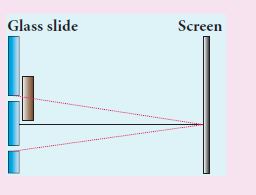
get shifted downwards
get shifted upwards
will remain the same
data insufficient to conclude
3.
A ray of light strikes a glass plate at an angle 60o. If the reflected and refracted rays are perpendicular to each other, the refractive index of the glass is, _____.
\(\sqrt3\)
\(\frac{3}{2}\)
\(\sqrt{\frac{3}{2}}\)
2
4.
When light is incident on a soap film of thickness 5 x 10⁻⁵ cm, the wavelength of light reflected maximum in the visible region is 5320 Å. Refractive index of the film will be, _____.
1.22
1.33
1.51
1.83
5.
Two coherent monochromatic light beams of intensities I and 4I are superposed. The maximum and minimum possible intensities in the resulting beam are _____.
5I and I
5I and 3I
9I and I
9I and 3I
6.
In a Young’s double-slit experiment, the slit separation is doubled. To maintain the same fringe spacing on the screen, the screen-to-slit distance D must be changed to, _____.
2D
\(\frac{D}{2}\)
\(\sqrt{2}\)D
\(\frac{D}{\sqrt2}\)
7.
Two point white dots are 1 mm apart on a black paper. They are viewed by eye of pupil diameter 3 mm approximately. The maximum distance at which these dots can be resolved by the eye is_____. [take wavelength of light, λ = 500 nm]
1 m
5 m
3 m
6 m
8.
An air bubble in glass slab of refractive index 1.5 (near normal incidence) is 5 cm deep when viewed from one surface and 3 cm deep when viewed from the opposite face. The thickness of the slab is ______.
8 cm
10 cm
12 cm
16 cm
9.
The radius of curvature of curved surface at a thin planoconvex lens is 10 cm and the refractive index is 1.5. If the plane surface is silvered, then the focal length will be, ______.
5 cm
10 cm
15 cm
20 cm
10.
When a biconvex lens of glass having refractive index 1.47 is dipped in a liquid, it acts as plane sheet of glass. This implies that the liquid must have refractive index, ______.
less than one
less than that of glass
greater than that of glass
equal to that of glass
11.
Stars twinkle due to, ______.
reflection
total internal reflection
refraction
polarisation
12.
13.
An object is placed in front of a convex mirror of focal length off and the maximum and minimum distance of an object from the mirror such that the image formed is real and magnified.
2f and c
c and \(\infty\)
f and O
None of these
14.
A rod of length 10 cm lies along the principal axis of a concave mirror of focal length 10 cm in such a way that its end closer to the pole is 20 cm away from the mirror. The length of the image is, ______.
2.5 cm
5cm
10 cm
15cm
15.
The speed of light in an isotropic medium depends on, ______.
its intensity
its wavelength
the nature of propagation
the motion of the source w.r.t medium
16.
A biconvex lens has radii of curvature 20 cm and 15 cm for the two curved surfaces. The refractive index of the material of the lens is 1.5.
(a) What is its focal length?
(b) Will the focal length change if the lens is flipped by the side?
17.
A compound microscope has a magnifying power of 100 when the image is formed at infinity. The objective has a focal length of 0.5 cm and the tube length is 6.5 cm. What is the focal length of the eyepiece.
18.
Discuss about astronomical telescope.
19.
List the uses of polaroids.
20.
State and obtain Malus’ law. (or) State Malus' Law.
21.
Differentiate between polarised and unpolarised light.
22.
Derive the equation for effective focal length for lenses in contact.
23.
Derive the relation between f and R for a spherical mirror.
24.
Obtain the equation for apparent depth.
25.
26.
What is polarisation?
27.
What is Rayleigh’s scattering?
28.
What is bandwidth of interference pattern?
29.
State Huygens’ principle.
30.
Define wavefront.
31.
Why do clouds appear white?
32.
Why does sky appear blue?
33.
What is power of a lens?
34.
Mention different parts of spectrometer and explain the preliminary adjustments.
35.
Discuss the diffraction at a grating and obtain the condition for the mth maximum.
36.
Explain the Young’s double slit experimental setup and obtain the equation for path difference.
37.
Obtain the equation for resultant intensity due to interference of light.
38.
Prove law of refraction using Huygens’ principle.
39.
What is dispersion? Obtain the equation for dispersive power of a medium.
40.
Obtain lens maker’s formula and mention its significance.
41.
Obtain the equation for radius of illumination (or) Snell’s window.
42.
43.
Derive the mirror equation and the equation for lateral magnification.
1.
(c)
plane polarised
2.
(b)
get shifted upwards
3.
n = tan ip = tan 60o = \(\sqrt{3}\)
4.
2n t cos r = (2m + 1) \(\frac{\lambda}{2}\)
For maximum
m = 2 (For visible region), n - refractive index.
cos r = cos 0 = 1
t = 5 x 10-5 x 10-2 = 5 x 10⁻⁷ m
\(n=\frac{(2m+1)\frac{\lambda}{2}}{2t}=\frac{5\lambda}{2 \times 2 \times t}\)
\(=\frac{5 \times5320\times10^{-10}}{4 \times 5 \times 10^{-7}}\)
\(=\frac{5 \times5320\times10^{-10}}{20}=1330 \times 10^3\)
n = 1.330
5.
I = l1 + l2 + 2\(\sqrt{I_1I_2}\)cos θ
If cos θ = cos 0 = l, I is max
= I+ 4I + 2\(\sqrt{41^2}\) cos 0
= 5I + 4I = 91
If cos π = -1, I is min
Imin = I + 4I + 2\(\sqrt{41^2}\) cos π
= 5I + 4I(-1)
= 5I + 4I = I
(Imax, Imin)= (9I, I)
6.
d' = 2d, β' = β, D' = ?
W.K.T, Fringe width
\(\beta = \frac{D\lambda}{d} \Rightarrow D' = \frac{Dd'}{d}\)
\(D' = \frac{D2d}{d}=2D\)
7.
λ = 500 nm = 500 x 10-9 m
x = 3 mm = 3 x 10⁻³ m
a = 1 mm = 1 x 10⁻³ m
\(d=\frac{xa}{1.22 \lambda}\)
\(d=\frac{3 \times1\times10^{-6}}{1.22 \times500\times10^{-9}}\)
\(=\frac{3 \times1\times10^{-6}}{6.10 \times 10^{-7}}\)
\(d=\frac{30}{6.1}=5 m\)
8.
Apparent depth = 3 + 5 = 8 cm
Real depth = thickness of the slab = t
n = 1.5
\(n=\frac{Real \ depth}{Apparent \ depth}\)
\(\therefore 1.5=\frac{t}{8}\)
t = 1.5 x 8
t = 12 cm
9.
\(\frac{1}{f} =(n-1)\left(\frac{1}{R_1}-\frac{1}{R_2}\right) \)
\(=(1.5-1)\left(\frac{1}{\infty}-\frac{1}{(-10)}\right)\)
(Since plano convex lens)
\(=0.5\left[\frac{1}{10}\right]=\frac{1}{20} \)
\(\mathrm{f}_t =20 \mathrm{~cm}\)
Formula for silvered lenses
\(\frac{1}{\mathrm{~F}} =\frac{2}{\mathrm{f}_1}+\frac{1}{\mathrm{f}_m} \)
\(\frac{1}{\mathrm{~F}} =\frac{2}{20}+\frac{1}{\infty} \)
\(\therefore \mathrm{F} =\frac{20}{2}=10 \mathrm{~cm}\)
10.
\(\frac{I}{f}=\left(\frac{\mu_{\mathrm{L}}}{\mu_L}-1\right)\left(\frac{1}{R_1}-\frac{1}{R_2}\right)\)
When the biconvex lens of glass dipped in liquid, it acts as a plane sheet of glass.
\(\therefore \mathrm{f}=\infty, \frac{1}{\mathrm{f}}=0 \quad \frac{\mu_g}{\mu_{\mathrm{L}}}-1=0 ; \frac{\mu_{\mathrm{s}}}{\mu_{\mathrm{L}}}=1, \mu_{\mathrm{s}}=\mu_{\mathrm{L}}\)
11.
(c)
refraction
12.
(a)
13.
Convex Mirror is diverging in nature and for all positions of objects, convex mirror forms virtual and erect image.
14.
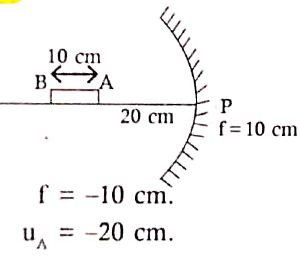
At end A,
\(\frac{1}{f} =\frac{1}{u_A}+\frac{1}{v_A} \)
\(\therefore \frac{1}{v_A} =\frac{1}{-10}-\frac{1}{-20} \)
\(\frac{1}{v_A} =-\frac{1}{10}+\frac{1}{20}=\frac{-2+1}{20}=-\frac{1}{20} \)
\(v_A =-20 \mathrm{~cm} \)
\(\left|v_{\wedge}\right|=20 \mathrm{~cm}\)
At end B,
\(\frac{1}{f} =\frac{1}{u_B}+\frac{1}{v_B} \)
\(\frac{1}{v_B} =\frac{1}{f}-\frac{1}{u_B}, \)
\(u_B =-30 \mathrm{~cm} \)
\(\frac{1}{v_B} =-\frac{1}{10}+\frac{1}{30} \)
\(=\frac{-3+1}{30}=\frac{-2}{30}=\frac{-1}{15} \)
\(v_B =-15 \mathrm{~cm} \)
\(\left|v_B\right| =15 \mathrm{~cm} \)
\(\therefore \quad\left|\mathrm{v}_{\mathrm{A}}\right|-\left|\mathrm{v}_{\mathrm{B}}\right| \) is the length of the image
= 20 - 15 = 5 cm
15.
v = nג
In an isotropic medium, there is no change in the frequency of the light. So, the speed of light depends on wavelength of light.
16.
For a biconvex lens, radius of curvature of the first surface is positive and that of the second surface is negative as shown in the figure.
.JPG)
Given, n = 1.5, R1 = 20 cm and R2 = –15 cm
(a) Lensmaker’s formula \(\frac{1}{f}=(n-1)\left(\frac{1}{R_{1}}-\frac{1}{R_{2}}\right)\)
Substituting the values,
\(\frac{1}{f}=(1.5-1)\left(\frac{1}{20}-\frac{1}{-15}\right)=(1.5-1)\left(\frac{1}{20}+\frac{1}{15}\right)\)
\(\frac{1}{f}=(0.5)\left(\frac{1}{20}+\frac{1}{15}\right)=(0.5)\left(\frac{3+4}{60}\right)=\left(\frac{1}{2} \times \frac{7}{60}\right)=\frac{7}{120}\)
\(f=\frac{120}{7}\) = 17.14 cm
As the focal length is positive the lens is a converging lens.
(b) When the lens is flipped by the side,
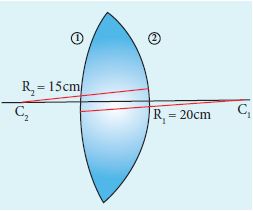
Now, R1= 15 cm and R2 = –20 cm, n = 1.5
Substituting the values in the lens maker's formula,
\(\cfrac { 1 }{ f } =\left( 1.5-1 \right) \left( \cfrac { 1 }{ 15 } -\cfrac { 1 }{-20 } \right) \)
\(\cfrac { 1 }{ f } =\left( 1.5-1 \right) \left( \cfrac { 1 }{ 15 } +\cfrac { 1 }{ 20 } \right) \)
This will also result in, f = 17.14 cm
Thus, it is concluded that the focal length of the lens will not change if it is flipped by the side. This is true for any lens. Students can verify this for any kind of lens.
17.
\(\mathrm{m}_{\alpha}=100 ; \mathrm{f}_{o}=0.5 \mathrm{~cm} ; \mathrm{f}_{\mathrm{e}}=? \)
\(\mathrm{~L}_{\alpha}=6.5 \mathrm{~cm}, \mathrm{D}=25 \mathrm{~cm} \)
When the image is formed at infinity,
\(\mathrm{m}_{\alpha}=\frac{\left(\mathrm{L}_{\alpha}-\mathrm{f}_{0}-\mathrm{f}_{\mathrm{c}}\right) \mathrm{D}}{\mathrm{f}_{0} \mathrm{f}_{\mathrm{e}}} \)
\(100 =\left(\frac{6.5-0.5-f_{e}}{0.5 \times f_{e}}\right) \times 25 \)
\(=\left(\frac{6-f_{e}}{0.5 f_{e}}\right) \times 25 \)
\(100 \times 0.5 f_{e} =150-25 f_{e} \)
\(50 f_{e} =150-25 f_{e} \)
\(75 f_{e} =150 \)
\(f_{e} =150 / 75=2 \mathrm{~cm} \)
18.
(i) An astronomic telescope used to get the magnification of distant astronomical objects like stars, planets, moon etc.
(ii) The image formed by astronomicaltelescope willbe inverted. It has an objective of long focal length and a much larger aperture than the eyepiece as shown in Figure.
(iii) Light from a distant object enters the objective and a real image is formed in the tube at its second focal point.
(iv) The eyepiece magnifies this image producing a final inverted image.
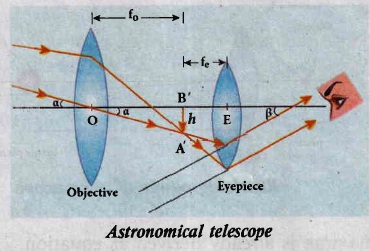
Magnification of astronomical telescope:
The magnification m is the ratio of the angle β subtended by the image to the angle α which subtended by the object with the principal axis
\(m=\cfrac { \beta }{ \alpha } \) ......(1)
From the diagram, ,\(\alpha=\frac{h}{f_e} \ and \ \beta=\frac{h}{f_e}\) ...................(2)
\(m=\cfrac { { f }_{ 0 } }{ { f }_{ e } } \) .........................(3)
The length of the telescope is approximate, L = f0 + fe.
19.
(i) Polaroids are used in goggles and cameras to avoid glare of light.
(ii) Polaroids are useful in 3D pictures i.e., in holography.
(iii) Polaroids are used to improve contrast in old oil paintings.
(iv) Polaroids are used in optical stress analysis.
(v) Polaroids are used as window glasses to control the intensity of incoming light.
(vi) Polarised laser beam acts as needle to read/ write in compact discs (CDs).
(vii) Polarised lights is used in liquid crystal display (LCD).
20.
When a beam of plane polarised light of intensity (Io) is incident on an analyser, the intensity of light (I) transmitted from the analyser varies directly as the square of the cosine of angle between the transmission axes of polariser and analyser.
\(I={ I }_{ o }cos^{ 2 }\theta \)
Consider the plane of polariser and analyser are inclined to each other at an angle ፀ. Let Io be the intensity and 'a' be the amplitude of the electric vector transmitted by the polariser. The amplitude 'a' of the incident light has two rectangular components, (acosθ) and (asinθ) which are the parallel and perpendicular components to the axis of transmission of the analyser. Only the component (acosθ) will be transmitted by the analyzer.
According to Malus's law
\(I\propto \left( acos\theta \right) ^{ 2 }\)
\(I=k\left( acos\theta \right) ^{ 2 }\)
Where k is constant of proportionality,
I = ka2 cos2 θ
I = Io = cos2 θ
Where Io = ka2 is the maximum intensity of light transmitted from the analyser.
21.
| S.No |
Polarised Light |
Unpolarised Light |
|---|---|---|
| (i) | It consists of waves having their electric field vibrations in a single plane normal to the direction of ray. | It consists of waves having their electric field and magnetic field vibrations in all directions normal to the direction of ray. |
| (ii) | Asymmetrical about the ray direction | Symmetrical about the ray direction. |
| (iii) | |It is obtained by converting unpolarised light using polaroids. | Produced by conventional light sources. |
22.
Consider two lenses 1 and 2 of focal length f1 and f2 are placed coaxially in contact with each other so that they have a common principal axis.
O be the object which is placed beyond the focus of the first lens on the principal axis. I' is the image of object O which is formed beyond the lens 2. Then, I' acts as an object for the lens 'P' is the common optical centre of the two lenses.
From the figure, PO =u, PI' = v' for lens I
PI' = v' (object distance) PI = v (image distance) for lens 2
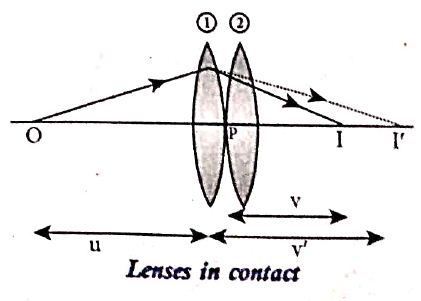
For lens 1,
\(\cfrac { 1 }{ v' } -\cfrac { 1 }{ u } =\cfrac { 1 }{ { f }_{ 1 } } \) .........(1)
For lens 2,
\(\cfrac { 1 }{ v } -\cfrac { 1 }{ u' } =\cfrac { 1 }{ { f }_{ 2 } } \) .........(2)
Adding (1) of (2)
\(\cfrac { 1 }{ v } -\cfrac { 1 }{ u } =\cfrac { 1 }{ f_1 }+\cfrac{1}{f_2} \) .........(3)
(vi) If the combination acts as a single lens of focal length f so that for an object at the position O it forms the image at I,
Then,
\(\cfrac { 1 }{ v } -\cfrac { 1 }{ u } =\cfrac { 1 }{ f } \) .........(4)
Comparing equations (3) and (4) we can write,
\(\cfrac { 1 }{ F } =\cfrac { 1 }{ { f }_{ 1 } } +\cfrac { 1 }{ { f }_{ 2 } } \) .........(5)
The above equation can be extended for any number of lenses in contact as,
\(\cfrac { 1 }{ f } =\cfrac { 1 }{ { f }_{ 1 } } +\cfrac { 1 }{ { f }_{ 2 } } +\cfrac { 1 }{ { f }_{ 3 } }+\cfrac { 1 }{ { f }_{ 4 } } +..........\)
23.
Relation between f and R:
C ⇒ Center of curvature
F ⇒ Principal focus
i ⇒ Angle of incidence
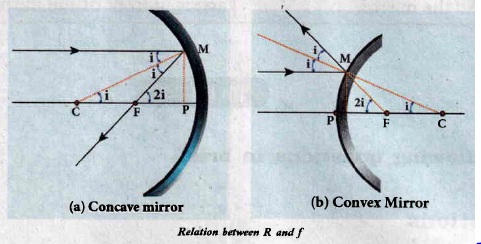
The angles
\(\tan i=\frac{P M}{P C} \text { and } \tan 2 i=\frac{P M}{P F}\)
As the angles are small, tan i = i and tan 2i = 2i.
\(\mathrm{i}=\frac{\mathrm{PM}}{\mathrm{PC}} \text { and } 2 \mathrm{i}=\frac{\mathrm{PM}}{\mathrm{PF}}\)
Simplifying further,
\(2 \frac{\mathrm{PM}}{\mathrm{PC}}=\frac{\mathrm{PM}}{\mathrm{PF}} ; 2 \mathrm{PF}=\mathrm{PC}, \mathrm{R}=2 \mathrm{f}\)
PF is focal length f and PC is the radius of curvature R.
R = 2f (or) f = R/2
24.
(i) Light from the object O at the bottom of the tank passes from denser medium (water) to rarer medium (air) to reach our eyes for viewing the object.
(ii) It deviates away from the normal in the rarer medium at the point of incidence B as shown in Figure.
(iii) The refractive index of the denser medium is n1 and that of rarer medium is n2. Here, n1 > n2.
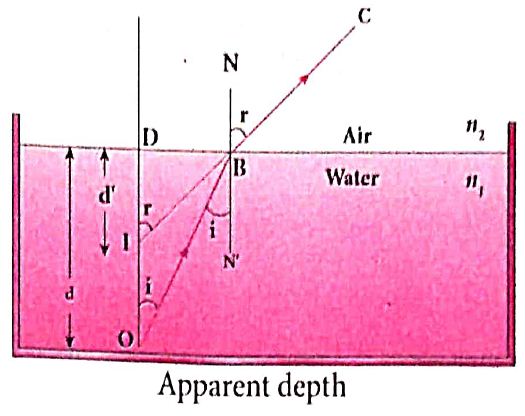
The angle of incidence in the denser medium is i and the angle of refraction in the rarer medium is r. The lines NN'and OD are parallel. Thus, the angle ∠DIB is also r. The angles i and r are very small as the diverging light from O entering the eye is very narrow. The Snell's law in product form for this refraction from equation is,
n1 sin i = n2 sin r
As the angles i and r are small, we can approximate, sin i = tan i and sin r tan r.
n1 tan i = n2 tan r
In triangles ∆DOB and ∆DIB,
\(tan \ i=\frac{DB}{DO}and \ tan \ r=\frac{DB}{DI}\)
\(n_1\frac{DB}{DO}=n_2\frac{DB}{DI}\)
DB is cancelled both sides. Now, DO is the actual depth d and DI is the apparent depth d'.
\(n_1\frac{1}{d}=n_2\frac{1}{d'}\)
After rearranging, \(\frac{d'}{d}=\frac{n_2}{n_1}\)
Rewriting the above equation for the apparent depth d', d' = \(=\frac{n_2}{n_1}d\)
As the rarer medium is air, its refractive index n, can be taken as 1, (n2 = 1) and the refractive index n1 of denser medium could then be taken as n itself, (n1 = n). Now, the equation for apparent depth becomes,
\(d'=\frac{d}{n}\)
The bottom appears to be elevated by d-d',
\(d-d'=d-\frac{d}{n}(or)d-d'=d(1-\frac{1}{n})\)
25.
26.
The Phenomenon of restricting the vibrations of light to a particular direction perpendicular to the direction of wave propagation motion is called polarization of light.
27.
If the scattering of light is by atoms and molecules which have size a yery less than that of the wavelength \({\lambda}\) of light a << \({\lambda}\) the scattering is called Rayleigh's scattering.
The intensity of Rayleigh's scattering is inversely proportional to fourth power of wavelength
\(\mathrm{I} ∝ \frac{1}{\lambda^{4}}\)
28.
The bandwidth (β) is defined as the distance between any two consecutive bright or dark fringes.
29.
According to Huygens's principle, each point of the wavefront is the source of secondary wavelets emanating from these points spreading out in all directions with the speed of the wave. These are called as secondary wavelets.
30.
A wavefront is the locus of points which are in the same state or phase of vibration.
31.
(i) If light is scattered by large particles like dust and water droplets present in the atmosphere which have size a greater than the wavelength \(\lambda\) of light, a > > \(\lambda\), the intensity of scattering is equal for all the wavelengths.
(ii) It is happening in clouds which contains large amount of dust and water droplets. Thus, in clouds all the colours get equally scattered irrespective of wavelength. so, the clouds appears white.
32.
\(\mathrm{I} ∝ \frac{1}{\lambda^{4}}\)
According to Rayleigh's scattering equation, violet colour which has the shortest wavelength gets much scattered during day time. The next scattered colour is blue. As our eyes are more sensitive to blue colour than violet colour the sky appears blue during day time.
33.
The power of a lens P is defined as the reciprocal of its focal length (in metre).
\(P=\frac{1}{f}\)
34.
i) The spectrometer is an optical instrument used to analyse the spectra of different sources of light, to measure the wavelength of different colours and to measure the refractive indices of materials of prisms.
ii) It basically consists of three parts namely. They are (i) collimator, (ii) prism table and (iii) Telescope
Adjustments of the spectrometer
(i) The following adjustments must be done in a spectrometer before doing the experiment.
(a) Adjustment of the eyepiece:
The telescope is turned towards an illuminated surface and the eyepiece is moved to and fro until the cross wires are clearly seen.
(b) Adjustment of the telescope:
The telescope is adjusted to' receive parallel rays by turning it towards a distant object and adjusting the distance between the objective lens and the eyepiece to get a clear image on the cross wire.
(c) Adjustment of the collimator:
The telescope is brought in line with the collimator. The distance between the illuminated slit and the lens of the collimator is adjusted until a clear image of the slit is seen at the cross wire.
(d) Levelling the prism table:
The prism table is brought to the horizontal level by adjusting the levelling screws and it is ensured by using sprit level.
35.
(i) Gratting has multiple slits with equal widths of size comparable to the wavelength of diffracting light.
(ii) Grating is a plane sheet of transparent material on which opaque rulings are made with a fine diamond pointer.
(iii) The modern commercial grating contains about 6000 lines per centimeter. The rulings act as obstacles having a definite width b and the transparent space between the rulings act as slit of width a.
(iv) The combined width of a ruling and a slit is called Gratting element (e = a + b).
(v) points on slit separated by a distance equal to the grating element are called corresponding points.
(vi) A plane transmission grating is represented by AB in Figure. Let a plane wavefront of monochromatic light with wavelength λ be incident on the grating.
(vii) As the width of the slits is comparable to that of wavelength, the incident light undergoes diffraction.
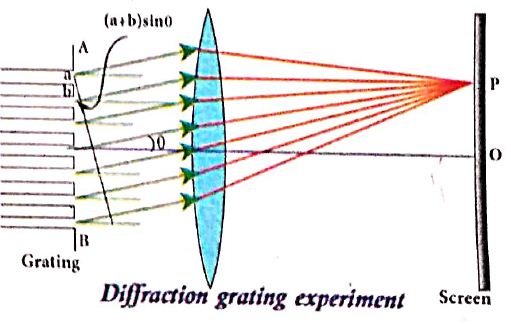
(viii) A diffraction pattern is obtained on the screen when the diffracted waves are focused on a screen using a convex lens.
(ix) Let us consider a point P at an angle θ with the perpendicular drawn from the center of the grating to the screen.
(x) The path difference ઠ between the diffracted waves from one pair of corresponding points is,
\(\delta =(a+b)sin\theta \) ........(1)
This path difference is the same for any pair of corresponding points. The point P on the screen will be maximum, when
ઠ= m λ where m = 0,1,2,3 ........(2)
Combining the above two equations, we get,
(a + b) sin θ = mλ ...............(3)
Here, m is called order of diffraction.
Condition for mth order maximum :
(i) On the side of central maxima different higher orders of diffraction maxima are formed at different angular positions. If we take,
\(N=\cfrac { 1 }{ a+b } \) .................(4)
(ii) Then, N gives the number of grating elements or rulings drawn per unit width of the grating. Normally, this number N is specified on the grating itself. Now, the equation becomes,
\(\cfrac { 1 }{ N } sin\theta =m\lambda \) (or) \(sin\theta =Nm\lambda \) ...............(5)
36.
Experimental setup:
(i) S is a source s1 and s2 the double slits which are at equidistances from 's'. Wavefronts from s1 and s2 spread out and overlap on other side of double slit.
(ii) When a screen is placed at a distance of about 1 meter from the slits, alternate bright and dark fringes which are equally spaced appear on the screen. These are called interference fringes or bands.
(iii) Using an eyepiece the fringes can be seen directly. At the center point O on the screen, waves from s1 and s2 travel equal distances and arrive in-phase as shown in Figure.
(iv) These two waves constructively interfere and bright fringe is observed at O. This is called cental bright fringe.
(v) When one of the slits is closed, The fringes disappear and there in uniform illumination on the screen.
(vi) This shows clearly that the bands are due to interference.
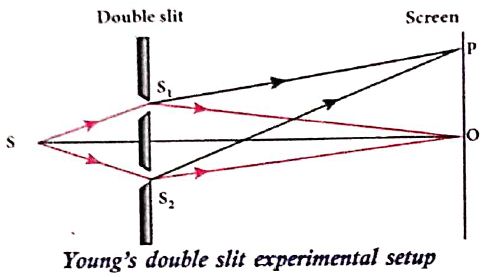
Equation for path difference :
(i) The Let d be the distance between the double slits s1 and s2 which act as coherent sources of wavelength λ.
(ii) A screen is placed parallel to the double slit at a distance D from it.
(iii) P is any point at a distance y from O.
(iv) The waves from S1 and S2 meet at P either in-phase or out-of-phase depending upon the path difference between the two waves.
.JPG)
The path difference \(\delta\) between the light waves from s1 and s2 to the point p is,
\(\delta=\mathrm{S}_{2} \mathrm{P}-\mathrm{S}_{1} \mathrm{P}\)
\(\delta=\mathrm{S}_{2} \mathrm{P}-\mathrm{MP}=\mathrm{S}_{2} \mathrm{M}\) .........(1)
\(\angle \mathrm{OCP}=\angle \mathrm{S}_{2} \mathrm{~S}_{1} \mathrm{M}=\theta\)
In right angle triangle \(\Delta \mathrm{S}_{1} \mathrm{S}_{2} \mathrm{M}\), the path difference S2M = d sin \(\theta\)
\(\delta=d \sin \theta\) ...........(2)
If the angle \(\theta\) is small, \(\sin \theta \approx \tan \theta \approx \theta\)
From the right angle triangle \(\Delta \mathrm{OCP}, \tan \theta=\frac{\mathrm{y}}{\mathrm{D}}\)
The path differences \(\delta=\frac{d y}{D}\) ...........(3)
Based on the condition of the path difference, the point P may have a bright (or) dark fringe
37.
Let us Consider two light waves from the two sources SI and S2 meeting at a point P as shown in figure
The wave from SI at an instant t at P is,
y1= a1 sin ω t ...................(1)
The wave form S2 at an instant t at P is,
y2= a2 sin (ωt + Φ) .............(2)
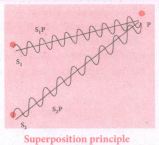
The two waves have different amplitudes al and a2 , same angular frequency ω, and a phase difference of \(\phi\)
y = y1 + y2 = a1 = a\sin ωt + a1sin2 (ωt + Φ) ............(3)
The simplification of the above equation by using trigonometric identities,
\(y=Asin\left( \omega t+\theta \right) \) ..............(4)
where, \(A=\sqrt { { a }_{ 1 }^{ 2 }+{ a }_{ 2 }^{ 2 }+2{ a }_{ 1 }{ a }_{ 2 }cos\phi } \) ..................(5)
\(\theta ={ tan }^{ -1 }\cfrac { { a }_{ 2 }sin\phi }{ { a }_{ 1 }+{ a }_{ 2 }cos\phi } \) ..................(6)
The resultant amplitude is maximum,
\({ A }_{ max }=\sqrt { \left( { a }_{ 1 }+{ a }_{ 2 } \right) ^{ 2 } } \) ; When Φ = 0,± 2π , ± 4π... ................(7)
The resultant amplitude is minimum
\({ A }_{ min }=\sqrt { \left( { a }_{ 1 }+{ a }_{ 2 } \right) ^{ 2 } } \); When Φ = ±π, ± 3π, ± 5π..., ............(8)
The intensity of light is proportional to square of amplitude,
I ∝ A2 ...........(9)
Now, equation (5) becomes,
\(1\infty { I }_{ 1 }+I_{ 2 }+2\sqrt { { I }_{ 1 }{ { I }_{ 2 } } } cos\phi \) ..........(10)
In equation (10) if the phase difference, f = 0, ± 2π, ± 4π ... , it corresponds to the condition for maximum intensity of light called as constructive interference.
The resultant maximum intensity is
\({ I }_{ max }\propto \left( { a }_{ 1 }+{ a }_{ 2 } \right) ^{ 2 }\propto { I }_{ 1 }{ I }_{ 2 }+2\sqrt { { \quad I }_{ 1 }{ I }_{ 2 } } \) ...............(11)
In equation (10) if the phase difference, Φ = ±π, ±3π, ± 5π ... , it corresponds to the condition for minimum intensity of light called destructive interference.
The resultant minimum intensity is,
\({ I }_{ min }\propto \left( { a }_{ 1 }+{ a }_{ 2 } \right) \propto { I }_{ 1 }+{ I }_{ 2 }2\sqrt { { I }_{ 1 }{ I }_{ 2 } } \) ................(12)
As a special case, if a1 = a2 = a, then equation (5) becomes
\(A=\sqrt{2 a^{2}+2 a^{2} \cos \phi} =\sqrt{2 a^{2}(1+\cos \theta)} \)
\(=\sqrt{2 a^{2} 2 \cos ^{2}\left(\frac{\phi}{2}\right)} \)
\(\mathrm{A}=2 \mathrm{a} \cos (\phi / 2) \) ........(13)
\(\mathrm{I} \alpha 4 \mathrm{a}^{2} \cos ^{2}(\phi / 2)\left[\therefore \mathrm{I} \alpha \mathrm{A}^{2}\right] \) ..............(14)
\(\mathrm{I}=4 \mathrm{I}_{0} \cos ^{2}(\phi / 2)\left[\therefore \mathrm{I}_{0} \alpha \mathrm{a}^{2}\right] \) ...............(15)
\(\mathrm{I}_{\max }=4 \mathrm{I}_{0} \text { when, } \phi=0, \pm 2 \pi, \pm 4 \pi \ldots . \) ...............(16)
\(\mathrm{I}_{\min }=0 \text { when, } \phi=\pm \pi, \pm 3 \pi, \pm 5 \pi \ldots . \) .............(17)
38.
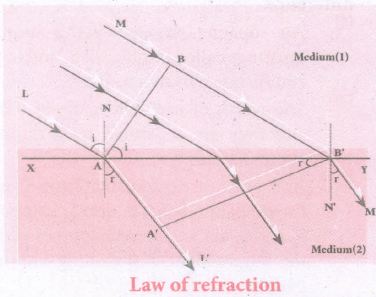
(i) Let us Consider a parallel beam of light is incident on a refracting plane surface XY such as a glass surface as shown in Figure.
(ii) The incident wavefront AB is in rarer medium (1) and the refracted wavefront A'B' is in denser medium (2).
(iii) These wavefronts are perpendicular to the incident rays L, M and refracted rays L', M' respectively.
\(t=\cfrac { BB' }{ { v }_{ 1 } } =\cfrac { AA' }{ { v }_{ 2 } } \) or \(\cfrac { BB' }{ AA' } =\cfrac { { v }_{ 1 } }{ { v }_{ 2 } } \)
(i) The incident rays, the refracted rays and the normal are in the same plane.
(ii) Angle of incidence
i = ∠ NAL = 90o - ∠NAB = ㄥ BAB'
Angle of refraction,
r = ∠ N'B'M = 90o-ㄥN'B'A' =∠ A'B'A
For the two right angle triangles ∆ABB' and ∆AA'B',
\(\cfrac { sini }{ sinr } =\cfrac { \frac { BB' }{ AB' } }{ \frac { AA' }{ AB' } } =\cfrac { BB' }{ AA' } =\cfrac { { v }_{ 1 } }{ { v }_{ 2 } } =\cfrac { \frac { c }{ { v }_{ 2 } } }{ \frac { c }{ { v }_{ 1 } } } \)
(iv) Here, C is speed of light in vacuum. The ratio \(\cfrac { c }{ v } \) is the constant, called refractive index of the medium. The refractive index of medium (1) is,\(\cfrac { c }{ { v }_{ 1 } } ={ n }_{ 1 }\) and that of medium (2) is,\(\cfrac { c }{ { v }_{ 1 } } ={ n }_{ 2 }\) In ratio form,
\(\cfrac { sini }{ sinr } =\cfrac { { n }_{ 2 } }{ { n }_{ 1 } } \) .............(1)
In product form,
n1 sin i = n2 sin r ..........(2)
Hence, the laws of refraction are proved.
39.
Dispersion: It is splitting of white light into its constituent colours.
(i) Consider a beam of white light passes through a prism; it gets dispersed into its constituent colours as shown in Figure.
(ii) Let \(\delta_{v}, \delta_{R} \) are the angles of deviation for violet and red light. Let nV and nR are the refractive indices for the violet and red light respectively
(iii) The refractive index of the material of a prism is given by the equation
\(\mathrm{n}=\frac{\sin \left(\frac{\mathrm{A}+\mathrm{D}}{2}\right)}{\sin (\mathrm{A} / 2)}\)
(iv) Here A is the angle of the prism and D is the angle of minimum deviation. If the angle of prism is small of the order of 10o, the prism is said to be a small angle prism.
(v) When rays of light pass through such prisms, the angle of deviation also becomes small. If A be the angle of a smitt angle prism and the angle of deviation then the prism formula becomes.
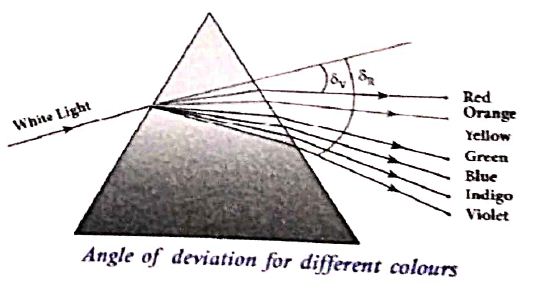
\(n=\frac{\sin \left(\frac{A+\delta}{2}\right)}{\sin (A / 2)}\)
For small angles of \(A\ and \ \delta \)
\(\sin \frac{A+\delta}{A} \approx \frac{A+\delta}{A} \)
\(\sin \frac{A}{2} \approx \frac{A}{2} \)
\(n=\frac{(A+\delta / 2)}{(A / 2)}=\frac{A+\delta}{A}=1+\frac{\delta}{A} \)
Further simplifying,
\(\frac{\delta}{A} =n-1 \)
\(\delta =(n-1) A \) .....(1)
(vi) When white light enters the prism, the deviation is different for different colours. Thus, the refractive index is also different for different colours
For Violet colour, \( \delta_{\mathrm{v}}=\left(\mathrm{n}_{\mathrm{v}}-1\right) \mathrm{A} \) ...(2)
For Red colour, \(\delta_{\mathrm{R}}=\left(\mathrm{n}_{\mathrm{R}}-1\right) \mathrm{A} \) ....(3)
(vii) As, angle of deviation for violet colour \(\delta_{v}\) is greater the angle of deviation for red colour \(\delta_{\mathrm{R}}\) the refractive index for violet colour nv is greater than the refractive index for red colour nR Subtracting \(\delta_{v}\) from \(\delta_{\mathrm{R}}\) we get
\(\delta_{\mathrm{v}}-\delta_{\mathrm{R}}=\left(\mathrm{n}_{\mathrm{v}}-\mathrm{n}_{\mathrm{R}}\right) \mathrm{A}\) ....(4)
(viii) The term \(\left(\delta_{v}-\delta_{R}\right)\) is the angular separation between the two extreme colours (violet and red) in the spectrum is called the angular dispersion. If we take \(\delta\) is the angle of deviation for any middly ray (green or yellow) and the corresponding refractive index. Then,
\(\delta=(n-1) A\) .....(5)
Dispersive power (ω):
It is the ability of the material of the prism to cause dispersion. It is defined as the ratio of the angular dispersion for the extreme colours to the deviation for any mean colour.
Dispersive power
\(\omega=\frac{\text { Angular dispersion }}{\text { Mean deviation }}=\frac{\delta_{v}-\delta_{R}}{\delta}\) ....(6)
Substituting \(\left(\delta_{\mathrm{v}}-\delta_{\mathrm{R}}\right) \text { and }(\delta) \)
\(\omega=\frac{\mathrm{n}_{\mathrm{v}}-\mathrm{n}_{\mathrm{R}}}{(\mathrm{n}-1)} \) .......(7)
(ix) Dispersive power is a dimensionless quality It has no unit. Dispersive power is always positive. The dispersive power of a prism depends only on the nature of material of the prism and it is independent of the angle of the prism.
40.
(i) Let us consider a thin lens made up of a medium of refractive index n2 is placed in a medium of refractive index n1. Let R1 and R2 be the radii of curvature of two spherical surfaces (1) and (2) respectively and P be the pole.
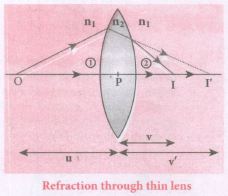
(ii) Consider a point object 'O' on the principal axis. A paraxial ray from 'O' which falls very close to P, after refraction at the surface (1) forms image at 1'.
(iii) Before it does so, it is again refracted by the surface (2). Therefore the final image is formed at I.
(iv) The general equation for the refraction at a single spherical surface is given from Equation,
\(\cfrac { { n }_{ 2 } }{ v } -\cfrac { { n }_{ 1 } }{ v} =\cfrac { \left( { n }_{ 2 }-{ n }_{ 1 } \right) }{ { R } } \)
For the refracting surface (1), the light goes from n1 to n2
\(\cfrac { { n }_{ 2 } }{ v' } -\cfrac { { n }_{ 1 } }{ u } =\cfrac { \left( { n }_{ 2 }-{ n }_{ 1 } \right) }{ { R }_{ 1 } } \) .....(1)
For the refracting surface (2), the light goes from n2 to n1
\(\frac{n_{1}}{v}+\frac{n_{2}}{v^{\prime}}=\frac{\left(n_{1}-n_{2}\right)}{R_{2}}\) ......(2)
For surface (2) I' acts as virtual object.
Adding the above two equations (1) and (2)
\(\cfrac { { n }_{ 1 } }{ v } -\cfrac { { n }_{ 1 } }{ u } =\left( { n }_{ 2 }-{ n }_{ 1 } \right) \left( \cfrac { 1 }{ { R }_{ 1 } } -\cfrac { 1 }{ { R }_{ 2 } } \right) \)
on further simplifying and rearranging,
\(\cfrac { 1 }{ v } -\cfrac { 1 }{ u } =\left( \cfrac { { n }_{ 2 }-{ n }_{ 1 } }{ { n }_{ 1 } } \right) \left( \cfrac { 1 }{ { R }_{ 1 } } -\cfrac { 1 }{ { R }_{ 2 } } \right) \)
\(\cfrac { 1 }{ v } -\cfrac { 1 }{ u } =\left( \cfrac { { n }_{ 2 } }{ n_{ 1 } } -1 \right) \left( \cfrac { 1 }{ { R }_{ 1 } } -\cfrac { 1 }{ { R }_{ 2 } } \right) \) ....(3)
If the object is at infinity, the image is formed at the focus of the lens. Thus, for u = \(\infty\), v = f. Then the equation becomes.
\(\cfrac { 1 }{ f } -\cfrac { 1 }{ \infty } =\left( \cfrac { { n }_{ 2 } }{ { { n }_{ 1 } } } -1 \right) \left( \cfrac { 1 }{ { R }_{ 1 } } -\cfrac { 1 }{ { R }_{ 2 } } \right) \)
\(\cfrac { 1 }{ f } =\left( \cfrac { { n }_{ 2 } }{ { n }_{ 1 } } -1 \right) \left( \cfrac { 1 }{ { R }_{ 1 } } -\cfrac { 1 }{ { R }_{ 2 } } \right) \) ......(4)
If the lens is kept in air, then we can take n2 = n and n1 = 1. So the equation (4) becomes,
\(\\ \cfrac { 1 }{ f } =\left( n-1 \right) \left( \cfrac { 1 }{ { R }_{ 1 } } -\cfrac { 1 }{ { R }_{ 2 } } \right) \) ..(5)
The above equation is called the lens maker's formula.
Significance:
It tells the lens manufacturers what curvature is needed to make a lens of desired focal length with a material of particular refractive index to make a lens of desired focal length. This formula holds good also for a concave lens.
41.
(i) The angle of view for water animals is restricted to twice the critical angle 2ic. The critical angle for water is 48.6°. Thus the angle of view is 97.2°.
(ii) The radius R of the circular area depends on the depth d from which it is seen and also the refractive indices of the media.
(iii) The radius R of Snell's window can be deduced with the illustration as shown in Figure.
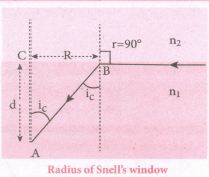
(iv) Light is seen from a point A at a depth 'd'.
(v) From the Snell's law in product form, n1 sini = n2 sinr
(vi) The equation for the refraction happening at the point B on the boundary between the two media is,
n1 sin ic = n2 sin90o ..(1)
n1sinic = n2 (∵ sin90o = 1)
\(sin{ i }_{ c }=\cfrac { { n }_{ 2 } }{ { n }_{ 1 } } \) ...(2)
From the right angle triangle ΔABC,
\({ sini }_{ c }=\cfrac { CB }{ AB } =\cfrac { R }{ \sqrt { { d }^{ 2 }+{ R }^{ 2 } } } \) ....(3)
Equating the above two equation
\(\cfrac { R }{ \sqrt { { d }^{ 2 }+{ R }_{ 2 } } } =\cfrac { { n }_{ 2 } }{ { n }_{ 1 } } \)
Squaring on both sides
\(\cfrac { { R }^{ 2 } }{ { R }^{ 2 }+d^{ 2 } } \left( \cfrac { { n }_{ 2 } }{ { n }_{ 1 } } \right) ^{ 2 }\)
Taking reciprocal,
\(\cfrac { { R }^{ 2 }+{ d }^{ 2 } }{ { R }^{ 2 } } =\left( \cfrac { { n }_{ 1 } }{ { n }_{ 2 } } \right) ^{ 2 }\)
On further simplifying
\(1+\cfrac { { d }^{ 2 } }{ { R }^{ 2 } } =\left( \cfrac { { n }_{ 1 } }{ { n }_{ 2 } } \right) ^{ 2 };\cfrac { { d }^{ 2 } }{ { R }^{ 2 } } =\left( \cfrac { { n }_{ 1 } }{ { n }_{ 2 } } \right) ^{ 2 }-1;\)
\(\cfrac { { d }^{ 2 } }{ { R }^{ 2 } } =\cfrac { { n }_{ 1 }^{ 2 } }{ { n }_{ 1 }^{ 2 } } -1=\cfrac { { n }_{ 1 }^{ 2 }-{ n }_{ 2 }^{ 2 } }{ { n }_{ 2 }^{ 2 } } \)
Again taking reciprocal and rearranging
\(\cfrac { { R }^{ 2 } }{ { d }^{ 2 } } =\cfrac { { { n }_{ 2 }^{ 2 } } }{ { n }_{ 1 }^{ 2 }-{ n }_{ 2 }^{ 2 } } { R }^{ 2 }={ d }^{ 2 }\left( \cfrac { { n }_{ 2 }^{ 2 } }{ { n }_{ 1 }^{ 2 }-{ n }_{ 2 }^{ 2 } } \right) \)
∴ The radius of illumination is,
\(R=d\sqrt { \cfrac { { n }_{ 2 }^{ 2 } }{ \left( n_{ 1 }^{ 2 }-{ n }_{ 2 }^{ 2 } \right) } } \) ...(4)
If the rarer medium outside is air, then, n2 = 1, and we can take n1 = n
\(R=d\left( \cfrac { 1 }{ \sqrt { { n }^{ 2 }-1 } } \right) \) or \(R=\cfrac { d }{ \sqrt { { n }^{ 2 }-1 } } \) ....(5)
42.
43.
Mirror Equation :
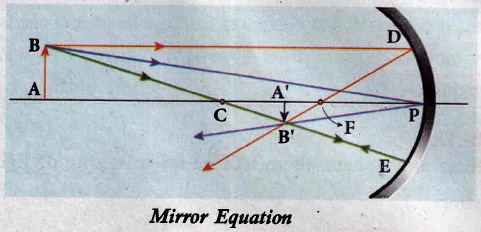
(i) AB is an object which is placed on the principal axis of a concave mirror beyond the center of curvature C. A' B' is an image which is formed between the point pole P, and the centre of curvature.
(ii) From the figure As per law of reflection, the angle of incidence ∠BPA is equal to the angle of reflection ∠B'PA'.
(iii) The triangles ∠BPA and ∠B'PA' are similar. Thus, from the rule of similar triangles,
\(\cfrac { { A }^{ ' }{ B }^{ ' } }{ AB } =\cfrac { { PA }^{ ' } }{ PA } \) ................(1)
(iv) The other set of similar triangles are, ΔDPF and ΔB'A'F. (PD is almost a straight vertical line)
\(\cfrac { { A }^{ ' }B' }{ PD } =\cfrac { A'F }{ PF } \)
(v) As, PD = AB the above equation becomes,
\(\cfrac { A'B' }{ AB } =\cfrac { A'F }{ PF } \) ......(2)
(vi) From equations (1) and (2) we can write,
\(\cfrac { PA' }{ PA } =\cfrac { A'F }{ PF } \)
(vii) As, A'F = PA' - PF, the above equation becomes,
\(\cfrac { PA' }{ PA } =\cfrac { PA'-PF }{ PF } \) .....(3)
(viii) We can apply the sign conventions for the various distances in the above equation
PA = - u, PA' = -v, PF = - f
(ix) All the three distances are negative as per sign convention, because they are measured to the left of the pole. Now, the equation (3) becomes,
\(\cfrac { -v }{ -u } =\cfrac { -v-\left( -f \right) }{ -f } \)
On further simplification,
\(\cfrac { v }{ u } =\cfrac { v-f }{ f } ;\cfrac { v }{ u } =\cfrac { v }{ f } -1 \)
Dividing either side with v,
\(\cfrac { 1 }{ u } =\cfrac { 1 }{ f } -\cfrac { 1 }{ v } \)
After rearranging,
\(\cfrac { 1 }{ v } +\cfrac { 1 }{ u } =\cfrac { 1 }{ f } \)
The above equation is called mirror equation.
Lateral magnification:
The lateral or transverse magnification is defined as the ratio of the height of the image to the height of the object. The height of the object and image are measured perpendicular to the principal axis.
Magnification (m) \(=\frac{\text { height of the image }\left(h^{\prime}\right)}{\text { height of the image }(h)} \)
\(m=\frac{h^{\prime}}{h} \) ....(1)
Applying proper sign conventions for equation,
\(\frac{A^{\prime} B^{\prime}}{A B}=\frac{P A^{\prime}}{P A} \)
\(A^{\prime} B^{\prime}=-h^{\prime}, A B=h, P A^{\prime}=-v, P A=-u \)
\(-\frac{h}{h}=\frac{-v}{-u} \)
On simplifying we get,
\(\mathrm{m}=\frac{\mathrm{h}^{\prime}}{\mathrm{h}}=-\frac{\mathrm{v}}{\mathrm{u}}\) ...(2)
Using mirror equation, we can further write the magnification as,
\(m=\frac{h^{\prime}}{h}=\frac{f-v}{f}=\frac{f}{f-u}\) ..(3)

12th Standard Syllabus & Materials
12th Standard
TN 12th Computer Applications களப்பெயர் முறைமை (DNS) Sample Question Papers Study Material - QB365 Set A
NEW12th Standard
TN 12th Computer Applications வலையமைப்பு எடுத்துக்காட்டுகள் மற்றும் நெறிமுறைகள் Sample Question Papers Study Material - QB365 Set A
NEW12th Standard
TN 12th Computer Applications கணினி வலையமைப்பு ஓர் அறிமுகம் Sample Question Papers Study Material - QB365 Set A
NEW12th Standard
TN 12th Computer Applications PHP-உடன் MySQL-ஐ இணைத்தல் Sample Question Papers Study Material - QB365 Set A



Tamilnadu Stateboard 12th Standard Subjects

Maths

Chemistry
Physics

Biology

Computer Science

Business Maths and Statistics

Economics

Commerce

Accountancy

History

Computer Applications
Biology
Computer Technology
Computer Applications
Computer Science
Business Maths and Statistics
Commerce
Economics
Maths
Chemistry
Physics
Computer Technology
History
Accountancy

Tamil

English

French
Tamilnadu Stateboard Standards


