
 100% FREE ACCESS
12th Standard Syllabus & Materials
12th Standard
TN 12th Computer Applications மின்னணு தரவு பரிமாற்றம் Sample Question Papers Study Material - QB365 Set A
NEW12th Standard
TN 12th Computer Applications மின் - வணிக பாதுகாப்பு அமைப்புகள் Sample Question Papers Study Material - QB365 Set A
NEW12th Standard
TN 12th Computer Applications மின்னணு செலுத்தல் முறைகள் Sample Question Papers Study Material - QB365 Set A
NEW12th Standard
TN 12th Computer Applications மின் - வணிகம் Sample Question Papers Study Material - QB365 Set A
NEW12th Standard
TN 12th Computer Applications திறந்த மூல கருத்துருக்கள் Sample Question Papers Study Material - QB365 Set A
NEW12th Standard
TN 12th Computer Applications வலையமைப்பு வடமிடல் Sample Question Papers Study Material - QB365 Set A

Published on: 19/10/2025
Download Tamil Nadu 12th Standard English question papers, model tests, one-mark questions, important questions, and public exam papers in PDF format. Free study materials and answer keys for TN State Board students.
Questions + Answers key
Take MCQ English Test
1.
Lord Weston was a (1)___ judge in England. Being pompous and vain, he told his secretary Roger that he had attained glory by hard work and (2)_____. He expressed his displeasure over Roger’s request for a half-holiday. Suddenly, he discovered a piece of paper with the words (3)______ in his pocket, and he feared that the message was a warning conveyed by his enemies who had received legal punishments from him. As the message was sent on the 15th of March, (the day Julius Caesar was assassinated), he was (4)____ that someone affected by his fair judgement was plotting his murder. Sensing the definite attack, Lord Weston ordered his secretary to (5)___ all the doors and windows. But his wife remained (6)___ by the threat. So, Lord Weston was angered by her (7)____ reaction. He ordered Roger to send the cook and the (8)______ away. Both Weston and Roger took elaborate precautionary measures to thwart the (9)_______ attempt. Finally, Weston was able to recollect that he had written the message “Remember Caesar” himself as a (10)_____. Caesar was actually a gardener who had an appointment to visit Weston’s garden. The play revolves around Weston’s absent-mindedness which is the crux of the play.
| callous | unperturbed | well-known | gardener | reminder |
| zealous service | Remember Caesar | assassination | shut | convinced |
2.
Bring out the irony in the message "Remember Caesar".
3.
What was the truth about the crumpled piece of paper ?
4.
Who reminded Lord Weston about Mr. Caesar ?
5.
Why did the speaker consider his life less important ?
6.
Whose life was of 'great value' to England ? In what way ?
7.
How did Lord Weston 'defuse' the 'infernal machine' ?
8.
Do you think that Lady Weston did not care about the threat to her husband ? State reasons.
9.
Mention the immediate steps taken by Lord Weston to protect himself from his assassin.
10.
Why was the speaker keen to know what day it was ?
11.
What made Lord Weston think that his life was in danger ?
12.
How did Roger react to Lord Weston's advice ?
13.
How did Lord Weston describe himself ?
14.
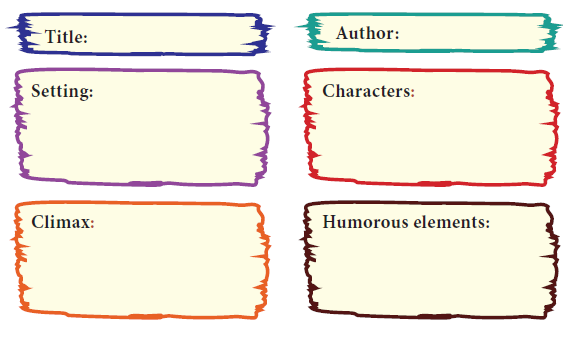
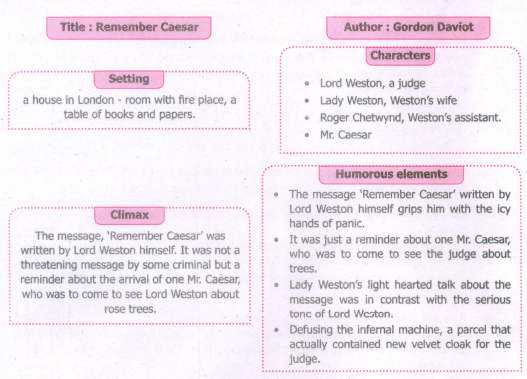
Based on your understanding of the play, complete the Graphic Organiser (GO).
15.
Narrate how the infernal m chine contribute to the humour of the play.
16.
Write in a paragraph about 150 words the character traits of Roger Chetwynd.
17.
Compare the character traits of Lord Weston and his wife.
18.
"Remember Caesar" is a light hearted comedy. Discuss the statement in a group and identify various aspects such as title, plot and characterisation that contribute to the humour in the play
1.
Lord Weston was a (1) well-known judge in England. Being pompous and vain, he told his secretary Roger that he had attained glory by hard work and (2) zealous service. He expressed his displeasure over Roger’s request for a half-holiday. Suddenly, he discovered a piece of paper with the words (3) Remember Caesar in his pocket, and he feared that the message was a warning conveyed by his enemies who had received legal punishments from him. As the message was sent on the 15th of March, (the day Julius Caesar was assassinated), he was (4) convinced that someone affected by his fair judgement was plotting his murder. Sensing the definite attack, Lord Weston ordered his secretary to (5) shut all the doors and windows. But his wife remained (6) unperturbed by the threat. So, Lord Weston was angered by her (7) callous reaction. He ordered Roger to send the cook and the (8) gardener away. Both Weston and Roger took elaborate precautionary measures to thwart the (9) assassination attempt. Finally, Weston was able to recollect that he had written the message “Remember Caesar” himself as a (10) reminder. Caesar was actually a gardener who had an appointment to visit Weston’s garden. The play revolves around Weston’s absent-mindedness which is the crux of the play.
2.
Lord Weston thought that the message 'Remember Caesar' was a t~reat to him. The date on which he saw the message was the fifteenth of March, the date of the l1\urder of Caesar. He feared that his life was in grave danger but the message had been actually written by himself. It was about Mr. Caesar, who was to come to see him that morning about rose trees. This is the irony in the message, 'Remember Caesar'.
3.
Lord Weston made a note 'Remember Caesar' on a piece of paper and put it in his pocket. So it was not thrust into his pocket by any body else.
4.
Roger reminded Lord Weston about Mr. caesar.
5.
The speaker had had his life and he was very old as well. So the speaker considered his life less important.
6.
Roger's life was a great value to England. There were still great things for him to do in the world. He must live and write Weston's life for posterity.
7.
Lord Weston asked Roger to bring the wooden pail of water. He inserted the parcel lengthwise into the pail. He asked Roger to bring the books from the shelf and plunge them into the water. Thus he defused the 'infernal machine'.
8.
Yes, Lady Weston did not care about the threat to her husband. When Weston said that his life was in grave danger, Lady Weston codlly said that the last time it was in danger, he had been eating meat. When Weston mentioned assassination, he said that he always wanted to be a great man and now he had got his wish.
9.
Weston asked Roger to go downstairs at once and look, bar and chain all the doors.
10.
When Weston read the words 'Remember Caesar' written on a scrap of paper, a horr~ble idea occurred to him. The words reminded him of caesar's murder and so he was keen to know what day it was.
11.
Lord Weston saw the words, 'Remember Caesar' on a scrap of paper which he took out of his pocket. He feared that the message was a warning conveyed by his enemies who had received legal punishments from him.
12.
Roger said that if Weston did not need him that afternoon, he might personally interview the clerk of the Awards Committee and find out why he had not sent that document.
13.
Lord Weston described himself as the best - known certainly the mostimpartial judge in England and a favoured servant of his gracious majesty, Charles, the Second.
14.
15.
| Title | Remember Caesar |
| Author | Gordon Daviot |
| Theme | Beware of absent-mindedness |
Lord Weston saw a package lying on a chair against the right wall. He suspected that it would have been given by a man who had brushed against him and might have put the threatening message in his pocket. At once he decided to get rid of the package. He asked Roger to bring the gardener's pail. Then he inserted the parcel lengthwise into the pail. He asked Roger to bring the first six books from the shelf. Roger brought the books and plunged them into the water. In fact he made a great fuss about the package. When he asked his wife what the parcel would have contained, she said that it was his new velvet cloak. Thus 'the infernal machine' proved to be a damp quib. It contributes to the humorous elements of the play.
| If you wish to forget anything on the spot, make a note that this thing is to be remembered |
16.
| Title | Remember Ceasar |
| Author | Gordon Daviot |
| Theme | Beware of absent mindedness |
Mr. Roger Chetwynd was Lord Weston's assistant. He was a thin, earnest, absent-minded conscientious young person. He was so conscientious that his mind, even when absent, was absent on his employer's business. He wanted a half holiday. Lord Weston asked him what prompted his demand for heedless leisure. Roger managed the situation by replying that he might personally interview the clerk of the Awards Committee and find out why he had not seen that document. As directed by his employer, he went downstairs to close the windows. He was so anxious that he wanted to be of any help while Lord Weston was in danger. He wanted to warn the authorities about the·threat to the life of his employer. When Weston asked him about the suspicious package, he said that it did not seem to be his business asking what it was. He was ready to handle it and said that his life was nothing . But Weston wanted him to live and write his life history for posterity. It was Roger who defused the tense moments by reminding Weston that it was Mr. Caesar, who was to see him that morning about rose trees.
| Blessed are the forgetfiul for they get the better even of their blunders. |
17.
| Tittle | Remember caesar |
| Author | Gordon Daviot |
| Theme | Beware of absent-mindedness |
Lord Weston was a famous judge in London. He described himself as the best-known and certainly the most impartial judge in England and a favoured servant of his gracious majesty, Charles the Second. He was pompous and proud to say that he won his honours by hard work and zealous service. He was absent-minded at times. That is why he had forgotten that he himself had written the message, 'Remember Caesar'. He refused to be bribed. He had never twisted the law to please the mob. He was very firm that he should not please them by dying on the day of their choice. Credulity was his flaw. Fear gripped him when he read the message and he was desperate enough to protect himself.
Lady Weston was an excellent homemaker. She was known for her practical simplicity, intelligence as well as malice. She was charming. She had a light - hearted approach to the problem her husband was facing. Her remarks were frivolous, intended to tease and taunt him. It seemed that she was callous but cool, calm and composed. Sarcasm was her forte.
18.
| Title | Remember Caesar |
| Author | Gordon Daviot |
| Theme | Beware of absent-mindedness |
Remember caesar' is full of humour and irony. The title reminds the readers of the great Roman Monarch, Julius caesar. The words 'Remember caesar' written on a scrap of paper, seems to Lord Weston a threatening message. The date of seeing the message is the thirteenth of March, the date of the murder of Julius caesar. So, Lord Weston jumps to conclusion that his life is in great danger as some one has plotted to murder him. But finally, Roger reminds him about a man by name Mr. caesar. Weston recollects that he himself has written the message. The precautionary steps taken by Weston and the light-hearted talk of Mrs Weston add humour to the play. When Weston tells Lady Weston that her husband's life is in grave danger, she is cool and calm enough to say that the last time it was in danger, he had been eating meat. Readers burst into laughter when Lord Weston tries to defuse the infernal machine, thinking that it will explode at any time. It is nothing but a parcel of velvet cloak for Weston. Thus the title, plot and characterization contribute humour to the play.
| Blessed are the forgetful for they get the better even of their blunders. |

12th Standard Syllabus & Materials
12th Standard
TN 12th Computer Applications களப்பெயர் முறைமை (DNS) Sample Question Papers Study Material - QB365 Set A
NEW12th Standard
TN 12th Computer Applications வலையமைப்பு எடுத்துக்காட்டுகள் மற்றும் நெறிமுறைகள் Sample Question Papers Study Material - QB365 Set A
NEW12th Standard
TN 12th Computer Applications கணினி வலையமைப்பு ஓர் அறிமுகம் Sample Question Papers Study Material - QB365 Set A
NEW12th Standard
TN 12th Computer Applications PHP-உடன் MySQL-ஐ இணைத்தல் Sample Question Papers Study Material - QB365 Set A



Tamilnadu Stateboard 12th Standard Subjects

Maths

Chemistry

Physics

Biology

Computer Science

Business Maths and Statistics

Economics

Commerce

Accountancy

History

Computer Applications
Biology
Computer Technology
Computer Applications
Computer Science
Business Maths and Statistics
Commerce
Economics
Maths
Chemistry
Physics
Computer Technology
History
Accountancy

Tamil
English

French
Tamilnadu Stateboard Standards


