
6th Standard CBSE Syllabus & Materials
6th Standard CBSE
cbse 6th Standard Social Science CIV - Urban Livelihoods Important Questions And Answers Study Material - QB365 Set C
NEW6th Standard CBSE
cbse 6th Standard Social Science CIV - Urban Livelihoods Important Questions And Answers Study Material - QB365 Set B
NEW6th Standard CBSE
cbse 6th Standard Social Science CIV - Urban Livelihoods Important Questions And Answers Study Material - QB365 Set A
NEW6th Standard CBSE
cbse 6th Standard Social Science CIV - Rural Livelihoods Important Questions And Answers Study Material - QB365 Set C
NEW6th Standard CBSE
cbse 6th Standard Social Science CIV - Rural Livelihoods Important Questions And Answers Study Material - QB365 Set B
NEW6th Standard CBSE
cbse 6th Standard Social Science CIV - Rural Livelihoods Important Questions And Answers Study Material - QB365 Set A

Published on: 24/10/2025
Download CBSE Class 6th Standard CBSE Mathematics question papers, sample papers, important questions, and previous year solved papers in PDF format. Get free study materials, NCERT solutions, and exam preparation resources for Class 6th Standard CBSE Mathematics
Questions + Answers key
Take MCQ Mathematics Test
1.
Construct \(\bar{PQ}\) of length 7 cm. From this cut-off \(\bar{PA}\) of length 3.2 cm. Measure \(\bar{QA}\)
2.
Draw a line segment AB using a ruler of length 5 cm. Also, construct a line segment of length 5 cm using ruler and compass.
3.
Draw a line AB to 6.5 cm length. At the end points A B draw two perpendiculars. Are these lines perpendicular to each other?
4.
Draw a circle of radius 4 cm. Draw the longest chord. Will it pass through the centre, if yes, what is the name such chord?
5.
Draw two circles of radius 4 cm and 5 cm intersecting each other at point C and O. Join the centres A and B of the circles and points C and D. What is the relation between \(\overline { CD } \) and \(\overline { AB } \)?
6.
Draw a right angled \(\triangle\)ABC, right angled at B. Draw a circle circumscribing the \(\triangle\)ABC. What is the side AC?
7.
Draw an equilateral \(\triangle\)ABC of side 3 cm. Construct a perpendiculars \(\overline { XB } \). What is the measure of \(\angle\)XBA?
8.
Construct a circle with radius 4 cm. Construct a rectangle inscribed in the circle. What are the diagonals of rectangle, so formed equal to?
9.
The longest chord of a circle is 8 cm. How will you find the centre of the circle?
10.
Draw a line segment PO length 4 cm using a ruler. Also, construct a line segment of 4 cm using ruler and compass.
11.
Draw a line segment \(\bar{AB}\) of length 5 cm. Take a point P on it. Through P, draw a perpendicular to AB. (using ruler and compasses).
12.
Draw PO of length 7 cm and find its axis of symmetry.
13.
There were five pieces of cloth of lengths 15 m, 21 m, 36 m, 42 m, 48 m. But all of them could be measured in whole units of a measuring rod. What could be the largest length of the rod?
14.
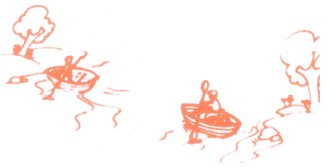
Two boatmen start simultaneously from the opposite shores of a river and they cross each other after 45 minutes of their starting from the respective shores. They rowed till they reached the opposite shore and returned immediately after reaching the shores. When will they cross each other again?
15.
The ratio of income to expenditure of Mr. Natarajan is 7: 5. if he saves Rs 2000 a month, what could be his income?
1.
First of all, we construct a line \(\bar{PQ}\) of length 7 cm.
Step I Place the zero mark of the ruler at P.
Step II Mark a point Q at a distance 7 ern from P.
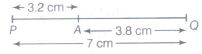
Step III Mark another point A between P and Q at distance 3.2 cm from P such that PA = 3.2 cm.
Step IV Measure line segment \(\bar{QA}\). We fin4 that \(\bar{QA}\) = 7.0 - 3.2 = 3.8 cm.
2.
To construct a line segment of length 5 cm using a ruler and compass, we use the following steps:
.png)
Step I Draw AB of length 5 cm.
Step II Draw a line I and mark a point C on it.
.png)
Step III Open the compasses equal to \(\bar{AB}\) .
Step IV Keeping the same opening. Place the pointer on C and mark a point D on I. This \(\bar{CD}\) is a equal to \(\bar{AB}\) .
3.
No, they are parallel to each other.
4.
Longest chord is diameter. Yes, it will pass through the centre.
5.
CD \(\bot \) AB
6.
Diameter
7.
30o
8.
8 cm
9.
We know that longest chord of a circle is a diameter. So, radius of circle is 4 cm.
Steps of construction are as follows:
Step I Draw a circle of radius 4 cm. The longest chords is AB = 8 cm.
Step II Now, draw the perpendicular bisector of AB, which intersect AB at O.
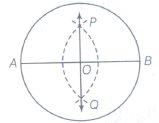
Step III 'O' is the centre of the circle.
10.
Steps of construction are as follows:
Step I Draw \(\bar{PQ}\) of length 4 cm.
.png)
Step II Draw a line l and mark a point R on it.
Step III Open the compasses equal to \(\bar{PQ}\).
Step IV Keeping the same opening. Place the pointer on R and mark a point S on I. Thus, \(\bar{RS}\) is a equal to \(\bar{PQ}\).
.png)
11.
Steps of construction are as follows:
Step I Draw a line segment \(\bar{AB}\) of length 5 cm.
Step II Take a point P and place the pointer of compasses at P draw an arc such that it intersects \(\bar{AB}\) at X and Y.
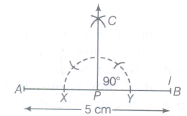
Step III With X and Y as centres and radius greater than \(\bar{PX}\), draw two arcs such that they intersect at C.
Step IV Join CP Thus, \(\bar{CP}\bot\bar{AB}\)
12.
We know that, perpendicular bisector of a line segment is its axis of symmetry.
Step I Draw a line segment \(\bar{PQ}\) = 7 cm.
Step II With P and 0 as centres and radius more than half of \(\bar{PQ}\), draw two arcs which intersect each other at A and B.
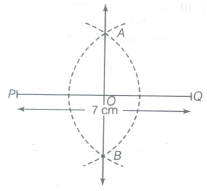
Step III Join A and B.
Thus, AB is the axis of symmetry of \(\bar{PQ}\).
13.
15 = 3 x 5, 21= 3 x 7,
36 = 2 x 2 x 3 x 3,
42 = 2 x 3 x 7,
48 = 2 x 2 x 2 x 2 x 3
∴ HCF=3
Hence, the largest length of the rod is 3 m.
14.
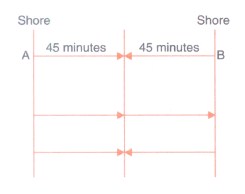
The conditions remaining the same, they will cross each other again after 45 + 45 = 90 minutes.
15.
Ratio of income to expenditure = 7 : 5
Let the income and expenditure per month be Rs 7x and 5x respectively.
Then, saving per month = Rs 7x - Rs 5x = Rs 2x
According to the question,
2x= 2000
⇒ x =\(\frac{2000}{2}\) =1000
⇒ 7x = 7 x 1000 = 7000
Hence, his income is Rs 7000 per month.
6th Standard CBSE Syllabus & Materials
6th Standard CBSE
cbse 6th Standard Social Science CIV - Urban Administration Important Questions And Answers Study Material - QB365 Set B
NEW6th Standard CBSE
cbse 6th Standard Social Science CIV - Urban Administration Important Questions And Answers Study Material - QB365 Set A
NEW6th Standard CBSE
cbse 6th Standard Social Science CIV - Rural Administration Important Questions And Answers Study Material - QB365 Set C
NEW6th Standard CBSE
cbse 6th Standard Social Science CIV - Rural Administration Important Questions And Answers Study Material - QB365 Set B


NCERT Books

Syllabus

Exam Pattern

Sample Question Papers

Previous year Question Papers

Important Notes

MCQ Practice test

NCERT Exemplers

Case study Questions

Image Based Questions

Passage based Questions

HOT Questions

Value Based Questions

Model Questions Papers
NCERT ( Book Back ) Questions

Assertion and Reason
Important Questions And Answers

CBSE 6th Standard CBSE Subjects
CBSE Standards