
6th Standard CBSE Syllabus & Materials
6th Standard CBSE
cbse 6th Standard Social Science CIV - Urban Livelihoods Important Questions And Answers Study Material - QB365 Set C
NEW6th Standard CBSE
cbse 6th Standard Social Science CIV - Urban Livelihoods Important Questions And Answers Study Material - QB365 Set B
NEW6th Standard CBSE
cbse 6th Standard Social Science CIV - Urban Livelihoods Important Questions And Answers Study Material - QB365 Set A
NEW6th Standard CBSE
cbse 6th Standard Social Science CIV - Rural Livelihoods Important Questions And Answers Study Material - QB365 Set C
NEW6th Standard CBSE
cbse 6th Standard Social Science CIV - Rural Livelihoods Important Questions And Answers Study Material - QB365 Set B
NEW6th Standard CBSE
cbse 6th Standard Social Science CIV - Rural Livelihoods Important Questions And Answers Study Material - QB365 Set A

Published on: 24/10/2025
Download CBSE Class 6th Standard CBSE Science question papers, sample papers, important questions, and previous year solved papers in PDF format. Get free study materials, NCERT solutions, and exam preparation resources for Class 6th Standard CBSE Science
Questions + Answers key
Take MCQ Science Test
1.
Why does a lump of cotton wool shrink in water?
2.
List five activities that are possible due to the presence of air
3.
How do plants and animals help each other in the exchange of gases in the atmosphere?
4.
Garima observed that when she left her tightly capped bottle full of water in the open sunlight, tiny bubbles were formed all around inside the bottle. Help Garima to know why it so happened?
5.
Nitrogen in air is important for living organisms. Specify.
6.
The gas Y is colourless and odourless having a slightly sour taste and is a minor component of air. It is moderately soluble in water. This gas neither burns nor supports burning. It rather extinguishes a burning fire. If there were no gas Y in air, there would be no animals or plants on the earth.
(a) Identify gas Y.
(b) In what percentage, gas Y is present in air?
(c) State two ways in which gas Y is added to the air.
(d) Gas Y is necessary for the existence of life. Why?
7.
During any fire incident, it is advised to
(a) wrap a towel or woollen blanket over the burning object.
(b) use a fire extinguisher to stop the fire.
Why are these methods advised? Give reasons.
8.
Air takes the shape, smell, etc from the object/ place it is present in. Explain.
9.
Observe the figure given below depicting distribution of some components present in air and answer the following questions:

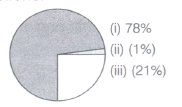
(a) Identify all the components.
(b) What purpose is served by component (iii)?
(c) Do the values or percentages of these components vary?
10.
A transparent glass window appears hazy when not wiped off regularly. Can you suggest a reason?
11.
Explain why air is considered a mixture.
12.
Is winnowing possible in a closed room? Give. reason
13.
How can you say that both animals and plants are dependent on each other for their survival?
14.
What is windmill? Write two uses of windmill.
15.
List four activities that are possible due to the presence of air.
1.
Lump of cotton wool has air among gaps of cotton fibres. When dipped in water, air from these gaps is replaced by water. The cotton lump becomes heavy and also shrinks due to removal of air gaps.
2.
The following activities are possible due to the presence of air
(i) Respiration by animals.
(ii) Photosynthesis by plants.
(iii) Power generation by windmills.
(iv) Burning of fuels and substances.
(v) Scattering of seeds and pollens of plants (pollination).
(vi) Movements of sailing yachts, gliders, parachutes and aeroplanes.
3.
There is an interdependence of plants and animals on each other for exchange of gases. Plants take carbon dioxide from the atmosphere and prepare food. This is called photosynthesis. During this process, plants give out oxygen to the atmosphere. Animals inhale this oxygen and gives out carbon dioxide to the atmosphere. Therefore, plants and animals help each other in the exchange of gases in the atmosphere.
4.
Air is dissolved in water in the form of oxygen. When water bottle is left in the open sunlight, tiny bubbles were formed all around inside the bottle because air dissolved in water starts escaping in the form of tiny bubbles due to heat from the sun.
5.
Nitrogen in air is used for manufacturing food by the plants produced by nitrogen fixation of atmospheric nitrogen into nitrates which mix with the soil. The plants absorb these as their food, so it is necessary and important for living organisms.
6.
(a) Carbon dioxide
(b) 0.03%
(c) (i) Respiration of living organisms.
(ii) Burning of fuels by human beings.
(d) All the food which animals eat is made from carbon dioxide gas of the air.
7.
Fire or burning is supported by air. In order to stop it,
(a) the towel or woollen blanket used, cuts off the supply of air (oxygen) which is supporting burning. As this supply is cut out, fire eventually stops.
(b) a fire extinguisher contains carbon dioxide gas which does not support burning. So, when fire extinguisher is used over the area, CO2 cuts off the oxygen supply from air causing fire to extinguish.
8.
i) Air does not have a fixed shape or size of its own because it is a gaseous mixture whose particles are very loose, thus not able to form a fixed shape.
ii) If air is blown in a balloon of round shape, it takes its shape. Similarly, air can be enclosed in packets of chips different in shape and size.
iii) Like water, air also has no smell. It carries the odour of whatever is present in the surroundings. We can smell a nice perfume or a bad smell because air carries the smell.
9.
(a) (i) Nitrogen, (ii) CO2, water vapour, other gases and dust particles, (iii) Oxygen
(b) Component (iii) is oxygen. It is used by humans and animals for respiration. It also helps in combustion burning.
(c) Yes, the composition of air is not always exactly the same. It changes slightly from place to place.
10.
Air is present everywhere and it contains some gases, water vapours and dust particles that stick to the window surface and are visible due to the transparency of windows.
These particles attract outdoor elements Iike pollens, etc which collect on glass window and together form a layer. That is why, transparent glass windows appear hazy if not wiped off regularly.
11.
The air is considered a mixture because of the following reasons:
(a) Air consists of many gases like oxygen, nitrogen, carbon dioxide, etc.
(b) The composition of air varies from place to place.
12.
No, winnowing is not possible in a closed room. The reason is that winnowing needs wind, which occurs only when air moves. Since, there is no wind. in a closed room, no winnowing can take place.
13.
Both plants and animals are interdependent on each other for their survival. Plants cannot survive for long without animals, as they need CO2 for photosynthesis, which is exhaled by animals. Similarly, in absence of plants, there will be no oxygen for animals to breathe in Hence we can say that both need each other and the balance of oxygen and carbon dioxide in the atmosphere is maintained by their presence.
14.
(a) A windmill is a machine that harnesses wind energy to grind grain, pump water, or generate electricity.
(b) The windmill is used to draw water from tube wells and to run flour mills. They are also used to generate electricity.
15.
The activities that are possible due to the presence of air are as follows :
(i) Respiration and water cycle.
(ii) Flying of birds and aeroplanes.
(iii) Dispersal of seeds.

6th Standard CBSE Syllabus & Materials
6th Standard CBSE
cbse 6th Standard Social Science CIV - Urban Administration Important Questions And Answers Study Material - QB365 Set B
NEW6th Standard CBSE
cbse 6th Standard Social Science CIV - Urban Administration Important Questions And Answers Study Material - QB365 Set A
NEW6th Standard CBSE
cbse 6th Standard Social Science CIV - Rural Administration Important Questions And Answers Study Material - QB365 Set C
NEW6th Standard CBSE
cbse 6th Standard Social Science CIV - Rural Administration Important Questions And Answers Study Material - QB365 Set B



NCERT Books

Syllabus

Exam Pattern

Sample Question Papers

Previous year Question Papers

Important Notes

MCQ Practice test

NCERT Exemplers

Case study Questions

Image Based Questions

Passage based Questions

HOT Questions

Value Based Questions

Model Questions Papers
NCERT ( Book Back ) Questions

Assertion and Reason
Important Questions And Answers

CBSE 6th Standard CBSE Subjects
CBSE Standards