6th Standard CBSE Syllabus & Materials
6th Standard CBSE
cbse 6th Standard Social Science CIV - Urban Livelihoods Important Questions And Answers Study Material - QB365 Set C
NEW6th Standard CBSE
cbse 6th Standard Social Science CIV - Urban Livelihoods Important Questions And Answers Study Material - QB365 Set B
NEW6th Standard CBSE
cbse 6th Standard Social Science CIV - Urban Livelihoods Important Questions And Answers Study Material - QB365 Set A
NEW6th Standard CBSE
cbse 6th Standard Social Science CIV - Rural Livelihoods Important Questions And Answers Study Material - QB365 Set C
NEW6th Standard CBSE
cbse 6th Standard Social Science CIV - Rural Livelihoods Important Questions And Answers Study Material - QB365 Set B
NEW6th Standard CBSE
cbse 6th Standard Social Science CIV - Rural Livelihoods Important Questions And Answers Study Material - QB365 Set A

Published on: 24/10/2025
Download CBSE Class 6th Standard CBSE Science question papers, sample papers, important questions, and previous year solved papers in PDF format. Get free study materials, NCERT solutions, and exam preparation resources for Class 6th Standard CBSE Science
Questions + Answers key
Take MCQ Science Test
1.
Burning of leaves is harmful. Why? Is burning of leaves considered illegal in India. If no, do you suggest it should be made illegal?
2.
Vermicompost produced from kitchen waste is far more better than chemical fertilisers. Why?
3.
The pie charts A and B shown in the figure are based on waste segregation method adopted by two families X and Y, respectively.
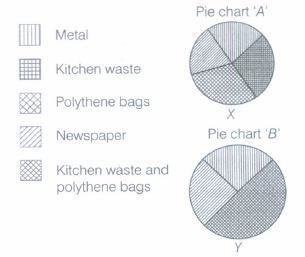
Which of the two families X or Y, do you think is more environmentally conscious and why?
4.
Municipality provides two types of dustbins for garbage collection. One blue coloured and one green coloured. Among the following wastes provided which, waste will you put in which dustbin?
Plastic materials, metal and glass items, waste of plants and animals, peels of fruits and vegetables, dried leaves and twigs, remains of meat like flesh and bones.
5.
Beautiful handcrafted articles like boxes and toys are made up of paper pulp in our country. Can you explain how paper pulp which is made from paper can be used to make hard boxes and other articles?
6.
What happens when
(a) cooking medium is made to flow down a drain?
(b) insecticides, motor oil, paints are poured down the drain?
(c) tea leaves, cotton swabs and old soft toys are thrown into the drain?
7.
Some waste materials can be reused in different forms. Can you make something useful with these waste materials-powder container, cold drink cans, plastic bottles, shoe boxes.
8.
Write three sentences on what comes to your mind when you get a chance to see the following.
(a) A rag picker
(b) A cow eating a polythene bag.
(c) Foul odour emanating from garbage at the entrance of your house.
9.
Precautions should be taken while storing cooked food items in plastic bags. Why?
10.
What is composting ? Do you think it is better to use compost instead of chemical fertilizers? Why?
11.
Write the main drawbacks of plastics.
12.
Given below are steps in vermi-composting and each step has been given in alphabet. Rearrange the steps in the correct sequence and write the alphabets on the chart provided. One step is done for you. A Sprinkle water to keep it moist.
B Cover with a gunny bag or grass.
C Spread sand on the floor of the pit.
D Place red worms in the pit.
E Add vegetable peels and fruit waste in the pit.
F Dig a pit in a suitable place in your garden
1.
Burning of leaves leads to air pollution and release of toxic gases which can cause diseases in living organisms.
No, burning of leaves is not illegal but it should be because leaves can be disposed in a very useful manner like compost.
It also releases harmful components in air on burning which leads to respiratory diseases and cancer in all.
2.
The manure produced from vermicomposting is of high quality Vermicompost is better because
(i) it is cheap and easy to produce while chemical fertilisers are very expensive.
(ii) vermicompost is a natural manure which does not harm the soil or the plants they are added to while chemical fertilisers have adverse effect on both.
3.
The family X is more environment friendly/conscious because they dispose off their kitchen waste and polythene bags separately.
Disposing them separately has an advantage as kitcher waste is biodegradable and can be converted into compost. Polythene bags on the contrary are non-biodegradable.
4.
The above mentioned wastes can be categorised into two categories:
(i) Green bins Wastes which can be decomposed is put in green dustbins, e.g. plants and animals waste, peels of vegetables and fruits, dried leaves, twigs, remains of meat like flesh and bones.
(ii) Blue bins Wastes which cannot be decomposed but can be recycled is put in blue dustbins, e.g. plastic materials, glass, metals, etc.
5.
By following these simple steps, we can make hard gifting boxes or other articles from the recycled paper pulp:
Step I Create a stencil by unfolding a small, one piece cardboard box and trace it on a piece of cardboard that is the same size as your mold. Then, cut out that shape with scissors.
Step II Place the box stencil between your mold and deckle.
Step III Raise the mold, deckle and stencil to the surface in one continuous motion and then remove them from the pulp.
Step IV Remove the box from the stencil and let the paper dry.
Step V Assemble the box by folding and gluing or taping the edges. Decorate it as your need.
6.
(a) If cooking medium is made to flow down a drain, it may clog pores in soil and can block pipes also.
(b) If insecticides, motor oil, paints are poured down the drain, this may kill useful microbes which help to purify water.
(c) If tea leaves, cotton swabs and old soft toys are thrown into the drain, it can choke the drains and block the water supply of the area.
7.
(i) Powder container The elongated metallic powder container can be used as pen-pencil stand or to grow money plant, etc. The plastic containers should be sent to plastic industries for recycling.
(ii) Cold drink cans For storing liquids, growing herbaceous plants like tulsi, money plant, small flowering plants.
(iii) Plastic bottles These can also be used for growing plants, storing liquids, etc.
(iv) Shoe box For making small red cross box, storing pen-pencils and other small articles.
8.
Following things come to our mind when we see
(a) A rag picker
(i) Poor people working due to poverty.
(ii) He removes the garbage generated by others.
(iii) He is exposing hirnself to harmful substances. generated due to toxic waste.
(b) A cow eating a polythene bag
(i) Cow is getting exposed to hazardous materials.
(ii) There may be a possibility of polythene choking the animal lead to death.
(iii) Incorrect/Improper disposal of polythenes by us.
(c) Foul odour emanating from garbage at the entrance of our house
(i) There must be a large quantity of waste generated in the house.
(ii) Unhealthy surroundings due to this.
(iii) Unpleasant sight.
9.
Plastic bags are not considered suitable for storing cooked food because
(i) these bags may have been used earlier for some other purposes. The residue left behind can be harmful.
(ii) food can mix with chemicals present in plastic bags.
(iii) sometimes bags collected by rag pickers are washed and used which is not a healthy practice.
(iv) plastic bags are not recommended for recycle and reuse as it can harm our health.
10.
Converting plant and animal waste into manure is called composting.
Yes,it is better to use compost instead of chemical fertilizers due to the following reasons.
(i) Compost provides better and natural nutrients to the growing plants.
(ii) It is better absorbed by the roots.
(iii) It is cheaper than the chemical fertilizers.
(iv) Chemical fertilizers do not get decomposed easily by natural methods thus increase. soil and water pollution.
11.
The drawbacks of plastics are as follows
(i) The major drawback of plastic is its non-degradability.
(ii) Consuming food packed in plastic bags could be harmful to our health.
(iii) All kinds of plastics give out harmful gases, on burning. These gases may cause many health problems, such as cancer, in humans.
(iv) Some animals such as cows swallow plastic bags filled with garbage, and they can die due to this.
(v) The plastics also block the sewerage system and the drains as a result of which the water spills over the roads during rains.
12.
Step I F
Step ll C
Step III E
Step IV A
Step V D
Step VI B

6th Standard CBSE Syllabus & Materials
6th Standard CBSE
cbse 6th Standard Social Science CIV - Urban Administration Important Questions And Answers Study Material - QB365 Set B
NEW6th Standard CBSE
cbse 6th Standard Social Science CIV - Urban Administration Important Questions And Answers Study Material - QB365 Set A
NEW6th Standard CBSE
cbse 6th Standard Social Science CIV - Rural Administration Important Questions And Answers Study Material - QB365 Set C
NEW6th Standard CBSE
cbse 6th Standard Social Science CIV - Rural Administration Important Questions And Answers Study Material - QB365 Set B



NCERT Books

Syllabus

Exam Pattern

Sample Question Papers

Previous year Question Papers

Important Notes

MCQ Practice test

NCERT Exemplers

Case study Questions

Image Based Questions

Passage based Questions

HOT Questions

Value Based Questions

Model Questions Papers
NCERT ( Book Back ) Questions

Assertion and Reason
Important Questions And Answers

CBSE 6th Standard CBSE Subjects
CBSE Standards