
6th Standard CBSE Syllabus & Materials
6th Standard CBSE
cbse 6th Standard Social Science CIV - Urban Livelihoods Important Questions And Answers Study Material - QB365 Set C
NEW6th Standard CBSE
cbse 6th Standard Social Science CIV - Urban Livelihoods Important Questions And Answers Study Material - QB365 Set B
NEW6th Standard CBSE
cbse 6th Standard Social Science CIV - Urban Livelihoods Important Questions And Answers Study Material - QB365 Set A
NEW6th Standard CBSE
cbse 6th Standard Social Science CIV - Rural Livelihoods Important Questions And Answers Study Material - QB365 Set C
NEW6th Standard CBSE
cbse 6th Standard Social Science CIV - Rural Livelihoods Important Questions And Answers Study Material - QB365 Set B
NEW6th Standard CBSE
cbse 6th Standard Social Science CIV - Rural Livelihoods Important Questions And Answers Study Material - QB365 Set A

Published on: 25/10/2025
Download CBSE Class 6th Standard CBSE Social Science question papers, sample papers, important questions, and previous year solved papers in PDF format. Get free study materials, NCERT solutions, and exam preparation resources for Class 6th Standard CBSE Social Science
Questions + Answers key
Take MCQ Social Science Test
1.
List five ways in which the non-whites were discriminated against.
2.
In Maya's story did the government support the idea that people are equal ?
3.
What are the various ways in which people participate in the process of government?
4.
How did people react when the government increase the money for electricity?
5.
How do people sense their power in a democracy in India?
6.
Read the extract carefully and answer the following question.
The Indian Constitution lays down the basic rules or laws that have to be followed by everyone. These laws are for both the government and the people. Conflicts and differences have to be resolved according to these laws.
How do conflicts and differences get resolved?
7.
How many years old was Maya Naidoo?
12 year old
11 year old
13 year old
14 year old
8.
Who was shocked after hearing the story of Hector Pieterson?
Maya
Maya's mother
Nelson Mandela
All of these
9.
What was the name of the black township in South Africa?
Johannesburg
Savvana
Soweta
Durban
10.
When did a particular government increase the money people had to pay for electricity?
In 2006
In 2005
In 2010
In 2003
11.
Which of the following dams is a downstream dam?
Mettur darn
Hirakud dam
Krishnasagar dam
None of the above
12.
What does apartheid mean?
13.
Who was the main leader of the African National Congress?
14.
When did South Africa become a democratic country?
15.
When are elections held in India?
16.
What is the main conflict between Karnataka and Tamil Nadu states?
17.
What is the general tendency regarding a girl child in Indian society?
18.
Write a short note on the Cauvery water dispute between Karnataka and Tamil
Nadu.
19.
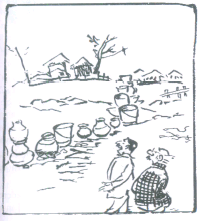
Look at the cartoon carefully and answer the question.
(i) What approval or disapproval is being expressed here?
20.
In India, the period of government is 6 years.
21.
Blacks and coloured people were not considered to be equal to whites.
22.
Ganga water dispute is between Karnataka and Tamil Nadu.
23.
Equality and justice are separable.
24.
The Central Government has to step in and see that a fair distribution of water is worked out.
1.
Five ways in which the non-whites were discriminated against are:
(i) Non-whites were not allowed to vote.
(ii) The best land was reserved for the white people and non-whites had to live on the worst available land.
(iii) Hospitals and ambulances were separate for whites and non-whites.
(iv) There were separate trains and buses.
(v) The bus stops were different for them.
2.
In Maya's story, the government did not support the idea that people are equal. Sharp differences were seen between the whites and non-whites. The whites availed all privileges while the non-whites had to face hardships. They had no voting rights like the whites.
3.
People participate in the process of government through following various ways:
(i) By taking interest in the working of the government.
(ii) By criticising the government when it is required.
(iii) By taking out rallies.
(iv) By organising a signature campaign.
4.
When in August 2005, the government increased the money people had to pay for electricity, this is how people reacted:
(i) They were very angry and expressed their disapproval very sharply.
(ii) They took out rallies and also organised a signature campaign.
5.
In India, governments are elected for a fixed term of 5 years. If governments want to continue to be in power, then they have to be re-elected by the people. Thus, this is a moment when people can sense their power in a democracy.
6.
The conflicts and differences are resolved by the government, because the Indian Constitution lays
down the basic rules or laws that have to be followed by everyone. These laws are for both the government and the people.
7.
(b)
11 year old
8.
(a)
Maya
9.
(c)
Soweta
10.
(b)
In 2005
11.
(a)
Mettur darn
12.
()
Apartheid means separation on the basis of race.
13.
()
Nelson Mandela was the most well known leader of the African National Congress.
14.
()
In 1994, South Africa became a democratic country.
15.
()
Elections are usually held every five years in India.
16.
()
The sharing of river water is the main conflict between Karnataka and Tamil Nadu states.
17.
()
There is a general tendency to value and care for the boy child more than the girl child.
18.
Cauvery Water Dispute
• River Cauvery flows through Karnataka and Tamil Nadu.
Two dams have been constructed on this river:
(i) Krishnasagar dam has been constructed on Cauvery in Karnataka.
(a) It stores water which is used in irrigation in several districts of Karnataka.
(b) It also meets the water needs of Bangalore city.
(ii) Mettur dam has been constructed in Tamil Nadu.
(a) Its water is used in crop irrigation in the delta regions of Tamil Nadu.
(iii) Downstream dam of Mettur can be filled up only if water from upstream dam Krishnasagar is released.
(iv) Neither of the two states gets as much water as per their requirement.
(v) Due to these two dams being on the same river, a conflict has arisen.
19.
Approval and disapproval are being expressed here as:
Approval The two persons express approval for presence of water in a tap.
Disapproval The condition of distribution of drinking water is not good. It should be condemned as it may give rise to aversion to the system and governance.
20.
(b)
21.
(a)
22.
(b)
23.
(b)
24.
(a)

6th Standard CBSE Syllabus & Materials
6th Standard CBSE
cbse 6th Standard Social Science CIV - Urban Administration Important Questions And Answers Study Material - QB365 Set B
NEW6th Standard CBSE
cbse 6th Standard Social Science CIV - Urban Administration Important Questions And Answers Study Material - QB365 Set A
NEW6th Standard CBSE
cbse 6th Standard Social Science CIV - Rural Administration Important Questions And Answers Study Material - QB365 Set C
NEW6th Standard CBSE
cbse 6th Standard Social Science CIV - Rural Administration Important Questions And Answers Study Material - QB365 Set B

NCERT Books

Syllabus

Exam Pattern

Sample Question Papers

Previous year Question Papers

Important Notes

MCQ Practice test

NCERT Exemplers

Case study Questions

Image Based Questions

Passage based Questions

HOT Questions

Value Based Questions

Model Questions Papers
NCERT ( Book Back ) Questions

Assertion and Reason
Important Questions And Answers

CBSE 6th Standard CBSE Subjects
CBSE Standards