
6th Standard CBSE Syllabus & Materials
6th Standard CBSE
cbse 6th Standard Social Science CIV - Urban Livelihoods Important Questions And Answers Study Material - QB365 Set C
NEW6th Standard CBSE
cbse 6th Standard Social Science CIV - Urban Livelihoods Important Questions And Answers Study Material - QB365 Set B
NEW6th Standard CBSE
cbse 6th Standard Social Science CIV - Urban Livelihoods Important Questions And Answers Study Material - QB365 Set A
NEW6th Standard CBSE
cbse 6th Standard Social Science CIV - Rural Livelihoods Important Questions And Answers Study Material - QB365 Set C
NEW6th Standard CBSE
cbse 6th Standard Social Science CIV - Rural Livelihoods Important Questions And Answers Study Material - QB365 Set B
NEW6th Standard CBSE
cbse 6th Standard Social Science CIV - Rural Livelihoods Important Questions And Answers Study Material - QB365 Set A

Published on: 25/10/2025
Download CBSE Class 6th Standard CBSE Social Science question papers, sample papers, important questions, and previous year solved papers in PDF format. Get free study materials, NCERT solutions, and exam preparation resources for Class 6th Standard CBSE Social Science
Questions + Answers key
Take MCQ Social Science Test
1.
Why do you think Soorajmal kept quiet even though Saroj asked him to speak?
2.
Take an example of anyone task done by a Panchayat in your area/nearby rural area and find out the following:
(a) Why it was taken up.
(b) Where the money came from.
(c) Whether or not the work has been completed.
3.
What is the composition of the Panchayat Samiti?
4.
What is Panchayat Samiti ?
5.
Name the award that was given to the village Panch of Maharashtra.
6.
Who was Amirchand?
A Politician
A Zamindar
A simple villager
A Sarpanch
7.
Who among the following elect(s) the Panchayat President?
Secretary
Members of Legislative Assembly
Villagers
All members of Gram Sabha
8.
Panchayati Raj system is at which level of democratic government?
First
Second
Third
Fourth
9.
Members of Gram Sabha should be of minimum:
20 years of age
19 years of age
21 years of age
18 years of age
10.
What are the three organs of the village Panchayat?
11.
Who is a District Commissioner?
12.
What is the main task of a Gram Panchayat?
13.
Describe the composition of a Village Panchayat.
14.
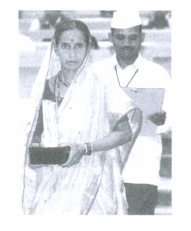
(i) Who are seen in the picture?
(ii) What award were they given?
(iii) When and why was this award given?
15.
What are the responsibilities of the Sarpanch in a Gram Panchayat ?
16.
Write five rules that became effective from April 1993 regarding the Panchayati Raj system.
17.
Watershed management has _____________this barren slope to a green ____________
18.
The ________________ meets regularly and one of its main tasks is to implement development programmes for all villages that come under it.
19.
With the help of _____________ it also regulates the money distribution.
20.
The Gram Panchayat is elected for ______________
21.
Sarpanch is directly elected by the members of the Gram Sabha.
22.
Every village Panchayat is divided into wards, i.e. smaller areas.
23.
The Gram Panchayat does not collect any local taxes.
24.
There is no link between the Gram Sabha and the Gram Panchayat. The Gram Panchayat meets regularly in order to perform its task efficiently and within given time limit.
1.
Soorajmal kept quiet because Amirchand was sitting in the Gram Sabha keeping an eye on everyone. He knew the power and influence of Amirchand.
2.
In my locality, Panchayat has taken up repairs of drains.
(a) It was taken up because the drains were in damaged condition. Dirty water was spreading on to the streets and busy roads.
(b) The money came from taxes, funds, grants and donations.
(c) The work is in the process, it would be finished by the end of year.
3.
A Panchayat Samiti is composed of elected members of the area and the Block Development Officer, otherwise unrepresented members, associate members and the elected members of that Panchayat Block on the Zila Parishad.
4.
Panchayat Samiti is organised at block level. It consists of the heads of Gram Panchayats falling within its jurisdiction. The head of the Panchayat Samiti is known as Block Pramukh or Pradhan.
5.
Two Village Panchs from Maharashtra were awarded the 'Nirmal Gram Purushkar' in 2005 for the excellent work done by them in the Panchayat.
6.
(b)
A Zamindar
7.
(b)
Members of Legislative Assembly
8.
(a)
First
9.
(d)
18 years of age
10.
()
Sarpanch, Panch and Secretary are the three organs of the village Panchayat.
11.
()
A District Commissioner is the main administrator to look after the laws and order in a district.
12.
()
The main task of the gram Panchayat includes construction and maintenance of infrastructure, levying and collecting taxes and executing government schemes for the village.
13.
A Village Panchayat is divided into wards. Each ward elects a representative who is known as the Ward Member, also called Panch. All the members of the Gram Sabha also elect a Sarpanch who is called Panchayat President. The ward Panchs and the Sarpanch form the Gram Panchayat. The tenure of the Gram Panchayat is five years.
The Gram Panchayat and Gram Sabha have a common secretary. He is a person whom the government appoints. Thus, he is not an elected person. The Secretary is responsible for calling the meeting of the Gram Sabha and Gram Panchayat. He also keeps a record of the proceedings of the meetings.
14.
(i)The village Panchs from Maharashtra are seen in the picture.
(ii)They were awarded with the Nirmal Gram Puruskar.
(iii)This award was given in 2005 for the excellent work done by them in the Panchayat.
15.
Sarpanch has various responsibilities, Some of them are as follows :
(i) Looking after street lights, construction and repair work of the roads in the villages and also, village markets, fairs, festivals and celebrations.
(ii) Keeping a record of births, deaths and marriages in the village.
(iii) Looking after public health and hygiene by providing facilities for sanitation and drinking water.
(iv) Providing education, implementing development schemes for agriculture and animal husbandry.
16.
In 1992, the Parliament amended the Constitution and formulated rules for the Panchayati Raj System. The States and the centre had to follow these rules from April, 1993 onwards. The rules are listed below:
(i) It should be a three-tier system at village level, the intermediate or block level and the district level.
(ii) Direct elections should be conducted for all the seats in the Panchayats.
(iii) The state should ensure representation of the Scheduled Castes and Scheduled Tribes in proportion to their population in the area. Minimum of one-third of the total number of seats is to be reserved forwomen.
(iv) A member of Panchayat should not be less than 21 years of age.
(v) The State Election Commission should hold regular Panchayat elections.
17.
()
transformed, meadow
18.
()
Gram Panchayat
19.
()
Panchayat Samitis
20.
()
Five years
21.
(a)
22.
(a)
23.
(b)
24.
(a)

6th Standard CBSE Syllabus & Materials
6th Standard CBSE
cbse 6th Standard Social Science CIV - Urban Administration Important Questions And Answers Study Material - QB365 Set B
NEW6th Standard CBSE
cbse 6th Standard Social Science CIV - Urban Administration Important Questions And Answers Study Material - QB365 Set A
NEW6th Standard CBSE
cbse 6th Standard Social Science CIV - Rural Administration Important Questions And Answers Study Material - QB365 Set C
NEW6th Standard CBSE
cbse 6th Standard Social Science CIV - Rural Administration Important Questions And Answers Study Material - QB365 Set B



NCERT Books

Syllabus

Exam Pattern

Sample Question Papers

Previous year Question Papers

Important Notes

MCQ Practice test

NCERT Exemplers

Case study Questions

Image Based Questions

Passage based Questions

HOT Questions

Value Based Questions

Model Questions Papers
NCERT ( Book Back ) Questions

Assertion and Reason
Important Questions And Answers

CBSE 6th Standard CBSE Subjects
CBSE Standards