6th Standard CBSE Syllabus & Materials
6th Standard CBSE
cbse 6th Standard Social Science CIV - Urban Livelihoods Important Questions And Answers Study Material - QB365 Set C
NEW6th Standard CBSE
cbse 6th Standard Social Science CIV - Urban Livelihoods Important Questions And Answers Study Material - QB365 Set B
NEW6th Standard CBSE
cbse 6th Standard Social Science CIV - Urban Livelihoods Important Questions And Answers Study Material - QB365 Set A
NEW6th Standard CBSE
cbse 6th Standard Social Science CIV - Rural Livelihoods Important Questions And Answers Study Material - QB365 Set C
NEW6th Standard CBSE
cbse 6th Standard Social Science CIV - Rural Livelihoods Important Questions And Answers Study Material - QB365 Set B
NEW6th Standard CBSE
cbse 6th Standard Social Science CIV - Rural Livelihoods Important Questions And Answers Study Material - QB365 Set A

Published on: 24/10/2025
Download CBSE Class 6th Standard CBSE Social Science question papers, sample papers, important questions, and previous year solved papers in PDF format. Get free study materials, NCERT solutions, and exam preparation resources for Class 6th Standard CBSE Social Science
Questions + Answers key
Take MCQ Social Science Test
1.
Discuss the lives of hawkers in the city.
2.
Describe the challenges which are faced by the rural and urban women in our country.
3.
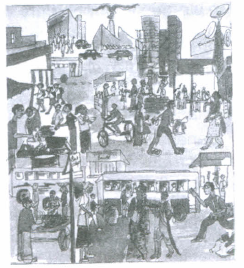
What do you see in this illustration?
4.
Look at the pictures given below carefully and answer the following questions:
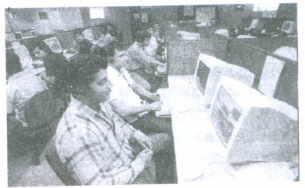
(i) Describe the work condition at all centres. Why are many call centres set up in India?
(ii) Where do we find a labour?
5.
Why do small workshops and factories need casual workers?
6.
Name the local bodies that look after the urban areas.
7.
Why do people prefer working in an organised sectors?
8.
Compare the livelihood challenges faced by rural and urban women.
1.
The hawkers face many things per day.
These are following:
(i) They work on their own, they are not employed by anyone. They sell their products from one place to another.
(ii) Their shops are usually temporary structures like some boards or papers spread over discarded boxes or may be a canvas sheet hung up on a few poles.
(iii) They may also use their own carts or simply a plastic sheet spread on the pavement.
(iv) They can be asked to dismantle their shops at any time by the police.
(v) There are certain parts of the city where these hawkers are not allowed to enter.
2.
Challenges faced by rural women are:
(i) Poor resource base and resource quality (small or no agricultural land and water).
(ii) Illiteracy and lack of skill.
(iii) Lack of awareness about different government schemes and programmes.
(iv) Lack of knowledge of disasters.
Challenges faced by urban women are:
(i) Lack of employment and irregular jobs.
(ii) Lack of job security and low wages.
(iii) Lack of sufficient and timely credit support system for petty trade.
(iv) Fear of eviction by police and civic bodies.
(v) Congested and hazardous working conditions.
3.
It is a busy street in a city with hawkers and vendors. Various types of vehicles like cycles, buses, cars are plying on the roads.
Some of the people are trying to board the bus.
Many other people are buying goods from various shops. Some children are going to school. Also some people are taking their meals at dhaba.
4.
(i) Call centres are generally set-up as large rooms with work stations that include a computer, a telephone set and supervisor's stations. India has become a major centre not only for Indian companies but also foreign companies. They set-up call centres here as they can get people who can speak English and will work for lower wages.
(ii) We find labour at labour chowk where many people were sitting on railings or in groups at the crossing These labourers are daily wage labourers.
5.
Small workshops and factories need casual workers for big profits and less investment. Casual workers are called for when the employer needs them. They are employed when the employer gets large orders or during certain seasons. If they complain about their payor working conditions, they are asked to leave any time. They are also expected to work for very long hours. If there is the need to finish same work urgently then these workers are called for work even on Sundays. All these factors are in favour of small workshops and factories. Therefore, they employ casual workers
6.
The local bodies that look after the problems of the urban areas are:
(i) Municipal Corporations,
(ii) Municipalities, and
(ii)Town Area Committees.
(i) Municipal Corporations: These are the local governing bodies of big cities such as Delhi, Mumbai, Kolkata, Chennai, etc. The main functions of the Municipal Corporations are providing public health and sanitation, making arrangement for vaccination, supply of safe drinking water, clearing and disposal of garbage, cleaning roads, drains and public toilets.
(ii) Municipalities: Smaller towns and cities with population ranging between 20,000-5,00,000have Municipalities as the local government body.
(iii)Town Area Committees: Municipalities and Municipal Corporations carry their day-to-day work with the help of a number of committees such as the Education Committee, the Public Health Committee and the District Planning Committee.
7.
Un-organised sector is characterised by low wages, long hours of work and lack of job security. people prefer to work in an organised sectors because of the following reasons:
(i) Workers enjoy security of employment.
(ii) There are fixed number of working hours. If workers work more, they have to be paid overtime by the employer.
(iii)Employees of the organised sectors are entitled to medical leaves, payment during holidays, provident fund, etc.
(iv) Workers also get medical benefits and under the laws, factory manager has to ensure the provision of facilities like drinking water and a safe working environment.
8.
Challenges faced by rural women:
(i) Poor resource base and resource quality (small or no agricultural land and water).
(ii) Illiteracy and lack of skill.
(iii) Lack of awareness on different government schemes and programmes.
(iv) Lack of knowledge of disasters.
Challenges faced by urban women:
(i) Lack of employment and irregular jobs.
(ii) Lack of job security and low wages.
(iii)Lack of sufficient and timely credit support system for petty trades.
(iv) Fear of eviction by police and civic bodies.
(v) Congested and hazardous working conditions

6th Standard CBSE Syllabus & Materials
6th Standard CBSE
cbse 6th Standard Social Science CIV - Urban Administration Important Questions And Answers Study Material - QB365 Set B
NEW6th Standard CBSE
cbse 6th Standard Social Science CIV - Urban Administration Important Questions And Answers Study Material - QB365 Set A
NEW6th Standard CBSE
cbse 6th Standard Social Science CIV - Rural Administration Important Questions And Answers Study Material - QB365 Set C
NEW6th Standard CBSE
cbse 6th Standard Social Science CIV - Rural Administration Important Questions And Answers Study Material - QB365 Set B



NCERT Books

Syllabus

Exam Pattern

Sample Question Papers

Previous year Question Papers

Important Notes

MCQ Practice test

NCERT Exemplers

Case study Questions

Image Based Questions

Passage based Questions

HOT Questions

Value Based Questions

Model Questions Papers
NCERT ( Book Back ) Questions

Assertion and Reason
Important Questions And Answers

CBSE 6th Standard CBSE Subjects
CBSE Standards