
 100% FREE ACCESS
12th Standard Syllabus & Materials
12th Standard
TN 12th Computer Applications மின்னணு தரவு பரிமாற்றம் Sample Question Papers Study Material - QB365 Set A
NEW12th Standard
TN 12th Computer Applications மின் - வணிக பாதுகாப்பு அமைப்புகள் Sample Question Papers Study Material - QB365 Set A
NEW12th Standard
TN 12th Computer Applications மின்னணு செலுத்தல் முறைகள் Sample Question Papers Study Material - QB365 Set A
NEW12th Standard
TN 12th Computer Applications மின் - வணிகம் Sample Question Papers Study Material - QB365 Set A
NEW12th Standard
TN 12th Computer Applications திறந்த மூல கருத்துருக்கள் Sample Question Papers Study Material - QB365 Set A
NEW12th Standard
TN 12th Computer Applications வலையமைப்பு வடமிடல் Sample Question Papers Study Material - QB365 Set A

Published on: 22/08/2026
Download Tamil Nadu 12th Standard Biology question papers, model tests, one-mark questions, important questions, and public exam papers in PDF format. Free study materials and answer keys for TN State Board students.
Questions + Answers key
Take MCQ Biology Test
1.
What is bioremediation ?
2.
Give an account on uterine wall layers.
3.
Generally human activities are against to the ecosystem, where as a student how will you help to protect ecosystem?
4.
Shape of pyramid in a particular ecosystem is always different in shape. Explain with example.
5.
Name of the food chain which is generally present in all type of ecosystem. Explain and write their significance.
6.
Discuss the gross primary productivity is more efficient than net primary productivity.
7.
When does antibiotic resistance develop?
8.
What is the composition of semen?
9.
10.
11.
12.
13.
What will happen if all producers are removed from ecosystem?
14.
Pyramid of energy is always upright. Give reasons
15.
16.
17.
18.
19.
Placenta is an endocrine tissue. Justify
20.
Explain the process of fertilization and implantation of the fertilized ovum.
21.
Define productivity & its type. (or) How to protect the ecosystem? (or) Explain the different classes of productivity of an ecosystem.
22.
Differentiate Primary succession and Secondary succession.
23.
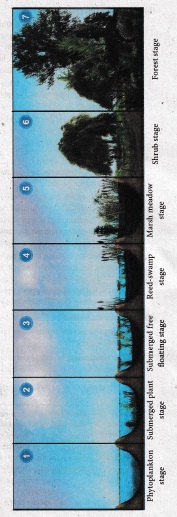
Various stages of succession are given bellow. From that rearrange them accordingly. Find out the type of succession and explain in detail.
Reed-swamp stage, phytoplankton stage, shrub stage, submerged plant stage, forest stage, submerged free floating stage, marsh meadow stage.
24.
Draw a pyramid from following details and explain in brief.
Quantities of organisms are given-Hawks - 50, plants - 1000.rabbit and mouse - 250 + 250, pythons and lizard - 100 + 50 respectively.
25.
Explain the various phases of the menstrual cycle.
1.
1. The use of naturally occurring or genetically engineered microorganisms to reduce or degrade pollutants is called bioremediation.
2. It is less expensive and more sustainable than other remediations available.
3. It is grouped into in situ bioremediation
4. Treatment of contaminated soil or water in the site.
5. Ex situ bioremediation - treatment of contaminated soil or water that is removed from the site and treated.
2.
The wall of the uterus has three layers of tissues. The outermost thin membranous serous layer called the perimetrium, the middle thick muscular layer called myometrium and the inner glandular layer called endometrium. The endometrium undergoes cyclic changes during the menstrual cycle while myometrium exhibits strong contractions during parturition.
3.
(I) Buying and use only ecofriendly products and recycle them.
(II) Growing more trees.
(III) Choosing sustained farm products (vegetables, fruits and greens, etc.)
(IV) Reduce the use of natural resources.
(V) Recycle the waste and reduce the amount of waste you produce.
(VI) Reduce consumption of water and electricity.
(VII) Reduce or eliminate the use of house-hold chemicals and pesticides.
(VIII) Maintain your cars and vehicles properly. (In order to reduce carbon emission).
(IX) Create awareness and educate about ecosystem protection among your friends and family members and ask them to find out solution to minimise this problem.
4.
Pyramid of number
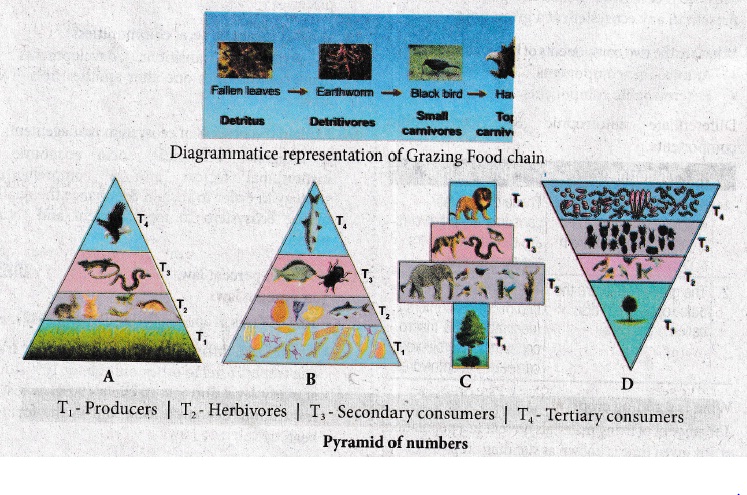
(i) In a forest ecosystem the pyramid of number is different in shape, it is because the base (T 1) of the pyramid occupies large sized trees (producer) which are lesser in number.
(ii) Herbivores (T2) occupying second trophic level, are more in number than the producers (T1).
(iii) In final trophic level (T4) tertiary consumers (lion) are lesser in number than the secondary consumers (T3).
(iv) Therefore, the pyramid of numbers in forest ecosystem looks spindle-shaped.
Pyramid of biomass
(i) In forest ecosystem, there is a gradual decrease in biomass of organisms at successive trophic levels from producers to top carnivores (Tertiary consumer). Therefore, the pyramid of biomass looks upright.
5.
Detritus food chain
(i) This type of food chain begins with dead organic matter which is an important source of energy.
(ii) A large amount of organic matter is derived from the dead plants, animals and their excreta.
(iii) This type of food chain is present in all ecosystems
(iv) The transfer of energy from the dead organic matter is transferred through a series of organisms called detritus consumers. (detrivores)-Small carnivores -large (top) carnivores with repeated eating and being eaten respectively.
6.
Gross Primary Productivity (GPP) is the total amount of food energy or biomass produced in an ecosystem by autotrophs through the process of photosynthesis whereas Net Primary Productivity (NPP) is the proportion of energy which remains after respiration loss in the plant. When we compare GPP with NPP more energy is present in former than in latter.
7.
(i) Antibiotic resistance occurs when bacteria develop the ability to defeat the drug designed to kill or inhibit their growth.
(ii) It is one of the most acute threats to public health.
(iii) Antibiotic resistance is accelerated by the misuse and overuse of antibiotics, as well as poor infection prevention control.
(iv) Antibiotics should be used only when prescribed by a certified health professional. When the bacteria become resistant, antibiotics cannot fight against them and the bacteria multiply.
(v) Narrow spectrum antibiotics are preferred over broad spectrum antibiotics. They effectively and accurately target specific pathogenic organisms and are less likely to cause resistance.
(vi) "Superbug" is a term used to describe strains of bacteria that are resistant to the majority of antibiotics commonly used today.
8.
Semen or seminal fluid is a milky white fluid which contains sperms and the seminal plasma, which is secreted from the seminal vesicles, prostate glands and bulbo urethal glands or Cowper's gland.
The semen comprises of Fructose, ascorbic acid, zinc, cholesterol, protein, calcium, chlorine, blood group antigens, citric acid, DNA, magnesium, Vitamin B12, phosphorous, sodium, potassium, uric acid,lactic acid, nitrogen, and other nutrients for the sperms.
9.
10.
11.
12.
13.
If all producers are removed from ecosystem We tend to face the following hurdles.
(i) The Ecosystem cannot be balanced
(ii) The interlocking pattern of food chain is broken
(iii) The movement of energy transfer among the food chain cannot be established
(iv) As the green plants occupying the first trophic level (T1) are producers - it affects majority of the food chain
14.
There is a gradual decrease in energy transfer at successive tropic levels from producers to higher levels, hence the pyramid of energy is always upright.
15.
16.
17.
18.
19.
Placenta during pregnancy secretes hormones such as human chorionic gonadotrophic (hcG) estrogen, progesterone and human placenta lactogen. So, placenta is regarded as an endocrine tissue.
20.
Fertilization occurs when a haploid sperm fuses with a haploid ovum to form a fertilized egg or diploid zygote.
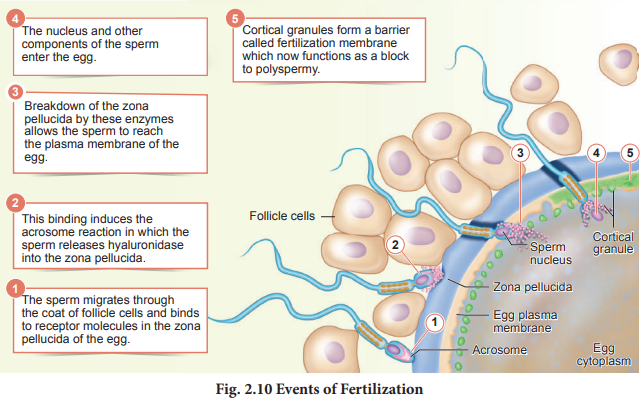
The sperms deposited in the female reproductive tract undergo capacitation, which is a biochemical event that enables the sperm to penetrate and fertilise the egg. Fertilization occurs only if the ovum and sperms are transported simultaneously to the ampullary isthmic junction of the fallopian tube.
Before a sperm can enter the egg, it must penetrate the multiple layers of granulosa (follicular) cells which are around the ovum forming the corona radiata . The follicular cells are held together by an adhesive cementing substance called hyaluronic acid. The acrosomal membrane disintegrates releasing the proteolytic enzyme, hyaluronidase during sperm entry through the corona radiata and zona pellucida. This is called acrosomal reaction. Once Fertilization is accomplished, cortical granules from the cytoplasm of the ovum form a barrier called the Fertilization membrane around the ovum preventing further penetration of other sperms. Thus polyspermy is prevented.
The first cleavage produces two identical cells called blastomeres. These produce 4 cells, then 8 and so on. After 72 hours of Fertilization, a loose collection of cells forms a berry shaped cluster of 16 or more cells called the morula
Under the influence of progesterone, smooth muscles of the fallopian tube relax and the dividing embryo takes 4-5 days to move through the fallopian tube into the uterine cavity and finally gets implanted in the uterine wall. At this point the embryo consists of a fluid filled hollow ball of about 100 cells, called the blastocyst. The blastocyst is composed of a single layer of large flattened cells called trophoblast and a small cluster of 20-30 rounded cells called the inner cell mass. The inner cell mass of the blastocyst develops into the embryo and becomes embedded in the endometrium of the uterus.
21.
(i) The rate of biomass production per unit area in a unit time is called productivity.
(ii) It can be expressed in terms of gm/m2/year or Kcal/m2/year.
(iii) It is classified as given below.
(a) Primary Productivity
(b) Secondary Productivity
(c) Community Productivity
(a) Primary Productivity:
1. The chemical energy or organic matter generated by autotrophs during the process of photosynthesis and chemosynthesis is called primary productivity.
2 It is the source of energy for all organisms, from bacteria to human.
(i) Gross Primary Productivity (GPP)
1. The total amount of food energy or organic matter or biomass produced in an ecosystem by autotrophs through the process of photosynthesis is called gross primary productivity.
(ii) Net Primary Productivity (NPP)
1. The proportion of energy which remains after respiration loss in the plant is called net Primary productivity.
2. It is also called as apparent photosynthesis.
3. Thus the difference between GPP and respiration is known as NPP.
NPP=GPP-Respiration
4. NPP of whole biosphere is estimated to be about 170 billion tons (dry weight) per year.
5. Out of which NPP of oceanic producers is only 55 billion tons per year in unit time.
(b) Secondary productivity :
1. The amount of energy stored in the tissues of heterotrophs or consumers is called secondary productivity.
(i) Gross secondary productivity
1. It is equivalent to the total amount of plant material is ingested by the herbivores minus the materials lost as faeces.
(ii) Net secondary productivity
1. Storage of energy or biomass by consumers per unit area per unit time, after respiratory loss is called net secondary productivity.
(c) Community productivity
1. The rate of net synthesis of organic matter (biomass) by a group of plants per unit area per unit time is known as community productivity.
22.
| Primary succession | Secondary succession |
| Developing in an barren area. | Developing in disturbed area. |
| Initiated due to a biological or any other external factors. | Starts due to external factors only. |
| No soil, while primary succession starts | It starts where soil covers is already present. |
| Pioneer species come from outside environment. | Pioneer species develop from existing environment. |
| It takes more time to complete. | It takes comparatively less time to complete |
23.
Type of succession
Hydrosere
(i) The succession in a freshwater ecosystem is also referred to as hydrosere
(ii) Succession in a pond, begins with colonization of the pioneer's like phytoplankton and finally ends with the formation of climax community like forest stage. It includes the following stages
(a) Phytoplankton stage
It is the first stage of succession consisting of the pioneer Community like blue green algae, green algae, diatoms, bacteria, etc.,
The colonization of these organisms enrich the amount of organic matter and nutrients of pond due to their life activities and death.
This favors the development of the next several stages
(b) Submerged plant stage
As the result of death and decomposition of planktons, silt brought from land by rain water, lead to a loose mud formation at the bottom of the pond. Hence, the rooted submerged hydrophytes begin to appear on the new substratum.
Example: Chara, Utricularia, Vallisneria and Hydrilla etc.
The death and decay of these plants will build up the substratum of pond to become shallow. Therefore, this habitat now replaces another group of plants which are of floating type.
(c) Submerged free floating stage
During this stage, the depth of the pond will become almost 2-5 feet
Hence, the rooted hydrophytic plants and with floating large leaves start colonising the pond.
Example: Rooted floating plants like Nelumbo, Nymphaea and Trapa. Some free floating species like Azolla, Lemna, Wolffia and Pistia are also present in this stage.
By death and decomposition of these plants, further the pond becomes more shallow.
Due to this reason, floating plant species is gradually replaced by another species which makes new several stage.
(d) Reed-swamp stage
It is also called an amphibious stage.
During this stage, rooted floating plants are replaced by plants which can live successfully in aquatic as well as aerial environment.
Example: Typha, Phragmites, Sagittaria and Scirpus etc. At the end of this stage, water level is very much reduced, making it unsuitable for the continuous growth of amphibious Plants.
(e) Marsh meadow stage
When the pond becomes swallowed due to decreasing water level
Species of Cyperaceae and Poaceae such as Carex, Iuncus, Cyperus and Eleocharis colonise the area
They form a mat-like vegetation with the help of their much branched root system.
This leads to an absorption and loss of large quantity of water
At the end of this stage, the soil becomes dry and the marshy vegetation disappears gradually and leads to shurb stage
(d) Shrub stage
As the disappearance of marshy vegetation continues, soil becomes dry.
Hence, these areas are now invaded by terrestrial plants like shrubs (Salix and Cornus) and trees (Populus and Alnus).
These plants absorb large quantity of water and make the habitat dry.
Further, the accumulation of humus with a rich flora of microorganisms produce minerals in the soil, ultimately favouring the arrival of new tree species in the area
(e) Forest stage
It is the climax community of hydrosere.
A variety of trees invade the area and develop any one of the diverse type of vegetation.
Example: Temperate mixed forest (Ulmus, Acer and Quercus), Tropical rain forest (Artocarpus and Cinnamomum) and Tropical deciduous forest (Bamboo and Tectona).
In the 7 stages of hydrosere succession, stage 1 is occupied by pioneer community, while the stage 7 is occupied by the climax community. The stages 2 to 6 are occupied by several communities,
24.
Grassland ecosystem : There is a gradual decrease in the number of organisms in each trophic level from producers to primary consumers and then to secondary consumers, and finally to tertiary consumers. Therefore pyramids of number in grassland ecosystem are always upright.
25.
Menstrual cycle / Ovarian cycle
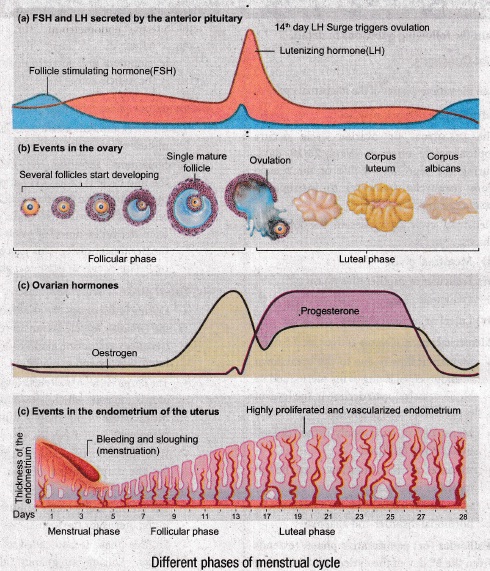
(i) The menstrual or ovarian cycle occurs approximately once in every 28/29 days, during the reproductive life of the female from menarche (puberty) to menopause except during pregnancy.
(ii) Menstrual cycle comprises of the following phases:
1. Menstrual phase
2. Follicular or proliferative phase
3. Ovulatory phase
4. Luteal or, secretory phase
(i) Menstrual phase: (Occurs and last for 3-5 days)
1. Menstrual flow is due to the breakdown of endometrial lining of the uterus, and its blood vessels due to decline in the level of progesterone and oestrogen.
2. Menstruation occurs only if the released ovum is not fertilized.
3. Absence of menstruation may be an indicator of pregnancy
4. However, it could also be due to stress, hormonal disorder and anaemia.
(ii) Follicular (or) proliferative phase: (extends from the 5th day of the cycle until the time of ovulation)
1. During this phase, the primary follicle in the ovary grows to become a fully mature Graafian follicle and simultaneously, the endometrium regenerates through proliferation. These changes in the ovary and the uterus are induced by the secretion of gonadotropins like FSH and LH, which increase gradually during the follicular phase. lt stimulates follicular development and secretion of oestrogen by the follicle cells.
(iii) Ovulatory phase (about 14th day):
1. Both LH and FSH attain peak level in the middle of the cycle.
2. Maximttm secretion of LH during the mid-cycle is called LH surge induces the rupture of the Graafian follicle and the release of the ovum (secondary oocyte) from the break down of ovary wall into the peritoneal cavity. This process called ovulation occurs at late luteal phase.
(iv) Luteal phase or secretory phase;
1. During luteal phase, the remaining part of the Graalian follicle is transformed into a transitory endocrine gland called corpus luteum at the end of ovulation.
2. The corpus luteum secretes a large amount of progesterone which is essential for the maintenance of the endometrium during pregnancy.
3. If fertilization takes place, it paves way for the implantation of the fertilized ovum.
4. The uterine wall secretes a nutritious fluid in the uterus for the foetus.
5. So, this phase is also called as secretory phase. During pregnancy all events of menstrual cycle stop and there is no menstruation.
6. In the absence of fertilization, the corpus luteum degenerates completely and leaves a scar tissue called corpus Albicans.
7. It also initiates the disintegration of the endometrium leading to menstruation, marking repetition of the next cycle.

12th Standard Syllabus & Materials
12th Standard
TN 12th Computer Applications களப்பெயர் முறைமை (DNS) Sample Question Papers Study Material - QB365 Set A
NEW12th Standard
TN 12th Computer Applications வலையமைப்பு எடுத்துக்காட்டுகள் மற்றும் நெறிமுறைகள் Sample Question Papers Study Material - QB365 Set A
NEW12th Standard
TN 12th Computer Applications கணினி வலையமைப்பு ஓர் அறிமுகம் Sample Question Papers Study Material - QB365 Set A
NEW12th Standard
TN 12th Computer Applications PHP-உடன் MySQL-ஐ இணைத்தல் Sample Question Papers Study Material - QB365 Set A



Tamilnadu Stateboard 12th Standard Subjects

Maths

Chemistry

Physics
Biology

Computer Science

Business Maths and Statistics

Economics

Commerce

Accountancy

History

Computer Applications
Biology
Computer Technology
Computer Applications
Computer Science
Business Maths and Statistics
Commerce
Economics
Maths
Chemistry
Physics
Computer Technology
History
Accountancy

Tamil

English

French
Tamilnadu Stateboard Standards


