
 100% FREE ACCESS
12th Standard Syllabus & Materials
12th Standard
TN 12th Computer Applications மின்னணு தரவு பரிமாற்றம் Sample Question Papers Study Material - QB365 Set A
NEW12th Standard
TN 12th Computer Applications மின் - வணிக பாதுகாப்பு அமைப்புகள் Sample Question Papers Study Material - QB365 Set A
NEW12th Standard
TN 12th Computer Applications மின்னணு செலுத்தல் முறைகள் Sample Question Papers Study Material - QB365 Set A
NEW12th Standard
TN 12th Computer Applications மின் - வணிகம் Sample Question Papers Study Material - QB365 Set A
NEW12th Standard
TN 12th Computer Applications திறந்த மூல கருத்துருக்கள் Sample Question Papers Study Material - QB365 Set A
NEW12th Standard
TN 12th Computer Applications வலையமைப்பு வடமிடல் Sample Question Papers Study Material - QB365 Set A

Published on: 28/11/2025
Download Tamil Nadu 12th Standard Biology question papers, model tests, one-mark questions, important questions, and public exam papers in PDF format. Free study materials and answer keys for TN State Board students.
Questions + Answers key
Take MCQ Biology Test
1.
2.
Name the temporary endocrine organ for during pregnancy. Write its uses.
3.
Complete the flow chart by mentioning the ploidy of cells in boxes.
4.
How Charles Bonnet and Abraham Trembley contributed to Biological filed?
5.
In Vivipary, how the developing embryos are nourished?
6.
In the diagram given below.
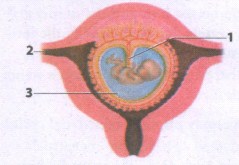
(a) Identify the diagram
(b) Label the parts
7.
8.
9.
10.
Menstruation does not occur during pregnancy give reason.
11.
In females a oogonia forms a single ovum only. What is the significance of the oogonia undergoing meiosis I & II when in a male, each spematogonia forms 4 sperms .
12.
13.
The organisms exhibiting sexual reproduction shows variations. Give reasons.
14.
15.
16.
17.
Placenta is an endocrine tissue. Justify
18.
19.
Explain the role of placenta during pregnancy.
20.
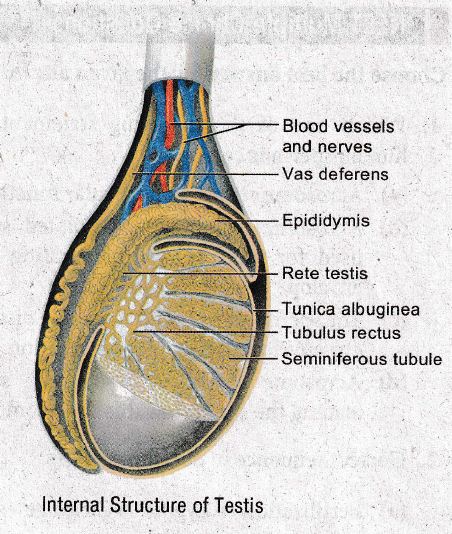
Explain the anatomy of testis with the help of a diagram.
21.
Write a note on cervial cancer. (or) Write the risk factors for cervical cancer.
22.
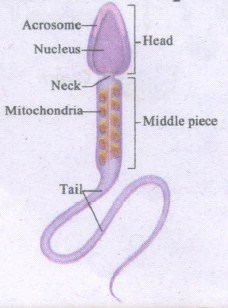
Describe the structure of a sperm. (or) Describe the structure of human sperm with a neat labelled diagram.
23.
Write notes on binary fission in animals.
24.
Explain the various phases of the menstrual cycle.
1.
2.
(i) Placenta is a temporary endocrine formed during pregnancy
(ii) It connects the foetus to the uterine through the umbilical cord.
(ii) It is the organ by which the nutri respiratory and excretory functions fulfilled.
3.
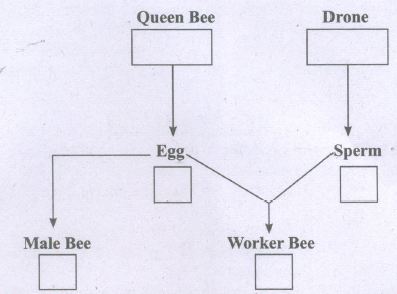
Queen Bee, Worker Bee - Diploid (2n)
Drones (Male Bee), Egg, sperm - Haploid (n)
4.
Charles Bonnet discovered the process of parthenogenesis.
Abraham Trembley was the first to study the concept of Regeneration in the Hydra.
5.
In Vivipary, the embryo develops inside the womb of females body, hence they are nourished by the mother through the placenta.
6.
(a) Human foetus within the uterus
(b) 1 - Umbilical cord
2 - Fallopian tube
3 - Amniotic fluid
7.
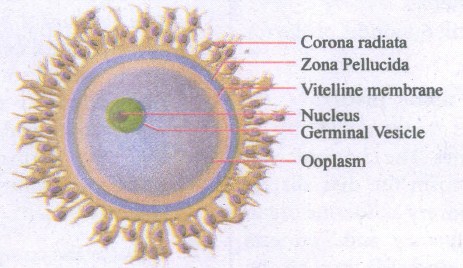
8.
9.
10.
Pregnancy begins soon after the formation of zygote after fertilization.
Following this the uterus, accessory organs and glands of female reproductive system get ready to receive the zygote and nourish it.
Menstruation occurs by disintegration of the uterine wall and corpus lute urn, if fertilization has not occurred. Therefore during pregnancy menstruation ceases and this continues till parturition or child birth.
11.
The meiotic divisions I & II take place in order to ensure that the ovum is haploid since normal chromosomal number is important for formation of normal zygote. Further polar bodies have less cellular contents and are small since they do not participate in fertilization most of the cellular contents lie in the ovum.
12.
13.
(i) Sexual reproduction involves formation of gametes by meioses brings in exchange of chromosomal segments between paternal and maternal chromosomes.
(ii) Fertilization is a chance of probability because the ovum is can be fertilized by any of the sperms. Hence variations will occur and degree of variations cannot be predicted in sexual reproduction.
14.
15.
16.
17.
Placenta during pregnancy secretes hormones such as human chorionic gonadotrophic (hcG) estrogen, progesterone and human placenta lactogen. So, placenta is regarded as an endocrine tissue.
18.
19.
(i) Placenta is a temporary endocrine organ formed during pregnancy and it connects the foetus to the uterine wall through the umbilical cord.
(ii) It is the organ by which the nutritive, respiratory and excretory functions are fulfilled.
(iii) The embryo's heart develops during the fourth week of pregnancy and circulates bloods through the umbilical cord and placenta as well as through its own tissues.
(iv) During pregnancy, the placenta acts as a temporary endocrine gland and produces large quantities of human Choronic Gonadotropin (hCG), human Placental Lactogen (hPL), oestrogens and progesterone which are essential for a normal pregnancy.
20.
(i) Testes are the primary male sex organs.
(ii) They are pair of ovoid bodies lying in the scrotum.
(iii) The scrotum is a sac of skin that hangs outside the abdominal cavity.
(iv) Each testis is covered by an outermost fibrous tunica albuginea and is divided by septa into 200 - 250 lobules each containing 2 - 4 highly coiled testicular tubules or seminiferous tubules.
(v) The stratified epithelium of the seminiferous tubule is made of two types of cells namely sertoli cells or nurse cells and spermatogonic cells or male germ cell.
21.
cervial cancer: Cervical cancer is caused by a sexually transmitted virus called Human Papilloma virus (HPV). HPV may cause abnormal growth of cervical cells or cervical dysplasia.
The most common symptoms and signs of cervical cancer are pelvic pain, increased vaginal discharge and abnormal vaginal bleeding. The risk factors for cervical cancer include
(i) Having multiple sexual partners
(ii) Prolonged use of contraceptive pills
Cervical cancer can be diagnosed by a Papanicolaou smear (PAP smear) combined With an HPV test. X-Ray, CT scan, MRI and a PET scan may also be used to determine the stage of cancer. The treatment options for cervical. cancer include radiation therapy, surgery and chemotherapy.
Modern screening techniques can detect precancerous changes in the cervix. Therefore screening is recommended for women above 30 years once in a year. Cervical cancer can be prevented with vaccination. Primary prevention begins with HPV vaccination of girls aged 9 - 13 years, before they become sexually active. Modification in lifestyle can also help in preventing cervical cancer. Healthy diet, avoiding tobacco usage, preventing early marriages, practicing monogamy and regular exercise minimize the risk of cervical cancer.
22.
Structure of human spermatozoan:
(i) The human sperm is a microscopic, flagellated and motile gamete. The whole body of the sperm is enveloped by plasma membrane and is composed of a head, neck and a tail.
(ii) The head comprises of two parts namely acrosome and nucleus.
(iii) Acrosome is a small cap like pointed structure present at the tip of the nucleus and is formed mainly from the golgi body of the spermatid.
(iv) It contains hyaluronidase, a proteolytic enzyme, popularly known as sperm lysin which helps to penetrate the ovum during fertilisation.
(v) The neck is very short and is present between the head and the middle piece. It contains the proximal centriole towards the nucleus which plays a role in the first division of zygote and the distal centriole gives rise to the axial filament of the sperm.
(vi) The middle piece possesses mitochondria spirally twisted around the axial filament called mitochondrial spiral or nebenkern. It produces energy in the form of ATP molecules for the movement of sperms.
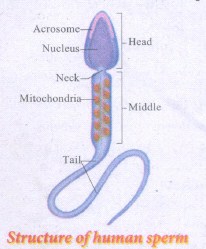
(vii) The tail is the longest part of the sperm and is slender and tapering.
(viii) It is formed of a central axial filament or axoneme and an outer protoplasmic sheath. The lashing movements of the tail push the sperm forward.
23.
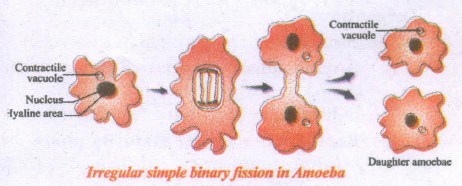
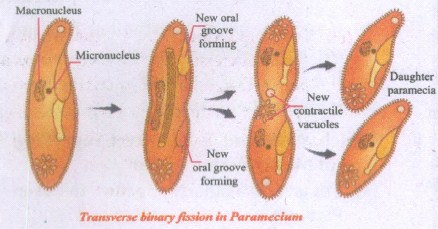
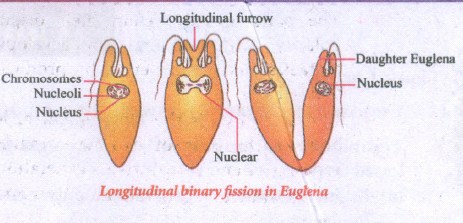
In binary fission, the parent organism divides into two halves and each half forms a daughter individual. The nucleus divides first amitotically or mitotically (karyokinesis), followed by the division of the cytoplasm (cytokinesis). The resultant offsprings are genetically identical to the parent. Depending on the plane of fission, binary fission is of the following types
(i) Simple irregular binary fission
(ii) Transverse binary fission
(iii) Longitudinal binary fission
(iv) Oblique binary fission
(i) Simple irregular binary fission is seen in Amoeba like irregular shaped organisms, where the plane of division is hard to observe. The contractile vacuoles cease to function and disappear. The nucleoli disintegrate and the nucleus divides mitotically. The cell then constricts in the middle, so the cytoplasm divides and forms two daughter cells.
(ii) In Transverse binary fission, the plane of the division runs along the transverse axis of the individual. E.g. Paramecium and Planaria. In Paramecium the macronucleus divides by amitosis and the micronucleus divides by mitosis.
(iii) In Longitudinal binary fission the nucleus and the cytoplasm divides in the longitudinal axis of the organism. In flagellates, the flagellum is retained usually by one daughter cell. The basal granule is divided into two and the new basal granule forms a flagellum in the other daughter individual. E.g. Vorticella and Euglena.
(iv) In Oblique binary fission the plane of division is oblique. It is seen in dinoflagellates. E.g. Ceratium.
24.
Menstrual cycle / Ovarian cycle
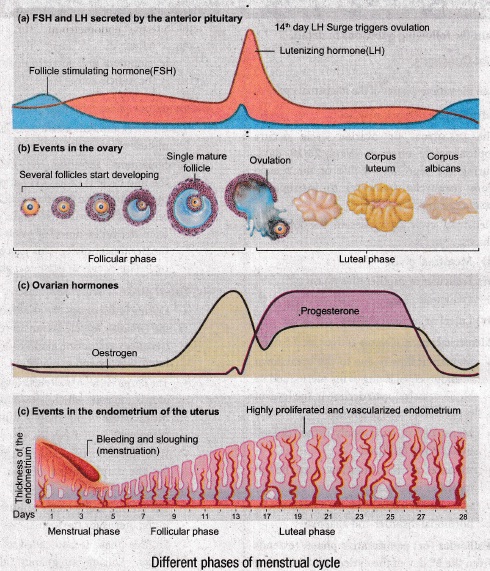
(i) The menstrual or ovarian cycle occurs approximately once in every 28/29 days, during the reproductive life of the female from menarche (puberty) to menopause except during pregnancy.
(ii) Menstrual cycle comprises of the following phases:
1. Menstrual phase
2. Follicular or proliferative phase
3. Ovulatory phase
4. Luteal or, secretory phase
(i) Menstrual phase: (Occurs and last for 3-5 days)
1. Menstrual flow is due to the breakdown of endometrial lining of the uterus, and its blood vessels due to decline in the level of progesterone and oestrogen.
2. Menstruation occurs only if the released ovum is not fertilized.
3. Absence of menstruation may be an indicator of pregnancy
4. However, it could also be due to stress, hormonal disorder and anaemia.
(ii) Follicular (or) proliferative phase: (extends from the 5th day of the cycle until the time of ovulation)
1. During this phase, the primary follicle in the ovary grows to become a fully mature Graafian follicle and simultaneously, the endometrium regenerates through proliferation. These changes in the ovary and the uterus are induced by the secretion of gonadotropins like FSH and LH, which increase gradually during the follicular phase. lt stimulates follicular development and secretion of oestrogen by the follicle cells.
(iii) Ovulatory phase (about 14th day):
1. Both LH and FSH attain peak level in the middle of the cycle.
2. Maximttm secretion of LH during the mid-cycle is called LH surge induces the rupture of the Graafian follicle and the release of the ovum (secondary oocyte) from the break down of ovary wall into the peritoneal cavity. This process called ovulation occurs at late luteal phase.
(iv) Luteal phase or secretory phase;
1. During luteal phase, the remaining part of the Graalian follicle is transformed into a transitory endocrine gland called corpus luteum at the end of ovulation.
2. The corpus luteum secretes a large amount of progesterone which is essential for the maintenance of the endometrium during pregnancy.
3. If fertilization takes place, it paves way for the implantation of the fertilized ovum.
4. The uterine wall secretes a nutritious fluid in the uterus for the foetus.
5. So, this phase is also called as secretory phase. During pregnancy all events of menstrual cycle stop and there is no menstruation.
6. In the absence of fertilization, the corpus luteum degenerates completely and leaves a scar tissue called corpus Albicans.
7. It also initiates the disintegration of the endometrium leading to menstruation, marking repetition of the next cycle.

12th Standard Syllabus & Materials
12th Standard
TN 12th Computer Applications களப்பெயர் முறைமை (DNS) Sample Question Papers Study Material - QB365 Set A
NEW12th Standard
TN 12th Computer Applications வலையமைப்பு எடுத்துக்காட்டுகள் மற்றும் நெறிமுறைகள் Sample Question Papers Study Material - QB365 Set A
NEW12th Standard
TN 12th Computer Applications கணினி வலையமைப்பு ஓர் அறிமுகம் Sample Question Papers Study Material - QB365 Set A
NEW12th Standard
TN 12th Computer Applications PHP-உடன் MySQL-ஐ இணைத்தல் Sample Question Papers Study Material - QB365 Set A



Tamilnadu Stateboard 12th Standard Subjects

Maths

Chemistry

Physics
Biology

Computer Science

Business Maths and Statistics

Economics

Commerce

Accountancy

History

Computer Applications
Biology
Computer Technology
Computer Applications
Computer Science
Business Maths and Statistics
Commerce
Economics
Maths
Chemistry
Physics
Computer Technology
History
Accountancy

Tamil

English

French
Tamilnadu Stateboard Standards


