
 100% FREE ACCESS
12th Standard Syllabus & Materials
12th Standard
TN 12th Computer Applications மின்னணு தரவு பரிமாற்றம் Sample Question Papers Study Material - QB365 Set A
NEW12th Standard
TN 12th Computer Applications மின் - வணிக பாதுகாப்பு அமைப்புகள் Sample Question Papers Study Material - QB365 Set A
NEW12th Standard
TN 12th Computer Applications மின்னணு செலுத்தல் முறைகள் Sample Question Papers Study Material - QB365 Set A
NEW12th Standard
TN 12th Computer Applications மின் - வணிகம் Sample Question Papers Study Material - QB365 Set A
NEW12th Standard
TN 12th Computer Applications திறந்த மூல கருத்துருக்கள் Sample Question Papers Study Material - QB365 Set A
NEW12th Standard
TN 12th Computer Applications வலையமைப்பு வடமிடல் Sample Question Papers Study Material - QB365 Set A

Published on: 28/11/2025
Download Tamil Nadu 12th Standard Biology question papers, model tests, one-mark questions, important questions, and public exam papers in PDF format. Free study materials and answer keys for TN State Board students.
Questions + Answers key
Take MCQ Biology Test
1.
A contraceptive pill prevents ovulation by ______.
blocking fallopian tube
inhibiting release of FSH and LH
stimulating release of FSH and LH
causing immediate degeneration of released ovum.
2.
3.
The Androgen Binding Protein (ABP) is produced by ________.
Leydig cells
Hypothalamus
Sertoli cells
Pituitary gland
4.
5.
Mammalian egg is ______.
Mesolecithal and non cleidoic
Microlecithal and non cleidoic
Alecithal and non cleidoic
Alecithal and cleidoic
6.
The male homologue of the female clitoris is ______.
Scrotum
Penis
Urethra
Testis
7.
The male sex hormone testosterone is secreted from _____.
Sertoli cells
Leydig cell
Epididymis
Prostate gland
8.
Klinefelters syndrome is characterized by a karyotype of ____.
XYY
XO
XXX
XXY
9.
10.
In which type of parthenogenesis are only males produced?
Arrhenotoky
Thelytoky
Amphitoky
Both a and b
11.
XO type of sex determination and XY type of sex determination are examples of ______.
Male heterogamety
Female heterogamety
Male homogamety
Both (b) and (c)
12.
Which of the following phenotypes is not possible in the progeny of the parental genotypic combination IAIO x IAIB?
AB
O
A
B
13.
Which of the following is not correct?
Three or more alleles of a trait in the population are called multiple alleles
A normal gene undergoes mutations to form many alleles
Multiple alleles map at different loci of a chromosome
A diploid organism has only two alleles out of many in the population
14.
15.
Haemophilia is more common in males because it is a ______.
Recessive character carried by Y-chromosome
Dominant character carried by Y-chromosome
Dominant trait carried by X-chromosome
Recessive trait carried by X-chromosome
16.
Amniocentesis, the foetal sex determination test, is banned in our country, Is it necessary? Comment.
17.
What are the strategies to be implemented in India to attain total reproductive health?
18.
Give a schematic representation of spermatogenesis and oogenesis in humans.
19.
What is colostrum? Write its significance.
20.
What are the applications of Karyotyping?
21.
Explain the mode of sex determination in honeybees.
22.
Why are sex linked recessive characters more common in the male human beings?
23.
The unicellular organisms which reproduce by binary fission are considered immortal. Justify
24.
25.
Differentiate foeticide and infanticide
26.
27.
Expand the acronyms
a. FSH
b. LH
c. hCG
d. hPL
28.
29.
Mention the symptoms of Down's syndrome.
30.
31.
What is Lyonisation?
32.
Distinguish between heterogametic and homogametic sex determination systems
33.
Why is the offspring formed by asexual reproduction referred as a clone?
34.
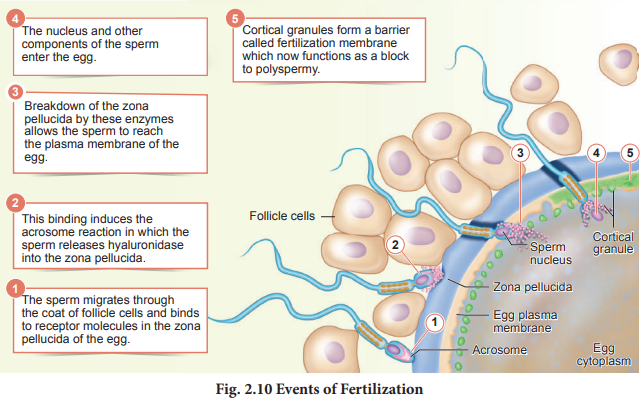
Explain the process of fertilization and implantation of the fertilized ovum.
35.
Explain the various barrier methods to control human population.
36.
Differentiate between the following:
(a) External and Internal fertilization
(b) Regeneration in lizard and Planaria
37.
Describe the major STDs and their symptoms.
38.
Explain the various phases of the menstrual cycle.
39.
Explain the inheritance of sex linked characters in human being.
40.
Give an account of genetic control of Rh factor.
41.
How is sex determined in human beings?
42.
43.
Give reasons for the following:
(a) Some organisms like honey bees are called parthenogenetic animals
(b) A male honey bee has 16 chromosomes where as its female has 32 chromosomes
1.
(b)
inhibiting release of FSH and LH
2.
(b)
3.
(c)
Sertoli cells
4.
(b)
5.
(c)
Alecithal and non cleidoic
6.
(b)
Penis
7.
(b)
Leydig cell
8.
(d)
XXY
9.
(c)
10.
(a)
Arrhenotoky
11.
(a)
Male heterogamety
12.
(b)
O
13.
(c)
Multiple alleles map at different loci of a chromosome
14.
(a)
15.
(d)
Recessive trait carried by X-chromosome
16.
1. Amniocentesis is the pre-natal diagnostic technique in which a sample of amniotic fluid from the womb of a pregnant woman is taken during early stages of embryonic development and the cells are cultured and analysed synthetically.
2. Any chromosomal disorder or a metabolic error can be detected and if necessary MTP can be advised.
3. But this technique is misused for knowing the sex of the foetus followed by female foeticide.
4. Female foeticide refers to aborting the female in the mother's womb.
5. In order to prevent female foeticide and infanticide, Government of India has taken various steps like PCPNDT Act .(preconception and prenatal diagnostic technique act-1994) enacted to ban the identification of sex and to prevent the use of prenatal diagnostic techniques for selective abortion.
17.
(i) Creating awareness and providing medical assistance to build a healthy society.
(ii) Introducing sex education in schools to provide information about adolescence and adolescence related changes.
(iii) Educating couples and those in the marriageable age groups about the available birth control methods and family planning norms.
18.
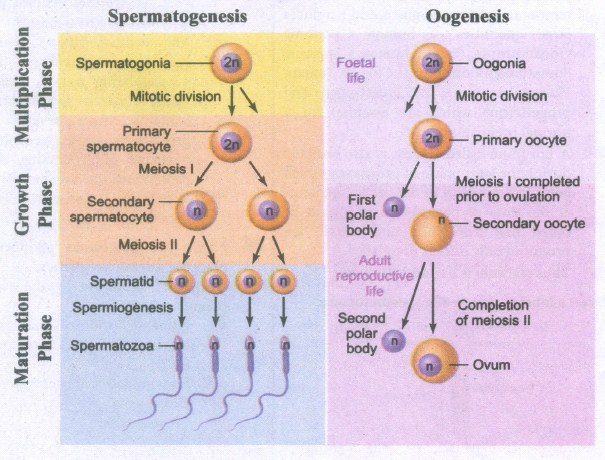
19.
Colostrum is the yellowish fluid produced from the mother's mammary glands during initial few days of location, after parturition.
Significance:
1. It has less lactose than milk and almost no fat, but it contains more proteins, vitamin A and minerals.
2. Colostrum is also rich in IgA antibodies.
3. This helps to protect the infant's digestive tract against bacterial infection.
4. Breast milk is the ideal food for infants as it contains all the constituents in suitable concentration and is easily digestable.
5. It is fully sufficient till about 6 months of age and all infants must be breast fed by the mother to ensure the growth of a healthy baby.
20.
(i) It helps in gender identification.
(ii) It is used to detect the chromosomal aberrations like deletion, duplication, translocation, invasion and nondisjunction of chromosomes.
(iii) It helps to identify the abnormalities of chromosomes like aneuploidy.
(iv) It is also used in predicting the evolutionary relationships between species.
(v) Genetic diseases in human beings can be detected by this technique.
21.
Sex determination in honeybees
sex determination is as follows
1. Haploid sex determination is seen in honeybees, it is based on the number of sets of chromosome, an individual receives.
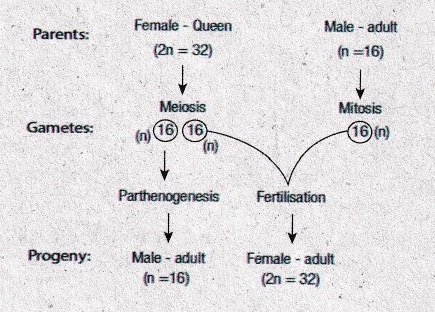
2. When the ovum is fertilized by a male gamete the zygote (2n = 32) develops into a female i.e., a queen or worker.
3. When the haploid ovum develops by parthenogenesis. i.e., without fertilization, a male individual, called drone is formed as adult male.
4. The male honeybees (drone) is haploid (with n = 16) and forms sperms by mitosis.
22.
1. The X chromosome which is common to male and female carries a number of genes. Such genes are called sex linked genes and the characters controlled by them are termed as sex-linked characters. The inheritance of sex linked genes or traits is known as sex linked inheritance.
2. Sex linked inherited traits are more common in males than females, because males are hemizygous (XY) and therefore express that traits when they inherit one mutant allele.
3. Any male receiving X linked recessive allele from his mother will express the trait as his y chromosome has no corresponding allele.
4. If a recessive X linked gene causes disorder then more males than females have the disorder because the disorder is caused by a single allele in males. Their y chromosome does not carry any corresponding allele. So that sex linked recessive characters are mole in moles.
23.
1. In unicellular organism there is no special structure for reproduction.
2. In binary fission the entire parent body constitute the reproductive unit and disappears when its division into two daughter unicellular cell is completed.
3. These two daughter cells function as two new individuals.
4. There is no remains of parent body cell and parent cannot be said to have died.
5. In fact after binary fission parent continues living as two daughter individual.
Hence, the unicellular organisms which undergo binary fission are called immortal (no natural death).
24.
25.
| Foeticide | Infanticide |
| It refers to aborting the female in the mother's womb. |
It refers to killing the female child after her birth |
26.
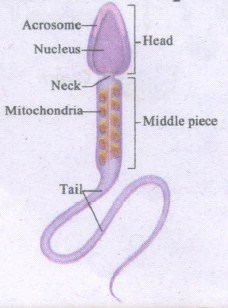
27.
(a) FSH - Follicular Stimulating Hormone
(b) LH - Lutinizing Hormone
(c) hCG - Human Chorionic Gonadotropin
(d) hPL - Human Placental Lactogen.
28.
29.
Symptoms:
1. Severe mental retardation
2. Defective development of the CNS.
3. Increased separation between the eyes.
4. Flattened nose, ears are malformed
5. Mouth is constantly open and the tongue protrudes.
30.
31.
The inactivation of an X chromosome one of the two X chromosomes in every cell in some female mammal is randomly inactivated early in embryonic development and named after geneticist Mary Lyon.
The inactive X chromosome is silenced by it being packaged in such a way that it has a transcriptionally inactive structure called heterochromatin found in nucleoplasm of nucleus.
32.
| Heterogametic sex determination | Homogametic sex determination |
| Produces identical gametes (produces one type of gamete) | Produces two different gametes |
| Two sex chromosomes of the organism are same (XX) (Females) | Two sex chromosomes of the organism are different (XY) (Males) |
33.
Offsprings produced by asexual reproduction are called clones, because they are genetically as well as morphologically similar to the parent organism.
They are not only similar to one another, but are also exact copies of their parent (e,g): Amoeba, Spirogyra, Hydra, Yeast, etc.
34.
Fertilization occurs when a haploid sperm fuses with a haploid ovum to form a fertilized egg or diploid zygote.
The sperms deposited in the female reproductive tract undergo capacitation, which is a biochemical event that enables the sperm to penetrate and fertilise the egg. Fertilization occurs only if the ovum and sperms are transported simultaneously to the ampullary isthmic junction of the fallopian tube.
Before a sperm can enter the egg, it must penetrate the multiple layers of granulosa (follicular) cells which are around the ovum forming the corona radiata . The follicular cells are held together by an adhesive cementing substance called hyaluronic acid. The acrosomal membrane disintegrates releasing the proteolytic enzyme, hyaluronidase during sperm entry through the corona radiata and zona pellucida. This is called acrosomal reaction. Once Fertilization is accomplished, cortical granules from the cytoplasm of the ovum form a barrier called the Fertilization membrane around the ovum preventing further penetration of other sperms. Thus polyspermy is prevented.
The first cleavage produces two identical cells called blastomeres. These produce 4 cells, then 8 and so on. After 72 hours of Fertilization, a loose collection of cells forms a berry shaped cluster of 16 or more cells called the morula
Under the influence of progesterone, smooth muscles of the fallopian tube relax and the dividing embryo takes 4-5 days to move through the fallopian tube into the uterine cavity and finally gets implanted in the uterine wall. At this point the embryo consists of a fluid filled hollow ball of about 100 cells, called the blastocyst. The blastocyst is composed of a single layer of large flattened cells called trophoblast and a small cluster of 20-30 rounded cells called the inner cell mass. The inner cell mass of the blastocyst develops into the embryo and becomes embedded in the endometrium of the uterus.
35.
The human population can be controlled by the following method:
Hormonal Method:
Various hormonal preparations come in the form of tablets or pills, commonly called contraceptive pills.
Barrier Methods:
Condoms are used by males, while diaphragms and spermicidal are used by females.
Intrauterine Devices (IUDs):
IUDs such as lippes loop and copper-T are fitted in the uterus. They prevent fertilisation.
Surgical Methods:
In females, the fallopian tubes are ligated. This is called tubectomy.
In males, the vas deferentia are ligated. This is called vasectomy.
Induced Abortion:
It is also known as medical termination of pregnancy (MTP).
If a woman becomes pregnant and the couple is not willing to have a baby, then the option of induced abortion is chosen.
36.
(a) External and Internal fertilization
| External Fertilization | Internal Fertilization |
| Takes place outside the female’s body. | Takes place inside the female’s body. |
| Usually, a large number of gametes are released in the surrounding medium (for example water). | Male gametes are released inside the body of the female by a copulatory organ. |
| Organisms that use external fertilization to reproduce must either live in the water or return to the water for reproduction. | Animals that have internal fertilization have completely transitioned to life on land. |
| As the chance of fertilization in water is generally less, hence, a large number of gametes are released. | The number of gametes produced in this mode is relatively less. |
| Examples: Fish, Amphibians, and most of the Algae, etc. | Examples: Reptiles, Birds, Mammals, Bryophytes, and Tracheophytes. |
(b) Regeneration in lizard and Planaria
| Regernation of lizard | Regeration of Planaria |
| If the tail of the lizard is cut and removed, a new tail will regerate in damaged part. In lizard only the new tail is regerated | If a planarian worm get cut then each half regenerates the lost part resulting in two worms. In planaria, the cut removed part developed into an entire worm. |
37.
The major sexually transmitted diseases are
(i) Gonorrhoea
1. Causative agent: Neisseria gonorrhoeae
2. Symptoms: Affects the urethra, rectum and throat and in females the cervix also get affected
3. Pain and pus discharge in the genital tract and burning sensation during urination.
4. Incubation period: 2 to 5 days
(ii) Syphilis
Causative agent : Treponema pallidum
Symptoms:
1. Primary stage: Formation of painless ulcer on the external genitalia.
2. Secondary stage : Skin lesions, rashes, swollen joints and fever and hair loss.
3. Tertiary stage : Appearance of chronic ulcers on nose. Lower legs and palate, loss of movement mental disorder visual impairment, heart problems, gummas (soft non-cancerous growths) etc.
(iii) Hepatitis B
1. Causative agent: Hepatitis B virus (HBV) with DNA.
2. Symptoms: Fatigue, jaundice, fever, rash and stomach pain.
3. Liver cirrhosis and liver failure occur in the later stage.
4. Incubation period: 30-80 days
(iv) AIDS:
1. Causative agent: Human immuno deficiency Virus (HIV) .
2. Symptoms: Enlarged lymph nodes, prolonged fever, prolonged diarrhoea, weight reduction, night sweating.
3. Incubation periods: 2 to 6 weeks even more than 10 years
38.
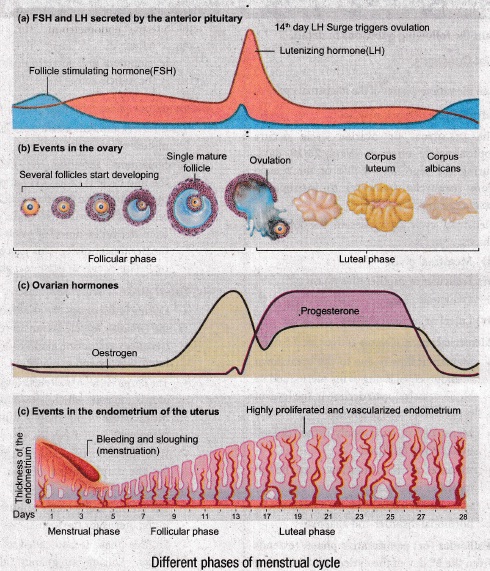
Menstrual cycle / Ovarian cycle
(i) The menstrual or ovarian cycle occurs approximately once in every 28/29 days, during the reproductive life of the female from menarche (puberty) to menopause except during pregnancy.
(ii) Menstrual cycle comprises of the following phases:
1. Menstrual phase
2. Follicular or proliferative phase
3. Ovulatory phase
4. Luteal or, secretory phase
(i) Menstrual phase: (Occurs and last for 3-5 days)
1. Menstrual flow is due to the breakdown of endometrial lining of the uterus, and its blood vessels due to decline in the level of progesterone and oestrogen.
2. Menstruation occurs only if the released ovum is not fertilized.
3. Absence of menstruation may be an indicator of pregnancy
4. However, it could also be due to stress, hormonal disorder and anaemia.
(ii) Follicular (or) proliferative phase: (extends from the 5th day of the cycle until the time of ovulation)
1. During this phase, the primary follicle in the ovary grows to become a fully mature Graafian follicle and simultaneously, the endometrium regenerates through proliferation. These changes in the ovary and the uterus are induced by the secretion of gonadotropins like FSH and LH, which increase gradually during the follicular phase. lt stimulates follicular development and secretion of oestrogen by the follicle cells.
(iii) Ovulatory phase (about 14th day):
1. Both LH and FSH attain peak level in the middle of the cycle.
2. Maximttm secretion of LH during the mid-cycle is called LH surge induces the rupture of the Graafian follicle and the release of the ovum (secondary oocyte) from the break down of ovary wall into the peritoneal cavity. This process called ovulation occurs at late luteal phase.
(iv) Luteal phase or secretory phase;
1. During luteal phase, the remaining part of the Graalian follicle is transformed into a transitory endocrine gland called corpus luteum at the end of ovulation.
2. The corpus luteum secretes a large amount of progesterone which is essential for the maintenance of the endometrium during pregnancy.
3. If fertilization takes place, it paves way for the implantation of the fertilized ovum.
4. The uterine wall secretes a nutritious fluid in the uterus for the foetus.
5. So, this phase is also called as secretory phase. During pregnancy all events of menstrual cycle stop and there is no menstruation.
6. In the absence of fertilization, the corpus luteum degenerates completely and leaves a scar tissue called corpus Albicans.
7. It also initiates the disintegration of the endometrium leading to menstruation, marking repetition of the next cycle.
39.
(i) The inheritance of a trait that is determined by a gene located on one of the sex chromosomes is called sex linked inheritance.
(ii) Genes present on the differential region of X or Y chromosomes are called sex linked genes. The genes present in the differential region of "X" chromosome are called X linked genes. The X-linked genes have no corresponding alleles in the Y chromosome.
(iii) The genes present in the differential region of Y chromosome are called Y- linked or holandric genes. The Y linked genes have no corresponding allele in X chromosome.
(iv) The Y linked genes inherit along with Y chromosome and they phenotypically express only in the male sex.
(v) Sex linked inherited traits are more common in males than females because, males are hemizygous and therefore express the trait when they inherit one mutant allele.
(vi) The X - linked and Y - linked genes in the differential region (non-homologus region) do not undergo pairing or crossing over during meiosis. The inheritance of X or Y linked genes is called sex-linked inheritance.
X linked Inheritance - Eg. Colour blindness
Y linked Inheritance - Eg. hypertrichosis
40.
(i) Fisher and Race hypothesis:
Rh factor involves three different pairs of alleles located on three different closely linked loci on the chromosome pair. This system is more commonly in use today, and uses the 'Cde' nomenclature.
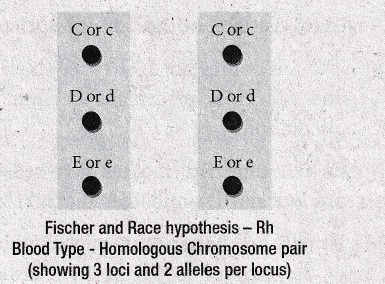
2. In the above Figure, three pairs of Rh alleles (Cc, Dd and Ee) occur at 3 different loci on homologous chromosome pair- 1.
3. The possible genotypes will be one C or c, one D or d, one E or e from each chromosome
For e.g. CDE/cde; CdE/cDe; cde/cde; CDe/CdE etc.
4. All genotypes carrying a dominant 'D' allele will produce Rh positive phenotype and double recessive genotype 'dd' will give rise to Rh negative phenotype.
(ii) Wiener Hypothesis
1. Wiener proposed the existence of eight alleles (R1, R2, RO, RZ, r, r1, r11, ry) at a single Rh locus.
2. All genotypes carrying a dominant 'R allele' (R1, R2, RO, RZ) will produce 'Rh- positive' phenotype and double recessive genotypes (rr, rr1, rr11, rry) will give rise to Rh- negative phenotype.
41.
1. The sex determining mechanism of humans is XX-XY type.
2. In humans, out of 23 pairs of chromosomes present, 22 pairs are exactly same in both males and females known as autosomes (body).
3. The 23rd chromosome is the sex chromosome. (i.e) Pair of X-chromosome (XX) is present in females and males having one X and one Y chromosome (XY).
4. During, spermatogenesis, in case of males two types of gametes are produced (x and y).
5. The 50% total sperms produced carry X-chromosomes and the rest 50% carry Y - chromosomes besides autosomes. This condition is called male diagamety.
6. The Y containing sperms and X containing sperms are called androsperms and gynosperms respectively.
7. Female produces only one type of ovum with an X-chromosome. If an ovum fertilizes with a sperm carrying X chromosome the zygote develops into a female (XX) and if an ovum is fertilized with sperm carrying Y-chromosome, zygote thus, formed will be male (YY).
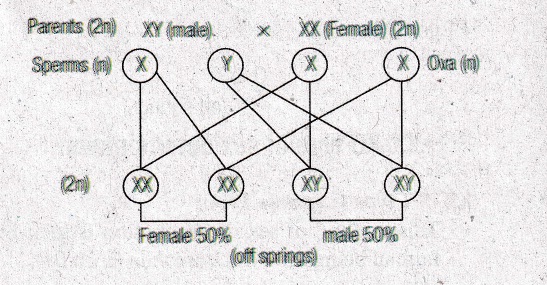
8. Hence, the genetic makeup of sperm, which fertilizes the ovum determines the sex of a child there are 50% chances of having either a male or female in each progeny.
9. Thus, it is by chance phenomenon, so women should not be blamed for giving birth to a girl child
42.
43.
(a) Some organisms like honeybees are called parthenogenetic animals.
1. In case of honeybees both haploid and diploid individuals formed, as a result of incomplete parthenogenesis.
2. Both sexual reproduction and parthenogenesis are inclusive.
3. Fertilized eggs (zygote) give rise to queen and workers (both are females) by the process of sexual reproduction.
4. Unfertilized eggs (ova) of females develop into drones (males) by the process of parthenogenesis.
(b) A male honeybee has 16 chromosomes where as its female has 32 chromosomes
1. It is because of haplodiploidy which is a sex determination system, in which males develop from unfertilized eggs (parthenogenesis) and are haploid (16n) and females develop frorn fertilized eggs and are diploid (32n) (sexual reproduction).
2. As unfertilized egg carries only half number of chromosome as compared to fertilized egg.
Therefore male honeybees have 16 chromosomes where as female has 32 chromosomes.

12th Standard Syllabus & Materials
12th Standard
TN 12th Computer Applications களப்பெயர் முறைமை (DNS) Sample Question Papers Study Material - QB365 Set A
NEW12th Standard
TN 12th Computer Applications வலையமைப்பு எடுத்துக்காட்டுகள் மற்றும் நெறிமுறைகள் Sample Question Papers Study Material - QB365 Set A
NEW12th Standard
TN 12th Computer Applications கணினி வலையமைப்பு ஓர் அறிமுகம் Sample Question Papers Study Material - QB365 Set A
NEW12th Standard
TN 12th Computer Applications PHP-உடன் MySQL-ஐ இணைத்தல் Sample Question Papers Study Material - QB365 Set A



Tamilnadu Stateboard 12th Standard Subjects

Maths

Chemistry

Physics
Biology

Computer Science

Business Maths and Statistics

Economics

Commerce

Accountancy

History

Computer Applications
Biology
Computer Technology
Computer Applications
Computer Science
Business Maths and Statistics
Commerce
Economics
Maths
Chemistry
Physics
Computer Technology
History
Accountancy

Tamil

English

French
Tamilnadu Stateboard Standards


