
 100% FREE ACCESS
12th Standard Syllabus & Materials
12th Standard
TN 12th Computer Applications மின்னணு தரவு பரிமாற்றம் Sample Question Papers Study Material - QB365 Set A
NEW12th Standard
TN 12th Computer Applications மின் - வணிக பாதுகாப்பு அமைப்புகள் Sample Question Papers Study Material - QB365 Set A
NEW12th Standard
TN 12th Computer Applications மின்னணு செலுத்தல் முறைகள் Sample Question Papers Study Material - QB365 Set A
NEW12th Standard
TN 12th Computer Applications மின் - வணிகம் Sample Question Papers Study Material - QB365 Set A
NEW12th Standard
TN 12th Computer Applications திறந்த மூல கருத்துருக்கள் Sample Question Papers Study Material - QB365 Set A
NEW12th Standard
TN 12th Computer Applications வலையமைப்பு வடமிடல் Sample Question Papers Study Material - QB365 Set A

Published on: 28/11/2025
Download Tamil Nadu 12th Standard Biology question papers, model tests, one-mark questions, important questions, and public exam papers in PDF format. Free study materials and answer keys for TN State Board students.
Questions + Answers key
Take MCQ Biology Test
1.
Spermatid \(\overset { A }{ \rightarrow }\) Spermatozoa what does 'A' stands for?
Spermatogenesis
Spermiation
Spermiogenesis
Gametogenesis
2.
Identify the correct Sequence of reproductive events in human beings.
Insemination, implanatation Fertilization Parturition and Placetation
Implanatation Fertilization, Insemination, Parturition and Placetation
Implanatation, Insemination, Fertilization, Parturition and Placetation
Insemination, Fertilization, Implanatation, Parturition and Placetation
3.
Excess of fluoride in drinking water causes:
Lung disease
Intestinal infection
Fluorosis
None of the above
4.
SMOG is derived from:
Smoke
Fog
Both (a) and (b)
Only A
5.
Cyclosporin – A is an immunosuppressive drug produced from _______
Aspergillus niger
Manascus purpureus
Penicillium notatum
Trichoderma polysporum
6.
7.
8.
Which of the following statements is not true about DNA replication in eukaryotes?
Replication begins at a single origin of replication.
Replication is bidirectional from the origins.
Replication occurs at about 1 million base pairs per minute
There are numerous different bacterial chromosomes, with replication occuring in each at the same time.
9.
10.
The milk secreted by the mammary glands soon after child birth is called ______.
Mucous
Colostrum
Lactose
Sucrose
11.
The process which the sperm undergoes before penetrating the ovum is _____.
Spermiation
Cortical reaction
Spermiogenesis
Capacitation
12.
13.
14.
Which of the following phenotypes in the progeny are possible from the parental combination AxB?
A and B only
A,B and AB only
AB only
A, B, AB and O
15.
Which of the following is not correct?
Three or more alleles of a trait in the population are called multiple alleles
A normal gene undergoes mutations to form many alleles
Multiple alleles map at different loci of a chromosome
A diploid organism has only two alleles out of many in the population
16.
17.
PCR is a useful tool for early diagnosis of an Infectious disease. Elaborate
18.
Define the following.
a. Species richness.
b. Endemism.
19.
20.
What is Lyonisation?
21.
List out chemical alarm signals produced during inflammation.
22.
Differentiate between the following:
(a) External and Internal fertilization
(b) Regeneration in lizard and Planaria
23.
Darwin's finches and Australian marsupials are suitable examples of adaptive radiation – Justify the statement
24.
Describe the major STDs and their symptoms.
25.
What are the three structural differences between RNA and DNA?
26.
Explain the process of replication of retrovirus after it gains entry into the human body.
27.
Explain the structure of immunoglobulin with suitable diagram.
28.
29.
What are DNA vaccines?
30.
Mention the major threats to biodiversity caused by human activities. Explain.
31.
When does antibiotic resistance develop?
32.
List the causative agent, mode of transmission and symptoms for Diptheria and Typhoid.
1.
(a)
Spermatogenesis
2.
(a)
Insemination, implanatation Fertilization Parturition and Placetation
3.
(c)
Fluorosis
4.
(c)
Both (a) and (b)
5.
(d)
Trichoderma polysporum
6.
(c)
7.
(b)
8.
(d)
There are numerous different bacterial chromosomes, with replication occuring in each at the same time.
9.
(b)
10.
(b)
Colostrum
11.
(d)
Capacitation
12.
(c)
13.
(c)
14.
(d)
A, B, AB and O
15.
(c)
Multiple alleles map at different loci of a chromosome
16.
17.
(i) PCR is a very sensitive technique which enables the amplification of desired DNA from a limited amount of DNA template.
(ii) A technique can be also used for amplifications of RNA in which case it is referred to as reverse transcription PCR (RT-PCR). In this process the RNA molecules (mRNA) must be converted to complementary DNA by the enzyme reverse transcriptase (reverse transcription).
(iii) The cDNA then serves as the template for PCR.
(iv) The specificity and sensitivity of PCR is useful for the diagnosis of inherited disorders (genetic, viral; bacterial, diseases).
(v) Hence, it can detect the presence of an infectious organism in the infected patient at an early stage of infection (even before the infectious organism has multiplied into large number).
18.
Endemism is the ecological state of a species being unique to a defined geographic location, such as an island, nation, country or other defined zone or habitat type; organisms that are indigenous to a place are not endemic to it if they are also found elsewhere.
19.
20.
The inactivation of an X chromosome one of the two X chromosomes in every cell in some female mammal is randomly inactivated early in embryonic development and named after geneticist Mary Lyon.
The inactive X chromosome is silenced by it being packaged in such a way that it has a transcriptionally inactive structure called heterochromatin found in nucleoplasm of nucleus.
21.
(i) An infection or tissue injury usually causes redness (rubber), swelling (tumor), pain (dolor). and production of heat (color) that may result in fever
(ii) Such localised expression is called inflammatory response, which occur due to release of certain chemical alarm signals such as histamine and prostaglandins.
22.
(a) External and Internal fertilization
| External Fertilization | Internal Fertilization |
| Takes place outside the female’s body. | Takes place inside the female’s body. |
| Usually, a large number of gametes are released in the surrounding medium (for example water). | Male gametes are released inside the body of the female by a copulatory organ. |
| Organisms that use external fertilization to reproduce must either live in the water or return to the water for reproduction. | Animals that have internal fertilization have completely transitioned to life on land. |
| As the chance of fertilization in water is generally less, hence, a large number of gametes are released. | The number of gametes produced in this mode is relatively less. |
| Examples: Fish, Amphibians, and most of the Algae, etc. | Examples: Reptiles, Birds, Mammals, Bryophytes, and Tracheophytes. |
(b) Regeneration in lizard and Planaria
| Regernation of lizard | Regeration of Planaria |
| If the tail of the lizard is cut and removed, a new tail will regerate in damaged part. In lizard only the new tail is regerated | If a planarian worm get cut then each half regenerates the lost part resulting in two worms. In planaria, the cut removed part developed into an entire worm. |
23.
Adaptive radiation is the process of evolution of different species in a given geographical area starting from a point and literally radiating to other geographical area habitats.
1. Darwins finches were the small black birds which Darwin observed in Galapagos islands.
2. There were many varities of these birds in the same island.
3. Darwin reasoned that after originating from a common ancestral seed eating stock the finches must have radiated to different geographical areas and undergone adaptive changes especially in their breaks enabling some of them to become insectivorous.
4. Living isolation for long new kinds of finches must have evolved which could survive in the new habitats.
5. Australian marsupials (Kangaroos) also show adaptive radiation
6. Marsupials in Australia and placental mammals in north America are two subclasses of mammals they adapted in similar way to a particular food resources, locomotary skill or climate.
7 They were separated from the ori-on ancestor more than 100 million year ago and each lineage continued to evolve independently despite temporal and geographical separation marsupials in Australia and placenta mammals in North America have reduced varieties of species living in similar habitats with similar way of life their overall resemblance in shape, locomotary mode, feeding and foraging are superimposed upon different modes of reproduction.
24.
The major sexually transmitted diseases are
(i) Gonorrhoea
1. Causative agent: Neisseria gonorrhoeae
2. Symptoms: Affects the urethra, rectum and throat and in females the cervix also get affected
3. Pain and pus discharge in the genital tract and burning sensation during urination.
4. Incubation period: 2 to 5 days
(ii) Syphilis
Causative agent : Treponema pallidum
Symptoms:
1. Primary stage: Formation of painless ulcer on the external genitalia.
2. Secondary stage : Skin lesions, rashes, swollen joints and fever and hair loss.
3. Tertiary stage : Appearance of chronic ulcers on nose. Lower legs and palate, loss of movement mental disorder visual impairment, heart problems, gummas (soft non-cancerous growths) etc.
(iii) Hepatitis B
1. Causative agent: Hepatitis B virus (HBV) with DNA.
2. Symptoms: Fatigue, jaundice, fever, rash and stomach pain.
3. Liver cirrhosis and liver failure occur in the later stage.
4. Incubation period: 30-80 days
(iv) AIDS:
1. Causative agent: Human immuno deficiency Virus (HIV) .
2. Symptoms: Enlarged lymph nodes, prolonged fever, prolonged diarrhoea, weight reduction, night sweating.
3. Incubation periods: 2 to 6 weeks even more than 10 years
25.
Structural difference between DNA and RNA.
| DNA | RNA |
| It is double stranded with exception of some viruses | It is generally single stranded |
| It is the genetic material in all living organism | It is genetic material in some viruses only |
| The sugar is deoxy ribose (pentose) | The sugar is ribose (pentose) |
| Nitrogenous bases present are adenine, guanine, thymine and cytosine | Nitrogenous bases present are adenine, guanine, cytosine and uracil |
| It is less reactive, chemically and structurally more stable. | It is more reactive chemically and structurally less stable |
| It usually occurs inside the nucleus and in some cell organelles like mitochondria and chloroplasts. |
Very little RNA occurs inside the nucleus. most of its found in the cytoplasm |
26.
(i) After getting into the body of the person, the virus enters into macrophages where RNA genome of the virus replicates to form viral DNA with the help of the enzyme reverse transcriptase.
(ii) This viral DNA gets incorporated into the DNA of host cells and directs the infected cells to produce viral particles.
(iii) The macrophages continue to produce viral particles and act like a HIV factory. simultaneously, HIV enters into helper T-lymphocytes (TH), replicates and produces progenies viruses.
The progenies viruses are released into the blood attack other helper T-lymphocytes. This is repeated, leading to a progressive decrease in the number of helper T-lymphocytes in the body of the infected person.
(v) During this period, the person suffers from bouts of fever, diarrhea and weight loss. Due to decrease in the number of helper T-lymphocytes, the person starts suffering from infections that could have been otherwise overcome, such as those due to bacteria especially mycobacterium viruses; fungi and even parasites like toxoplasma.
(vi) The patient becomes so immune deficient that he/she is unable to protect himself/herself against infections.
27.
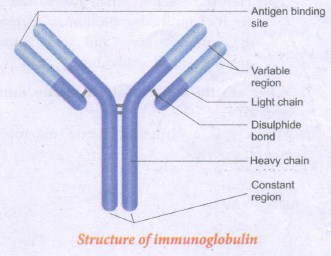
(i) In the 195"os,experiments by Porter and Edelman revealed the basic structure of the immunoglobulin.
(ii) An antibody molecule is Y shaped structu re that comprises of four polypeptide chains, two identical light chains (L) of molecular weight 25,000 Da (approximately 214 amino acids) and two identical heavy chains (H) of molecular weight 50,000 Da (approximately 450 amino acids).
(iii) The polypeptide chains are linked together by di-sulphide (S-S) bonds. One light chain is attached to each heavy chain and two heavy chains are attached to each other to form a Y shaped (Fig.) structure. Hence, an antibody is represented by H2L2.
(iv) Each chain (L and H) has two terminals. They are C - terminal (Carboxyl) and amino or N-terminal.
(v) Each chain (L and H) has two regions. They have variable (V) region at one end and a much larger constant (C) region at the other end.
(vi) Antibodies responding to different antigens have very different (V) regions but their (C) regions are the same in all antibodies.
(vii) In each arm of the monomer antibody, the (V) regions of the heavy and light chains combines to form an antigen - binding site shaped to 'fit' a specific antigenic determinant. Thus each antibody monomer has two such antigen - binding regions.
(viii) The (C) regions that forms the stem of the antibody monomer determine the antibody class and serve common functions in all antibodies.
28.
29.
(i) Genetic immunization by using DNA vaccines is a novel approach that came into being in 1990.
(ii) The immune response of the body is stimulated by a DNA molecule.
(iii) A DNA vaccine consists of a gene encoding an antigen protein, inserted on to a plasmid, and then incorporated into the cells in a target animal.
(iv) DNA instructs the cells to make antigenic molecules which are displayed on its surfaces. This would evoke an antibody response to the free floating antigen secreted by the cells.
(v) The DNA vaccine cannot cause the disease as it contains only copies of a few of its genes.
(vi) DNA vaccines are relatively easy and inexpensive to design and produce.
(vii) Vaccines produced by these new techniques have definite advantages like producing target proteins, long lasting immunity and trigger immune response only against specific pathogens with less toxic effects.
30.
Even though India is one of the 17 identified megadiverse countries of the world, it faces lots of threats to its biodiversity.
(i) Apart from natural causes, human activities, both directly and indirectly are today's main reason for habitat loss and biodiversity loss.
(ii) Fragmentation and degradation due to agricultural practices, extraction (mining, fishing, logging, harvesting) and development (settlements, industrial and associated infrastructures) lead to habitat loss and fragmentation leads to the formation of isolated, small and scattered populations and as endangered species.
31.
(i) Antibiotic resistance occurs when bacteria develop the ability to defeat the drug designed to kill or inhibit their growth.
(ii) It is one of the most acute threats to public health.
(iii) Antibiotic resistance is accelerated by the misuse and overuse of antibiotics, as well as poor infection prevention control.
(iv) Antibiotics should be used only when prescribed by a certified health professional. When the bacteria become resistant, antibiotics cannot fight against them and the bacteria multiply.
(v) Narrow spectrum antibiotics are preferred over broad spectrum antibiotics. They effectively and accurately target specific pathogenic organisms and are less likely to cause resistance.
(vi) "Superbug" is a term used to describe strains of bacteria that are resistant to the majority of antibiotics commonly used today.
32.
(i) For Diphtheria:
Causal agent: Corynebacterium diphtheria.
Mode of Transmission: Droplet infection through breathing.
Symptoms: Fever, sore throat, hoarseness and difficulty in breathing
(ii) For Typhoid:
Causal agent: Salmonella typhi
Mode of Transmission: Through contaminated food and water
Symptoms: Headache, abdominal discomfort, fever and diarrhea.

12th Standard Syllabus & Materials
12th Standard
TN 12th Computer Applications களப்பெயர் முறைமை (DNS) Sample Question Papers Study Material - QB365 Set A
NEW12th Standard
TN 12th Computer Applications வலையமைப்பு எடுத்துக்காட்டுகள் மற்றும் நெறிமுறைகள் Sample Question Papers Study Material - QB365 Set A
NEW12th Standard
TN 12th Computer Applications கணினி வலையமைப்பு ஓர் அறிமுகம் Sample Question Papers Study Material - QB365 Set A
NEW12th Standard
TN 12th Computer Applications PHP-உடன் MySQL-ஐ இணைத்தல் Sample Question Papers Study Material - QB365 Set A



Tamilnadu Stateboard 12th Standard Subjects

Maths

Chemistry

Physics
Biology

Computer Science

Business Maths and Statistics

Economics

Commerce

Accountancy

History

Computer Applications
Biology
Computer Technology
Computer Applications
Computer Science
Business Maths and Statistics
Commerce
Economics
Maths
Chemistry
Physics
Computer Technology
History
Accountancy

Tamil

English

French
Tamilnadu Stateboard Standards


