
 100% FREE ACCESS
12th Standard Syllabus & Materials
12th Standard
TN 12th Computer Applications மின்னணு தரவு பரிமாற்றம் Sample Question Papers Study Material - QB365 Set A
NEW12th Standard
TN 12th Computer Applications மின் - வணிக பாதுகாப்பு அமைப்புகள் Sample Question Papers Study Material - QB365 Set A
NEW12th Standard
TN 12th Computer Applications மின்னணு செலுத்தல் முறைகள் Sample Question Papers Study Material - QB365 Set A
NEW12th Standard
TN 12th Computer Applications மின் - வணிகம் Sample Question Papers Study Material - QB365 Set A
NEW12th Standard
TN 12th Computer Applications திறந்த மூல கருத்துருக்கள் Sample Question Papers Study Material - QB365 Set A
NEW12th Standard
TN 12th Computer Applications வலையமைப்பு வடமிடல் Sample Question Papers Study Material - QB365 Set A

Published on: 28/11/2025
Download Tamil Nadu 12th Standard Chemistry question papers, model tests, one-mark questions, important questions, and public exam papers in PDF format. Free study materials and answer keys for TN State Board students.
Questions + Answers key
Take MCQ Chemistry Test
1.
Ampicillin is an example of _______ drugs.
anaesthetic
antibiotic
tranquilizer
none of the above
2.
Drugs that bind to the receptor site and inhibit its natural function are called _______.
antagonists
agonists
enzymes
molecular targets
3.
The unit of zero order rate constant is _____.
litre mol-1 sec-1
mol litre-1 sec-1
sec-1
litre2 sec-1
4.
When Copper is heated with cone HNO3 it produces
Cu (NO3)2 and N2O
Cu (NO3)2 and NO2
Cu (NO3)2 and NO
Cu (NO3)2 NO and N2O
5.
Name the process by which elements such as germanium, silicon and gallium are refined.
Vapour phase method
Electrolytic refining
Zone refining
Van-Arkel method
6.
The decomposition of phosphine (PH3) on tungsten at low pressure is a first order reaction. It is because the _____.
rate is proportional to the surface coverage
rate is inversely proportional to the surface coverage
rate is independent of the surface coverage
rate of decomposition is slow
7.
On hydrolysis, PCl3 gives________.
H3PO3
PH3
H3PO4
POCl3
8.
The metal oxide which cannot be reduced to metal by carbon is ________.
PbO
Al2O3
ZnO
FeO
9.
How is phosphine prepared?
10.
What are antibiotics?
11.
Write Arrhenius equation and explains the terms involved.
12.
What is the role of quick lime in the extraction of Iron from its oxide Fe2O3?
13.
Explain the mechanism of cleansing action of soaps and detergents.
14.
What is an elementary reaction? Give the differences between order and molecularity of a reaction.
15.
Give the balanced equation for the reaction between chlorine with cold NaOH and hot NaOH.
16.
Explain zone refining process with an example.
17.
Write a note on vulcanization of rubber
18.
Explain the structure of ammonia.
19.
Derive integrated rate law for a zero order reaction A\(\longrightarrow \) product.
20.
Write a short note on electrochemical principles of metallurgy.
1.
(b)
antibiotic
2.
(a)
antagonists
3.
(b)
mol litre-1 sec-1
4.
(b)
Cu (NO3)2 and NO2
5.
(c)
Zone refining
6.
Given:
At low pressure the reaction follows first order therefore,
Rate α [reactant]1
Rate α (surface area)
At high pressure due to the complete coverage of surface area, the reaction follows zero order.
Rate α [reactant]0
Therefore the rate is independent of surface area.
7.
(a)
H3PO3
8.
(b)
Al2O3
9.
Phosphine is prepared by the action of NaOH with white phosphorus in an inert atmosphere of CO2 (or) hydride.
\(\mathrm{P}_{4}+3 \mathrm{NaOH}+3 \mathrm{H}_{2} \mathrm{O} \rightarrow 3 \mathrm{NaH}_{2} \mathrm{PO}_{2}+\mathrm{PH}_{3} \uparrow\\ \quad \quad \quad \quad \quad \quad \text {Sodium hypo phosphite Phosphine}\)
10.
(i) Many micro organisms (bacteria, fungi and moulds) produce certain chemicals which inhibit the growth or metabolism of some other micro organism. Such chemicals are called antibiotics.
(ii) Eg: Penicillin from the mould penicillium notatum
11.
Arrhenius equation is,
\(k=Ae^\left ({ \frac { -Ea }{ RT } } \right )\)
Here,
A \(\rightarrow\) Frequency factor
Ea \(\rightarrow\) Activation energy of the reaction
R \(\rightarrow\) Gas constant
T \(\rightarrow\) Absolute temperature (in K)
12.
In this extraction, a basic flux, quick lime (CaO) is used, since the silica gangue present in the ore is acidic in nature. The quick lime combines with it to form calcium silicate (slag).
CaO(s) + Sio2(s) ⟶ CaSio3(s)
Flux Gangue Slag
13.
(i) To understand how a soap works as a cleansing agent, let us consider sodium palmitate an example of a soap. The cleansing action of soap is directly related to the structure of carboxylate ions (palmitate ion) present in soap. The structure of palmitate exhibit dual polarity. The hydrocarbon portion is non polar and the carboxyl portion is polar.

(ii) The nonpolar portion is hydrophobic while the polar end is hydrophilic. The hydrophobic hydro carbon portion is soluble in oils and greases, but not in water. The hydrophilic carboxylate group is soluble in water.
(iii) The dirt in the cloth is due to the presence of dust particles intact or grease which stick. When the soap is added to an oily or greasy part of the cloth, the hydrocarbon part of the soap dissolve in the grease, leaving the negatively charged carboxylate end exposed on the grease surface.
(iv) At the same time the negatively charged carboxylate groups are strongly attracted by water, thus leading to the formation of small droplets called micelles and grease is floated away from the solid object. When the water is rinsed away, the grease goes with it. As a result, the cloth gets free from dirt and the droplets are washed away with water. The micelles do not combine into large drops because their surfaces are all negatively charged and repel each other. The cleansing ability of a soap depends upon its tendency to act as a emulsifying agent between water and water insoluble greases.
.JPG)
The cleansing action of detergents are similar to cleansing action of soap. Eg: the structure of a cationic detergents is:
.JPG)
14.
(a) Elementary reaction
Each and Every single step in a reaction mechanism is called an elementary reaction.
Rate = k[A] [B]
(b)
| Order of reaction | Molecularity of a reaction |
|---|---|
| Order of reaction is the sum of the powers of concentration terms involved in the experimentally determined rate law. | Molecularity of a reaction is the total number of reactant species that are involved in an elementary step. |
| It can be zero (or) fractional (or) integer | It is always a whole number, cannot be zero or a fractional number. |
| It is assigned for a overall reaction. | It is assigned for each elementary step of the mechanism. |
15.
Chlorine reacts with cold dilute alkali to give chloride and hypochlorite, while with hot concentrated alkali chlorides and chlorates are formed.
\(\mathrm{Cl}_{2}+\mathrm{H}_{2} \mathrm{O} \rightarrow \mathrm{HCl}+\underset{\text { Hypochlorous acid }}{\mathrm{HOCl}} \)
\(\mathrm{HCl}+\mathrm{NaOH} \rightarrow \mathrm{NaCl}+\mathrm{H}_{2} \mathrm{O} \)
\(\mathrm{HOCl}+\mathrm{NaOH} \rightarrow \mathrm{NaOCl}+\mathrm{H}_{2} \mathrm{O} \)
(Sodium hypo chlorite)
Overall Reaction
3Cl2 + 6NaOH \(\rightarrow\) NaClO3 + 5NaCl + 3H2O
(Sodium Chlorate)
16.
Zone refining :
1. Zone refining method is based on the principles of fractional crystallisation.
2. When an impure metal is melted and allowed to solidify, the impurities will prefer to be in the molten region. In this process the impure metal is taken in the form of a rod.
3. One end of the rod is heated using a mobile induction heater which results in melting of the metal on that portion of the rod.
4. When the heater is slowly moved to the other end the pure metal crystallises while the impurities will move on to the adjacent molten zone.
5. As the heater moves further away, the molten zone containing impurities also moves along with it.
6. The process is repeated several times by moving the heater in the same direction again and again to get pure metal.
7. This process is carried out in an inert gas atmosphere to prevent the oxidation of metals.
8. Elements such as germanium (Ge), silicon (Si) and galium (Ga) that are used as semiconductor are refined using this process.
17.
(i) Natural rubber is mixed with 3-5% sulphur and heated at 100-150°C causes cross-linking of the cis-1,4-polyisoprene chains through disulphide (-S-S-) bonds.
(ii) The physical properties of rubber can be altered by controlling the amount of sulphur that is used for vulcanization.
(iii) In sulphur rubber, made with about 1 to 3% sulphur is soft and stretchy.When 3 to 10% sulphur is used the resultant rubber is somewhat harder but flexible.
18.
Structure of ammonia
(i) Ammonia molecule is pyramidal in shape N-H bond distance is 1.016Å and H-H bond, distance is 1.645Å with a bond angle 107°.
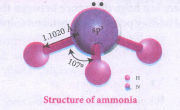
(ii) The structure of ammonia may be regarded as a tetrahedral with one lone pair of electrons in one tetrahedral position hence it has a pyramidal shape.
19.
A reaction in which the rate is independent of the concentration of the reactant over a wide range of concentration is called a zero order reaction.
Let us consider the following by hypothetical zero order reaction.
A⟶ product
The rate law can be written as,
Rate = k[A]0
\(\frac { -d\left[ A \right] }{ dt } =k(1)\ \ \ \therefore \left( { \left[ A \right] }^{ 0 }=1 \right) \)
\(\Rightarrow -d\left[ A \right] =kdt\)
Integrate the above equation between the limits of [A0] at zero time and [A] at some later time 't',
\(-\int _{ \left[ { A }_{ 0 } \right] }^{ \left[ A \right] }{ d\left[ A \right] } =k\int _{ 0 }^{ t }{ dt } \)
\(-{ \left( \left[ A \right] \right) }_{ \left[ { A }_{ 0 } \right] }^{ \left[ A \right] }=k{ \left( t \right) }_{ 0 }^{ t }\)
[A0] - [A] = kt
\(k=\frac { \left[ { A }_{ 0 } \right] -\left[ A \right] }{ t } \)
Straight line equation y = mx + c
ie., \(\left[ A \right] =-kt+\left[ { A }_{ 0 } \right] \)
⇒ y = c + mx
A plot [A] vs time gives a straight line with a slope of -k and y intercept of [A0]
20.
1. Reduction of oxides of active metals such as sodium, potassium etc., by carbon is thermodynamically not feasible.
2. Such metals are extracted from their ores by using electrochemical methods.
3. In this technique, the metal salts are taken in a fused form or in solution form.
4. The metal ion present can be reduced by some suitable reducing agent or by electrolysis.
5. Gibbs free energy for the electrolysis process is given by
Here,
\(\Delta\)Go = -nFEo
\(\Delta\)Go - Standard Gibb's free energy change
n - number of electrons involved,
F - Faraday,
Eo - Standard electrode potential
6. If Eo is positive then the \(\Delta\)Go is negative and the reduction is spontaneous
7. Hence a redox reaction is planned in such a way that the e.m.f of the net redox reaction is positive.
8. When a more reactive metal is added to less reactive metal salt solution, the more reactive metal will go into the solution.
Example:
\({ Cu }_{ (s) }+2{ Ag }^{ + }_{ (aq) }\longrightarrow { Cu }^{ 2+ }_{ (aq) }+2{ Ag }_{ (s) }\)
\({ Cu }^{ 2+ }_{ (aq) }+{ Zn }_{ (s) }\longrightarrow { Cu }_{ \left( s \right) } +{ Zn }^{ 2+ }_{ (aq) }\)

12th Standard Syllabus & Materials
12th Standard
TN 12th Computer Applications களப்பெயர் முறைமை (DNS) Sample Question Papers Study Material - QB365 Set A
NEW12th Standard
TN 12th Computer Applications வலையமைப்பு எடுத்துக்காட்டுகள் மற்றும் நெறிமுறைகள் Sample Question Papers Study Material - QB365 Set A
NEW12th Standard
TN 12th Computer Applications கணினி வலையமைப்பு ஓர் அறிமுகம் Sample Question Papers Study Material - QB365 Set A
NEW12th Standard
TN 12th Computer Applications PHP-உடன் MySQL-ஐ இணைத்தல் Sample Question Papers Study Material - QB365 Set A



Tamilnadu Stateboard 12th Standard Subjects

Maths
Chemistry

Physics

Biology

Computer Science

Business Maths and Statistics

Economics

Commerce

Accountancy

History

Computer Applications
Biology
Computer Technology
Computer Applications
Computer Science
Business Maths and Statistics
Commerce
Economics
Maths
Chemistry
Physics
Computer Technology
History
Accountancy

Tamil

English

French
Tamilnadu Stateboard Standards


