
 100% FREE ACCESS
12th Standard Syllabus & Materials
12th Standard
TN 12th Computer Applications மின்னணு தரவு பரிமாற்றம் Sample Question Papers Study Material - QB365 Set A
NEW12th Standard
TN 12th Computer Applications மின் - வணிக பாதுகாப்பு அமைப்புகள் Sample Question Papers Study Material - QB365 Set A
NEW12th Standard
TN 12th Computer Applications மின்னணு செலுத்தல் முறைகள் Sample Question Papers Study Material - QB365 Set A
NEW12th Standard
TN 12th Computer Applications மின் - வணிகம் Sample Question Papers Study Material - QB365 Set A
NEW12th Standard
TN 12th Computer Applications திறந்த மூல கருத்துருக்கள் Sample Question Papers Study Material - QB365 Set A
NEW12th Standard
TN 12th Computer Applications வலையமைப்பு வடமிடல் Sample Question Papers Study Material - QB365 Set A

Published on: 28/11/2025
Download Tamil Nadu 12th Standard Chemistry question papers, model tests, one-mark questions, important questions, and public exam papers in PDF format. Free study materials and answer keys for TN State Board students.
Questions + Answers key
Take MCQ Chemistry Test
1.
Nitromethane condenses with acetaldehyde to give
nitro propane
1-nitro-2-propanol
2-nitro-1-propanol
3-nitro propanol
2.
The optically inactive amino acid is_______
glycine
alanine
proline
phenylalanine
3.
Colloidal solution of ink is prepared by _______.
mechanical dispersion
electro dispersion
ultrasonic dispersion
peptisation
4.
Which of the following are epimers?
D(+)-Glucose and D(+)-Galactose
D(+)-Glucose and D(+)-Mannose
Neither (a) nor (b)
Both (a) and (b)
5.
6.
Which one of the following characteristics are associated with adsorption?
\(\Delta\)G and \(\Delta\)H are negative but \(\Delta\)S is positive
\(\Delta\)G and \(\Delta\)S are negative but \(\Delta\)H is positive
\(\Delta\)G is negative but \(\Delta\)H and \(\Delta\)S are positive
\(\Delta\)G, \(\Delta\)H and \(\Delta\)S all are negative.
7.
Oxalic acid on heating with cone H2SO4 gives ______.
CO only
CO2 only
CO2 + H2O
CO + CO2 + H2O
8.
P4O6 reacts with cold water to give _______.
H3PO3
H4P2O7
HPO3
H3PO4
9.
Why are lyophillic colloidal sols are more stable than lyophobic colloidal sol.
10.
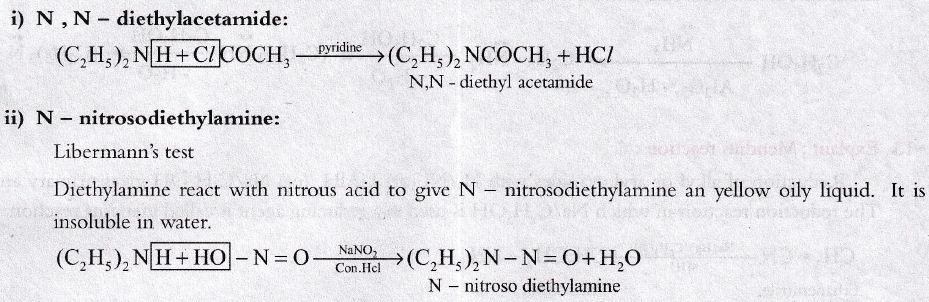
How will you convert diethylamine into
i) N, N – diethylacetamide
ii) N – nitrosodiethylamine
11.
Give any three difference between DNA and RNA.
12.
Give the uses of helium.
13.
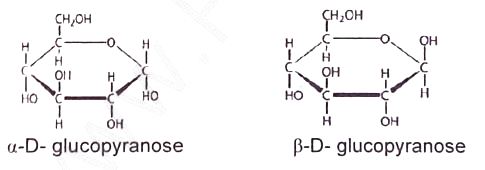
Write the structure of the following:
\(\alpha\) - D - glucopyranose and
\(\beta\) - D - glucopyranose
14.
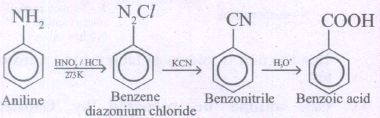
\({ C }_{ 6 }{ H }_{ 5 }{ NH }_{ 2 }\xrightarrow [ 273k,HCl ]{ { HNO }_{ 2 } } A\xrightarrow [ { Cu }_{ 2 }({ CN })_{ 2 } ]{ KCN } B \stackrel { { H }_{ 3 }O }\rightarrow C\)
Identify A, Band C.
15.
Why are colloids purified?
16.
What is the difference between a sol and a gel?
17.
Give the reason for bleaching action of Cl2.
18.
Mention characteristics of interhalogen compounds.
19.
Explain intermediate compound formation theory of catalysis with an example.
20.
How will you distinguish between primary secondary and tertiary alphatic amines.
21.
Write a short note on peptide bond.
1.
(b)
1-nitro-2-propanol
2.
(a)
glycine
3.
(a)
mechanical dispersion
4.
(d)
Both (a) and (b)
5.
(d)
6.
Adsorption leads to decrease in randomnes (entropy).i.e, ΔS < 0 for the adsorption to occur, ΔG slhould be -ve. We know that ΔG = ΔH - TΔS if ΔS is -ve, TΔS is +ve.It means that ΔG will become negative only when ΔH is -ve and ΔH > TΔS.
7.
(d)
CO + CO2 + H2O
8.
(a)
H3PO3
9.
(i) In lyophillic colloids or sols definite attractive force or affinity exists between dispersion medium and dispersed phase. Examples: sols of protein and starch. They are more stable and will not get precipitated easily.
(ii) In a lyophobic colloids, no attractive force exists between the dispersed phase and dispersion medium. They are less stable and precipitated readily, but cannot be produced again by just adding the dispersion medium.
Examples: sols of gold, silver, platinum and copper.
10.
11.
| DNA | RNA |
|---|---|
| DNA is mainly present in nucleus, mitochondria and chloroplast | RNA is mainly present in cytoplasm, nucleolus and ribosomes |
| It contains deoxyribose sugar | It contains ribose sugar |
| Base pair A = T. G≡C | Base pair A = U. C≡G |
| Double stranded molecules | Single stranded molecules |
| It's life time is high | It is short lived |
| It is stable and not hydrolysed easily by alkalis | It is unstable and hydrolyzed easily by alkalis |
| It can replicate itself | It cannot replicate itself It is formed from DNA |
12.
(i) Helium is used to provide inert atmosphere in electric-arc welding of metals.
(ii) Helium has lowest boiling point hence used in cryogenics.
(iii) It is much less denser than air and hence used for filling air balloons.
13.
14.
15.
The colloidal solutions due to their different methods of preparation may contain impurities. If they are not removed, they may destablise and precipitate the colloidal solution.
16.
| S.no | Sol | Gel |
| (a) | The liquid state of collidal solution | The solid (or) semi solid stage of a colloidal solution. |
| (b) | Very low viscosity | Very high viscosity |
| (c) | It does not have definite structure. | It possesses definite structure. |
17.
(i) Bleaching action of Cl2 is due to its oxidising property.
(ii) In aqueous solution, Cl2 liberates nascent oxygen which brings about the oxidation of coloured substances present in vegetables and organic matter to colourless substances.
\(\mathrm{Cl}_{2}+\mathrm{H}_{2} \mathrm{O} \rightarrow 2 \mathrm{HCl}+\mathrm{[O}]\)
Coloured substance +[O] → colorless substance.
18.
(i) The central atom will be the larger one.
(ii) It can be formed only between two halogen and not more than two halogens.
(iii) Fluorine can't act as a central metal atom being the smallest one.
(iv) Due to high electro-negativity with small size fluorine helps the central atom to attain high coordination number.
(v) They can undergo the auto ionization. They are strong oxidizing agents.
19.
The intermediate compound formation theory :
A catalyst acts by providing a new path with low energy of activation. In homogeneous catalysed reactions a catalyst may combine with one or more reactant to form an intermediate which reacts with other reactant or decompose to give products and the catalyst is regenerated.
Consider the reactions :
A+B➝AB; C is the catalyst .............(1)
A + C ➝ AC (intermediate) ..........(2)
AC + B ⟶ AB + C ...............(3)
Example 1:
The mechanism of Fridel crafts reaction is given below
\({ C }_{ 6 }{ H }_{ 6 }+{ { CH }_{ 3 }Cl\overset { anhydrous\\ { AlCl }_{ 3 } }{ \longrightarrow } }{ C }_{ 6 }{ H }_{ 5 }{ CH }_{ 3 }+HCl\)
The action of catalyst is explained as follows
CH3Cl + AlCl3 ⟶ [CH3]+ [AlCl4]-
It is an intermediate.
\({ C }_{ 6 }{ H }_{ 6 }+\left[ { CH }_{ 3 }^{ + } \right] \left[ { AlCl }_{ 4 } \right] ^{ - }\longrightarrow { C }_{ 6 }{ H }_{ 5 }{ CH }_{ 3 }+{ AlCl }_{ 3 }+Hcl\)
Example 2:
\({ { 2KClO }_{ 3 }\overset {\\ { MnO }_{ 3 } }{ \longrightarrow } }{ 2KCl }+{ 3O }_{ 2 }\)
Thermal decomposition of KCIO3 in the presence of MnO2 proceeds as follows. Steps in the reaction
2KCIO3 ⟶ 2KCI + 3O2 Can be given as
2KClO3 + 6MnO2 → 6MnO3 + 2KCl
It is an intermediate
6MnO3 → 6MnO2 + 3O2
Example 3:
Formation of water due to the reaction of H2 and O2 in the presence of Cu can be given as
H2 + 1/2O2 → H2O
2Cu + \(\frac{1}{2}\)O2 → Cu2O
It is an intermediate.
Cu2O + H2 → H2O + 2Cu
Advantages:
This theory describes
(a) The specificity of a catalyst and
(b) The increase in the rate of the reaction with increasc inthe concentration of a catalyst
Limitations:
(a) The intermediate compound theory fails to explain the action of catalytic poison and activators (promoters).
(b) This theory is unable to explain the mechanism of heterogeneous catalysed reactions.
20.
| S.No | Reagents or Reaction | Primary amine RNH2 | Secondary amine R2NH | Tertiary amine R3N |
|---|---|---|---|---|
|
1. |
Carbylamine reaction or with CHCl3/KOH |
Carbylamine is formed (unpleasant smell) |
- | - |
| 2. | Mustard oil reaction or CS2/HgCl2 (Hoffmann's mustard oil test) |
Alkyl isothiocyanate is formed (Mustard oil odour) |
- | - |
| 3. | HNO2 (or) NaNO2 / HCl |
Alcohol is formed +H2 | Yellow oily nitrosoamine is formed, insoluble in water. (Liberman's Test) |
Forms nitrite in cold, soluble in water. |
| 4. | CH3COCl | N-acetyl derivative is formed | N,N- diacetyl derivative is formed |
- |
| 5. | Diethyl oxalate Hoffmann's method |
Solid oxamide is formed | Liquid oxamic ester is formed |
- |
| 6. | Benzene sulphonyl chloride in presence of excess. KOH (Hinsberg's reaction) |
N- alkyl benzene sulphonamide is formed (soluble) |
N, N - dialkyl benzene sulphonamide is formed (Insoluble). |
- |
| 7. | With RX | 1 mol → 2o amine 2 mol → 3o amine 3 mol → Quarternary salt |
1 mol → 3o amine 2 mol → Quarternary salt |
1 mol → Quarternary salt |
21.
(i) The amino acids are linked covalently by peptide bonds. The carboxyl group of the first amino acid react with the amino group of the second amino acid to give an amide linkage between these amino acids. This amide linkage is called peptide bond. The resulting compound is called a dipeptide. Addition an another amino acid to this dipeptide a second peptide bond results in tripeptide.
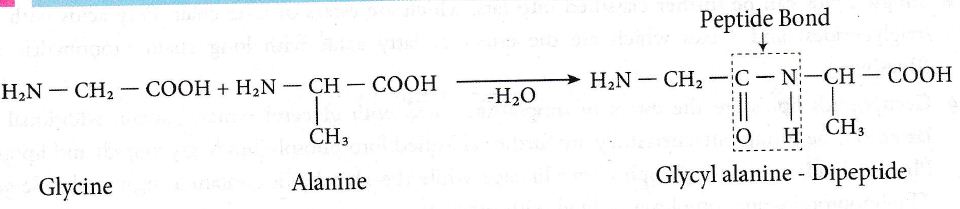
(ii) Thus we can generate tetra peptide, penta peptide etc... When you have more number of amino acids linked this way you get a polypeptide. If the number of amino acids are less it is called as a polypeptide, if it has large number of amino acids (and preferably has a function) then it is called a protein.
(iii) The amino end of the peptide is known as N - terminal or amino terminal while the carboxy end is called C-terminal or carboxy terminal. In general protein sequences are written from N-Terminal to C-Terminal.The atoms other than the side chains (R-groups) are called main chain or the back bone of the polypeptide.

12th Standard Syllabus & Materials
12th Standard
TN 12th Computer Applications களப்பெயர் முறைமை (DNS) Sample Question Papers Study Material - QB365 Set A
NEW12th Standard
TN 12th Computer Applications வலையமைப்பு எடுத்துக்காட்டுகள் மற்றும் நெறிமுறைகள் Sample Question Papers Study Material - QB365 Set A
NEW12th Standard
TN 12th Computer Applications கணினி வலையமைப்பு ஓர் அறிமுகம் Sample Question Papers Study Material - QB365 Set A
NEW12th Standard
TN 12th Computer Applications PHP-உடன் MySQL-ஐ இணைத்தல் Sample Question Papers Study Material - QB365 Set A



Tamilnadu Stateboard 12th Standard Subjects

Maths
Chemistry

Physics

Biology

Computer Science

Business Maths and Statistics

Economics

Commerce

Accountancy

History

Computer Applications
Biology
Computer Technology
Computer Applications
Computer Science
Business Maths and Statistics
Commerce
Economics
Maths
Chemistry
Physics
Computer Technology
History
Accountancy

Tamil

English

French
Tamilnadu Stateboard Standards


