
 100% FREE ACCESS
12th Standard Syllabus & Materials
12th Standard
TN 12th Computer Applications மின்னணு தரவு பரிமாற்றம் Sample Question Papers Study Material - QB365 Set A
NEW12th Standard
TN 12th Computer Applications மின் - வணிக பாதுகாப்பு அமைப்புகள் Sample Question Papers Study Material - QB365 Set A
NEW12th Standard
TN 12th Computer Applications மின்னணு செலுத்தல் முறைகள் Sample Question Papers Study Material - QB365 Set A
NEW12th Standard
TN 12th Computer Applications மின் - வணிகம் Sample Question Papers Study Material - QB365 Set A
NEW12th Standard
TN 12th Computer Applications திறந்த மூல கருத்துருக்கள் Sample Question Papers Study Material - QB365 Set A
NEW12th Standard
TN 12th Computer Applications வலையமைப்பு வடமிடல் Sample Question Papers Study Material - QB365 Set A

Published on: 22/08/2026
Download Tamil Nadu 12th Standard Chemistry question papers, model tests, one-mark questions, important questions, and public exam papers in PDF format. Free study materials and answer keys for TN State Board students.
Questions + Answers key
Take MCQ Chemistry Test
1.
The substance which is used to increase the activity of a catalyst is called _______.
an auto catalyst
a catalytic poison
an active centre
a promoter
2.
An example of positively charged colloid is________.
clay
starch
Ag
haemoglobin
3.
The autocatalyst in the oxidation of oxalic acid by acidified KMnO4 is _______.
K2SO4
MnSO4
KMnO4
CO2
4.
Adsorption of a gas on solid metal surface is spontaneous and exothermic, then ______.
ΔH increases
ΔS increases
ΔG increases
ΔS decreases
5.
Collodion is a 4% solution of which one of the following compounds in alcohol – ether mixture?
Nitroglycerine
Cellulose acetate
Glycoldinitrate
Nitrocellulose
6.
The most effective electrolyte for the coagulation of As2S3Sol is _______.
NaCl
Ba(NO3)2
K3[Fe(CN)6]
Al2(SO4)3
7.
Fog is colloidal solution of _______.
solid in gas
gas in gas
liquid in gas
gas in liquid
8.
Which one of the following characteristics are associated with adsorption?
\(\Delta\)G and \(\Delta\)H are negative but \(\Delta\)S is positive
\(\Delta\)G and \(\Delta\)S are negative but \(\Delta\)H is positive
\(\Delta\)G is negative but \(\Delta\)H and \(\Delta\)S are positive
\(\Delta\)G, \(\Delta\)H and \(\Delta\)S all are negative.
9.
Write the characteristics of catalysts.
10.
Explain the factors affecting adsorption.
11.
Explain intermediate compound formation theory of catalysis with an example.
12.
Differentiate physisorption and chemisorption.
13.
Define: Gold number.
14.
What is Brownian movement?
15.
What is Helmholtz double layer?
16.
Why does bleeding stop by rubbing moist alum
17.
18.
Mention the different demulsification techniques.
19.
Write a note on electro dispersion.
20.
Explain Homogeneous catalysis with few examples. (or) What is Homogeneous catalysis? given examples.
21.
Write a note.
(i) Positive catalyst
(ii) Negative catalyst
22.
Write a note on catalytic poison
23.
Write a note on electro osmosis.
24.
Why are lyophillic colloidal sols are more stable than lyophobic colloidal sol.
1.
(d)
a promoter
2.
(d)
haemoglobin
3.
(b)
MnSO4
4.
ΔS is -ve
5.
Pyroxylin(nitro cellulose)
6.
As2S3 is a negatively charged colloid. It will be most effectively coagulated by the cation with greater valency. i.e., Al3+.
7.
dispersion medium-gas
dispersed phase-liquid
8.
Adsorption leads to decrease in randomnes (entropy).i.e, ΔS < 0 for the adsorption to occur, ΔG slhould be -ve. We know that ΔG = ΔH - TΔS if ΔS is -ve, TΔS is +ve.It means that ΔG will become negative only when ΔH is -ve and ΔH > TΔS.
9.
(i) For a chemical reaction, catalyst is needed in very small quantity.
(ii) There may be some physical changes, but the catalyst remains unchanged in mass and chemical composition in a chemical reaction.
(iii) A catalyst itself cannot initiate a reaction.
(iv) A solid catalyst will be more effective if it is taken in a finely divided form.
(v) A catalyst are specific in nature.
(vi) In an equilibrium reaction, presence of catalyst reduces the time for attainment of equilibrium and hence it does not affect the position of equilibrium and the value of equilibrium constant.
(vii) A catalyst is highly effective at a particular temperature called as optimum temperature.
(viii) Presence of a catalyst generally does not change the nature of products
10.
Factors affecting adsorption:
The adsorption is well understood by considering I the various factors affecting it. Qualitatively, the extent of surface adsorption depends on
(i) Nature of adsorbent
(ii) Nature of adsorbate
(iii) Pressure
(iv) Concentration at a given temperature.
(i) The adsorption is a surface phenomenon: it depends on the surface area of adsorbent. i.e., higher the surface area, higher is the amount adsorbed.
(ii) Nature of adsorbate:
The nature of adsorbate can influence the adsorption. Gases like SO2, NH3, HCI and CO2 are easily liquefiable as have greater vander waal's force of attraction. On the other hand, permanent gases like H2, N2 and O2 cannot be liquefied easily. These permanent gases are having low critical temperature and adsorbed slowly, while gases with high critical temperature are adsorbed readily.
(iii) Effect of temperature:
Chemical adsorption is fast with increase pressure, it cannot alter the amount. In Physisorption, when pressure increases the amount of adsorption increases.
(iv) Effect of pressure:
When pressure increases, adsorption becomes steadily increase in case of chemisorption and increases in case of physisorption.
11.
The intermediate compound formation theory :
A catalyst acts by providing a new path with low energy of activation. In homogeneous catalysed reactions a catalyst may combine with one or more reactant to form an intermediate which reacts with other reactant or decompose to give products and the catalyst is regenerated.
Consider the reactions :
A+B➝AB; C is the catalyst .............(1)
A + C ➝ AC (intermediate) ..........(2)
AC + B ⟶ AB + C ...............(3)
Example 1:
The mechanism of Fridel crafts reaction is given below
\({ C }_{ 6 }{ H }_{ 6 }+{ { CH }_{ 3 }Cl\overset { anhydrous\\ { AlCl }_{ 3 } }{ \longrightarrow } }{ C }_{ 6 }{ H }_{ 5 }{ CH }_{ 3 }+HCl\)
The action of catalyst is explained as follows
CH3Cl + AlCl3 ⟶ [CH3]+ [AlCl4]-
It is an intermediate.
\({ C }_{ 6 }{ H }_{ 6 }+\left[ { CH }_{ 3 }^{ + } \right] \left[ { AlCl }_{ 4 } \right] ^{ - }\longrightarrow { C }_{ 6 }{ H }_{ 5 }{ CH }_{ 3 }+{ AlCl }_{ 3 }+Hcl\)
Example 2:
\({ { 2KClO }_{ 3 }\overset {\\ { MnO }_{ 3 } }{ \longrightarrow } }{ 2KCl }+{ 3O }_{ 2 }\)
Thermal decomposition of KCIO3 in the presence of MnO2 proceeds as follows. Steps in the reaction
2KCIO3 ⟶ 2KCI + 3O2 Can be given as
2KClO3 + 6MnO2 → 6MnO3 + 2KCl
It is an intermediate
6MnO3 → 6MnO2 + 3O2
Example 3:
Formation of water due to the reaction of H2 and O2 in the presence of Cu can be given as
H2 + 1/2O2 → H2O
2Cu + \(\frac{1}{2}\)O2 → Cu2O
It is an intermediate.
Cu2O + H2 → H2O + 2Cu
Advantages:
This theory describes
(a) The specificity of a catalyst and
(b) The increase in the rate of the reaction with increasc inthe concentration of a catalyst
Limitations:
(a) The intermediate compound theory fails to explain the action of catalytic poison and activators (promoters).
(b) This theory is unable to explain the mechanism of heterogeneous catalysed reactions.
12.
| S.No | Physical adsorption or vander waals adsorption or Physisorption | Chemical adsorption or Chemisorption or Activated adsorption |
|---|---|---|
| 1. | It is instantaneous | It is very slow |
| 2. | It is non-specific | It is very specific depends on nature of adsorbent and adsorbate |
| 3. | In Physisorption, when pressure increases the amount of adsorption increases | Chemical adsorption is fast with increase pressure, it can not alter the amount. |
| 4. | Physisorption decreases with increase in temerature | When temperature is raised chemisorption first increases and then decreases |
| 5. | No transfer of electrons | Chemisorption involves transfer of electrons between the adsorbent and adsorbate |
| 6. | Heat of adsorption is low in the order of 40kJ/ mole. | Heat of adsorption is high i.e., from 40- 400kJ/mole. |
| 7. | Multilayer of the adsorbate is formed on the adsorbent. | Monolayer of the adsorbate is formed |
| 8. | It occurs on all sides | Adsorption occurs at fixed sites called active centres. It depends on surface area |
| 9 | Activation energy is insignificant. | Chemisorption involves the formation of activated complex with appreciable activation energy. |
13.
Gold number is defined as the number of milligrams of hydrophilic colloid that will just prevent the precipitation of 10 ml of gold sol on the addition of 1 ml of 10 % NaCl solution. Smaller the gold number greater the protective power.
14.
(i) The Continuous rapid Zig - Zag, Chaotic, random and ceaseless motion executed by a colloidal sol particles in the dispersion medium is called Brownian movement.
(ii) The colloidal sol particles are continuously bombarded with the molecules of the dispersion medium and hence they follow a zigzag, random, continuous movement.
Ex: Movement of pollen grains suspended in water.
15.
(i) The surface of colloidal particle adsorbs one type of ion due to preferential adsorption.
(ii) This layer attracts the oppositely charged ions in the medium and hence at the boundary separating the two electrical double layers are setup. This is called as Helmholtz electrical double layer.
16.
(a) Blood is a colloidal sol. When we rub the injured part with moist alum, coagulation of blood takes place.
(b) Coagulation stops bleeding. Moist alum is an electrolyte.
17.
18.
1. Distilling of one component
2. Adding an electrolyte to destroy the charge.
3. Destroying the emulsifier using chemical methods.
4. Using solvent extraction to remove one component.
5. By freezing one of the components.
6. By applying centrifugal force.
7. Adding dehydrating agents for water in oil (W/O) type.
8. Using ultrasonic waves.
9. Heating at high pressures.
19.
An electrical arc is struck between electrodes dispersed in water surrounded by ice. When a current of 1 amp 100 V is passed an arc produced forms vapours of metal which immediately condense to form colloidal solution. Ex copper, silver, gold, platinum, etc. can be prepared.
20.
Homogeneous catalysis :
In a homogeneous catalysed reaction, the reactants, products and catalyst are present in the same phase.
Illustration (1):
\(2 \mathrm{SO}_{2(\mathrm{~g})}+\mathrm{O}_{2(\mathrm{~g})}+[\mathrm{NO}]_{(\mathrm{g})} \rightarrow 2 \mathrm{SO}_{3(\mathrm{~g})}+[\mathrm{NO}]_{(\mathrm{g})}\)
In this reaction the catalyst NO, reactants, SO2 and O2, and product, SO3 are present in the gaseous form.
Illustration (2):
In the decomposition of acetaldehyde by I2 catalyst, the reactants and products are all present in the vapour phase.
\(\mathrm{CH}_{3} \mathrm{CHO}_{(\mathrm{g})}+\left[\mathrm{I}_{2}\right]_{(\mathrm{g})} \rightarrow \mathrm{CH}_{4(\mathrm{~g})}+\mathrm{CO}_{(\mathrm{g})}+\left[\mathrm{I}_{2}\right]_{(\mathrm{g})}\)
Let us consider some examples in which the reactants, products and catalyst are present in aqueous solution.
(1) Hydrolysis of cane sugar with a mineral acid as catalyst.
\(\mathrm{C}_{12} \mathrm{H}_{22} \mathrm{O}_{11(l)}+\mathrm{H}_{2} \mathrm{O}_{(l)} \stackrel{\mathrm{H}_{2} \mathrm{SO}_{4}}{\longrightarrow} \mathrm{C}_{6} \mathrm{H}_{12} \mathrm{O}_{6(l)}+\mathrm{C}_{6} \mathrm{H}_{12} \mathrm{O}_{6(l)}\\ Sucrose \quad \quad \quad \quad \quad \quad \quad \quad \quad Glucose \quad \quad Fructose\)
(2) Ester hydrolysis with acid or alkali as catalyst.
\( \mathrm{CH}_{3} \mathrm{COOC}_{2} \mathrm{H}_{5(l)}+\mathrm{H}_{2} \mathrm{O}_{(l)} \stackrel{\mathrm{H}_{2} \mathrm{SO}_{4}}{\longrightarrow} \mathrm{CH}_{3} \mathrm{COOH}_{(l)}+\mathrm{C}_{2} \mathrm{H}_{5} \mathrm{OH}_{(l)}\\ Ethyl \ acetate \quad \quad \quad \quad \quad \quad \quad \quad acetic \ acid \quad \quad ethyl alcohol\)
21.
(i) Positive catalyst: A catalyst which enhances the speed of the reactions called positive catalyst and the phenomenon is known as positive catalysis Eg: Decomposition of KClO3 in the presence of manganese dioxide (MnO2).
Eg: Decomposition of KCIO3 in the presence of manganese dioxide (MnO2).
\(2KCl{ O }_{ 3 }\overset { Mn{ O }_{ 2 } }{ \underset { \Delta }{ \longrightarrow } } 2KCl+{ 3O }_{ 2 }\uparrow \)
(ii) Negative catalyst: A catalyst which retard (or) reduce the reaction rate is known as negative catalyst or inhibitors and the phenomenon is known as negative catalysis.
Eg: Decomposition of H2O2 decreases in the presence of glycerine.
\({ 2H }_{ 2 }{ O }_{ 2 }\overset { Glycerine }{ \longrightarrow } { 2H }_{ 2 }O+{ O }_{ 2 }\)
22.
(i) Certain substances when added to a catalysed reaction decreases or completely destroys the activity of catalyst and they are often known as catalytic poisons.
For example,
(ii) In the reaction, 2SO2 + O2 ⟶ 2SO3 with a Pt catalyst, the poison is As2O3
(iii) i.e., As2O3 destroys the activity of Pt. As2O3 blocks the activity of the catalyst. So, the activity is lost.
23.
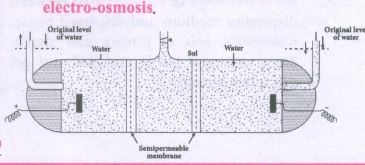
A sol is electrically neutral. Hence the medium carries an equal but opposite charge to that of dispersed particles. When sol particles are prevented from moving, under the influence of electric field the medium moves in a direction opposite to that of the sol particles. This movement of dispersion medium under the influence of electric potential is called electro osmosis.
24.
(i) In lyophillic colloids or sols definite attractive force or affinity exists between dispersion medium and dispersed phase. Examples: sols of protein and starch. They are more stable and will not get precipitated easily.
(ii) In a lyophobic colloids, no attractive force exists between the dispersed phase and dispersion medium. They are less stable and precipitated readily, but cannot be produced again by just adding the dispersion medium.
Examples: sols of gold, silver, platinum and copper.

12th Standard Syllabus & Materials
12th Standard
TN 12th Computer Applications களப்பெயர் முறைமை (DNS) Sample Question Papers Study Material - QB365 Set A
NEW12th Standard
TN 12th Computer Applications வலையமைப்பு எடுத்துக்காட்டுகள் மற்றும் நெறிமுறைகள் Sample Question Papers Study Material - QB365 Set A
NEW12th Standard
TN 12th Computer Applications கணினி வலையமைப்பு ஓர் அறிமுகம் Sample Question Papers Study Material - QB365 Set A
NEW12th Standard
TN 12th Computer Applications PHP-உடன் MySQL-ஐ இணைத்தல் Sample Question Papers Study Material - QB365 Set A



Tamilnadu Stateboard 12th Standard Subjects

Maths
Chemistry

Physics

Biology

Computer Science

Business Maths and Statistics

Economics

Commerce

Accountancy

History

Computer Applications
Biology
Computer Technology
Computer Applications
Computer Science
Business Maths and Statistics
Commerce
Economics
Maths
Chemistry
Physics
Computer Technology
History
Accountancy

Tamil

English

French
Tamilnadu Stateboard Standards


