
 100% FREE ACCESS
12th Standard Syllabus & Materials
12th Standard
TN 12th Computer Applications மின்னணு தரவு பரிமாற்றம் Sample Question Papers Study Material - QB365 Set A
NEW12th Standard
TN 12th Computer Applications மின் - வணிக பாதுகாப்பு அமைப்புகள் Sample Question Papers Study Material - QB365 Set A
NEW12th Standard
TN 12th Computer Applications மின்னணு செலுத்தல் முறைகள் Sample Question Papers Study Material - QB365 Set A
NEW12th Standard
TN 12th Computer Applications மின் - வணிகம் Sample Question Papers Study Material - QB365 Set A
NEW12th Standard
TN 12th Computer Applications திறந்த மூல கருத்துருக்கள் Sample Question Papers Study Material - QB365 Set A
NEW12th Standard
TN 12th Computer Applications வலையமைப்பு வடமிடல் Sample Question Papers Study Material - QB365 Set A

Published on: 22/08/2026
Download Tamil Nadu 12th Standard Computer Applications question papers, model tests, one-mark questions, important questions, and public exam papers in PDF format. Free study materials and answer keys for TN State Board students.
Questions + Answers key
Take MCQ Computer Applications Test
1.
Write any two EDI Standards.
2.
What is Paperless Trade ?
3.
What is DES?
4.
Define EDI.
5.
What is digital signature?
6.
Write a short note on typopiracy.
7.
Write a short note on EDI via VAN.
8.
Write about plain text and cipher text.
9.
Write a note on digital certificate.
10.
Write a note on UN/EDIFACT.
11.
List the various layers of EDI.
12.
List any two E-Commerce Security Threats.
13.
Briefly explain various types of EDI.
14.
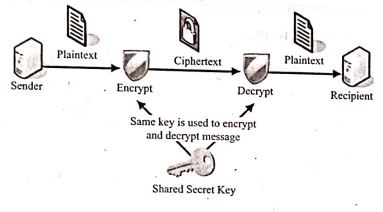
Differentiate symmetric key and asymmetric key encryption.
1.
The most widely used EDI message standards are the United Nations EDIFACT and the ANSI X12.
2.
The exchange of business documents between one trade partner and another electronically is called as Paperless Trade .
3.
The Data Encryption Standard (DES)is a Symmetric key data encryption method.
4.
The Electronic Data Interchange (EDI) is the exchange of business documents between one trade partner and another electronically. It is transferred through a dedicated channel or through the Internet in a predefined format without much human intervention.
5.
A digital signature is a mechanism that is used to verify that a particular digital document, message or transaction is authentic.
6.
Typopiracy is a variant of Cyber Squatting. Some fake websites try to take advantage of users common typographical errors in typing a website address and direct users to a different website. Such people try to take advantage of some popular websites to generate accidental traffic for their websites. e.g. www.goggle.com, www.facebook.com
7.
(i) EDI via VAN (Value Added Network) is where EDI documents are transferred with the support of third party network service providers.
(ii) Many businesses prefer this network model to protect them from the updating ongoing complexities of network technologies.
8.
(i) Plain text:
Plain Text is the message or data in a legible, natural format. From a secrecy standpoint, plain text is highly insecure and easily accessible by humans. Another name for plain text is cleartext. The unsecretive text refers to a message or piece of information.
(ii) Cipher text:
It is the encrypted data usually the output of an encryption algorithm. Cipher Text is a plaintext communication that has been changed to make it unintelligible to everyone but the intended receivers. It has so become a secret, to put it another way. The message would be difficult to read or decipher for an attacker or eavesdropper who saw the cipher text.
9.
(i) A digital certificate is an electronic document used to prove the ownership of a public key.
(ii) This certificate includes the information about the sender's identity, digital signature and a public key.
(iii) A digital certificate function is similar to the function of identification cards such as passports and driving licenses.
(iv) Digital certificates are issued by recognized Certification Authorities (CA).
(v) Common digital certificate systems are X.509 and PGP (Pretty Good Privacy).
10.
(i) United Nations/Electronic Data Interchange for Administration, Commerce and Transport (UN/EDIFACT) is an international EDI - standard developed under the supervision of the United Nations.
(ii) In 1987, the UN / EDIFACT syntax rules were approved as ISO: ISO9735 standard by the International Organization for Standardization.
(iii) EDIFACT includes a set of internationally agreed standards, catalogs and guidelines for electronic exchange of structured data between independent computer systems.
(iv) It is a cross-industry, standard data format of electronic data for commercial transactions.
(v) Maintenance and further development of this standard goes through the United Nations Center for Trade Facilitation and Electronic Business (UN/CEFACT), which is affiliated to the UN Economic Commission for Europe (UNECE).
11.
Electronic data interchange architecture specifies four different layers namely
(i) Semantic layer
(ii) Standards translation layer
(iii) Transport layer
(iv) Physical layer
12.
(i) Information leakage
(ii) Tampering
(iii) Payment frauds
(iv) Malicious code threats
(v) Distributed denial of service attacks
(vi) Cyber squatting
(vii) Typopiracy
(viii) Hacking
13.
The types of EDI were constructed based on how EDI communication connections and the conversion were organized. Thus based on the medium used for transmitting EDI documents the following are the major EDI types:
(i) Direct EDI
(ii) EDI via VAN
(iii) EDI via FTP/VPN, SFTP, FTPS
(iv) Web EDI
(v) Mobile EDI
1. Direct EDI/point-to-point : It is also called as Point-to-Point EDI. It establishes a direct connection between various business stakeholders and partners individually. This type of EDI suits to larger businesses with a lot of day to day business transactions.
2. EDI via VAN : EDI via VAN (Value Added Network) is where EDI documents are transferred with the support of third party network service providers.Many businesses prefer this network model to protect them from the updating ongoing complexities of network technologies.
3. EDI via FTP/VPN, SFTP, FTPS : When protocols like FTP/VPN, SFTP and FTPS are used to exchange of EDI based documents through the Internet or Intranet it is called as EDI via FTP/VPN, SFTP, FTPS.
4. Web EDI : Web based EDI conducts EDI using an web browser via the Internet. Here the businesses are allowed to use any browser to transfer data to their business partners.Web based EDI is easy and convenient for small and medium organizations.
5. Mobile EDI - When smartphones or other such handheld devices are used to transfer EDI documents it is called as mobile EDI.Mobile EDI applications considerably increase the speed of EDI transactions.
14.
| Symmetric Key Encryption | Asymmetric Key Encryption |
| Same key is used for both encryption and decryption | Different keys are used for encryption and decryption |
| Speed of encryption or decryption is very fast | Speed of encryption or decryption is comparatively slow |
| Plain text and cipher text are of same size | The size of cipher text is always greater than plain text. |
| Algorithms like DES, AES, RC4 uses symmetric key encryption | Algorithms like RSA, ECC, DSA use asymmetric key encryption |
| Provides confidentiality | Provides confidentiality, authenticity and non-repudiation |
| The number of key used grows exponentially with the number of users | The number of key used grows linearly with the number of users |
 |
|

12th Standard Syllabus & Materials
12th Standard
TN 12th Computer Applications களப்பெயர் முறைமை (DNS) Sample Question Papers Study Material - QB365 Set A
NEW12th Standard
TN 12th Computer Applications வலையமைப்பு எடுத்துக்காட்டுகள் மற்றும் நெறிமுறைகள் Sample Question Papers Study Material - QB365 Set A
NEW12th Standard
TN 12th Computer Applications கணினி வலையமைப்பு ஓர் அறிமுகம் Sample Question Papers Study Material - QB365 Set A
NEW12th Standard
TN 12th Computer Applications PHP-உடன் MySQL-ஐ இணைத்தல் Sample Question Papers Study Material - QB365 Set A



Tamilnadu Stateboard 12th Standard Subjects

Maths

Chemistry

Physics

Biology

Computer Science

Business Maths and Statistics

Economics

Commerce

Accountancy

History
Computer Applications
Biology
Computer Technology
Computer Applications
Computer Science
Business Maths and Statistics
Commerce
Economics
Maths
Chemistry
Physics
Computer Technology
History
Accountancy

Tamil

English

French
Tamilnadu Stateboard Standards


