
 100% FREE ACCESS
12th Standard Syllabus & Materials
12th Standard
TN 12th Computer Applications மின்னணு தரவு பரிமாற்றம் Sample Question Papers Study Material - QB365 Set A
NEW12th Standard
TN 12th Computer Applications மின் - வணிக பாதுகாப்பு அமைப்புகள் Sample Question Papers Study Material - QB365 Set A
NEW12th Standard
TN 12th Computer Applications மின்னணு செலுத்தல் முறைகள் Sample Question Papers Study Material - QB365 Set A
NEW12th Standard
TN 12th Computer Applications மின் - வணிகம் Sample Question Papers Study Material - QB365 Set A
NEW12th Standard
TN 12th Computer Applications திறந்த மூல கருத்துருக்கள் Sample Question Papers Study Material - QB365 Set A
NEW12th Standard
TN 12th Computer Applications வலையமைப்பு வடமிடல் Sample Question Papers Study Material - QB365 Set A

Published on: 28/11/2025
Download Tamil Nadu 12th Standard Physics question papers, model tests, one-mark questions, important questions, and public exam papers in PDF format. Free study materials and answer keys for TN State Board students.
Questions + Answers key
Take MCQ Physics Test
1.
An e.m. wave is propagating in a medium with a velocity \(\vec{v}=v \hat{i}\). The instantaneous oscillating electric field of this e.m. wave is along + y-axis, then the direction of oscillating magnetic field of the e.m. wave will be along _____.
–y direction
–x direction
+z direction
–z direction
2.
The gravitational waves were theoretically proposed by _____.
Conrad Rontgen
Marie Curie
Albert Einstein
Edward Purcell
3.
The particle which gives mass to protons and neutrons are _____.
Higgs particle
Einstein particle
Nanoparticle
Bulk particle
4.
The particle size of ZnO material is 30 nm. Based on the dimension it is classified as _____.
Bulk material
Nanomaterial
Soft material
Magnetic material
5.
The frequency range of 3 MHz to 30 MHz is used for ______.
Ground wave propagation
Space wave propagation
Sky wave propagation
Satellite communication
6.
Which one of the following represents forward bias diode?
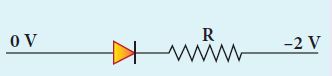
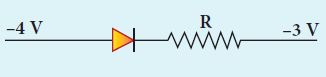


7.
The barrier potential of a silicon diode is approximately, ______.
0.7 V
0.3 V
2.0 V
2.2 V
8.
The ratio between the radius of first three orbits of hydrogen atom is _____.
1:2:3
2:4:6
1:4:9
1:3:5
9.
In a hydrogen atom, the electron revolving in the fourth orbit, has angular momentum equal to _____.
h
\(\frac{h}{\pi}\)
\(\frac{4h}{\pi}\)
\(\frac{2h}{\pi}\)
10.
11.
If the mean wavelength of light from sun is taken as 550 nm and its mean power as 3.8 x 1026 W, then the number of photons emitted per second from the sun is of the order of _____.
1045
1042
1054
1051
12.
Two radiations with photon energies 0.9 eV and 3.3 eV respectively are falling on a metallic surface successively. If the work function of the metal is 0.6 eV, then the ratio of maximum speeds of emitted electrons in the two cases will be _____.
1:4
1:3
1:1
1:9
13.
When a metallic surface is illuminated with radiation of wavelength λ, the stopping potential is V. If the same surface is illuminated with radiation of wavelength 2λ, the stopping potential is \(\frac{V}{4}\). The threshold wavelength for the metallic surface is _____.
4λ
5λ
\(\frac{5}{2}λ\)
3λ
14.
15.
The radius of curvature of curved surface at a thin planoconvex lens is 10 cm and the refractive index is 1.5. If the plane surface is silvered, then the focal length will be, ______.
5 cm
10 cm
15 cm
20 cm
16.
A rod of length 10 cm lies along the principal axis of a concave mirror of focal length 10 cm in such a way that its end closer to the pole is 20 cm away from the mirror. The length of the image is, ______.
2.5 cm
5cm
10 cm
15cm
17.
The vertical component of Earth’s magnetic field at a place is equal to the horizontal component. What is the value of angle of dip at this place?
30°
45°
60°
90°
18.
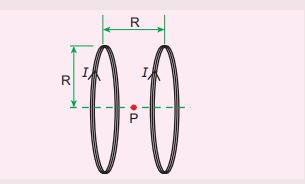
Two identical coils, each with N turns and radius R are placed coaxially at a distance R as shown in the figure. If I is the current passing through the loops in the same direction, then the magnetic field at a point P at a distance of R/2 from the centre of each coil is _____.
\(\frac { 8N{ \mu }_{ ° }I }{ \sqrt { 5 } R } \)
\(\frac { 8N{ \mu }_{ ° }I }{ { 5 }^{ 3/2 }R } \)
\(\frac { 8N{ \mu }_{ ° }I }{ { 5 }R } \)
\(\frac { 4N{ \mu }_{ ° }I }{ \sqrt { 5 } R } \)
19.
The magnetic field at the centre O of the following current loop is
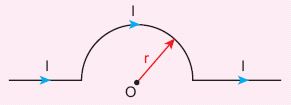
\(\frac { { \mu }_{ ° }I }{ 4r } \bigotimes \)
\(\frac { { \mu }_{ ° }I }{ 4r } \bigodot \)
\(\frac { { \mu }_{ ° }I }{ 2r } \bigotimes \)
\(\frac { { \mu }_{ ° }I }{ 2r } \bigodot \)
20.
The instantaneous values of alternating current and voltage in a circuit are \(i=\frac { 1 }{ \sqrt { 2 } } \sin\left( 100\pi t \right) \) A and v \(=\frac { 1 }{ \sqrt { 2 } } \sin\left( 100\pi t+\frac { \pi }{ 3 } \right) V.\)The average power in watts consumed in the circuit is
\(\frac{1}{4}\)
\(\frac{\sqrt3}{4}\)
\(\frac{1}{2}\)
\(\frac{1}{8}\)
21.
An inductor 20 mH, a capacitor 50 μF and a resistor 40Ω are connected in series across a source of emf V = 10 sin 340 t. The power loss in AC circuit is
0.76 W
0.89 W
0.46 W
0.67 W
22.
When the current changes from +2A to −2A in 0.05 s, an emf of 8 V is induced in a coil. The co-efficient of self-induction of the coil is
0.2H
0.4H
0.8H
0.1H
23.
Consider an oscillator which has a charged particle oscillating about its mean position with a frequency of 300 MHz. The wavelength of electromagnetic waves produced by this oscillator is _____.
1 m
10 m
100 m
1000 m
24.
25.
An electric field \(\vec { E } =10x\hat { i } \) exists in a certain region of space. Then the potential difference V = Vo – VA, where Vo is the potential at the origin and VA is the potential at x = 2 m is _____.
10 V
-20 V
+20 V
-10 V
26.
What is the ratio of the charges \(\left| \frac { { q }_{ 1 } }{ { q }_{ 2 } } \right| \) for the following electric field line pattern?
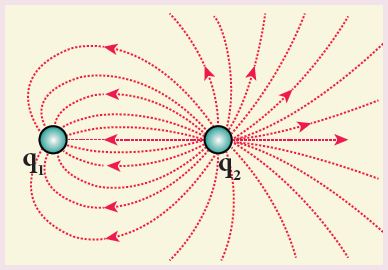
\(\frac { 1 }{ 5 } \)
\(\frac { 25 }{ 11 } \)
5
\(\frac { 11 }{ 25 } \)
27.
Two identical point charges of magnitude –q are fixed as shown in the figure below. A third charge +q is placed midway between the two charges at the point P. Suppose this charge +q is displaced a small distance from the point P in the directions indicated by the arrows, in which direction(s) will +q be stable with respect to the displacement?
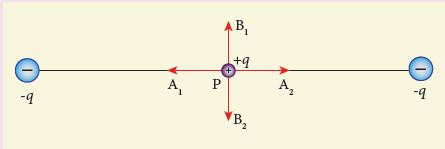
A1 and A2
B1 and B2
both directions
No stable
28.
A piece of copper and another of germanium are cooled from room temperature to 80 K. The resistance of ______.
each of them increases
each of them decreases
copper increases and germanium decreases
copper decreases and germanium increases
29.
A toaster operating at 240 V has a resistance of 120 Ω. The power is ______.
400 W
2 W
480 W
240 W
30.
A wire of resistance 2 ohms per meter is bent to form a circle of radius 1m. The equivalent resistance between its two diametrically opposite points, A and B as shown in the figure is
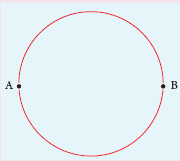
\(\pi \Omega\)
\(\frac{\pi}{2}\Omega\)
2\(\pi \Omega\)
\(\frac{\pi}{4}\Omega\)
1.
(c)
+z direction
2.
Albert Einstein theoretically proposed the existence of gravitational waves in the year 1915.
3.
Proton and neutron are made up of quarks. Later, it was found that Higg's particles or God particles give mass to the particles like protons, neutrons etc.
4.
Size of the particle is between
1-100 nm - Nano.
Size of the particle is greater
than-100 nm - Bulk.
5.
Ground wave propagation: frequency less than 2 MHz
Sky wave propagation: 3 to 30 MHz
Space wave propagation: Above 30 MHz to 400 GHz
Satellite communication: uplink communication 6 GHz band downlink communication 4 GHz band
6.
(a)
7.
(a)
0.7 V
8.
rn ∞ n2
r1: r2: r3 = 1: 4: 9
9.
\(L=\frac{nh}{2\pi}=\frac{4h}{2\pi}=\frac{2h}{\pi}\)
10.
(b)
11.
\(\mathrm{P} =\frac{\mathrm{n}}{\mathrm{t}} \frac{\mathrm{hc}}{\lambda} \)
\(\frac{\mathrm{n}}{\mathrm{t}} =\frac{\mathrm{P} \lambda}{\mathrm{hc}} \)
\(\frac{\mathrm{n}}{\mathrm{t}} =\frac{3.8 \times 10^{26} \times 550 \times 10^{-9}}{6.6 \times 10^{-3} \times 3 \times 10^8}=1 \times 10^{-15}\)
12.
K.E= hv - Φ
K.E1 = 0.9 - 0.6 = 0.3 eV
K.E2 = 3.3 - 0.6 = 2.7 ev
K.E ∝ v2
\(\frac{0.3}{2.7}=\frac{v^2_1}{v^2_2} \)
\(\frac{v^1}{v^2} =\frac{1}{3}\)
13.
\(\frac{\mathrm{hc}}{\lambda}=\phi+\mathrm{eV} \) .....(1)
\(\frac{\mathrm{hc}}{2 \lambda}=\phi+\frac{\mathrm{eV}}{4}\) .....(2)
multiply (2) eqn by 4
\(\frac{2 h c}{\lambda}=4 \phi+\mathrm{eV}\) .....(3)
subtract eqn (1) from (3), we get
\(\frac{ h c}{\lambda}=3 \phi \Rightarrow \phi = \frac{ h c}{3\lambda}\)
\(\frac{ h c}{\lambda_o}=\frac{ h c}{3\lambda}\)
⋋o = 3⋋
14.
(b)
15.
\(\frac{1}{f} =(n-1)\left(\frac{1}{R_1}-\frac{1}{R_2}\right) \)
\(=(1.5-1)\left(\frac{1}{\infty}-\frac{1}{(-10)}\right)\)
(Since plano convex lens)
\(=0.5\left[\frac{1}{10}\right]=\frac{1}{20} \)
\(\mathrm{f}_t =20 \mathrm{~cm}\)
Formula for silvered lenses
\(\frac{1}{\mathrm{~F}} =\frac{2}{\mathrm{f}_1}+\frac{1}{\mathrm{f}_m} \)
\(\frac{1}{\mathrm{~F}} =\frac{2}{20}+\frac{1}{\infty} \)
\(\therefore \mathrm{F} =\frac{20}{2}=10 \mathrm{~cm}\)
16.
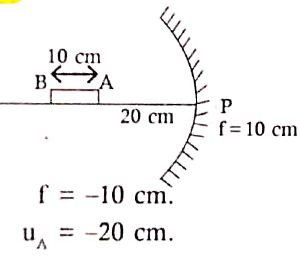
At end A,
\(\frac{1}{f} =\frac{1}{u_A}+\frac{1}{v_A} \)
\(\therefore \frac{1}{v_A} =\frac{1}{-10}-\frac{1}{-20} \)
\(\frac{1}{v_A} =-\frac{1}{10}+\frac{1}{20}=\frac{-2+1}{20}=-\frac{1}{20} \)
\(v_A =-20 \mathrm{~cm} \)
\(\left|v_{\wedge}\right|=20 \mathrm{~cm}\)
At end B,
\(\frac{1}{f} =\frac{1}{u_B}+\frac{1}{v_B} \)
\(\frac{1}{v_B} =\frac{1}{f}-\frac{1}{u_B}, \)
\(u_B =-30 \mathrm{~cm} \)
\(\frac{1}{v_B} =-\frac{1}{10}+\frac{1}{30} \)
\(=\frac{-3+1}{30}=\frac{-2}{30}=\frac{-1}{15} \)
\(v_B =-15 \mathrm{~cm} \)
\(\left|v_B\right| =15 \mathrm{~cm} \)
\(\therefore \quad\left|\mathrm{v}_{\mathrm{A}}\right|-\left|\mathrm{v}_{\mathrm{B}}\right| \) is the length of the image
= 20 - 15 = 5 cm
17.
\(tan \ I=\frac{B_V}{B_H}=1\)
∴ I = 45o
18.
\(B=\frac { { \mu }_{ ° }NI a^2}{ { 2(a^2+x^2)}^{ \frac { 3 }{ 2 } } } \)
put a = R
and x = R/2, we get,
\(B=\frac { 8N{ \mu }_{ ° }I }{ { 5 }^{ 3 / 2 }R } \)
19.
Magnetic filed at the centre of a circular
loop, B = \(\frac{μ_oI}{2\pi R}\)
From the figure, R =\(\frac{2r}{\pi}\)
\(\therefore B'=\frac{μ_oI}{2\pi \times\frac{2r}{\pi}}=\frac{μ_oI}{4r}\)
\(B'=\frac { { \mu }_{ ° }I }{ 4r } \bigotimes \)
20.
Pav = \(\frac{1}{2}\)V0I0cosΦ
\(= \frac{1}{2}\times\frac{1}{\sqrt{2}}\times\frac{1}{\sqrt{2}}cos\times\frac{\pi}{3}\times \frac{1}{2}\times\frac{1}{2}\times\frac{1}{2}=\frac{1}{8}\)
21.
L = 20 x 10-3H. C = 50 x 10-6 F, R= 40Ω
enf V = 10 sin 340 t
\(\therefore V_0=10 \mathrm{~V}, \omega=340 \)
\(X_1=1 \omega^{\prime}=20 \times 10^3 \times 340 \)
\(=6800 \times 10^{-1}=6.8 \Omega \)
\(X_C=\frac{1}{C .} \)
\(=\frac{1}{50 \times 10^{-\alpha} \times 340}=\frac{10^{\circ}}{17000}=\frac{10^{\prime}}{17}=58.823 \Omega \)
\(Z=\sqrt{R^2+\left(X_6-X_1\right)^2} \)
\(=\sqrt{(40)^2+(58.82-6.8)^2} \)
\(=\sqrt{(40)^2+(52.02)^2} \)
\(=65.62 \Omega\)
The peak current in the circuit is,
\(I_0=\frac{V_0}{Z}=\frac{10}{65.62} \)
\(\cos 0=\frac{R}{Z}=\frac{40}{65.62} \)
\(\text{Power loss in A.C. circuit }=V_{r m} 1_{r \rightarrow \infty} \cos \phi \)
\(=\frac{1}{2} V_{\mathrm{o}} I_{\mathrm{c}} \cos \phi \)
\(=\frac{1}{2} \times 10 \times \frac{10}{65.62} \times \frac{40}{65.62}\)
\(\frac{2000}{4305.98}\)
= 0.46 W
22.
\(\text {emf } e=8 \mathrm{~V} \)
\(d I=I_1-I_0=2-(-2)=4 \mathrm{~A} \)
\(\text {dt }=0.05 \mathrm{~s} \)
\(L=\frac{-e}{d I / d t}=\frac{-8}{4 / 0.05} \)
\(=\frac{-8 \times 0.05}{4}=\frac{-0.40}{4} \)
=-0.1 H
-ve sign indicates that self-induced emf always opposes the current w.r.t. time.
23.
ג = \(\frac{c}{f}=\frac{3 \times10^8}{300 \times 10^6}=1 m\)
24.
(b)
25.
\(\vec {E}\) = 10x\(\hat{i},\) when x = 2 m
\(\vec {E}\) = 10 x 2 x \(\hat{i}\) = 20\(\hat{i}\)
Since, \(E=\frac{-dV}{dx}\therefore V=+20 V\)
26.
q ∝ Φ
∴ \(\frac {q_1}{q_2} = \frac {Φ_1}{Φ_2}=\frac{11}{25}\)
27.
The charge + q will be stable between B1 and B2 with respect to the displacement.
28.
Resistivity ∝ temperature for conductor. so, copper → decreases
Resistivity ∝\(\frac{1}{\text {temperature for semiconductor}}\)
so, germanium → increases.
29.
\(P=\frac{V^2}{R}=\frac{240 \times 240}{120}=480 \ W\)
30.
Total length = 2πr = 2π
∴ Resistance of each segment = 2π/2 = π Ω

12th Standard Syllabus & Materials
12th Standard
TN 12th Computer Applications களப்பெயர் முறைமை (DNS) Sample Question Papers Study Material - QB365 Set A
NEW12th Standard
TN 12th Computer Applications வலையமைப்பு எடுத்துக்காட்டுகள் மற்றும் நெறிமுறைகள் Sample Question Papers Study Material - QB365 Set A
NEW12th Standard
TN 12th Computer Applications கணினி வலையமைப்பு ஓர் அறிமுகம் Sample Question Papers Study Material - QB365 Set A
NEW12th Standard
TN 12th Computer Applications PHP-உடன் MySQL-ஐ இணைத்தல் Sample Question Papers Study Material - QB365 Set A



Tamilnadu Stateboard 12th Standard Subjects

Maths

Chemistry
Physics

Biology

Computer Science

Business Maths and Statistics

Economics

Commerce

Accountancy

History

Computer Applications
Biology
Computer Technology
Computer Applications
Computer Science
Business Maths and Statistics
Commerce
Economics
Maths
Chemistry
Physics
Computer Technology
History
Accountancy

Tamil

English

French
Tamilnadu Stateboard Standards


