
7th Standard CBSE Syllabus & Materials
7th Standard CBSE
CBSE 7th Standard Science Wastewater Story Sample Question Papers Study Material - QB365
NEW7th Standard CBSE
CBSE 7th Standard Science Forests: Our Lifeline Sample Question Papers Study Material - QB365
NEW7th Standard CBSE
CBSE 7th Standard Science Water: A Precious Resource Sample Question Papers Study Material - QB365
NEW7th Standard CBSE
CBSE 7th Standard Science Light Sample Question Papers Study Material - QB365
NEW7th Standard CBSE
CBSE 7th Standard Science Electric Current and Effects Sample Question Papers Study Material - QB365 Set C
NEW7th Standard CBSE
CBSE 7th Standard Science Electric Current and Effects Sample Question Papers Study Material - QB365 Set B

Published on: 31/10/2025
Download CBSE Class 7th Standard CBSE Science question papers, sample papers, important questions, and previous year solved papers in PDF format. Get free study materials, NCERT solutions, and exam preparation resources for Class 7th Standard CBSE Science
Questions + Answers key
Take MCQ Science Test
1.
What is a pendulum ? How can it be used to determine time?
2.
What were the definitions of a day, a month and a year for our ancestors ?
3.
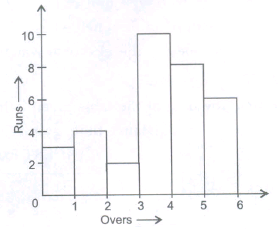
In a cricket match a team scored 3, 4, 2, 10, 8, 6 runs in first 6 overs. Show these runs by a bar graph (supply graph paper).
4.
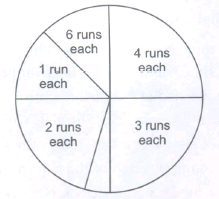
In a match, a team scored 200 runs, out of which they made twelve fours, three sixes, twenty times three runs, twenty times two runs and thirty four times one run. Show this by a pie chart. (Approx
5.
The following figure shows the distance-time graph for the motion of two vehicles (C and D). At what time and distance (from the starting point), they will cross each other.
6.
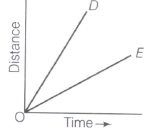
The following figure shows the distance-time graph for the motion of two objects 0 and E. Which one of them is moving slower?
7.
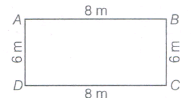
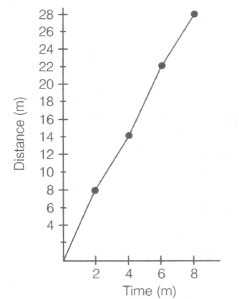
Starting from A, Paheli moves along a rectangular path ABCD as shown in figure. She takes 2 min to travel each side. Plot a distance-time graph and explain whether the motion is uniform or non-uniform.
8.
The average age of children of class VII is 12 years and 3 months. Express this age in second.
9.
Briefly mention how many types of motion are there. Also, name all of them.
10.
Differentiate between a uniform and non-uniform motion.
11.
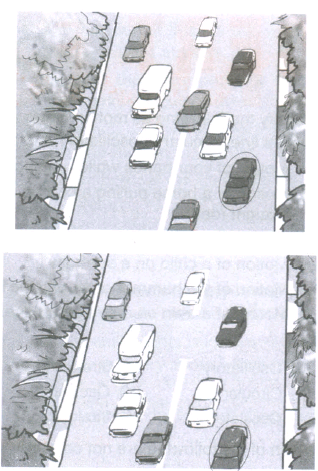
Suppose, the two photographs, shown in two figures had been taken at an interval of 10 s. If a distance of 100 m is shown by 1 cm in these photographs, then calculate the speed of the circled car.
12.
Salma takes 15 min from her house to reach her school on a bicycle. If the bicycle has a speed of 2 m/s, calculate the distance between her house and the school.
13.
The distance between two stations is 240 km. A train takes 4 h to cover this distance. Calculate the speed of the train.
14.
A simple pendulum takes 32 s to complete 20 oscillations. What is the time period of the pendulum?
15.
Which of the following are not correct?
(a) The basic unit of time is second.
(b) Every object moves with a constant speed.
(c) Distances between two cities are measured in kilometres.
(d) The time period of a given pendulum is not constant.
(e) The speed of a train is expressed in m/h.
1.
A pendulum is a simple device which shows periodic motion. A simple pendulum consists of a non-magnetic metal ball called bob. This bob is suspended with the help of a string. The open end of the string is tied to a support. Bob of the pendulum is held at a side and released. It starts moving in a to and fro motion. This is called an oscillatory motion. The time taken by the pendulum to complete one oscillation is called time period. This time period is always same with a pendulum having same length. Time period changes with the change in the length of the string.
The string of the pendulum is adjusted to the length, that it completes one oscillation in second and it keeps on moving the clock giving us time. It has been found that a pendulum of about 25 cm length takes exactly one second to complete one oscillation.
2.
Day: Time between two sunrise.
Month: Time between one new moon to the next.
Year : Time taken by earth to complete one revolution of the earth.
3.
4.
5.
Firstly, draw perpendicular lines from point E on x-axis and y-axis.
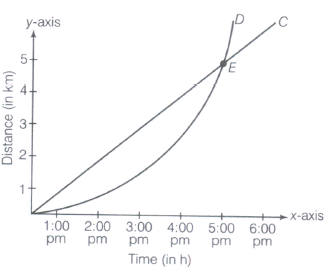
The two vehicles (C and D) will meet (or cross) each other at 5:00 PM and after travelling a distance of 4 km.
6.
After studying the figure given alongside, 0 or E is moving slower as the slope of distance-time graph of E is less than that of graph D.
7.
Since, the distance covered per unit time for the entire distance covered is not the same, the motion is a non-uniform motion
8.
Given, the average age of children 12 years and 3 months
1 year = 365 days = 365 \(\times\) 24 h [ 1 day = 24 h ]
= 365 \(\times\) 24 \(\times\) 3600 s [ 1 h = 36000 s]
12 years = 31536000 s \(\times\)12 = 378432000 s
3 months = 30 \(\times\) 3 days = 30 \(\times\) 3 \(\times\) 24 h = 30 \(\times\) 3 \(\times\) 24 \(\times\) 3600s = 7776000s
So, total age in second = 378432000 + 7776000 = 386208000s
9.
Different types of motion are there and they can be named as follows
(i) Periodic motion
(ii) Rolling motion
(iii) Rotatory motion
(iv) Oscillatory and vibratory motions
(v) Translatory motion
10.
When a body travels equal distance in an equal interval of time, then the body is said to be in a uniform motion.
When a body travels unequal distance in an equal interval of time, then the body is said to be in non-uniform motion.
11.
Speed of the circled car is given by
\(=\frac{Distance\ covered}{Time\ taken}=\frac{100}{10\times 100}\)
\((1\ cm=\frac{1}{100}m)\)
\(=\frac{1}{10}m/s\)
12.
As, we know that
Distance covered by the body = Speed \(\times\) Time
speed = 2 m/s
Time =15 min =15 \(\times\) 60= 900s
So, distance = 900 \(\times\)2 = 1800 m = 1.8 km
13.
As, we know that the speed of a body is given by \(Speed=\frac{Distance\ travelled}{time\ taken}=\frac{240}{4}=60km/h\)
14.
Time period of simple pendulum is given by
\(\frac{Time\ taken}{Number\ of\ oscillations}=\frac{32}{20}s=1.65\)
(i.e. the time to complete one cycle)
15.
(b), (d) and (e) are not correct.

7th Standard CBSE Syllabus & Materials
7th Standard CBSE
CBSE 7th Standard Science Electric Current and Effects Sample Question Papers Study Material - QB365 Set A
NEW7th Standard CBSE
CBSE 7th Standard Science Motion and Time Sample Question Papers Study Material - QB365 Set D
NEW7th Standard CBSE
CBSE 7th Standard Science Motion and Time Sample Question Papers Study Material - QB365 Set B



NCERT Books

Syllabus

Exam Pattern

Sample Question Papers

Previous year Question Papers

Important Notes

MCQ Practice test

NCERT Exemplers

Case study Questions

Image Based Questions

Passage based Questions

HOT Questions

Value Based Questions

Model Questions Papers
NCERT ( Book Back ) Questions

Assertion and Reason
Important Questions And Answers

CBSE 7th Standard CBSE Subjects
CBSE Standards