7th Standard CBSE Syllabus & Materials
7th Standard CBSE
CBSE 7th Standard Science Wastewater Story Sample Question Papers Study Material - QB365
NEW7th Standard CBSE
CBSE 7th Standard Science Forests: Our Lifeline Sample Question Papers Study Material - QB365
NEW7th Standard CBSE
CBSE 7th Standard Science Water: A Precious Resource Sample Question Papers Study Material - QB365
NEW7th Standard CBSE
CBSE 7th Standard Science Light Sample Question Papers Study Material - QB365
NEW7th Standard CBSE
CBSE 7th Standard Science Electric Current and Effects Sample Question Papers Study Material - QB365 Set C
NEW7th Standard CBSE
CBSE 7th Standard Science Electric Current and Effects Sample Question Papers Study Material - QB365 Set B

Published on: 31/10/2025
Download CBSE Class 7th Standard CBSE Science question papers, sample papers, important questions, and previous year solved papers in PDF format. Get free study materials, NCERT solutions, and exam preparation resources for Class 7th Standard CBSE Science
Questions + Answers key
Take MCQ Science Test
1.
A stone is dropped from a height of 20m above the ground. Will it have a uniform or non-uniform speed, as it moves towards the ground?
2.
What is meant by slow and fast motion?
3.
A train is running at a speed of 45 km/h, How long will it take to reach Lucknow from Delhi when the distance between two stations is 350 km ?
4.
(a) What is called the bob of the pendulum?
(b) A simple pendulum takes 35s to complete 20 oscillations. What is the time-period of the pendulum ?
5.
What is a simple pendulum ? What is the timeperiod of a pendulum?
6.
What is a sundial?
7.
What is a sand clock?
8.
State the way through which we can prepare a pendulum by our own.
9.
Name the different types of graphs.
10.
State the factors on which the time period of a simple pendulum depend.
11.
Explain how time was measured when pendulum clocks were not available.
12.
Estimate that how many hours are there in a year.
13.
Determine the number of seconds there in a day.
14.
Briefly explain how will decide which object is moving fast and which one is moving slow.
15.
Name the axis that represents dependent variable.
1.
A free falling body moves with constant speed, i.e., speed of earth's gravity. Thus, the stone will have a uniform motion
2.
Slow and fast are relative terms. Slow motion of a body means speed is lower than the other body which is running fast.
3.
Speed of train = 45 km/h
Train to cover 45 km = 1 h
Train covers 350 km = \(\frac { 350 }{ 45 } \) = 7.77 hour
4.
(a) The metallic ball hanging by a wire/string is called bob.
(b) Time to complete 20 oscillations = 35 s
Time to complete one oscillation = \(\frac { 35 }{ 20 } \) = 1.4sec
\(\therefore\) One oscillation = Time period = 1.4 sec.
5.
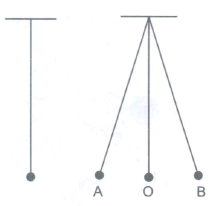
A simple pendulum has a small metallic ball called bob suspended from a rigid stand by a thread. The time taken by the pendulum to complete one oscillation is called time period. One oscillation of a pendulum is completed when the bob moves from position O to A and then from A to B and then back to A or from A to B to A.
6.
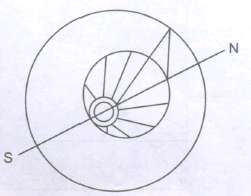
A sundial consists of triangular metallic plate called gnomon fixed vertically at the centre of a circular plate. The device is placed in the open in such a way that gnomon points in the north-south direction. It works on the principle that as position of sun in the sky changes, the position and length of shadow also changes. These are calibrated with time
7.
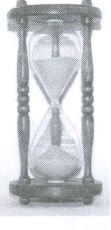
Sand clock is a clock used by Romans to measure a constant time called hour. It consists two chambers fitted over one another filled with an amount of sand and it takes exactly one hour to empty a chamber. Once the upper chamber is completely emptied, the chamber is turned upside down to record the time again. It is also called hour glass
8.
By suspending a metal ball with the help of a cotton thread and the other end of the thread can be tied to some different supports, so in this way, we can prepare a pendulum by our own.
9.
Different types of graphs are
(i) Line graph
(ii) Pie chart
(iii) Bar graph
10.
The factors on which the time period of a simple pendulum depend are
(i) Length of the pendulum
(ii) Acceleration due to gravity
11.
Before the discovery of pendulum clocks, sundials, water clocks and sand clocks were used.
12.
In a year, we have 365 days and 1 day = 24 h So, for 365 days, we have 24 \(\times\) 365 h = 8760 h
13.
In a day, we have 24 h
We know that 1 h = 3600 s
So, 24 h = 3600 \(\times\) 24 = 86400s
14.
If an object covers more distance in equal intervals of time with respect to other, then we can say that object is moving faster with respect to the other object.
15.
y-axis represents the dependent variable.

7th Standard CBSE Syllabus & Materials
7th Standard CBSE
CBSE 7th Standard Science Electric Current and Effects Sample Question Papers Study Material - QB365 Set A
NEW7th Standard CBSE
CBSE 7th Standard Science Motion and Time Sample Question Papers Study Material - QB365 Set C
NEW7th Standard CBSE
CBSE 7th Standard Science Motion and Time Sample Question Papers Study Material - QB365 Set B



NCERT Books

Syllabus

Exam Pattern

Sample Question Papers

Previous year Question Papers

Important Notes

MCQ Practice test

NCERT Exemplers

Case study Questions

Image Based Questions

Passage based Questions

HOT Questions

Value Based Questions

Model Questions Papers
NCERT ( Book Back ) Questions

Assertion and Reason
Important Questions And Answers

CBSE 7th Standard CBSE Subjects
CBSE Standards