
10th Standard Syllabus & Materials
10th Standard
Tamilnadu 10th Standard Social Science GEO - India - Population, Transport, Communication and Trade Important Questions And Answers Study Material - QB365 Set C
NEW10th Standard
Tamilnadu 10th Standard Social Science GEO - India - Population, Transport, Communication and Trade Important Questions And Answers Study Material - QB365 Set B
NEW10th Standard
Tamilnadu 10th Standard Social Science GEO - India - Population, Transport, Communication and Trade Important Questions And Answers Study Material - QB365 Set A
NEW10th Standard
Tamilnadu 10th Standard Social Science GEO - India - Resources and Industries Important Questions And Answers Study Material - QB365 Set C
NEW10th Standard
Tamilnadu 10th Standard Social Science GEO - India - Resources and Industries Important Questions And Answers Study Material - QB365 Set B
NEW10th Standard
Tamilnadu 10th Standard Social Science GEO - India - Resources and Industries Important Questions And Answers Study Material - QB365 Set A
Published on: 19/10/2025
Download Tamil Nadu 10th Standard Maths question papers, model tests, one-mark questions, important questions, and public exam papers in PDF format. Free study materials and answer keys for TN State Board students.
Questions + Answers key
Take MCQ Maths Test
1.
\(\text { If } \mathbf{A}+\mathbf{B}=\left[\begin{array}{cc} 10 & 8 \\ 8 & 4 \end{array}\right] \text { and } \mathbf{A}-\mathbf{B}=\left[\begin{array}{cc} 2 & -4 \\ 0 & 6 \end{array}\right], \text { then A = }\)
\(\left[\begin{array}{ll}6 & 2 \\ 4 & 5\end{array}\right]\)
\(\left[\begin{array}{ll}6 & 2 \\ 4 & 6\end{array}\right]\)
\(\left[\begin{array}{cc} 4 & 6 \\ 4 & -1 \end{array}\right]\)
\(\left[\begin{array}{ll} 1 & 3 \\ 4 & 5 \end{array}\right]\)
2.
\(\text { If } \mathbf{A}=\left[\begin{array}{cc} 1 & -2 \\ 5 & 3 \end{array}\right] \text { then } \mathbf{A}+\mathbf{A}^{\mathrm{T}}=\)
\(\left[\begin{array}{ll}2 & 3 \\ 3 & 6\end{array}\right]\)
\(\left[\begin{array}{cc}2 & -4 \\ 10 & 6\end{array}\right]\)
\(\left[\begin{array}{cc} 2 & 4 \\ -10 & 6 \end{array}\right]\)
None of these
3.
\(\text { If } \mathbf{A}=\left[\begin{array}{ll} x & 1 \\ 1 & 0 \end{array}\right] \text { and } \mathbf{A}^{2}=\mathbf{I}, \text { then } \mathbf{x}=\)
0
1
-1
2
4.
If \(A=\left[ \begin{matrix} 1 & 2 \\ 3 & 4 \\ 5 & 6 \end{matrix} \right] _{ 3\times 2 }\) \(B=\left[ \begin{matrix} 1 & 2 & 3 \\ 4 & 5 & 6 \end{matrix} \right] _{ 2\times 3 }\) then which of the following products can be made from these matrices
(i) A2
(ii) B2
(iii) AB
(iv) BA
(i) only
(ii) and (iii) only
(iii) and (iv) only
all the above
5.
6.
7.
8.
Which of the following can be calculated from the given matrices A = \(\left( \begin{matrix} 1 & 2 \\ 3 & 4 \\ 5 & 6 \end{matrix} \right) \), B = \(\left( \begin{matrix} 1 & 2 & 3 \\ 4 & 5 & 6 \\ 7 & 8 & 9 \end{matrix} \right) \),
(i) A2
(ii) B2
(iii) AB
(iv) BA
(i) and (ii) only
(ii) and (iii) only
(ii) and (iv) only
all of these
9.
Find the matrix X if 2X + \(\left( \begin{matrix} 1 & 3 \\ 5 & 7 \end{matrix} \right) =\left( \begin{matrix} 5 & 7 \\ 9 & 5 \end{matrix} \right) \)
\(\left(\begin{array}{cc} -2 & -2 \\ 2 & -1 \end{array}\right)\)
\(\left(\begin{array}{cc} 2 & 2 \\ 2 & -1 \end{array}\right)\)
\(\left(\begin{array}{ll} 1 & 2 \\ 2 & 2 \end{array}\right)\)
\(\left(\begin{array}{ll} 2 & 1 \\ 2 & 2 \end{array}\right)\)
10.
11.
\(\begin{aligned} &\text { If } A \\ \end{aligned}=\left[\begin{array}{rr} 2 & -2 \\ -3 & 4 \end{array}\right], \text { find }-A^{2}+6 \mathbf{A}\)
12.
\(\text { If } \mathbf{A}=\left[\begin{array}{cc} 1 & -2 \\ 3 & 0 \end{array}\right], B=\left[\begin{array}{rr} -1 & 4 \\ 2 & 3 \end{array}\right] \text { and } C=\left[\begin{array}{rr} 0 & 1 \\ -1 & 0 \end{array}\right]\text { find } 5 \mathrm{~A}-3 \mathrm{~B}+2 \mathrm{C}\)
13.
Find the values of x, y and z from the following equations.
\(\left[ \begin{matrix} x+y+z \\ x+z \\ y+z \end{matrix} \right] =\left[ \begin{matrix} 9 \\ 5 \\ 7 \end{matrix} \right] \)
14.
Verify that A2 = I when A = \(\left( \begin{matrix} 5 & -4 \\ 6 & -5 \end{matrix} \right) \)
15.
If A = \(\left[ \begin{matrix} \cos { \theta } & \sin { \theta } \\ -\sin { \theta } & \cos { \theta } \end{matrix} \right] \) prove that AAT = I.
16.
If A = \(\left[ \begin{matrix} 2 & 5 \\ 4 & 3 \end{matrix} \right] \), B = \(\left[ \begin{matrix} 1 & -3 \\ 2 & 5 \end{matrix} \right] \) find AB, BA and check if AB = BA?
17.
A has ‘a’ rows and ‘a + 3’ columns. B has ‘b’ rows and ‘17 – b’ columns, and if both products AB and BA exist, find a, b?
18.
Find the value of a, b, c, d, from the following matrix equation.
\(\left[ \begin{matrix} d & 8 \\ 3b & a \end{matrix} \right] +\left[ \begin{matrix} 3 & a \\ -2 & -4 \end{matrix} \right] =\left[ \begin{matrix} 2 & 2a \\ b & 4c \end{matrix} \right] +\left[ \begin{matrix} 0 & 1 \\ -5 & 0 \end{matrix} \right] \)
19.
Find the value of a, b, c, d from the equation \(\left( \begin{matrix} a-b & 2a+c \\ 2a-b & 3c+d \end{matrix} \right) =\left( \begin{matrix} 1 & 5 \\ 0 & 2 \end{matrix} \right) \)
20.
Construct a 3 x 3 matrix whose elements are aij = i2j2
21.
If A = \(\left[ \begin{matrix} 1 & 2 & 1 \\ 2 & -1 & 1 \end{matrix} \right] \) and B = \(\left[ \begin{matrix} 2 & -1 \\ -1 & 4 \\ 0 & 2 \end{matrix} \right] \) show that (AB)T = BTAT
22.
If A = \(\left[ \begin{matrix} 1 & 1 \\ -1 & 3 \end{matrix} \right] \), B = \(\left[ \begin{matrix} 1 & 2 \\ -4 & 2 \end{matrix} \right] \), C = \(\left[ \begin{matrix} -7 & 6 \\ 3 & 2 \end{matrix} \right] \) verify that A(B + C) = AB + AC
23.
If A = \(\left[ \begin{matrix} 1 & -1 & 2 \end{matrix} \right] \), B = \(\left[ \begin{matrix} 1 & -1 \\ 2 & 1 \\ 1 & 3 \end{matrix} \right] \) and C = \(\left[ \begin{matrix} 1 & 2 \\ 2 & -1 \end{matrix} \right] \) show that (AB)C = A(BC)
24.
Solve \(\left[ \begin{matrix} 2 & 1 \\ 1 & 2 \end{matrix} \right] \left[ \begin{matrix} x \\ y \end{matrix} \right] =\left[ \begin{matrix} 4 \\ 5 \end{matrix} \right] \)
25.
Solve for x, y : \(\left[ \begin{matrix} { x }^{ 2 } \\ { y }^{ 2 } \end{matrix} \right] +2\left[ \begin{matrix} -2x \\ -y \end{matrix} \right] =\left[ \begin{matrix} -5 \\ 8 \end{matrix} \right] \)
26.
Find the non-zero values of x satisfying the matrix equation \(x\left[ \begin{matrix} 2x & 2 \\ 3 & x \end{matrix} \right] +2\left[ \begin{matrix} 8 & 5x \\ 4 & 4x \end{matrix} \right] =2\left[ \begin{matrix} { x }^{ 2 }+8 & 24 \\ 10 & 6x \end{matrix} \right] \)
27.
Find x and y if \(x\left[ \begin{matrix} 4 \\ -3 \end{matrix} \right] +y\left[ \begin{matrix} -2 \\ 3 \end{matrix} \right] =\left[ \begin{matrix} 4 \\ 6 \end{matrix} \right] \)
28.
Find X and Y if X + Y = \(\left[ \begin{matrix} 7 & 0 \\ 3 & 5 \end{matrix} \right] \) and X - Y = \(\left[ \begin{matrix} 3 & 0 \\ 0 & 4 \end{matrix} \right] \)
29.
If A = \(\left[ \begin{matrix} 1 & 8 & 3 \\ 3 & 5 & 0 \\ 8 & 7 & 6 \end{matrix} \right] \), B = \(\left[ \begin{matrix} 8 & -6 & -4 \\ 2 & 11 & -3 \\ 0 & 1 & 5 \end{matrix} \right] \), C = \(\left[ \begin{matrix} 5 & 3 & 0 \\ -1 & -7 & 2 \\ 1 & 4 & 3 \end{matrix} \right] \) compute the following
3A + 2B - C
1.
(a)
\(\left[\begin{array}{ll}6 & 2 \\ 4 & 5\end{array}\right]\)
2.
(a)
\(\left[\begin{array}{ll}2 & 3 \\ 3 & 6\end{array}\right]\)
3.
(a)
0
4.
(c)
(iii) and (iv) only
5.
(c)
6.
(c)
7.
(c)
8.
(c)
(ii) and (iv) only
9.
(b)
\(\left(\begin{array}{cc} 2 & 2 \\ 2 & -1 \end{array}\right)\)
10.
(d)
11.
\(A=\left[\begin{array}{rr}
2 & -2 \\
-3 & 4
\end{array}\right]\)
\(A^{2}=A \cdot A\)
\(=\left[\begin{array}{rr}
2 & -2 \\
-3 & 4
\end{array}\right]\left[\begin{array}{rr}
2 & -2 \\
-3 & 4
\end{array}\right] \)
\(=\left[\begin{array}{rr}
4+6 & -4-8 \\
-6-12 & 6+16
\end{array}\right] \)
\(=\left[\begin{array}{rr}
10 & -12 \\
-18 & 22
\end{array}\right]
\)
\(\therefore \ -A^{2}+6 A=\left[\begin{array}{rr}
-10 & 12 \\
18 & -22
\end{array}\right]+6\left[\begin{array}{rr}
2 & -2 \\
-3 & 4
\end{array}\right]\)
\(=\left[\begin{array}{rr}
-10 & 12 \\
18 & -22
\end{array}\right]+\left[\begin{array}{rr}
12 & -12 \\
-18 & 24
\end{array}\right]\)
\(=\left[\begin{array}{ll}
2 & 0 \\
0 & 2
\end{array}\right]\)
12.
\(5 \mathrm{~A} -3 \mathrm{~B}+2 \mathrm{C} \)
\(=5\left[\begin{array}{cc}
1 & -2 \\
3 & 0
\end{array}\right]-3\left[\begin{array}{rr}
-1 & 4 \\
2 & 3
\end{array}\right]+2\left[\begin{array}{rr}
0 & 1 \\
-1 & 0
\end{array}\right] \)
\(=\left[\begin{array}{cc}
5 & -10 \\
15 & 0
\end{array}\right]-\left[\begin{array}{rr}
-3 & 12 \\
6 & 9
\end{array}\right]+\left[\begin{array}{cc}
0 & 2 \\
-2 & 0
\end{array}\right] \)
\(=\left[\begin{array}{cc}
8 & -20 \\
7 & -9
\end{array}\right]
\)
13.
\(\left[ \begin{matrix} x+y+z \\ x+z \\ y+z \end{matrix} \right] =\left[ \begin{matrix} 9 \\ 5 \\ 7 \end{matrix} \right] \)
⇒ x + y + z = 9 ...(1)
⇒ x + z = 5..(2)
⇒ y + z = 7 ...(3)
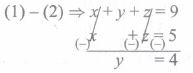
Sub y = 4 in (3)
4 + z = 7
z = 3
Sub z = 3 in (2)
x + 3 = 5
x = 2
x = 2, y = 4, x = 3
14.
A=\(\left( \begin{matrix} 5 & -4 \\ 6 & -5 \end{matrix} \right) \)
\({ A }^{ 2 }=\begin{pmatrix} 5 & -4 \\ 6 & -5 \end{pmatrix}\begin{pmatrix} 5 & -4 \\ 6 & -5 \end{pmatrix}\)
\(=\begin{pmatrix} (25-24) & (-20+20) \\ (30-30) & (-24+25) \end{pmatrix}\)
\(=\left( \begin{matrix} 1 & 0 \\ 0 & 1 \end{matrix} \right) =I\)
A2 = I
Hence it is proved
15.
A = \(\left[ \begin{matrix} \cos { \theta } & \sin { \theta } \\ -\sin { \theta } & \cos { \theta } \end{matrix} \right] \)
\({ A }^{ T }=\left( \begin{matrix} cos\theta & -sin\theta \\ sin\theta & cos\theta \end{matrix} \right) \)
\(A.{ A }^{ T }=\left( \begin{matrix} cos\theta & sin\theta \\ -sin\theta & cos\theta \end{matrix} \right) \left( \begin{matrix} cos\theta & -sin\theta \\ sin\theta & cos\theta \end{matrix} \right) \)
\(=\left( \begin{matrix} { cos }^{ 2 }\theta +s{ in }^{ 2 }\theta & -cos\theta sin\theta +cos\theta sin\theta \\ -sin\theta \quad cos\theta +cos\theta sin\theta & { sin }^{ 2 }\theta +{ cos }^{ 2 }\theta \end{matrix} \right) \)
\(\\ =\begin{pmatrix} 1 & 0 \\ 0 & 1 \end{pmatrix}=I\)
AAT = 1
Hence proved.
16.
\(A=\left[\begin{array}{ll}
2 & 5 \\
4 & 3
\end{array}\right], B=\left[\begin{array}{cc}
1 & -3 \\
2 & 5
\end{array}\right]\)
\(A B=\left[\begin{array}{ll}
2 & 5 \\
4 & 3
\end{array}\right]\left[\begin{array}{cc}
1 & -3 \\
2 & 5
\end{array}\right]\)
\(=\left[\begin{array}{cc}
2+10 & -6+25 \\
4+6 & -12+15
\end{array}\right]=\left[\begin{array}{cc}
12 & 19 \\
10 & 3
\end{array}\right]\)
\(\mathrm{BA}=\left[\begin{array}{cc}
1 & -3 \\
2 & 5
\end{array}\right]\left[\begin{array}{ll}
2 & 5 \\
4 & 3
\end{array}\right]\)
\(=\left[\begin{array}{cc}
2-12 & 5-9 \\
4+20 & 10+15
\end{array}\right]=\left[\begin{array}{cc}
-10 & -4 \\
24 & 25
\end{array}\right]\)
\(\therefore A B \neq B A\)
17.
Given A has 'a' rows and 'a + 3'columns
B has 'b' rows and '17- b' columns
Since AB and BA exist
For AB, No. of columns in A = No. of rows in B
a + 3 = b
For BA, No. of columns in B = No of rows in A
17 - b = a
17- (a + 3) = a
17- a - 3 = a
2a = 14
a = 7
b = a + 3 = 7 + 3 = 10
a = 7, b = 10.
18.
First, we add the two matrices on both left, right hand sides to get
\(\left[ \begin{matrix} d+3 & 8+a \\ 3b-2 & a-4 \end{matrix} \right] =\left[ \begin{matrix} 2 & 2a+1 \\ b-5 & 4c \end{matrix} \right] \)
Equating the corresponding elements of the two matrices, we have
d + 3 = 2 gives d = –1
8 + a = 2a + 1 gives a = 7
3b - 2 = b - 5 gives b = \(\frac {-3}{2}\)
Substituting a = 7 in a - 4 = 4c gives c = \(\frac {3}{4}\)
Therefore, a = 7, b = \(\frac {-3}{2}\), c = \(\frac {3}{4}\), d = -1.
19.
The given matrices are equal. Thus all corresponding elements are equal.
Therefore, a - b = 1 …(1)
2a + c = 5 …(2)
2a - b = 0 …(3)
3c + d = 2 …(4)
(3) gives 2a - b = 0
2a = b …(5)
Put 2a = b in equation (1), a - 2a = 1 gives a = −1
Put a = −1 in equation (5), 2(-1) = b gives b = −2
Put a = −1 in equation (2), 2(-1) + c = 5 gives c = 7
Put c = 7 in equation (4), 3(7) + d = 2 gives d = −19
Therefore, a = −1, b = −2, c = 7, d = −19
20.
The general 3 x 3 matrix is given by A = \(\left( \begin{matrix} { a }_{ 11 } & { a }_{ 12 } & { a }_{ 13 } \\ { a }_{ 21 } & { a }_{ 22 } & { a }_{ 23 } \\ { a }_{ 31 } & { a }_{ 32 } & { a }_{ 33 } \end{matrix} \right) \) aij = i2j2
a11 = 12 x 12 = 1 x 1 = 1; a12 = 12 x 22 = 1 x 4 = 4; a13 = 12 x 32 = 1 x 9 = 9
a21 = 22 x 12 = 2 x 1 = 2; a22 = 22 x 22 = 4 x 4 = 16; a23 = 22 x 32 = 4 x 9 = 36
a31 = 32 x 12 = 3 x 1 = 3; a32 = 32 x 22 = 9 x 4 = 36; a33 = 32 x 32 = 9 x 9 = 81
Hence the required matrix is A = \(\left( \begin{matrix} 1 & 4 & 9 \\ 4 & 16 & 36 \\ 9 & 36 & 81 \end{matrix} \right) \)
21.
LHS = (AB)T
AB = \({ \left[ \begin{matrix} 1 & 2 & 1 \\ 2 & -1 & 1 \end{matrix} \right] }_{ 2\times 3 }\times { \left[ \begin{matrix} 2 & -1 \\ -1 & 4 \\ 0 & 2 \end{matrix} \right] }_{ 3\times 2 }\)
= \(\left[ \begin{matrix} 2-2+0 & -1+8+2 \\ 4+1+0 & -2-4+2 \end{matrix} \right] =\left[ \begin{matrix} 0 & 9 \\ 5 & -4 \end{matrix} \right] \)
(AB)T = \({ \left[ \begin{matrix} 0 & 9 \\ 5 & -4 \end{matrix} \right] }^{ T }=\left[ \begin{matrix} 0 & 5 \\ 9 & -4 \end{matrix} \right] \) ....(1)
RHS = (BTAT)
BT = \(\left[ \begin{matrix} 2 & -1 & 0 \\ -1 & 4 & 2 \end{matrix} \right] \), AT = \(\left[ \begin{matrix} 1 & 2 \\ 2 & -1 \\ 1 & 1 \end{matrix} \right] \)
BTAT = \({ \left[ \begin{matrix} 2 & -1 & 0 \\ -1 & 4 & 2 \end{matrix} \right] }_{ 2\times 3 }\times { \left[ \begin{matrix} 1 & 2 \\ 2 & -1 \\ 1 & 1 \end{matrix} \right] }_{ 3\times 2 }\)
= \(\left[ \begin{matrix} 2-2+0 & 4+1+0 \\ -1+8+2 & -2-4+2 \end{matrix} \right] \)
BTAT = \(\left[ \begin{matrix} 0 & 5 \\ 9 & -4 \end{matrix} \right] \)...(2)}
From (1) and (2), (AB)T = BTAT.
Hence proved.
22.
LHS = A(B + C)
B + C = \(\left[ \begin{matrix} 1 & 2 \\ -4 & 2 \end{matrix} \right] +\left[ \begin{matrix} -7 & 6 \\ 3 & 2 \end{matrix} \right] =\left[ \begin{matrix} -6 & 8 \\ -1 & 4 \end{matrix} \right] \)
A(B + C) = \(\left[ \begin{matrix} 1 & 1 \\ -1 & 3 \end{matrix} \right] \times \left[ \begin{matrix} -6 & 8 \\ -1 & 4 \end{matrix} \right] =\left[ \begin{matrix} -6-1 & 8+4 \\ 6-3 & -8+12 \end{matrix} \right] =\left[ \begin{matrix} -7 & 12 \\ 3 & 4 \end{matrix} \right] \) ......(1)
RHS = AB + AC
AB = \(\left[ \begin{matrix} 1 & 1 \\ -1 & 3 \end{matrix} \right] \times \left[ \begin{matrix} 1 & 2 \\ -4 & 2 \end{matrix} \right] =\left[ \begin{matrix} 1-4 & 2+2 \\ -1-12 & -2+6 \end{matrix} \right] =\left[ \begin{matrix} -3 & 4 \\ -13 & 4 \end{matrix} \right] \)
AC = \(\left[ \begin{matrix} 1 & 1 \\ -1 & 3 \end{matrix} \right] \times \left[ \begin{matrix} -7 & 6 \\ 3 & 2 \end{matrix} \right] =\left[ \begin{matrix} -7+3 & 6+2 \\ 7+9 & -6+6 \end{matrix} \right] =\left[ \begin{matrix} -4 & 8 \\ 16 & 0 \end{matrix} \right] \)
Therefore, AB + AC = \(\left[ \begin{matrix} -3 & 4 \\ -13 & 4 \end{matrix} \right] +\left[ \begin{matrix} -4 & 8 \\ 16 & 0 \end{matrix} \right] =\left[ \begin{matrix} -7 & 12 \\ 3 & 4 \end{matrix} \right] \) ....(2)
From (1) and (2), A(B + C) = AB + AC. Hence proved.
23.
LHS (AB)C
AB = \({ \left[ \begin{matrix} 1 & -1 & 2 \end{matrix} \right] }_{ 1\times 3 }{ \left[ \begin{matrix} 1 & -1 \\ 2 & 1 \\ 1 & 3 \end{matrix} \right] }_{ 3\times 2 }=\left[ \begin{matrix} 1-2+2 & -1-1+6 \end{matrix} \right] =\left[ \begin{matrix} 1 & 4 \end{matrix} \right] \)
(AB)C = \({ \left[ \begin{matrix} 1 & 4 \end{matrix} \right] }_{ 1\times 2 }\times { \left[ \begin{matrix} 1 & 2 \\ 2 & -1 \end{matrix} \right] }_{ 2\times 2 }=\left[ \begin{matrix} 1+8 & 2-4 \end{matrix} \right] =\left[ \begin{matrix} 9 & -2 \end{matrix} \right] \) ....(1)
RHS = A(BC)
BC = \({ \left[ \begin{matrix} 1 & -1 \\ 2 & 1 \\ 1 & 3 \end{matrix} \right] }_{ 3\times 2 }\times { \left[ \begin{matrix} 1 & 2 \\ 2 & -1 \end{matrix} \right] }_{ 2\times 2 }=\left[ \begin{matrix} 1-2 & 2+1 \\ 2+2 & 4-1 \\ 1+6 & 2-3 \end{matrix} \right] =\left[ \begin{matrix} -1 & 3 \\ 4 & 3 \\ 7 & -1 \end{matrix} \right] \)
A(BC) = \({ \left[ \begin{matrix} 1 & -1 & 2 \end{matrix} \right] }_{ 1\times 3 }{ \left[ \begin{matrix} -1 & 3 \\ 4 & 3 \\ 7 & -1 \end{matrix} \right] }_{ 3\times 2 }\)
A(BC) = \(\left[ \begin{matrix} -1-4+14 & 3-3-2 \end{matrix} \right] =\left[ \begin{matrix} 9 & -2 \end{matrix} \right] \) ....(2)
From (1) and (2), (AB)C = A(BC).
24.
\({ \left[ \begin{matrix} 2 & 1 \\ 1 & 2 \end{matrix} \right] }_{ 2\times 2 }{ \left[ \begin{matrix} x \\ y \end{matrix} \right] }_{ 2\times 1 }=\left[ \begin{matrix} 4 \\ 5 \end{matrix} \right] \)
By matrix multiplication \(\left[ \begin{matrix} 2x+y \\ x+2y \end{matrix} \right] =\left[ \begin{matrix} 4 \\ 5 \end{matrix} \right] \)
Rewriting 2x + y = 4 ....(1)
x + 2y = 5 ....(2)
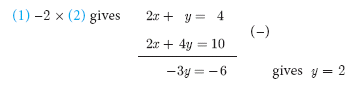
Substituting y = 2 in (1), 2x + 2 = 4 gives x = 1
Therefore, x = 1, y = 2.
25.
x2-4x = 5
y2-2y = 8
y2-2y-8 = 0
(y-4) (y+2) = 0
y = 4, -2
x2 - 4x - 5 = 0
(x - 5) (x + 1) = 0
x = 5, -1
x = -15, y = 4, -2
26.
\(\left[ \begin{matrix} 2{ x }^{ 2 } & 2x \\ 3x & { x }^{ 2 } \end{matrix} \right] +2\left[ \begin{matrix} 8 & 5x \\ 4 & 4x \end{matrix} \right] =\left[ \begin{matrix} { 2x }^{ 2 }+16 & 24 \\ 10 & 6x \end{matrix} \right] \)
12x=48 ⇒ x=4
27.
4x - 2y = 4 ...(1)
-3x + 3y = 6 ...(2)
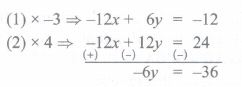
y = 6
Sub y = 6 in (1) ⇒ 4x - 2(6) = 4
4x = 16
x = 4
x = 4, y = 6
28.
X + Y = \(\left[ \begin{matrix} 7 & 0 \\ 3 & 5 \end{matrix} \right] \) ...(1)
X - Y= \(\left[ \begin{matrix} 3 & 0 \\ 0 & 4 \end{matrix} \right] \) ...(2)
______________
\((1)+(2)\Rightarrow 2x=\left[ \begin{matrix} 10 & 0 \\ 3 & 9 \end{matrix} \right] \)
\(=\left[ \begin{matrix} 5 & 0 \\ \frac { 3 }{ 2 } & \frac { 9 }{ 2 } \end{matrix} \right] \)
\((1)-(2)\Rightarrow X+Y=\left[ \begin{matrix} 7 & 0 \\ 3 & 5 \end{matrix} \right] \)
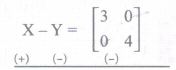
\(2Y=\left[ \begin{matrix} 4 & 0 \\ 3 & 1 \end{matrix} \right] \Rightarrow Y=\frac { 1 }{ 2 } \left[ \begin{matrix} 4 & 0 \\ 3 & 1 \end{matrix} \right] \)
\(\therefore Y=\left[ \begin{matrix} 2 & 0 \\ \frac { 3 }{ 2 } & \frac { 1 }{ 2 } \end{matrix} \right] \)
\(X=\left[ \begin{matrix} 5 & 0 \\ \frac { 3 }{ 2 } & \frac { 9 }{ 2 } \end{matrix} \right] , Y=\left[ \begin {matrix} 2 & 0 \\ \frac { 3 }{ 2 } & \frac { 1 }{ 2 } \end{matrix} \right] \)
29.
3A + 2B - C = \(3\left[ \begin{matrix} 1 & 8 & 3 \\ 3 & 5 & 0 \\ 8 & 7 & 6 \end{matrix} \right] +2\left[ \begin{matrix} 8 & -6 & -4 \\ 2 & 11 & -3 \\ 0 & 1 & 5 \end{matrix} \right] -\left[ \begin{matrix} 5 & 3 & 0 \\ -1 & -7 & 2 \\ 1 & 4 & 3 \end{matrix} \right] \)
= \(\left[ \begin{matrix} 3 & 24 & 9 \\ 9 & 15 & 0 \\ 24 & 21 & 18 \end{matrix} \right] +\left[ \begin{matrix} 16 & -12 & -8 \\ 4 & 22 & -6 \\ 0 & 2 & 10 \end{matrix} \right] +\left[ \begin{matrix} -5 & -3 & 0 \\ 1 & 7 & -2 \\ -1 & -4 & -3 \end{matrix} \right] \)
= \(\left[ \begin{matrix} 14 & 9 & 1 \\ 14 & 44 & -8 \\ 23 & 19 & 25 \end{matrix} \right] \)

10th Standard Syllabus & Materials
10th Standard
Tamilnadu 10th Standard Social Science GEO - Climate and Natural Vegetation of India Important Questions And Answers Study Material - QB365 Set C
NEW10th Standard
Tamilnadu 10th Standard Social Science GEO - Climate and Natural Vegetation of India Important Questions And Answers Study Material - QB365 Set B
NEW10th Standard
Tamilnadu 10th Standard Social Science GEO - Climate and Natural Vegetation of India Important Questions And Answers Study Material - QB365 Set A
NEW10th Standard
Tamilnadu 10th Standard Social Science GEO - India - Location, Relief and Drainage Important Questions And Answers Study Material - QB365 Set B



Tamilnadu Stateboard 10th Standard Subjects
Tamilnadu Stateboard Standards