
10th Standard Syllabus & Materials
10th Standard
Tamilnadu 10th Standard Social Science GEO - India - Population, Transport, Communication and Trade Important Questions And Answers Study Material - QB365 Set C
NEW10th Standard
Tamilnadu 10th Standard Social Science GEO - India - Population, Transport, Communication and Trade Important Questions And Answers Study Material - QB365 Set B
NEW10th Standard
Tamilnadu 10th Standard Social Science GEO - India - Population, Transport, Communication and Trade Important Questions And Answers Study Material - QB365 Set A
NEW10th Standard
Tamilnadu 10th Standard Social Science GEO - India - Resources and Industries Important Questions And Answers Study Material - QB365 Set C
NEW10th Standard
Tamilnadu 10th Standard Social Science GEO - India - Resources and Industries Important Questions And Answers Study Material - QB365 Set B
NEW10th Standard
Tamilnadu 10th Standard Social Science GEO - India - Resources and Industries Important Questions And Answers Study Material - QB365 Set A

Published on: 19/10/2025
Download Tamil Nadu 10th Standard Maths question papers, model tests, one-mark questions, important questions, and public exam papers in PDF format. Free study materials and answer keys for TN State Board students.
Questions + Answers key
Take MCQ Maths Test
1.
A coin is tossed thrice. What is the probability of getting two consecutive tails?
2.
Find the range and coefficient of range of the following data: 25, 67, 48, 53, 18, 39, 44.
3.
Find the slope of a line joining the given points (- 6, 1) and (-3, 2)
4.
What is the slope of a line whose inclination is 300?
5.
In each of the following, Find the value of ‘a’ for which the given points are collinear. (2, 3), (4, a) and (6, –3)
6.
If \(\triangle\)ABC is similar to \(\triangle\)DEF such that BC = 3 cm, EF = 4 cm and area of \(\triangle\)ABC = 54 cm2. Find the area of \(\triangle\)DEF.
7.
A Relation R is given by the set {(x, y) / y = x + 3, x \(\in \) {0, 1, 2, 3, 4, 5}}. Determine its domain and range.
8.
If A x B = {(3,2), (3, 4), (5,2), (5, 4)} then find A and B.
9.
If A = {1,3,5} and B = {2,3} then
(i) find A x B and B x A
(ii) Is A x B = B x A? If not why?
(iii) Show that n(A x B) = n(B x A) = n(A) x n(B)
10.
Basic Proportionality Theorem (BPT) or State and prove Thales theorem?
11.
Two dice are rolled. Find the probability that the sum of outcomes is (i) equal to 4 (ii) greater than 10 (iii) less than 13.
12.
If the function f is defined by
\(f(x)= \begin{cases}x+2 & \text { if } x>1 \\ 2 & \text { if }-1 \leq x \leq 1 \\ x-1 & \text { if }-3<x<-1\end{cases}\)
find the values of
i) f(3)
ii) f(0)
iii) f(-1.5)
iv) f(2) + f(-2)
13.
Let A = {1,2,3,4} and B = { 2, 5, 8, 11,14} be two sets. Let f: A ⟶ B be a function given by f(x) = 3x − 1. Represent this function
(i) by arrow diagram
(ii) in a table form
(iii) as a set of ordered pairs
(iv) in a graphical form
14.
Find the value of k, if the area of a quadrilateral is 28 sq. units, whose vertices are (–4, –2), (–3, k), (3, –2) and (2, 3)
15.
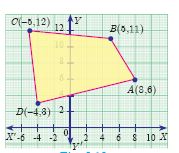
Find the area of the quadrilateral formed by the points (8, 6), (5, 11), (-5, 12) and (-4, 3).
16.
Varshika drew 6 circles with different sizes. Draw a graph for the relationship between the diameter and circumference of each circle as shown in the table and use it to find the circumference of a circle when its diameter is 6 cm.
\(\begin{array}{|l|c|c|c|c|c|} \hline \text { Diameter }(\mathbf{x}) \mathbf{c m} & 1 & 2 & 3 & 4 & 5 \\ \hline \text { Circumference }(\mathbf{y}) \mathbf{c m} & 3.1 & 6.2 & 9.3 & 12.4 & 15.5 \\ \hline \end{array}\)
17.
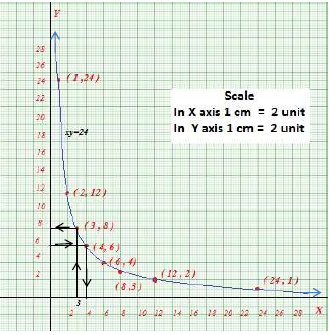
Draw the graph xy = 24, x, y > 0, Using the graph find,
(i) y when x = 3 and
(ii) x when y = 6.
18.
19.
Construct a triangle similar to a given triangle LMN with its sides equal to \(\frac { 4 }{ 5 } \) of the corresponding sides of the triangle LMN (scale factor \(\frac { 4 }{ 5 }<1\)).
1.
When a coin is tossed thrice, the outcome will be
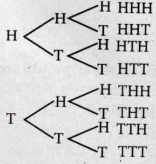
The sample space s = {(HHH), (THH), (HTH), (HHT), (HTT), (THT), (TTH), (TTT)}
n(S) = 3
Let A be the event of getting two consecutive tails
4 = {HTT, TTH, TTT}
n(A) = 3
\(\Rightarrow P=\frac { n\left\{ F \right\} }{ n\{ O\} } =\frac { 3 }{ 8 } \)
Probability of getting two consecutive tails = \(\frac{3}{8}\)
2.
Largest value L = 67; Smallest value S =18
Range R = L = S = 67 - 18 = 49
Coefficient of range = \(\frac { L-S }{ L+S } \)
Coefficient of range = \(\frac { 67-18 }{ 67+18 } =\frac { 49 }{ 85 } \) = 0.576
3.
(- 6, 1) and (-3, 2)
The slope \(\frac { { y }_{ 2 }-{ y }_{ 1 } }{ { x }_{ 2 }-{ x }_{ 1 } } =\frac { 2-1 }{ -3+6 } =\frac { 1 }{ 3 } \)
4.
Here θ = 300
Slope m = tan θ
Therefore, slope m = tan 300 = \(\frac{1}{\sqrt{3}}\)
5.
Given points are (2, 3), (4, a) and (6, - 3)
Since the points are colinear, Area of triangle is zero
\(\text { i.e., } \frac{1}{2}\left[x_{1}\left(y_{2}-y_{3}\right)+x_{2}\left(y_{3}-y_{1}\right)+x_{3}\left(y_{1}-y_{2}\right)\right]=0\)
2(a + 3) + 4(- 3 -3) + 6(3 - a) = 0
2a + 6 - 24 + 18 - 6a = 0
-4a + 0 = 0
-4a = 0
a = 0
6.
Since the ratio of area of two similar triangles is equal to the ratio of the squares of any two corresponding sides, we have
\(\frac { Area(\Delta ABC) }{ Area(\Delta DEF) } =\frac { { BC }^{ 2 } }{ { EF }^{ 2 } } \) gives \(\frac { 54 }{ Area(\Delta DEF) } =\frac { { 3 }^{ 2 } }{ { 4 }^{ 2 } } \)
\(Area(\Delta DEF)=\frac { 16\times 54 }{ 9 } =96{ cm }^{ 2 }\)
7.
Given Set = {(x, y) / y = x + 3, x \(\in \) {0, 1, 2, 3, 4, 5}}
When x = 0, y = 0 + 3 = 3
When x = 1, y = 1 + 3 = 4
When x = 2,y = 2 + 3 = 5
When x = 3, y = 3 + 3 = 6
When x = 4, y = 4 + 3 = 7
When x = 5, y = 5 + 3 = 8
Relation R = {(0, 3), (1,4), (2,5), (3,6), (4,7), (5,8)}
Domain of R = {0, 1, 2, 3, 4, 5}
Range of R = {3, 4, 5, 6, 7, 8}
8.
A x B = {(3,2), (3,4), (5,2), (5,4)}
We have A = {set of all first coordinates of elements of A x B}. Therefore, A = {3,5}
B = {set of all second coordinates of elements of A x B}. Therefore, B = {2,4}
Thus A = {3,5} and B = {2,4}.
9.
Given that A = {1,3,5} and B = {2,3}
(i) A x B = {1,3,5} x {2,3} = {(1,2), (1,3), (3,2), (3,3), (5,2), (5,3)} ...(1)
B x A = {2,3} x {1,3,5} = {(2,1), (2,3), (2,5), (3,1), (3,3), (3,5)} ...(2)
(ii) From (1) and (2) we conclude that A x B ≠ B x A as (1,2) ≠ (2,1) and (1,3) ≠) (3,1). etc
(iii) n(A) = 3; n (B) = 2.
From (1) and (2) we observe that, n (A x B) = n (B x A) = 6;
we see that, n(A) x n(B) = 3 x 2 = 6 and n (B) x n (A) = 2 x 3 = 6
Hence, n (A x B) = n (B x A) = n(A) x n(B) = 6.
Thus, n(A x B) = n (B x A) = n(A) x n(B).
10.
Statement
A straight line drawn parallel to a side of triangle intersecting the other two sides, divides the sides in the same ratio.
Proof
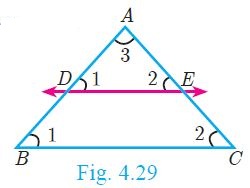
In \(\Delta ABC\) ,D is a point on AB and E is a point on AC
To prove : \(\cfrac { AD }{ DB } =\cfrac { AE }{ EC } \)
Construction: Draw a line DE || BC
| No. | Statement | Reason |
| 1. | \(\angle ABC=\angle ADE=\angle 1\) | Corresponding angles are equal because DE || BC |
| 2. | \(\angle ACB=\angle AED=\angle 2\) | Corresponding angles are equal because DE || BC |
| 3. | \(\\ \angle DAE=\angle BAC=\angle 3\) | Both triangles have a common angle |
| 4. | \(\Delta ABC\sim \Delta ADE\) | By AAA similarity |
| \(\frac { AB }{ AD } =\frac { AC }{ CE } \) | Corresponding sides are proportional | |
| \(\frac { AD+DB }{ AD } =\frac { AE+EC }{ AE } \) | Split AB and AC using the points D and E. | |
| \(1+\frac { DB }{ AD } =1+\frac { EC }{ AE } \) | On simplification | |
| \(\frac { DB }{ AD } =\frac { EC }{ AE } \) | Cancelling 1 on both sides | |
| \(\frac { AD }{ DB } =\frac { AE }{ EC } \) | Taking reciprocals | |
| Hence proved |
11.
When we roll two dice, the sample space is given by
S = \(\{ (1,1),(1,2),(1,3),(1,4),(1,5),(1,6)\\ (2,1),(2,2),(2,3),(2,4),(2,5),(2,6)\\ (3,1),(3,2),(3,3),(3,4),(3,5),(3,6)\\ (4,1),(4,2),(4,3),(4,4),(4,5),(4,6)\\ (5,1),(5,2),(5,3),(5,4),(5,5),(5,6)\\ (6,1),(6,2),(6,3),(6,4),(6,5),(6,6)\} \)
n(S) = 36
(i) Let A be the event of getting the sum of outcome values equal to 4.
Then A = {(1, 3),(2, 2),(3, 1)}; n(A) = 3.
Probability of getting the sum of outcomes equal to 4 is P(A) = \(\frac { n(A) }{ n(S) } =\frac { 3 }{ 36 } =\frac { 1 }{ 12 } \)
(ii) Let B be the event of getting the sum of outcome values greater than 10.
Then B = {(5,6),(6,5),(6,6)}; n(B) = 3
Probability of getting the sum of outcomes greater than 10 is P(B) = \(\frac { n(B) }{ n(S) } =\frac { 3 }{ 36 } =\frac { 1 }{ 12 } \)
(iii) Let C be the event of getting the sum of outcomes less than 13. Here all the outcomes have the sum value less than 13. Hence C = S
Therefore, n(C) = n(S) = 36
Probability of getting the sum value less than 13 is P(C) = \(\frac { n(C) }{ n(S) } =\frac { 36 }{ 36 } \) = 1
12.
\(f(x)= \begin{cases}x+2 & \text { if } x>1 \\ 2 & \text { if }-1 \leq x \leq 1 \\ x-1 & \text { if }-3<x<-1\end{cases}\)
i) f(3) = 3 + 2 = 5
ii) f(0) = 2
iii) f(-1.5) = -1.5 - 1 = -2.5
iv) f(2) + f( -2) = ( 2 + 2 ) + ( -2 -1)
= 4 - 3 = 1
13.
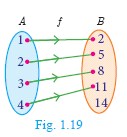
A = {1, 2, 3, 4} ; B = {2, 5, 8,11,14}; f(x) = 3x − 1
f(1) = 3(1) –1 = 3 – 1 = 2; f(2) = 3(2) –1 = 6 –1 = 5
f(3) = 3(3) –1 = 9 –1 = 8; f(4) = 4(3) –1 = 12 –1 = 11
(i) Arrow diagram
Let us represent the function f :A ⟶ B by an arrow diagram
(ii) Table form
The given function f can be represented in a tabular form as given below
| x | 1 | 2 | 3 | 4 |
| f(x) | 2 | 5 | 8 | 11 |
(iii) Set of ordered pairs
The function f can be represented as a set of ordered pairs as
f = {(1,2),(2,5),(3,8),(4,11)}
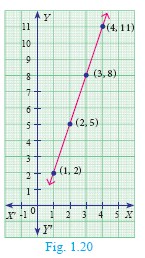
(iv) Graphical form
In the adjacent xy -plane the points
(1,2), (2,5), (3,8), (4,11) are plotted (Fig.1.20).
14.
Given vertices are (- 4, - 2),(- 3, k), (3, - 2) and (2,3) and area of quadrilateral is 28 sq. units.
Area of quadrilateral \(=\frac{1}{2}\left[\left(x_{1}-x_{3}\right)\left(y_{2}-y_{4}\right)-\right. \left.\left(x_{2}-x_{4}\right)\left(y_{1}-y_{3}\right)\right] \)
\(\frac{1}{2}\) [(- 4 - 3) (k - 3) - (- 3 - 2) (- 2 + 2)] = 28
(-7) (k - 3) - (- 5) (0) = 56
-7k + 21 = 56
-7k = 56 - 21 = 35
\(k=\frac{35}{-7}=-5\)
k = -5
15.
Before determining the area of quadrilateral, plot the vertices in a graph.
Let the vertices be A(8, 6), B(5, 11), C(-5, 12) and D(-4, 3).
Therefore, area of the quadrilateral ABCD
=\(\frac{1}{2}\) { (x1y2 + x2y3 + x3y1) - (x2y1 + x3y2 + x1y3) }
=\(\frac{1}{2}\) { (80 + 60 - 15 - 24) - (30 - 55 - 48 + 24)}
=\(\frac{1}{2}\) {109 + 49 }
=\(\frac{1}{2}\) { 158 } = 79 sq. units
16.
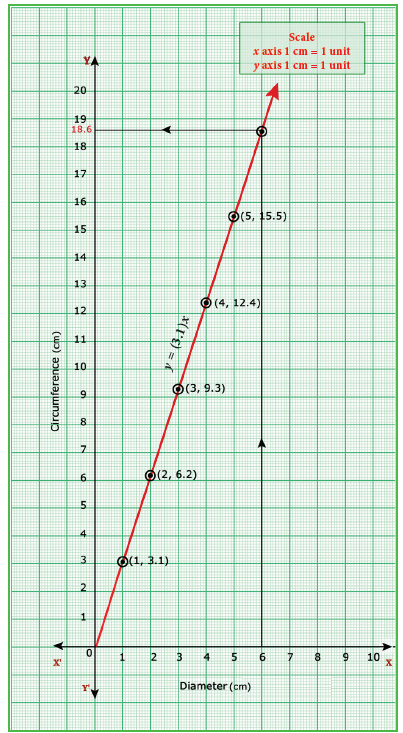
From the table, we found that as x increases, y also increases. Thus, the variation is a direct variation.
Let y = kx, where k is a constant of proportionality.
From the given values, we have
\(k=\frac{3.1}{1}=\frac{6.2}{2}=\frac{9.3}{3}=\frac{12.4}{4}=\ldots=3.1\)
When you plot the points (1, 3.1) (2, 6.2) (3, 9.3), (4, 12.4), (5, 15.5), you find the relation y = (3.1)x forms a straight-line graph.
Clearly, from the graph, when diameter is 6 cm, its circumference is 18.6 cm.
17.
1. Table
| x | 24 | 12 | 8 | 6 | 4 | 3 | 2 | 1 |
| y | 1 | 2 | 3 | 4 | 6 | 8 | 12 | 24 |
2. Variation:
Indirect Variation
3. Equation
xy = k
xy = 24 x 1 = 12 x 2 = 8 x 3 =... = 12
xy = 24
4. Points
(24,1),(12,2),(8,3),(6,4)
(4,6),(3,8),(2,12),(1,24)
5. Solution
From the graph
(i) If x = 3, then, y = 8
(ii) If y = 6 then, x = 4
18.
19.
Given a triangle LMN, we are required to construct another triangle whose sides are \(\frac { 4 }{ 5 } \) of the corresponding sides of the \(\triangle\)LMN
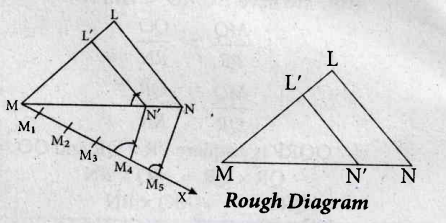
Steps of construction:
1. Constructed a LMN with any measurement
2. Drawn a ray MX making an acute angle with MN on the side opposite to the vertex L.
3. Located 5 points M1, M2, M3, M4, M5 on MX so that
MM1 = M1M2 = M2M3 = M3M4 = M4M5
4. Joined, M5N and drawn a line through M4 parallel to M5N to intersect MN at N.
5. Drawn' a line through N, parallel to the line NL to intersect ML at L
Then L'MN' is the required triangle each of whose sides is four-fifth of the corresponding sides of LMN

10th Standard Syllabus & Materials
10th Standard
Tamilnadu 10th Standard Social Science GEO - Climate and Natural Vegetation of India Important Questions And Answers Study Material - QB365 Set C
NEW10th Standard
Tamilnadu 10th Standard Social Science GEO - Climate and Natural Vegetation of India Important Questions And Answers Study Material - QB365 Set B
NEW10th Standard
Tamilnadu 10th Standard Social Science GEO - Climate and Natural Vegetation of India Important Questions And Answers Study Material - QB365 Set A
NEW10th Standard
Tamilnadu 10th Standard Social Science GEO - India - Location, Relief and Drainage Important Questions And Answers Study Material - QB365 Set B



Tamilnadu Stateboard 10th Standard Subjects
Tamilnadu Stateboard Standards