
10th Standard Syllabus & Materials
10th Standard
Tamilnadu 10th Standard Social Science GEO - India - Population, Transport, Communication and Trade Important Questions And Answers Study Material - QB365 Set C
NEW10th Standard
Tamilnadu 10th Standard Social Science GEO - India - Population, Transport, Communication and Trade Important Questions And Answers Study Material - QB365 Set B
NEW10th Standard
Tamilnadu 10th Standard Social Science GEO - India - Population, Transport, Communication and Trade Important Questions And Answers Study Material - QB365 Set A
NEW10th Standard
Tamilnadu 10th Standard Social Science GEO - India - Resources and Industries Important Questions And Answers Study Material - QB365 Set C
NEW10th Standard
Tamilnadu 10th Standard Social Science GEO - India - Resources and Industries Important Questions And Answers Study Material - QB365 Set B
NEW10th Standard
Tamilnadu 10th Standard Social Science GEO - India - Resources and Industries Important Questions And Answers Study Material - QB365 Set A

Published on: 19/10/2025
Download Tamil Nadu 10th Standard Maths question papers, model tests, one-mark questions, important questions, and public exam papers in PDF format. Free study materials and answer keys for TN State Board students.
Questions + Answers key
Take MCQ Maths Test
1.
If the circumference of a conical wooden piece is 484 cm then find its volume when its height is 105 cm.
2.
Find the volume of a cylinder whose height is 2 m and whose base area is 250 m2.
3.
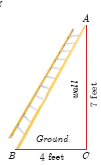
What length of ladder is needed to reach a height of 7 ft along the wall when the base of the ladder is 4 ft from the wall? Round off your answer to the next tenth place.
4.
The ratio of the radii of two right circular cones of same height is 1 : 3. Find the ratio of their curved surface area when the height of each cone is 3 times the radius of the smaller cone.
5.
6.
The radius of a conical tent is 7 m and the height is 24 m. Calculate the length of the canvas used to make the tent if the width of the rectangular canvas is 4 m?
7.
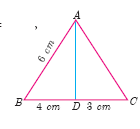
In the figure, AD is the bisector of \(\angle\)A. If BD = 4 cm, DC = 3 cm and AB = 6 cm, find AC.
8.
A vertical stick of length 6 m casts a shadow 400 cm long on the ground and at the same time a tower casts a shadow 28 m long. Using similarity, find the height of the tower.
9.
If \(\triangle\)ABC is similar to \(\triangle\)DEF such that BC = 3 cm, EF = 4 cm and area of \(\triangle\)ABC = 54 cm2. Find the area of \(\triangle\)DEF.
10.
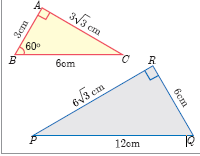
Observe Fig and find \(\angle\)P
11.
State and Prove - Angle Bisector Theorem
12.
Pythagoras Theorem
13.
Basic Proportionality Theorem (BPT) or State and prove Thales theorem?
14.
Show that the angle bisectors of a triangle are concurrent.
15.
A right circular cylindrical container of base radius 6 cm and height 15 cm is full of ice cream. The ice cream is to be filled in cones of height 9 cm and base radius 3 cm, having a hemispherical cap. Find the number of cones needed to empty the container.
16.
A capsule is in the shape of a cylinder with two hemisphere stuck to each of its ends. If the length of the entire capsule is 12 mm and the diameter of the capsule is 3 mm, how much medicine it can hold?
17.
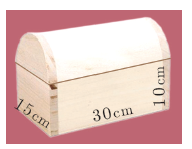
A jewel box is in the shape of a cuboid of dimensions 30 cm x 15 cm x 10 cm surmounted by a half part of a cylinder as shown in the figure. Find the volume and T.S.A. of the box.
18.
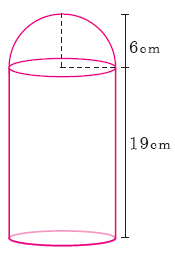
A toy is in the shape of a cylinder surrounded by a hemisphere. The height of the toy is 25 cm. Find the total surface area of the toy if its common diameter is 12 cm.
19.
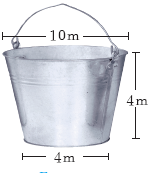
An industrial metallic bucket is in the shape of the frustum of a right circular cone whose top and bottom diameters are 10 m and 4 m and whose height is 4 m. Find the curved and total surface area of the bucket.
20.
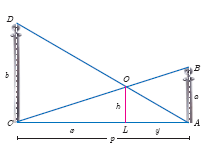
Two poles of height ‘a’ metres and ‘b’ metres are ‘p’ metres apart. Prove that the height of the point of intersection of the lines joining the top of each pole to the foot of the opposite pole is given by \(\frac { ab }{ a+b } \) meters
1.
Given circumference = 484 cm
\(2 \pi r =484
\)
\(2 \times \frac{22}{7} \times r =484
\)
\(r =\frac{484 \times 7}{44}=77 \mathrm{~cm}
\)
height h = 105 cm
Volume of cone \(=\frac{1}{3} \pi r^{2} h \text { cu. units }
\)
\(=\frac{1}{3} \times \frac{22}{7} \times 77 \times 77 \times 105
\)
= 652190 cm3
2.
Let r and h be the radius and height of the cylinder respectively.
Given that, height h = 2 m, base area = 250 m2
Now, volume of a cylinder = \(\pi\)r h 2 cu. units
= base area x h
= 250 x 2 = 500 m3
Therefore, volume of the cylinder = 500 m3
3.
Let x be the length of the ladder. BC = 4 ft, AC = 7 fit.
By Pythagoras theorem we have, AB2 = AC2 + BC2
x2 = 72 + 42 gives x2 = 49 + 16
x2 = 65, Hence \(x=\sqrt { 65 } \)
The number \(\sqrt { 65 } \) is between 8 and 8.1.
82 = 64 < 65.61 = 8.12
Therefore, the length of the ladder is approximately 8.1ft
4.
Let the radii of two cones be r1 and r2 and heights be h1 and h2
Given ratio of their radii = \(\frac{r_{1}}{r_{2}}=\frac{1}{3}\)
\(r_{1}=\frac{r_{2}}{3}
\)
\(h_{1}=3 r_{1}, h_{2}=3 r_{1}
\)
[ r1 is the radius of smaller cone]
Slant heights \(l_{1} =\sqrt{h_{1}^{2}+r_{1}^{2}}
\)
\(=\sqrt{9 r_{1}^{2}+r_{1}^{2}}=\sqrt{10} r_{1}
\)
\(l_{2} =\sqrt{h_{2}^{2}+r_{2}^{2}}
\)
\(=\sqrt{9 r_{1}^{2}+9 r_{1}^{2}}=\sqrt{18 r_{1}^{2}}=3 \sqrt{2} r_{1}\)
Ratio of curved surface areas
\(=\frac{\text { CSA of I cone }}{\text { CSA of II cone }}
\)
\(=\frac{\pi r_{1} l_{1}}{\pi r_{2} l_{2}} =\frac{r_{1}\left(\sqrt{10} r_{1}\right)}{\left(3 r_{1}\right)\left(3 \sqrt{2} r_{1}\right)}
\)
\(=\frac{\sqrt{10}}{9 \sqrt{2}}= \frac{\sqrt{5} \sqrt{2}}{9 \sqrt{2}}=\frac{\sqrt{5}}{9}
\)
Ratio of C.S.A = \(\sqrt{5}: 9\)
5.
6.
Let r and h be the radius and height of the cone respectively.
Given that, radius r = 7 m and height h = 24 m
Hence, l = \(\sqrt { { r }^{ 2 }+{ h }^{ 2 } } \)
\(=\sqrt { 49+576 } \)
\(l=\sqrt { 625 } =25m\)
C.S.A. of the conical tent = \(\pi\)rl sq. units
Area of the canvas \(=\frac { 22 }{ 7 } \times 7\times 25={ 550 }m^{ 2 }\)
Now, length of the canvas \(\frac{Area\ of\ the\ canvas}{width}=\frac{550}{4}=137.5m\)
Therefore, the length of the canvas is 137.5 m
7.
In \(\triangle\)ABC, AD is the bisector of \(\angle\)A
Therefore by Angle Bisector of \(\angle\)A
\(\frac { AB }{ AC } =\frac { BD }{ DC } \)
\(\frac{4}{3}=\frac{6}{A C}\) gives 4AC = 18. Hence, AC \(=\frac{9}{2}=4.5 \mathrm{~cm}\)
8.
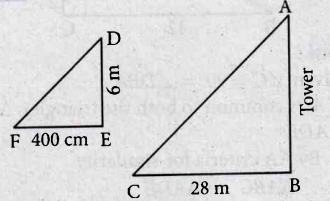
Let DE is the vertical stick and AB is the tower,
DE = 6 m, EF = 400 cm = 4 m, BC = 28 m
From DFE and ACB
Using similarity criteria
\(\frac{A B}{D E}=\frac{B C}{E F}\)
\(\frac{A B}{6}=\frac{28}{4} \)
\(A B=\frac{28 \times 6}{4}=42 \mathrm{~m} \)
Height of the tower = 42 m
9.
Since the ratio of area of two similar triangles is equal to the ratio of the squares of any two corresponding sides, we have
\(\frac { Area(\Delta ABC) }{ Area(\Delta DEF) } =\frac { { BC }^{ 2 } }{ { EF }^{ 2 } } \) gives \(\frac { 54 }{ Area(\Delta DEF) } =\frac { { 3 }^{ 2 } }{ { 4 }^{ 2 } } \)
\(Area(\Delta DEF)=\frac { 16\times 54 }{ 9 } =96{ cm }^{ 2 }\)
10.
In \(\Delta BAC\) and \(\Delta PRQ,\quad \frac { AB }{ RQ } =\frac { 3 }{ 6 } =\frac { 1 }{ 2 } \)
\(\frac { BC }{ QP } =\frac { 6 }{ 12 } =\frac { 1 }{ 2 } ;\frac { CA }{ PR } =\frac { 3\sqrt { 3 } }{ 6\sqrt { 3 } } =\frac { 1 }{ 2 } \)
Therefore, \(\frac { AB }{ QP } =\frac { BC }{ QP } =\frac { CA }{ PR } \)
By SSS similarity, we have \(\triangle\)BAC~\(\triangle\)QRB
\(\angle\)P =\(\angle\)C (since the corresponding parts of similar triangle)
\(\angle\)P =\(\angle\)C 180o -\((\angle A+\angle B)={ 180 }^{ 0 }-({ 90 }^{ 0 }+{ 60 }^{ 0 })\)
\(\angle\)P = 180o - 150o = 30o
11.
Statement :
The internal bisector of an angle of a triangle divides the opposite side internally in the ratio of the corresponding sides containing the angle
Proof
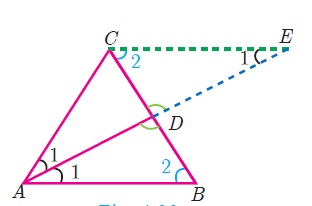
Given : In ΔABC,AD is the internal bisector
To prove : \(\frac{A B}{A C}=\frac{B D}{C D}\)
Construction : Draw a line through C parallel to AB. Extend AD to meet line through C at E
| No | Statement | Reason |
|---|---|---|
| 1. | ∠AEC =∠BAE =∠1 | Two parallel lines cut by a transversal make alternate angles equal |
| 2. | ΔACE is isosceles AC = CE … (1) |
In ΔACE,∠CAE = ∠CEA |
| 3. | ΔABD∼ΔECD \(\frac{A B}{C E}=\frac{B D}{C D}\) |
By AA Similarity |
| 4. | \(\frac{A B}{A C}=\frac{B D}{C D}\) | From (1) AC = CE Hence proved |
12.
Statement
In a right angle triangle, the square on the hypotenuse is equal to the sum of the squares on the other two sides.
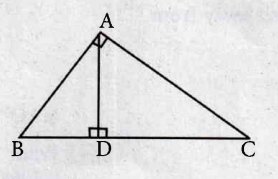
Proof
Given : In \(\triangle\)ABC , \(\angle\)A = 90°
To prove : AB2 +AC2 = BC2
Construction : Draw AD \(\perp\) BC
| No. | Statement | Reason |
| 1. | Compare \(\triangle\)ABC and \(\triangle\)DBA ÐB is common \(\angle\)BAC = \(\angle\)BDA = 90° Therefore, \(\triangle\)ABC \(\sim\) \(\triangle\)DBA \(\frac{A B}{B D}=\frac{B C}{A B}\) AB2 = BC x BD ........(1) |
Given \(\angle\)BAC = 90° and by construction \(\angle\)BDA = 90° By AA similarity |
| 2. | Compare \(\triangle\)ABC and \(\triangle\)DAC \(\angle\)C is common \(\angle\)BAC = \(\angle\)ADC = 90o Therefore, \(\triangle\)ABC \(\sim\) \(\triangle\)DAC \(\frac{B C}{A C}=\frac{A C}{D C}\) AC2 = BC x DC ...(2) |
Given \(\angle\)BAC = 90° and by construction \(\angle\)ADC = 90° By AA similarity |
Adding (1) and (2) we get
AB2 +AC2 = BC x BD +BC x DC
= BC(BD +DC) = BC x BC
AB2 +AC2 = BC2 .
Hence the theorem is proved.
13.
Statement
A straight line drawn parallel to a side of triangle intersecting the other two sides, divides the sides in the same ratio.
Proof
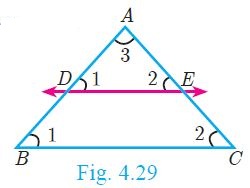
In \(\Delta ABC\) ,D is a point on AB and E is a point on AC
To prove : \(\cfrac { AD }{ DB } =\cfrac { AE }{ EC } \)
Construction: Draw a line DE || BC
| No. | Statement | Reason |
| 1. | \(\angle ABC=\angle ADE=\angle 1\) | Corresponding angles are equal because DE || BC |
| 2. | \(\angle ACB=\angle AED=\angle 2\) | Corresponding angles are equal because DE || BC |
| 3. | \(\\ \angle DAE=\angle BAC=\angle 3\) | Both triangles have a common angle |
| 4. | \(\Delta ABC\sim \Delta ADE\) | By AAA similarity |
| \(\frac { AB }{ AD } =\frac { AC }{ CE } \) | Corresponding sides are proportional | |
| \(\frac { AD+DB }{ AD } =\frac { AE+EC }{ AE } \) | Split AB and AC using the points D and E. | |
| \(1+\frac { DB }{ AD } =1+\frac { EC }{ AE } \) | On simplification | |
| \(\frac { DB }{ AD } =\frac { EC }{ AE } \) | Cancelling 1 on both sides | |
| \(\frac { AD }{ DB } =\frac { AE }{ EC } \) | Taking reciprocals | |
| Hence proved |
14.
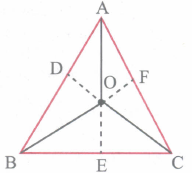
Let \(\triangle\)ABC be B triangle points D, E, F are angular bisectors of \(\angle A, \angle B \text { and } \angle C\) respectively. By angular bisector theorem we have
\( \frac{B D}{D C}=\frac{A B}{A C} \Rightarrow \mathrm{AB}=\frac{B D \times A C}{D C} \)
\(\frac{A C}{B C}=\frac{A F}{F B} \Rightarrow \mathrm{AC}=\frac{A F \times B C}{F B} \)
\(\frac{A E}{E C}=\frac{A B}{B C} \Rightarrow \mathrm{AB}=\frac{A E \times B C}{E C}\)
From (1) and (3), we have
\(\frac{B D \times A C}{D C}=\frac{A E \times B C}{E C}\)
Now substituting (2) in (4) we have
\( \frac{B D \times\left(\frac{A F \times B C}{F B}\right)}{D C} =\frac{A E \times B C}{E C} \)
\(\frac{B D \times A F \times B C}{D C \times F B} =\frac{A E \times B C}{E C} \)
\(B D \times A F \times E C =\frac{A E \times B C \times D C \times F B}{B C} \)
\(B D \times A F \times C E =E A \times F B \times D C \)
\(\therefore \frac{B D \times A F \times C E}{E A \times F B \times D C}=1\)
Hence by Ceva's theorem we conclude that the angle bisectors of a triangle are concurrent.
15.
Let h and r be the height and radius of the cylinder respectively.
Given that, h = 15 cm, r = 6 cm
Volume of the container V = \(\pi\)r2h cubic units.
Let, r1 = 3 cm, h1 = 9 cm be the radius and height of the cone.
Also, r1 = 3 cm is the radius of the hemispherical cap.
Volume of one ice cream cone = (Volume of the cone + Volume of the hemispherical cap)
\(=\frac { 1 }{ 3 } \pi { r }_{ 1 }^{ 2 }{ h }_{ 1 }+\frac { 2 }{ 3 } \pi { r }_{ 1 }^{ 3 }\)
\(=\frac { 1 }{ 3 } \times \frac { 22 }{ 7 } \times 3\times 3\times 9+\frac { 2 }{ 3 } \times \frac { 22 }{ 7 } \times 3\times 3\times 3\)
\(=\frac { 22 }{ 7 } \times 9(3+2)=\frac { 22 }{ 7 } \times 45\)
\(Number\ of\ cones=\frac { volume\ of\ the\ cylinder }{ volume\ of\ one\ ice\ cream\ cone } \)
Number of ice cream cones needed \(=\frac { \frac { 22 }{ 7 } \times 6\times 6\times 15 }{ \frac { 22 }{ 7 } \times 45 } =12\)
Thus 12 ice cream cones are required to empty the cylindrical container.
16.
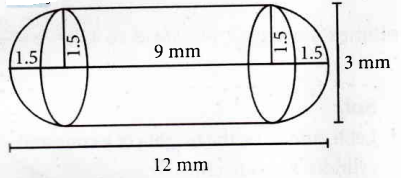
From the figure,
Diameter of hemisphere = 3 mm
Radius of hemisphere = 1.5 mm
Volume of hemisphere = \(\frac{2}{3} \pi r^{3} \ cu. units \)
Volume of 2 hemispheres = \(2\left(\frac{2}{3} \pi r^{3}\right) \)
\(=\frac{4}{3} \pi(1.5)^{3} \)
\(=4.5 \pi \mathrm{mm}^{3} \)
Radius of cylinder = 1.5 mm
Height of cylinder = 12 - 3 = 9 mm
Volume of cylinder \(=\pi r^{2} h \text { cu. units } \)
\(=\pi(1.5)^{2}(9) \)
\(=20.25 \pi \mathrm{mm}^{3} \)
Amount of medicine that a capsule can hold = Volume of cylinder + Volume of 2 hemispheres
\(=20.25 \pi+4.5 \pi \)
\(=24.75 \pi \mathrm{mm}^{3} \)
\(=24.75 \times \frac{22}{7}=77.785 \mathrm{~mm}^{3}\)
17.
Let l, b and h1 be the length, breadth and height of the cuboid. Also let us take r and h2 be the radius and height of the cylinder.
Now, Volume of the box = Volume of the cuboid + \(\frac{1}{2}\) (Volume of cylinder)
\((l\times b\times { h }_{ 1 })+\frac { 1 }{ 2 } ({ \pi r }^{ 2 }{ h }_{ 2 })cu.units\)
\(=\left( 30\times 15\times 10 \right) +\frac { 1 }{ 2 } \left( \frac { 22 }{ 7 } \times \frac { 15 }{ 2 } \times 30 \right) \)
= 4500 + 2651.79 = 7151. 79
Therefore, Volume of the box = 7151.79 cm3
18.
Let r and h be the radius and height of the cylinder respectively.
Given that, diameter d = 12 cm, radius r = 6 cm
Total height of the toy is 25 cm
Therefore, height of the cylindrical portion = 25 - 6 = 19 cm
T.S.A. of the toy = C.S.A. of the cylinder + C.S.A. of the hemisphere + Base Area of the cylinder
\(2\pi rh+2\pi { r }^{ 2 }+\pi { r }^{ 2 }\)
\(=\pi r(2h+3r)\quad sq.units\)
\(\frac { 22 }{ 7 } \times 6\times 56=1056\)
Therefore, T.S.A. of the toy is 1056 cm2
19.
Let h, l, R and r be the height, slant height, outer radius and inner radius of the frustum.
Given that, diameter of the top = 10 m; radius of the top R = 5 m.
diameter of the bottom = 4 m; radius of the bottom r = 2 m, height h = 4 m
Now, \(l=\sqrt { { h }^{ 2 }+\left( R-{ r } \right) ^{ 2 } } \)
\(=\sqrt { { 4 }^{ 2 }+(5-2)^{ 2 } } \)
\(l=\sqrt { 16+9 } =\sqrt { 25 } =5m\)
Here, C.S.A. = \(\pi\)(R + r)l sq. units
\(\frac { 22 }{ 7 } (5+2)\times 5={ 110m }^{ 2 }\)
T.S.A. = \(\pi\)(R + r)l + \(\pi\)R2 + \(\pi\)r2 sq. units
\(\frac { 22 }{ 7 } \left[ (5+2)5+25+4 \right] =\frac { 1408 }{ 7 } =201.14\)
Therefore, C.S.A. = 110 m2 and T.S.A. = 201.14 m2
20.
Let AB and CD be two poles of height ‘a’ metres and ‘b’ metres respectively such that the poles are ‘p’ metres apart. That is AC = p metres. Suppose the lines AD and BC meet at O, such that OL = h metres
Let CL = x and LA = y.
Then, x + y = p
In \(\Delta ABC\) and \(\Delta LOC\), we have
\(\angle CAB=\angle CLO\) [each equal to 90o]
\(\angle C=\angle C\) [ C is common]
\(\Delta CAB\sim \Delta CLO\) [By AA similarity]
\(\frac { CA }{ CL } =\frac { AB }{ LO } \) gives \(\frac { P }{ x } =\frac { a }{ h } \)
so, \(x=\frac { ph }{ a } \) ..(1)
In \(\Delta ALO\) and \(\Delta ACD\), we have
\(\angle ALO=\angle ACD\) [each equal to 90° ]
\(\angle A=\angle A[\mathrm{~A} \text { is common }]\)
\(\frac { AL }{ AC } =\frac { OL }{ DC } \) gives \(\frac { y }{ p } =\frac { h }{ b } \) we get, \(y=\frac { ph }{ b } \) ....(2)
(1) + (2) gives \(x+y=\frac { ph }{ a } +\frac { ph }{ b } \)
\(p=ph\left( \frac { 1 }{ a } +\frac { 1 }{ b } \right) \) (since x + y = p)
\(1=h\left( \frac { a+b }{ ab } \right) \)
Therefore, \(h=\frac { ab }{ a+b } \)
Hence, the height of the intersection of the lines joining the top of each pole to the foot of the opposite pole is \(\frac { ab }{ a+b } \) meters.

10th Standard Syllabus & Materials
10th Standard
Tamilnadu 10th Standard Social Science GEO - Climate and Natural Vegetation of India Important Questions And Answers Study Material - QB365 Set C
NEW10th Standard
Tamilnadu 10th Standard Social Science GEO - Climate and Natural Vegetation of India Important Questions And Answers Study Material - QB365 Set B
NEW10th Standard
Tamilnadu 10th Standard Social Science GEO - Climate and Natural Vegetation of India Important Questions And Answers Study Material - QB365 Set A
NEW10th Standard
Tamilnadu 10th Standard Social Science GEO - India - Location, Relief and Drainage Important Questions And Answers Study Material - QB365 Set B



Tamilnadu Stateboard 10th Standard Subjects
Tamilnadu Stateboard Standards