
10th Standard Syllabus & Materials
10th Standard
Tamilnadu 10th Standard Social Science GEO - India - Population, Transport, Communication and Trade Important Questions And Answers Study Material - QB365 Set C
NEW10th Standard
Tamilnadu 10th Standard Social Science GEO - India - Population, Transport, Communication and Trade Important Questions And Answers Study Material - QB365 Set B
NEW10th Standard
Tamilnadu 10th Standard Social Science GEO - India - Population, Transport, Communication and Trade Important Questions And Answers Study Material - QB365 Set A
NEW10th Standard
Tamilnadu 10th Standard Social Science GEO - India - Resources and Industries Important Questions And Answers Study Material - QB365 Set C
NEW10th Standard
Tamilnadu 10th Standard Social Science GEO - India - Resources and Industries Important Questions And Answers Study Material - QB365 Set B
NEW10th Standard
Tamilnadu 10th Standard Social Science GEO - India - Resources and Industries Important Questions And Answers Study Material - QB365 Set A

Published on: 19/10/2025
Download Tamil Nadu 10th Standard Maths question papers, model tests, one-mark questions, important questions, and public exam papers in PDF format. Free study materials and answer keys for TN State Board students.
Questions + Answers key
Take MCQ Maths Test
1.
Find the sum of
12 + 22 +...+ 192
2.
3.
The radius of a sphere increases by 25%. Find the percentage increase in its surface area.
4.
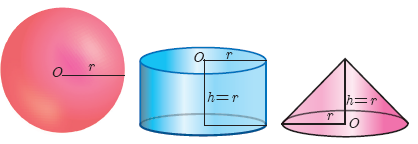
A sphere, a cylinder and a cone are of the same radius, where as cone and cylinder are of same height. Find the ratio of their curved surface areas.
5.
The curved surface area of a right circular cylinder of height 14 cm is 88 cm2 . Find the diameter of the cylinder.
6.
Find the indicated terms of the sequences whose nth terms are given by
\({ a }_{ n }=\frac { 5n }{ n+2 } ;{ a }_{ 6 }\) and a13 ,
7.
Prove that square of any integer leaves the remainder either 0 or 1 when divided by 4.
8.
Find the sum to n terms of the series
3 + 33 + 333 + ...to n terms
9.
A hemispherical bowl is filled to the brim with juice. The juice is poured into a cylindrical vessel whose radius is 50% more than its height. If the diameter is same for both the bowl and the cylinder then find the percentage of juice that can be transferred from the bowl into the cylindrical vessel.
10.
A cylindrical glass with diameter 20 cm has water to a height of 9 cm. A small cylindrical metal of radius 5 cm and height 4 cm is immersed it completely. Calculate the raise of the water in the glass?
11.
The houses of a street are numbered from 1 to 49. Senthil’s house is numbered such that the sum of numbers of the houses prior to Senthil’s house is equal to the sum of numbers of the houses following Senthil’s house. Find Senthil’s house number?
12.
Find the sum of all natural numbers between 300 and 600 which are divisible by 7.
13.
A right angled triangle PQR where ∠Q = 90o is rotated about QR and PQ. If QR = 16 cm and PR = 20 cm, compare the curved surface areas of the right circular cones so formed by the triangle.
14.
15.
A school announces that for a certain competitions, the cash price will be distributed for all the participants equally as shown below:
| No. of participants (x) | 2 | 4 | 6 | 8 | 10 |
| Amount for each participant in Rs. (y) | 180 | 90 | 60 | 45 | 36 |
i. Find the constant of variation.
ii. Graph the above data and hence find, how much will each participant get if the number of participants are 12.
16.
Draw the two tangents from a point which is 10 cm away from the centre of a circle of radius 5 cm. Also, measure the lengths of the tangents.
17.
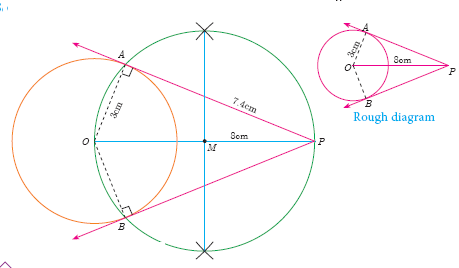
Draw a circle of diameter 6 cm from a point P, which is 8 cm away from its centre. Draw the two tangents PA and PB to the circle and measure their lengths.
18.
The value of (13 + 23 + 33 +...+153) - (1 + 2 + 3 +...+ 15)is
14400
14200
14280
14520
19.
An A.P. consists of 31 terms. If its 16th term is m, then the sum of all the terms of this A.P. is
16 m
62 m
31 m
\(\frac { 31 }{ 2 } \) m
20.
The sum of the exponents of the prime factors in the prime factorization of 1729 is
1
2
3
4
21.
The ratio of the volumes of a cylinder, a cone and a sphere, if each has the same diameter and same height is
1:2:3
2:1:3
1:3:2
3:1:2
22.
A frustum of a right circular cone is of height 16 cm with radii of its ends as 8 cm and 20 cm. Then, the volume of the frustum is
3328\(\pi\) cm3
3228\(\pi\) cm3
3240\(\pi\) cm3
3340\(\pi\) cm3
23.
In a hollow cylinder, the sum of the external and internal radii is 14 cm and the width is 4 cm. If its height is 20 cm, the volume of the material in it is
5600\(\pi\) cm3
1120\(\pi\) cm3
56\(\pi\) cm3
3600\(\pi\) cm3
24.
The height of a right circular cone whose radius is 5 cm and slant height is 13 cm will be
12 cm
10 cm
13 cm
5 cm
25.
1.
12 + 22 +...+ 192 = \(\frac { 19\times \left( 19+1 \right) \left( 2\times 19+1 \right) }{ 6 } =\frac { 19\times 20\times 39 }{ 6 } =2470\)
2.
3.
Let the radius of the sphere be 'r' cm
Surface area = \(4 \pi r^{2}\)
when radius is increased by 25% ,then new diameter = r + 25% + r
\(=r+\frac{25 r}{100}=\frac{5 r}{4}\)
Surface area of new sphere
\(=4 \pi\left(\frac{5 r}{4}\right)^{2} \)
\(=4 \pi\left(\frac{25 r^{2}}{16}\right) \)
\(=\frac{25 \pi r^{2}}{4} \)
Increase in surface area = \(\frac{25 \pi r^{2}}{4}-4 \pi r^{2}\)
\(=\frac{25 \pi r^{2}-16 \pi r^{2}}{4} \)
\(=\frac{9 \pi r^{2}}{4} \)
Percentage increase in surface area
\(=\frac{9 \pi r^{2} / 4}{4 \pi r^{2}} \times 100 \% \)
\(=\frac{900}{16} \%=56.25 \% \)
4.
Required Ratio = C.S.A. of the sphere: C.S.A. of the cylinder : C.S.A. of the cone
\(4\pi { r }^{ 2 }:2\pi rh:\pi rl,\ (l=\sqrt { { r }^{ 2 }+{ h }^{ 2 } } =\sqrt { { 2r }^{ 2 } } =\sqrt { 2r } units)\)
\(=4:2:\sqrt { 2 } =2\sqrt { 2 } :\sqrt { 2 } :1\).
5.
Given that, C.S.A. of the cylinder = 88 sq. cm
2\(\pi\)rh = 88
\(2\times \frac { 22 }{ 7 } \times 14=88\) (given h = 14cm)
2r = \(\frac { 88\times 7 }{ 22\times 14 } =2\)
Therefore, diameter = 2 cm
6.
Given \(a_{n}=\frac{5 n}{n+2}\)
To find a6, put n = 6
\(\therefore a_{6}=\frac{5 \times 6}{6+2}=\frac{30}{8}=\frac{15}{4}\)
To find a13, put n = 13
\(a_{13}=\frac{5 \times 13}{13+2}=\frac{65}{15}=\frac{13}{3}
\)
\(\therefore a_{6}=\frac{15}{4} \text { and } a_{13}=\frac{13}{3}
\)
7.
All the integers 'a' must be either even or odd.
If it is even then a = 2q.
If it is odd then a = 2q + 1
Case 1:
lf a = 2q
a2 = (2q)2
a2 = 4q2, remainder 0 when divided by 4.
Case 2:
If a = 2q+ 1
a2 = (2q + 2)2
= 4q2 + 4q + 1
= 4q ( q + 1) + 1
a2 = 4m + 1 Where m = q (q + 1) is an integer
It is of the form bq + 1 where 1 is the remainder when divided by 4.
The square of any integer leaves the remainder either 0 or 1 when divided by 4.
8.
3 + 33 + 333 + ... to n terms.
Let Sn = 3 + 33 + 333 + ...upto n terms
= 3( 1 + 11 + 111 + ... to n terms)
= \(\frac { 3 }{ 9 } \) (9 + 99 + 999 + ... to n terms)
(multiply and divide by 9)
= \(\frac { 1 }{ 3 } \)3[(10 - 1) + (100 - 1) + (1000 - 1) + to n terms]
= \(\frac { 1 }{ 3 } \) [(10 - 1) + (102 - 1) + (103 - 1) +... + n upto n terms]
= \(\frac { 1 }{ 3 } \) {[10 + 102 + 103 +...upto n terms] - n}
10 + 102 +... is a G.P. with a = 10, r = 10.
\(\therefore S_{n} =\frac{a\left(r^{n}-1\right)}{r-1}
\)
\(S_{n} =\frac{1}{3}\left\{\left[\frac{10\left(10^{n}-1\right)}{10-1}\right]-n\right\}
\)
\(=\frac{1}{3}\left[\frac{10\left(10^{n}-1\right)}{9}-n\right]
\)
\(=\frac{10}{27}\left(10^{n}-1\right)-\frac{n}{3}\)
3 + 33 + 333 + ... to n terms \(=\frac{10}{27}\left(10^{n}-1\right)-\frac{n}{3}\)
9.
Let the radius of hemispherical bowl = r
Volume of hemispherical bowl
\(=\frac{2}{3} \pi r^{3} \text { cu. units }\)
Let the height of cylindrical vessel = h
Given \(r=h+h \frac{50}{100} \Rightarrow \mathrm{r}=\mathrm{h}\left(1+\frac{50}{100}\right)
\)
\(\mathrm{h}= \frac{2}{3} r
\)
Now, Volume of cylindrical vessel
\(=\pi r^{2}\left(\frac{2 r}{3}\right)=\frac{2}{3} \pi r^{3}\)
Hence, Volume of juice in the cylindrical vessel
\(=\frac{\frac{2}{3} \pi r^{3}}{\frac{2}{3} \pi r^{3}} \times 100 \%=100 \%\)
10.
Diameter of Glass = 20 cm
radius = 10 cm
water upto height = 9 cm
radius of cylindrical metal = 5 cm
height of cylindrical metal = 4 cm
Volume of water displaced = Volume of cylindrical metal
\(\pi r_{1}^{2} h_{1}=\pi r_{2}^{2} h_{2}
\)
\((10)^{2} h_{1}=(5)^{2}(4)
\)
\(h_{1}=\frac{100}{100}=1 \mathrm{~cm}
\)
Hence, the increase in water level is 1 cm.
11.
Let Senthil’s house number be x.
It is given that 1 + 2 + 3 +... + (x -1) = (x + 1) + (x + 2) + .... + 49
1 + 2 + 3 + ... + (x - 1) = [1 + 2 + 3...+49] - [1 + 2 + 3+ ...+ x]
\(\frac { x-1 }{ 2 } \left[ 1+\left( x-1 \right) \right] =\frac { 49 }{ 2 } \left[ 1+49 \right] -\frac { x }{ 2 } \left[ 1+x \right] \)
\(\frac { x\left( x-1 \right) }{ 2 } =\frac { 49\times 50 }{ 2 } -\frac { x\left( x+1 \right) }{ 2 } \)
x2 - x = 2450 - x2 - x \(\Rightarrow\) 2 x 2 = 2450
x2 = 1225 gives x = 35
Therefore, Senthil’s house number is 35.
12.
The natural numbers between 300 and 600 which are divisible by 7 are 301, 308, 315, …, 595.
The sum of all natural numbers between 300 and 600 is 301 + 308 + 315 +...+ 595
The terms of the above series are in A.P.
First term a = 301; common difference d = 7; Last term l = 595.
\(n=\left( \frac { l-a }{ d } \right) +1=\left( \frac { 595-301 }{ 7 } \right) +1=43\)
Since, \({ S }_{ n }=\frac { n }{ 2 } \left[ a+l \right] \), we have \({ s }_{43 }=\frac { 43 }{ 2 } \left[ 301+595 \right] \) = 19264
13.
Right triangle PQR, right angled at Q and
PR = 20 cm, QR = 16 cm
PQ2 = PR2 - QR2
= (20)2 - (16)2
= 400 - 256 = 144
PQ = 12 cm
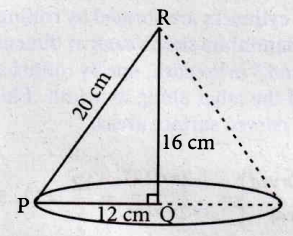
When right triangle PQR, rotates about QR, a right circular cone is formed with PQ = 12 cm as base radius and PR = 20 cm as
slant height.
C.S.A of the Cone = \(\pi r l\) sq. units
\(=\frac{22}{7} \times 12 \times 20=754.29 \mathrm{~cm}^{2}\)
When right triangle PQR, rotates about PQR, a right circular cone is formed with
QR = 16 cm as base radius and PR = 20 cm as slant height
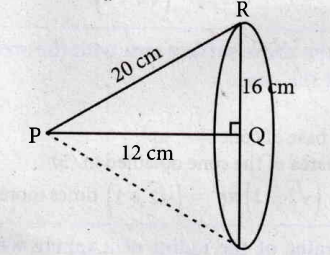
C.S.A of the Cone \(=\pi r l \text { sq.units } \)
\(=\frac{22}{7} \times 16 \times 20 \)
= 1005.71 cm2
Hence, C.S.A of the cone when rotates about PQ is larger.
14.
15.
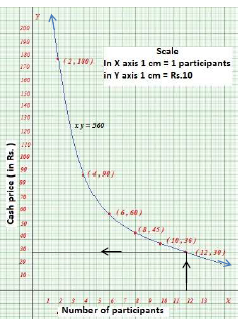
1. Table:
| No. of participants ( x ) | 2 | 4 | 6 | 8 | 10 |
| Amount for each participants in Rs. ( y) | 180 | 90 | 60 | 45 | 36 |
2. Variation
Indirect Variation
3. Equation
xy = k
xy = 2 x 180 = 4 x 90 = 6 x 60 =.... = 360
xy = 360
4.Points
(2,180), (4,190),(6,60 ) (8,45 ) ,(10,36 )
5. Solution
(i) Constant of Variation
(ii) Cash Price each participant will get if 12 participants participate = Rs. 30 /-
16.
The distance between the point from the centre is 10 cm.
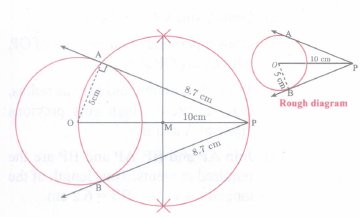
Length of the tangents PA - PB = 8.7 cm
Construction:
Steps:
(1) With O as centre, draw a circle of radius 5cm.
(2) Draw a line OP = 10 cm.
(3) Draw a perpendicular bisector of OP which cuts OP at M.
(4) With M as centre and MO as radius, draw a circle which cuts previous circle at A and B.
(5) Join AP and BP. AP and BP are the required tangents. Thus length of the tangents are PA and PB = 8.7 cm
17.
Given, diameter (d) = 6 cm, we find radius \((r)=\cfrac { 6 }{ 2 } =3cm\)
Construction
Step 1: With centre at O, draw a circle of radius 3 cm.
Step 2: Draw a line OP of length 8 cm.
Step 3: Draw a perpendicular bisector of OP, which cuts OP at M.
Step 4: With M as centre and MO as radius, draw a circle which cuts previous circle at A and B.
Step5: Join AP and BP. AP and BP are the required tangents. Thus length of the tangents are PA = PB = 7.4 cm.
Verification : In the right angle triangle OAP,PA2 = OP2 - OA2 = 64 -9 = 55
\(PA=\sqrt { 55= } 7.4\ cm\) (approximately) .
18.
(c)
14280
19.
(i) To check if h is one – one, we assume that h(b1) = h(b2)
Then we get 2.47 b1 + 54.10 = 2.47 b2 + 54.10
2.47b1 = 2.47b2 ⇒ b1 = b2
Thus, h(b1) = h(b2) ⇒ b1 = b2, So, the function h is one – one.
(ii) If the length of the thigh bone b = 50, then the height is
h(50) = (2.47 x 50) + 54.10 = 177.6 cms
(iii) If the height of a person is 147.96 cms, then h(b) = 147.96 and so the length of the thigh bone is given by 2.47b + 54.10 = 147.96.
b = \(\frac { 93.86 }{ 2.47 } \)
Therefore, the length of the thigh bone is 38 cms.
20.
(c)
3
21.
(d)
3:1:2
22.
(a)
3328\(\pi\) cm3
23.
(b)
1120\(\pi\) cm3
24.
(a)
12 cm
25.
(d)

10th Standard Syllabus & Materials
10th Standard
Tamilnadu 10th Standard Social Science GEO - Climate and Natural Vegetation of India Important Questions And Answers Study Material - QB365 Set C
NEW10th Standard
Tamilnadu 10th Standard Social Science GEO - Climate and Natural Vegetation of India Important Questions And Answers Study Material - QB365 Set B
NEW10th Standard
Tamilnadu 10th Standard Social Science GEO - Climate and Natural Vegetation of India Important Questions And Answers Study Material - QB365 Set A
NEW10th Standard
Tamilnadu 10th Standard Social Science GEO - India - Location, Relief and Drainage Important Questions And Answers Study Material - QB365 Set B



Tamilnadu Stateboard 10th Standard Subjects
Tamilnadu Stateboard Standards