
10th Standard Syllabus & Materials
10th Standard
Tamilnadu 10th Standard Social Science GEO - India - Population, Transport, Communication and Trade Important Questions And Answers Study Material - QB365 Set C
NEW10th Standard
Tamilnadu 10th Standard Social Science GEO - India - Population, Transport, Communication and Trade Important Questions And Answers Study Material - QB365 Set B
NEW10th Standard
Tamilnadu 10th Standard Social Science GEO - India - Population, Transport, Communication and Trade Important Questions And Answers Study Material - QB365 Set A
NEW10th Standard
Tamilnadu 10th Standard Social Science GEO - India - Resources and Industries Important Questions And Answers Study Material - QB365 Set C
NEW10th Standard
Tamilnadu 10th Standard Social Science GEO - India - Resources and Industries Important Questions And Answers Study Material - QB365 Set B
NEW10th Standard
Tamilnadu 10th Standard Social Science GEO - India - Resources and Industries Important Questions And Answers Study Material - QB365 Set A
Published on: 19/10/2025
Download Tamil Nadu 10th Standard Maths question papers, model tests, one-mark questions, important questions, and public exam papers in PDF format. Free study materials and answer keys for TN State Board students.
Questions + Answers key
Take MCQ Maths Test
1.
A two wheeler parking zone near bus stand charges as below
\(\begin{array}{|l|c|c|c|c|} \hline \text { Time in hours (x)} & 4 & 8 & 12 & 24 \\ \hline \text { Amount } Rs. (y) & 60 & 120 & 180 & 360 \\ \hline \end{array}\)
Check if the amount charged are in direct variation or in inverse variation to the parking time. Graph the data. Also
(i) find the amount to be paid when parking time is 6 hr;
(ii) find the parking duration when the amount paid is Rs. 150.
2.
Draw the graph xy = 24, x, y > 0, Using the graph find,
(i) y when x = 3 and
(ii) x when y = 6.
3.
4.
Construct a triangle similar to a given triangle ABC with its sides equal to \(\frac { 6 }{ 5 } \) of the corresponding sides of the triangle ABC (scale factor \(\frac { 6 }{ 5 } >1\)).
5.
Find the co-efficient of variation for the following data: 16, 13, 17,21, 18.
6.
A coin is tossed thrice. Find the probability of getting exactly two heads or atleast one tail or consecutive two heads.
7.
Two dice are rolled together. Find the probability of getting a doublet or sum of faces as 4.
8.
Two unbiased dice are rolled once. Find the probability of getting
(i) a doublet (equal numbers on both dice)
(ii) the product as a prime number
(iii) the sum as a prime number
(iv) the sum as 1
9.
The marks scored by 10 students in a class test are 25, 29, 30, 33, 35, 37, 38, 40, 44, 48. Find the standard deviation.
10.
The probability that it will rain tomorrow is 0.85. What is the probability that it will not rain tomorrow?
11.
If P(A) = \(\frac{2}{3}\), P(B) = \(\frac{2}{5}\), P(A U B) = \(\frac{1}{3}\) then find P(A ∩ B).
12.
A coin is tossed thrice. What is the probability of getting two consecutive tails?
13.
Write the sample space for tossing three coins using tree diagram.
14.
The standard deviation and mean of a data are 6.5 and 12.5 respectively. Find the coefficient of variation.
15.
Find the standard deviation of first 21 natural numbers.
16.
The standard deviation of a data is 5. If each value is multiplied by 2, then the new variance is ___________
3
100
10
225
17.
18.
19.
If a letter is chosen at random from the English alphabets {a, b,...,z}, then the probability that the letter chosen precedes x
\(\frac{12}{13}\)
\(\frac{1}{13}\)
\(\frac{23}{26}\)
\(\frac{3}{26}\)
20.
A page is selected at random from a book. The probability that the digit at units place of the page number chosen is less than 7 is
\(\frac{3}{10}\)
\(\frac{7}{10}\)
\(\frac{3}{9}\)
\(\frac{7}{9}\)
21.
If the mean and coefficient of variation of a data are 4 and 87.5% then the standard deviation is
3.5
3
4.5
2.5
22.
Variance of first 20 natural numbers is
32.25
44.25
33.25
30
23.
Which of the following is not a measure of dispersion?
Range
Standard deviation
Arithmetic mean
Variance
1.
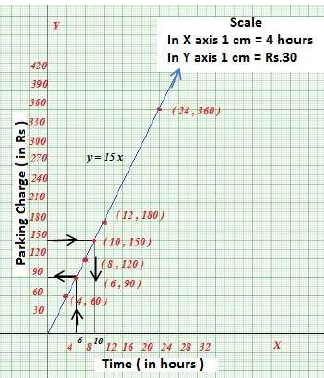
1.Table
| Time ( in hours ) ( x) | 4 | 8 | 12 | 24 |
| Amount in Rs ( y ) | 60 | 120 | 180 | 360 |
2.Variation :
Direct Variation
3. Equation
y = 5x
\(k=\frac{y}{x}=\frac{60}{4}=\frac{120}{8}=\ldots \ldots \ldots=15\)
4.Points :
(4,60),(8,120),(12,180),(24,320)
5.Solution :
(i). If the parking time is 6 hours , then the parking charge = Rs. 90
(ii). If the amount Rs.150 is paid , then the Parking time = 10 hours
2.
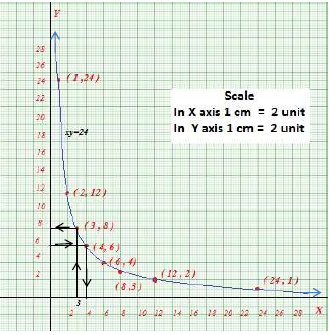
1. Table
| x | 24 | 12 | 8 | 6 | 4 | 3 | 2 | 1 |
| y | 1 | 2 | 3 | 4 | 6 | 8 | 12 | 24 |
2. Variation:
Indirect Variation
3. Equation
xy = k
xy = 24 x 1 = 12 x 2 = 8 x 3 =... = 12
xy = 24
4. Points
(24,1),(12,2),(8,3),(6,4)
(4,6),(3,8),(2,12),(1,24)
5. Solution
From the graph
(i) If x = 3, then, y = 8
(ii) If y = 6 then, x = 4
3.
4.
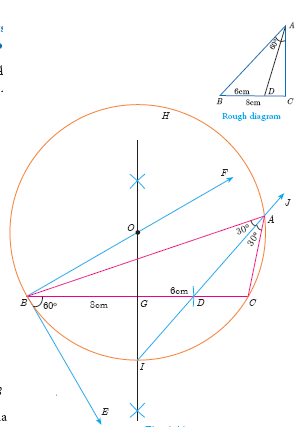
Given a triangle ABC, we are required to construct another triangle whose sides are \(\frac { 6 }{ 5 } \) of the corresponding sides of the ABC
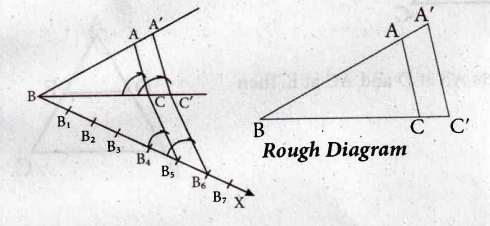
Steps of construction:
1. Constructed a ABC with any measurement
2. Drawn a ray BX making an acute angle with BC on the side opposite to the vertex A.
3. Joined B5 to C and drawn a line through B6 parallel to B5C intersecting the extended line segment BC at C.
4. Drawn a line through C' parallel to CA intersecting the extended BA at A'.
5. Then A'BC' is the required triangle each of whose sides is six fifths of the corresponding sides of ABC.
5.
Mean \(\bar { x } \) = \(\frac { 16+13+17+21+18 }{ 5 } =\frac { 85 }{ 5 } \) = 17
| x | d = x - 17 | d2 |
| 16 | -1 | 1 |
| 13 | -4 | 16 |
| 17 | 0 | 0 |
| 21 | 4 | 16 |
| 18 | 1 | 1 |
| Σd = 0 | Σd2 = 34 |
σ =\(\sqrt { \frac { \Sigma d^{ 2 } }{ n } } =\sqrt { \frac { 34 }{ 5 } } =\sqrt { 638 } \)
σ = 2.61
Co-efficient of variation
CV = \(\frac { \sigma }{ \bar { x } } \) x 100 = \(\frac { 2.61 }{ 17 } \) x 100
= 15.35%
6.
A coin is tossed thrice by the sample space
S = {HHH, HHT, HTH, HTT, THH, THT, TTH, TTT}
n(S) = 8
Let A be the event of getting exactly two heads
A = { HHT, HTH, THH}
n(A) = 3
\(P(A)=\frac{n(A)}{n(S)}=\frac{3}{8}\)
Let B be the event of getting atleast one tail.
B = {HHT, HTH, HTT, THH, THT, TTH, TTT}
n(B) = 7
\(\mathrm{P}(\mathrm{B})=\frac{n(\mathrm{~B})}{n(\mathrm{~S})}=\frac{7}{8}\)
Let C be the event of getting consecutively two heads
C = {HHT, THH, HHH}
n(C) = 3
\(\mathrm{P}(\mathrm{C})=\frac{n(\mathrm{C})}{n(\mathrm{~S})}=\frac{3}{8}\)
A n B = {HHT, HTH, THH}
n(A n B) = 3
\(\mathrm{P}(A \cap B) =\frac{n(\mathrm{~A} \cap \mathrm{B})}{n(\mathrm{~S})}=\frac{3}{8}
\)
\(B \cap C =\{\mathrm{HHT}, \mathrm{THH}\}
\)
\(n(\mathrm{~A} \cap \mathrm{C}) =2
\)
\(P(\mathrm{~B} \cap \mathrm{C}) =\frac{n(\mathrm{~B} \cap \mathrm{C})}{n(\mathrm{~S})}=\frac{2}{8}
\)
\(A \cap C =\{\mathrm{HHT}, \mathrm{THH}\}\)
\(n(\mathrm{~A} \cap \mathrm{C}) =2
\)
\(P(B \cap C) =\frac{n(\mathrm{~B} \cap \mathrm{C})}{n(\mathrm{~S})}=\frac{2}{8}
\)
\(A \cap C =\{\mathrm{HHT}, \mathrm{THH}\}
\)
\(n(\mathrm{~A} \cap \mathrm{C}) =2
\)
\(P(\mathrm{~A} \cap \mathrm{C}) =\frac{n(\mathrm{~A} \cap \mathrm{C})}{n(\mathrm{~S})}=\frac{2}{8}
\)
\(A \cap B \cap C =\{\mathrm{HHT}, \mathrm{THH}\}
\)
\(n(\mathrm{~A} \cap \mathrm{B} \cap \mathrm{C})=2
\)
\(P(\mathrm{~A} \cap \mathrm{B} \cap \mathrm{C})=\frac{n(\mathrm{~A} \cap \mathrm{B} \cap \mathrm{C})}{n(\mathrm{~S})}=\frac{2}{8}
\)
\(P(\mathrm{~A} \cup \mathrm{B} \cup \mathrm{C})=P(\mathrm{~A})+\mathrm{P}(\mathrm{B})+\mathrm{P}(\mathrm{C})
\) \(\ -P(A \cap B)-P(B \cap C)
\)
\(P(A \cup B \cup C)= \frac{3}{8}+\frac{7}{8}+\frac{3}{8}-\frac{3}{8}-\frac{2}{8}-\frac{2}{8}+\frac{2}{8}
\)
\(= \frac{3+7+3-3-2-2+2}{8}
\)
\(= \frac{8}{8}=1
\)
The required probability is 1.
7.
When two dice are rolled together, there will be 6 x 6 = 36 outcomes. Let S be the sample space. Then n(S) = 36.
Let A be the event of getting a doublet and B be the event of getting face sum 4.
Then A = {(1,1),(2,2),(3,3),(4,4),(5,5),(6,6)}
B = {(1,3),(2,2),(3,1)
Therefore, A∩B = {(2,2)}
Then, n(A) = 6, n(B) = 3, n(A∩B) = 1
P(A) = \(\frac { n(A) }{ n(S) } =\frac { 6 }{ 36 } \)
P(B) = \(\frac { n(B) }{ n(S) } =\frac { 3 }{ 36 } \)
P(A∩B) = \(\frac { n(A\cap B) }{ n(S) } =\frac { 1 }{ 36 } \)
Therefore, P (getting a doublet or a total of 4) = P(AUB)
P(AUB) = P(A) + P(B) - P(A∩B)
=\(\frac { 6 }{ 36 } +\frac { 3 }{ 36 } -\frac { 1 }{ 36 } =\frac { 8 }{ 36 } =\frac { 2 }{ 9 } \)
Hence, the required probability is \(\frac { 2 }{ 9 } \).
8.
When two unbiased dice are rolled, the Sample Space
s = {(1, 1) (1, 2) (r,3) (1,4) (1,5) (1,6)
(2, 1) (2,2) (2, 3) (2, 4) (2,5) (6, 6)
(3, 1) (3,2) (3, 3) (3, 4) (3, 5) (3, 6)
(4, 1) (4,2) (4,3) (4,4) (4, 5) (4,6)
(5, 1) (5,2) (5,3) (5,4) (5,5) (6,6)
(6, 1) (6,2) (6, 3) (6,4) (6, 5) (6, 6)}
n(S) = 36
(i) Let A be the event of getting a doublet
A = {( 1, 1) (2,2) (3,3) (4, 4) (5, 5) (6, 6)}
n(A) = 6
\(\mathrm{P}(\mathrm{A})=\frac{n(A)}{n(S)}=\frac{6}{36}=\frac{1}{6}\)
(ii) Let B be the event of getting the product as a prime number.
B = {(1,2) (1,3) (1, 5) (2,1) (3, 1) (5, 1)}
n(B) = 6
\(P(B)=\frac{6}{36}=\frac{1}{6}\)
(iii) Let C be the event of getting the sum as a prime number.
c = {(1, 1) ( 1, 2) (1, 4) ( 1, 6) (2, 1) (2, 3) (2, 5) (3,2) (3, 4) (4, 1) (4,3) (5,2) (5,6) (6, 1) (6,5)}
n(C) = 15
\(\mathrm{P}(\mathrm{C})=\frac{n(C)}{n(S)}=\frac{15}{36}=\frac{5}{12}\)
(iv) Let D be the event of getting the sum as 1. Since it is an impossible event.
n(D) = 0 and P(D) = g
9.
The mean of marks is 35.9 which is not an integer. Hence we take assumed mean, A=35,n=10.
| xi | di = xi - A di = x - 35 |
di2 |
| 25 | -10 | 100 |
| 29 | -6 | 36 |
| 30 | -5 | 25 |
| 33 | -2 | 4 |
| 35 | 0 | 0 |
| 37 | 2 | 4 |
| 38 | 3 | 9 |
| 40 | 5 | 25 |
| 44 | 9 | 81 |
| 48 | 13 | 169 |
| \({ \Sigma d }_{ i }\) = 9 | \(\frac { { \Sigma d }_{ i }^{ 2 } }{ n } \) = 453 |
Standard deviation
σ =\(\sqrt { \frac { { \Sigma d }_{ i }^{ 2 } }{ n } -\left( \frac { { \Sigma d }_{ i } }{ n } \right) ^{ 2 } } \)
= \(\sqrt { \frac { 453 }{ 10 } -\left( \frac { 9 }{ 10 } \right) ^{ 2 } } \)
= \(\sqrt { 45.3-0.81 } \)
= \(\sqrt { 44.49 } \)
σ ≃ 6.67
(ii) Step deviation method
Let x1, x2, xn,... be the given data. Let A be the assumed mean.
Let c be the common divisor of xi-A
Let di = \(\frac { x_{ i }-A }{ c } \)
Then xi = dic + A ....(1)
Σxi = Σ(dic + A) = cΣdi + A x n
\(\frac { \Sigma { x }_{ i } }{ n } =c\frac { \Sigma d_{ i } }{ n } +A\)
\(\bar { x } \) = c \(\bar { d } \)+A ..(2)
\({ x }_{ i }-\bar { x } =c{ d }_{ i }+A-c\bar { d } -A=c(\bar { d_{ i } } -\bar { d } )\)(using (1) and (2))
σ = \(\sqrt { \frac { \Sigma ({ x }_{ i }-\bar { x } )^{ 2 } }{ n } } =\sqrt { \frac { \Sigma (c({ d }_{ i }-\bar { d } )^{ 2 } }{ n } } =\sqrt { \frac { { c }^{ 2 }\Sigma ({ d }_{ i }-\bar { d } )^{ 2 } }{ n } } \)
σ = \(c\times \sqrt { \frac { { \Sigma d }_{ i }^{ 2 } }{ n } -\left( \frac { { \Sigma d }_{ i } }{ n } \right) ^{ 2 } } \\ \)
10.
P (will rain) + P (will not rain) = 1
P (will not rain) = 1 - P (will rain)
= 1 - 0.85 = 0.15
Probability that will not rain tomorrow =.0.15.
11.
\(
\mathrm{P}(A \cup B) =\mathrm{P}(\mathrm{A})+\mathrm{P}(\mathrm{B})-\mathrm{P}(A \cap B)
\)
\(\frac{1}{3} =\frac{2}{3}+\frac{2}{5}-\mathrm{P}(A \cap B)
\)
\(\mathrm{P}(A \cap B) =\frac{2}{3}+\frac{2}{5}-\frac{1}{3}
\)
\(\mathrm{P}(A \cap B) =\frac{10+6-5}{15}=\frac{16-5}{15}=\frac{11}{15}
\)
12.
When a coin is tossed thrice, the outcome will be
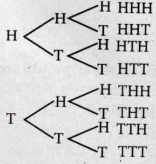
The sample space s = {(HHH), (THH), (HTH), (HHT), (HTT), (THT), (TTH), (TTT)}
n(S) = 3
Let A be the event of getting two consecutive tails
4 = {HTT, TTH, TTT}
n(A) = 3
\(\Rightarrow P=\frac { n\left\{ F \right\} }{ n\{ O\} } =\frac { 3 }{ 8 } \)
Probability of getting two consecutive tails = \(\frac{3}{8}\)
13.
When we toss three coins the outcome will be
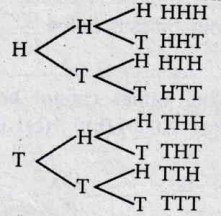
The sample space = { HHH, HHT, HTH, HTT, THH, THT, TTH, TTT}
Total number of outcomes = 8
14.
Standard deviation \(\sigma=6.5\)
Mean \(\bar{x}=12.5\)
Coefficient of variation C.V \(=\frac{\sigma}{x} \times 100 \%
\)
\(=\frac{6.5}{12.5} \times 100 \%
\)
\(=\frac{65}{125} \times 100 \%
\)
\(=\frac{13}{25} \times 100 \%
\)
= 52 %
Co-efficient of variation is 52%
15.
Standard deviation of first n natural numbers
\(=\sqrt{\frac{n^{2}-1}{12}}\)
SD of first 21 natural numbers
\(
=\sqrt{\frac{21^{2}-1}{12}}
\)
\(=\sqrt{\frac{441-1}{12}}=\sqrt{\frac{440}{12}}
\)
\(=\sqrt{36.6666}=6.05\)
Standard deviation of first 21 natural numbers = 6.05
16.
(b)
100
17.
(c)
18.
(d)
19.
(c)
\(\frac{23}{26}\)
20.
(b)
\(\frac{7}{10}\)
21.
(a)
3.5
22.
(c)
33.25
23.
(c)
Arithmetic mean

10th Standard Syllabus & Materials
10th Standard
Tamilnadu 10th Standard Social Science GEO - Climate and Natural Vegetation of India Important Questions And Answers Study Material - QB365 Set C
NEW10th Standard
Tamilnadu 10th Standard Social Science GEO - Climate and Natural Vegetation of India Important Questions And Answers Study Material - QB365 Set B
NEW10th Standard
Tamilnadu 10th Standard Social Science GEO - Climate and Natural Vegetation of India Important Questions And Answers Study Material - QB365 Set A
NEW10th Standard
Tamilnadu 10th Standard Social Science GEO - India - Location, Relief and Drainage Important Questions And Answers Study Material - QB365 Set B



Tamilnadu Stateboard 10th Standard Subjects
Tamilnadu Stateboard Standards