
10th Standard Syllabus & Materials
10th Standard
Tamilnadu 10th Standard Social Science GEO - India - Population, Transport, Communication and Trade Important Questions And Answers Study Material - QB365 Set C
NEW10th Standard
Tamilnadu 10th Standard Social Science GEO - India - Population, Transport, Communication and Trade Important Questions And Answers Study Material - QB365 Set B
NEW10th Standard
Tamilnadu 10th Standard Social Science GEO - India - Population, Transport, Communication and Trade Important Questions And Answers Study Material - QB365 Set A
NEW10th Standard
Tamilnadu 10th Standard Social Science GEO - India - Resources and Industries Important Questions And Answers Study Material - QB365 Set C
NEW10th Standard
Tamilnadu 10th Standard Social Science GEO - India - Resources and Industries Important Questions And Answers Study Material - QB365 Set B
NEW10th Standard
Tamilnadu 10th Standard Social Science GEO - India - Resources and Industries Important Questions And Answers Study Material - QB365 Set A

Published on: 19/10/2025
Download Tamil Nadu 10th Standard Maths question papers, model tests, one-mark questions, important questions, and public exam papers in PDF format. Free study materials and answer keys for TN State Board students.
Questions + Answers key
Take MCQ Maths Test
1.
What is the probability that a leap year selected at random will contain 53 saturdays. (Hint: 366 = 52 x 7 + 2)
2.
The standard deviation and mean of a data are 6.5 and 12.5 respectively. Find the coefficient of variation.
3.
Find the angle of elevation of the top of a tower from a point on the ground, which is 30 m away from the foot of a tower of height \(10\sqrt { 3 } m\)
4.
If the range and the smallest value of a set of data are 36.8 and 13.4 respectively, then find the largest value.
5.
Find the square root of the following expressions
256(x - a)8 (x - b)4 (x - c)16 (x - d)20
6.
prove that \(\frac { sec\theta }{ sin\theta } -\frac { sin\theta }{ cos\theta } =cot\theta \)
7.
Find the values of m and n if the following polynomials are perfect squares
36x⁴ - 60x³ + 61x² - mx + n
8.
From a point on the ground 40 m away from the foot of a tower, the angle of elevation of the top of the tower is 30o. The angle of elevation of the top of the water tank on the tower is 45o. Find
(i) The height of the tower and
(ii) The depth of the tank.
9.
Two unbiased dice are rolled once. Find the probability of getting
(i) a doublet (equal numbers on both dice)
(ii) the product as a prime number
(iii) the sum as a prime number
(iv) the sum as 1
10.
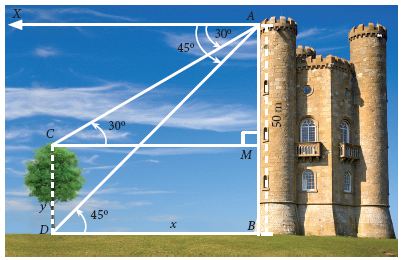
From the top of a tower 50 m high, the angles of depression of the top and bottom of a tree are observed to be 30° and 45° respectively. Find the height of the tree.(\(\sqrt { 3 } \) = 1.732)
11.
The marks scored by the students in a slip test are given below.
| x | 4 | 6 | 8 | 10 | 12 |
| f | 7 | 3 | 5 | 9 | 5 |
Find the standard deviation of their marks.
12.
Find the mean and variance of the first n natural numbers.
13.
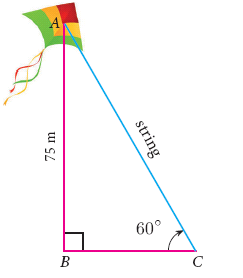
A kite is flying at a height of 75m above the ground, the string attached to the kite is temporarily tied to a point on the ground. The inclination of the string with the ground is \(60°\).find the length of the string ,assuming that there is no slack in the string.
14.
If \(\frac { cos\alpha }{ cos\beta } \) = m and \(\frac { cos\alpha }{ sin\beta } \) = n, then prove that (m2 + n2) cos2\(\beta\) = n2
15.
If (sin α + cosec α)2 + (cos α + sec α)2 = k + tan2α + cot2α, then the value of k is equal to
9
7
5
3
16.
The probability a red marble selected at random from a jar containing p red, q blue and r green marbles is
\(\frac { q }{ p+q+r } \)
\(\frac { p }{ p+q+r } \)
\(\frac { p+q }{ p+q+r } \)
\(\frac { p+r }{ p+q+r } \)
17.
If the standard deviation of x, y, z is p then the standard deviation of 3x + 5, 3y + 5, 3z + 5 is
3p + 5
3p
p + 5
9p + 15
18.
The range of the data 8, 8, 8, 8, 8. . . 8 is
0
1
8
3
19.
20.
If x = a tan\(\theta \) and y = b sec\(\theta \) then
\(\frac { { y }^{ 2 } }{ { b }^{ 2 } } -\frac { { x }^{ 2 } }{ { a }^{ 2 } } =1\)
\(\frac { x^{ 2 } }{ a^{ 2 } } -\frac { y^{ 2 } }{ b^{ 2 } } =1\)
\(\frac { x^{ 2 } }{ a^{ 2 } } +\frac { y^{ 2 } }{ b^{ 2 } } =1\)
\(\frac { x^{ 2 } }{ a^{ 2 } } -\frac { y^{ 2 } }{ b^{ 2 } } =0\)
21.
If sin \(\theta \) + cos\(\theta \) = a and sec \(\theta \) + cosec \(\theta \) = b, then the value of b(a2 - 1) is equal to
2a
3a
0
2ab
22.
Draw the graph of y = x2 - 5x - 6 and hence solve x2 - 5x - 14 = 0
23.
Draw the graph of y = x2 - 4 and hence solve x2 - x - 12 = 0
1.
leap year has 366 days. So it has 52 full weeks and 2 days. 52 Saturdays must be in 52 full weeks.
The possible chances for the remaining two days will be the sample space.
S = {(Sun-Mon, Mon-Tue, Tue-Wed, Wed-Thu, Thu-Fri, Fri-Sat, Sat-Sun)}
n(S) = 7
Let A be the event of getting 53rd Saturday.
Then A = {Fri-Sat, Sat-Sun}; n(A) = 2
Probability of getting 53 Saturdays in a leap year is P(A0 = \(\frac { n(A) }{ n(S) } =\frac { 2 }{ 7 } \).
2.
Standard deviation \(\sigma=6.5\)
Mean \(\bar{x}=12.5\)
Coefficient of variation C.V \(=\frac{\sigma}{x} \times 100 \%
\)
\(=\frac{6.5}{12.5} \times 100 \%
\)
\(=\frac{65}{125} \times 100 \%
\)
\(=\frac{13}{25} \times 100 \%
\)
= 52 %
Co-efficient of variation is 52%
3.
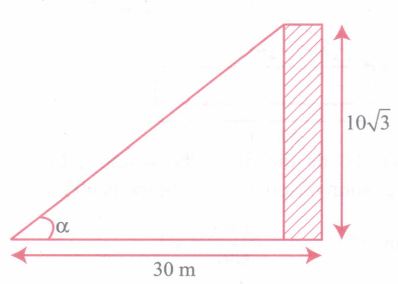
From the right \(\triangle\)ABC
\( \tan \theta =\frac{\text { Opposite side }}{\text { Adjacent side }}=\frac{A C}{B C} \)
\(=\frac{10 \sqrt{3} m}{30 m}=\frac{\sqrt{3}}{3} \)
\(=\frac{\sqrt{3}}{\sqrt{3} \sqrt{3}}=\frac{1}{\sqrt{3}} \)
\(\tan \theta =\frac{1}{\sqrt{3}} \)
\(\theta =\tan ^{-1}\left(\frac{1}{\sqrt{3}}\right)\)
0 = 30o
Angle of elevation is 30o
4.
If the range = 36.8 and
the smallest value =13.4
Range R = L - S
36.8 = L-13.4
= 36.8 + 13.4 = 50.2
The largest value L = 50.2
5.
\(\sqrt { 256{ \left( x-a \right) }^{ 8 }{ \left( x-b \right) }^{ 4 }{ \left( x-c \right) }^{ 16 }{ \left( x-d \right) }^{ 20 } } \) = 16|(x - a)4(x - b)2 (x - c)8 (x - d)10|
6.
\(\frac { sec\theta }{ sin\theta } -\frac { sin\theta }{ cos\theta } = \frac { \frac { 1 }{ cos\theta } }{ sin\theta } -\frac { sin\theta }{ cos\theta } =\frac { 1 }{ sin\theta cos\theta } -\frac { sin\theta }{ cos\theta } \)
\(=\frac { 1-si{ n }^{ 2 }\theta }{ sin\theta cos\theta } =cot\theta \)
7.
36x⁴ - 60x³ + 61x² - mx + n
= (6x²)² - 2.6x².5x + (5x)² + 36x² - mx + n
= (6x² - 5x)² + 36x² - mx + n
= (6x² - 5x)² + 2.3.(6x² - 5x) + 30x - mx + n
= (6x² - 5x)² + 2.3.(6x² - 5x) + 3² + (30 - m)x
= (6x² - 5x + 3)² + (30 - m)x + (n - 9)
Therefore the last obtained polynomial will be a perfect square if
30 - m = 0 and n - 9 = 0
Now
30 - m = 0 gives m = 30
n - 9 = 0 gives n = 9
8.
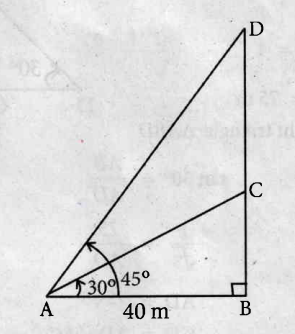
Let BC is the tower.
CD is the water tank.
In right triangle \(\Delta\)ABD
\(\tan 45^{\circ} =\frac{B D}{A B} \)
\(1 =\frac{B C+C D}{40} \)
\(B C+C D =40 \mathrm{~m} \)
\(\text { In the right triangle } \triangle A B C\)
\(\tan 30^{\circ} =\frac{B C}{A B} \)
\(\frac{1}{\sqrt{3}} =\frac{B C}{40} \)
\(\mathrm{BC}=\frac{40}{\sqrt{3}} m \)
\(\mathrm{BC}=23.1 \mathrm{~m} \)
\(\text { Substituting } \mathrm{BC}=23.1 \mathrm{~m} \text { in (1) }\)
\(23.1+C D =40 \)
\(C D =40-23.1 \)
\(=16.9 \mathrm{~m} \)
Height of the tower = 23.1 m.
Depth of the tank = 16.9 m.
9.
When two unbiased dice are rolled, the Sample Space
s = {(1, 1) (1, 2) (r,3) (1,4) (1,5) (1,6)
(2, 1) (2,2) (2, 3) (2, 4) (2,5) (6, 6)
(3, 1) (3,2) (3, 3) (3, 4) (3, 5) (3, 6)
(4, 1) (4,2) (4,3) (4,4) (4, 5) (4,6)
(5, 1) (5,2) (5,3) (5,4) (5,5) (6,6)
(6, 1) (6,2) (6, 3) (6,4) (6, 5) (6, 6)}
n(S) = 36
(i) Let A be the event of getting a doublet
A = {( 1, 1) (2,2) (3,3) (4, 4) (5, 5) (6, 6)}
n(A) = 6
\(\mathrm{P}(\mathrm{A})=\frac{n(A)}{n(S)}=\frac{6}{36}=\frac{1}{6}\)
(ii) Let B be the event of getting the product as a prime number.
B = {(1,2) (1,3) (1, 5) (2,1) (3, 1) (5, 1)}
n(B) = 6
\(P(B)=\frac{6}{36}=\frac{1}{6}\)
(iii) Let C be the event of getting the sum as a prime number.
c = {(1, 1) ( 1, 2) (1, 4) ( 1, 6) (2, 1) (2, 3) (2, 5) (3,2) (3, 4) (4, 1) (4,3) (5,2) (5,6) (6, 1) (6,5)}
n(C) = 15
\(\mathrm{P}(\mathrm{C})=\frac{n(C)}{n(S)}=\frac{15}{36}=\frac{5}{12}\)
(iv) Let D be the event of getting the sum as 1. Since it is an impossible event.
n(D) = 0 and P(D) = g
10.
The height of the tower AB = 50 m
Let the height of the tree CD = y and BD = x
From the diagram,\(\angle \)XAC = 30° = \(\angle \)ACM and\(\angle \) = XAD = 45° =\(\angle \) ADB
In right triangle ABD,
tan45° = \(\frac { AB }{ BD } \)
1 = \(\frac { 50 }{ x } \) gives x = 50 m
In right triangle AMC,
tan30° = \(\frac { AM }{ CM } \)
\(\frac { 1 }{ \sqrt { 3 } } =\frac { AM }{ 50 } \)[since DB = CM]
AM = \(\frac { 50 }{ \sqrt { 3 } } =\frac { 50\sqrt { 3 } }{ 3 } =\frac { 50\times 1.732 }{ 3 } \) = 28.87 m.
Therefore, height of the tree = CD = MB = AB − AM = 50 – 28.87 = 21.13 m
11.
Let the assumed mean, A = 8
| xi | fi | di = xi - A | fidi | fidi2 |
| 4 | 7 | -4 | -28 | 112 |
| 6 | 3 | -2 | -6 | 12 |
| 8 | 5 | 0 | 0 | 0 |
| 10 | 9 | 2 | 18 | 36 |
| 12 | 5 | 4 | 20 | 80 |
| N = 29 | Σfidi = 4 | Σfidi2 = 240 |
Standard deviation
σ = \(\sqrt { \frac { \Sigma { f }_{ i }{ d }_{ i }^{ 2 } }{ N } -\left( \frac { \Sigma { f }_{ i }{ d }_{ i } }{ N } \right) ^{ 2 } } \)
= \(\sqrt { \frac { 240 }{ 29 } -\left( \frac { 4 }{ 29 } \right) ^{ 2 } } =\sqrt { \frac { 240\times 29-16 }{ 29\times 29 } } \)
σ = \(\sqrt { \frac { 6944 }{ 29\times 29 } } \); σ ≃ 2.87
Calculation of Standard deviation for continuous frequency distribution
(i) Mean method:
Standard deviation σ = \(\sqrt { \frac { \Sigma { f }_{ i }({ x }_{ i }-\bar { x } )^{ 2 } }{ N } } \)
Where, xi = Middle value of the i th class
fi = Frequency of the i th class
(ii) Shortcut method (or) Step deviation method:
To make the calculation simple, we provide the following formula. Let A be the assumed mean, xi be the middle value of the ith class and c is the width of the class interval.
Let di = \(\frac { { x }_{ i }-A }{ c } \)
σ = \(\sqrt { \frac { \Sigma { f }_{ i }{ d }_{ i }^{ 2 } }{ N } -\left( \frac { \Sigma { f }_{ i }{ d }_{ i } }{ N } \right) ^{ 2 } } \).
12.
Mean \(\bar { x } \) = \(\frac { Sum\ of\ all\ observations }{ Number\ of\ observation } \)
= \(\frac { \Sigma x_{ i } }{ n } =\frac { 1+2+3+...+n }{ n } =\frac { n(n+1) }{ 2\times n } \)
Mean \(\bar { x } \) = \(\frac { n+1 }{ 2 } \)
Variance σ2 = \(\frac { \Sigma x_{ i }^{ 2 } }{ n } -\left( \frac { \Sigma x_{ i } }{ n } \right) ^{ 2 }\left[ \begin{matrix} \Sigma x_{ i }^{ 2 }={ 1 }^{ 2 }+{ 2 }^{ 2 }+{ 3 }^{ 2 }+...+{ n }^{ 2 } \\ (\Sigma x_{ i })^{ 2 }=(1+2+3+...+n)2 \end{matrix} \right] \)
= \(\frac { n(n+1)(2n+1) }{ 6\times n } -\left[ \frac { n(n+1) }{ 2\times n } \right] ^{ 2 }\)
= \(\frac { 2n^{ 2 }+3n+1 }{ 6 } -\frac { { n }^{ 2 }+2n+1 }{ 4 } \)
Variance σ2 = \(\frac { 4n^{ 2 }+6n+2-3n^{ 2 }-6n-3 }{ 12 } =\frac { { n }^{ 2 }-1 }{ 12 } \).
13.
Let AB be the height of the kite above the ground. Then, AB = 75.
Let AC be the length of the string.
In right triangle ABC,\(\angle \)ACB = \(60°\)
\(sin\theta =\frac { AB }{ AC } \)
\(sin60°=\frac { 75 }{ AC } \)
gives \(\frac { \sqrt { 3 } }{ 2 } =\frac { 75 }{ AC } \) so, AC = \(\frac { 150 }{ \sqrt { 3 } } =50\sqrt { 3 } \)
Hence, the length of the string is 50\(\sqrt { 3 } m\)
14.
Given
\(
\frac{\cos \alpha}{\cos \beta}=m
\)
\(\frac{\cos \alpha}{\sin \beta} =n
\)
\(\text { LHS } =\left(m^{2}+n^{2}\right) \cos ^{2} \beta
\)
\(=\left(\frac{\cos ^{2} \alpha}{\cos ^{2} \beta}+\frac{\cos ^{2} \alpha}{\sin ^{2} \beta}\right) \cos ^{2} \beta
\)
\(=\frac{\left(\cos ^{2} \alpha \sin ^{2} \beta+\cos ^{2} \alpha \cos ^{2} \beta\right)}{\cos ^{2} \beta \sin ^{2} \beta} \cos ^{2} \beta
\)
\(=\frac{\cos ^{2} \alpha\left(\sin ^{2} \beta+\cos ^{2} \beta\right)}{\sin ^{2} \beta}
\)
\(=\frac{\cos ^{2} \alpha}{\sin ^{2} \beta}(1)
\)
\(=\left(\frac{\cos \alpha}{\sin \beta}\right)^{2}
\)
= n2 = RHS
15.
(b)
7
16.
(b)
\(\frac { p }{ p+q+r } \)
17.
(b)
3p
18.
(a)
0
19.
(d)
20.
(a)
\(\frac { { y }^{ 2 } }{ { b }^{ 2 } } -\frac { { x }^{ 2 } }{ { a }^{ 2 } } =1\)
21.
(a)
2a
22.
| x | -5 | -4 | -3 | -2 | -1 | 0 | 1 | 2 | 3 | 4 |
| x2 | 25 | 16 | 9 | 4 | 1 | 0 | 1 | 4 | 9 | 16 |
| -5x | 25 | 20 | 15 | 10 | 5 | 0 | -5 | -10 | -15 | -20 |
| -6 | -6 | -6 | -6 | -6 | -6 | -6 | -6 | -6 | -6 | -6 |
| y=x2+5x-6 | 44 | 30 | 18 | 8 | 0 | -6 | -10 | -12 | -12 | -10 |
Draw the parabola using the points (-5, 44), (-4, 30), (-3, 18), (-2, 8), (-1, 10), (0, -6), (1, -10), (2, -12), (3, -12), (4, -10)
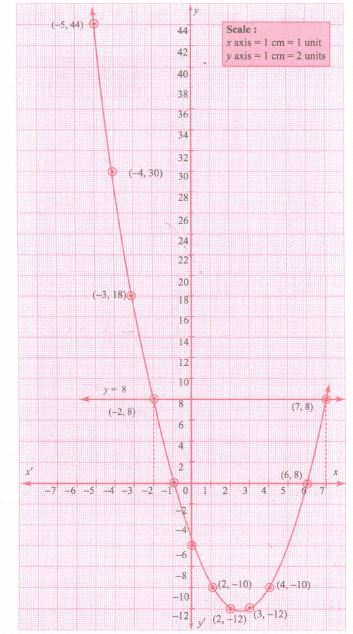
To solve the equation X2 - 5x - 14 = 0, subtract X2 - 5x - 14 = 0 from y = X2 - 5x - 6.
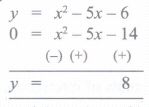 is a straight line parallel to x axis.
The co-ordinates of the points of intersection of the line and the parabola forms the solution set for the
equation X2 - 5x - 14 = 0.
∴ Solution {-2, 7}
23.
| x | -4 | -3 | -2 | -1 | 0 | 1 | 2 | 3 | 4 |
| x2 | 16 | 9 | 4 | 1 | 0 | 1 | 4 | 9 | 16 |
| -4 | -4 | -4 | -4 | -4 | -4 | -4 | -4 | -4 | -4 |
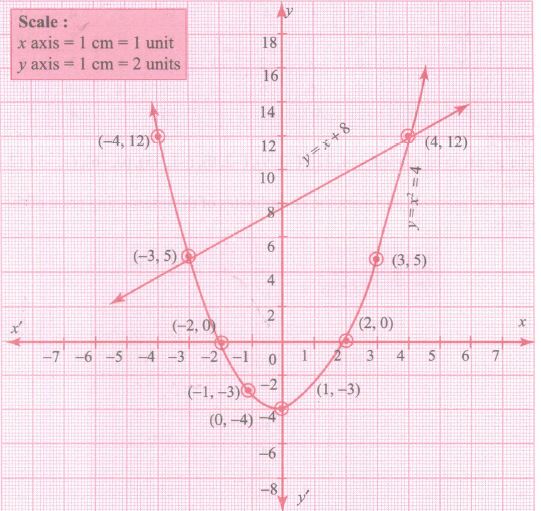
| x2-4 | 12 | 5 | 0 | -3 | -4 | -3 | 0 | 5 | 12 |
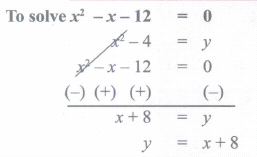
| x | -4 | -3 | -2 | -1 | 0 | 1 | 2 | 3 | 4 |
| 8 | 8 | 8 | 8 | 8 | 8 | 8 | 8 | 8 | 8 |
| x-8 | 4 | 5 | 6 | 7 | 8 | 9 | 10 | 11 | 12 |
Point of intersection (-3,5), (4, 12) solution of x2 -x - 12 = 0 is -3, 4

10th Standard Syllabus & Materials
10th Standard
Tamilnadu 10th Standard Social Science GEO - Climate and Natural Vegetation of India Important Questions And Answers Study Material - QB365 Set C
NEW10th Standard
Tamilnadu 10th Standard Social Science GEO - Climate and Natural Vegetation of India Important Questions And Answers Study Material - QB365 Set B
NEW10th Standard
Tamilnadu 10th Standard Social Science GEO - Climate and Natural Vegetation of India Important Questions And Answers Study Material - QB365 Set A
NEW10th Standard
Tamilnadu 10th Standard Social Science GEO - India - Location, Relief and Drainage Important Questions And Answers Study Material - QB365 Set B



Tamilnadu Stateboard 10th Standard Subjects
Tamilnadu Stateboard Standards