
10th Standard CBSE Syllabus & Materials
10th Standard CBSE
cbse 10th Standard Social Science HIS - Print Culture and Modern World Important Questions And Answers Study Material - QB365 Set C
NEW10th Standard CBSE
cbse 10th Standard Social Science HIS - Print Culture and Modern World Important Questions And Answers Study Material - QB365 Set B
NEW10th Standard CBSE
cbse 10th Standard Social Science HIS - Print Culture and Modern World Important Questions And Answers Study Material - QB365 Set A
NEW10th Standard CBSE
cbse 10th Standard Social Science HIS - The Age of Industrialization Important Questions And Answers Study Material - QB365 Set C
NEW10th Standard CBSE
cbse 10th Standard Social Science HIS - The Age of Industrialization Important Questions And Answers Study Material - QB365 Set B
NEW10th Standard CBSE
cbse 10th Standard Social Science HIS - The Age of Industrialization Important Questions And Answers Study Material - QB365 Set A

Published on: 21/10/2025
Download CBSE Class 10th Standard CBSE Maths question papers, sample papers, important questions, and previous year solved papers in PDF format. Get free study materials, NCERT solutions, and exam preparation resources for Class 10th Standard CBSE Maths
Questions + Answers key
Take MCQ Maths Test
5 Marks
1.
Find the distance between the points (0,0) and (36,15)
2.
Find the LCM and HCF of the following pairs of integers and verify that LCM x HCF = Product of the two numbers.
26 and 91
3.
Find the zeroes of the polynomial x2-3 and verify the relationship between the zeroes and the coefficients.
4.
Draw the graphs of the equations x - y +1= 0 and 3x + 2y - 12 = 0. Determine the coordinates of the vertices of the triangle formed by these lines and the X-axis and shade the triangular region.
5.
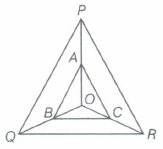
In the given figure, A, B and C are points on OP, OQ and OR respectively, such that \(AB\parallel PQ\) and \(AC\parallel PR\). Show that \(BC\parallel QR\).
6.
State whether the following statements are true or false. Justify your answer.
sin (A + B) = sin A + sin B.
7.
Consider the following distribution of daily wages of 50 workers of a factory:
| Daily wages (in RS) | Number of workers |
|---|---|
| 100-120 | 12 |
| 120-140 | 14 |
| 140-160 | 8 |
| 160-180 | 6 |
| 180-200 | 10 |
Find the mean daily wages of the workers of the factory by using an appropriate method.
3 Marks
8.
Show that the points (7,10), (-2,5) and (3,-4) are the vertices of an isosceles right triangle.
9.
The coordinates of A and B are (-3,3) and (12,-7) respectively. P is a point which divides AB in the ratio AP:AB=2:5 find the coordinates of P.
10.
Two tankers contain 850 L and 680 L of petrol respectively. Find the maximum capacity of a container which can measure the petrol of either tanker, in exact number of times.
11.
Explain, why (3 x 5 x 7) + 7 is a composite number?
12.
Check whether 6n can end with the digit 0 for any natural number n.
13.
If (x)=ax+b, then find the zero of f (x).
14.
Solve the following system of linear equations
ax+by-a+b=0
and bx-ay-a-b=0.
15.
A street light bulb is fixed on a pole 6 m above the level of the street. If a woman of height 1.5 m casts a shadow of 3 m, find how far is she away from the base of the pole?
16.
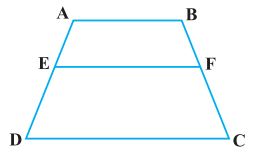
ABCD is a trapezium with AB || DC. E and F are points on non-parallel sides AD and BC respectively such that EF is parallel to AB. Show that \(\frac{AE}{ED}=\frac{BF}{FC}\).
17.
Prove that \(\frac { \sin { \theta } -\cos { \theta } +1 }{ \sin { \theta } +\cos { \theta } -1 } =\frac { 1 }{ \sec { \theta } -\tan { \theta } } \) using the identity \(\sec ^{ 2 }{ \theta } =1+\tan ^{ 2 }{ \theta } .\)
18.
Solve the following pair of linear equations by the substitution method
3x - y = 3
9x - 3y = 9
19.
Find the HCF and LCM of 6, 72 and 120 using the prime factorisation method.
20.
Prove that the following are irrational :
7\(\sqrt 5\)
21.
Find the zeroes of the following quadratic polynomials and verify the relationship between the zeroe and the coefficients.
t2 – 15
22.
Which of the following pairs of linear equations are consistent/inconsistent? If consistent, obtain the solution graphically:
x – y = 8, 3x – 3y = 16
5 Marks
1.
Let points be A(0,0) and B(36,15)
The distance between two points is
\(AB=\sqrt{(x_2-x_1)^2+(y_2-y_1)^2}\)
=\(\sqrt{(36-0)^2+(15-0)^2}\)
=\(\sqrt{1296+225}=\sqrt{1521}=39\)
2.
We have, 26 and 91
| 2 | 26 |
| 13 | 13 |
| 1 |
| 7 | 91 |
| 13 | 13 |
| 1 |
\(\therefore \) Prime factors of 26 = 2 x 13
and prime factors of 91 = 7 x 13
Now, LCM of 26 and 91 = 2 x 7 x 13 = 182
and HCF of 26 and 91 = 13
For verification
LCM x HCF = 182 x 13 = 2366
and product of two numbers = 26 x 91 = 2366
Thus, LCM x HCF = Product of two numbers.
3.
Recall the identity a2 - b2 = (a - b)(a + b). Using it, we can write:
x2 - 3 = (x - \(\sqrt{3}\))(x + \(\sqrt{3}\))
So, the value of x2 - 3 is zero when x = \(\sqrt{3}\) or x = -\(\sqrt{3}\)
Therefore, the zeroes of x2 - 3 are \(\sqrt{3}\) and -\(\sqrt{3}\)
Now,
sum of zeroes = \(\sqrt{3}\) - \(\sqrt{3}\) = 0 = \(\frac{-(Coefficient \quad of \quad x)}{Coefficient \quad of \quad x^{2}}\)
product of zeroes = (\(\sqrt{3}\))(-\(\sqrt{3}\)) = -3 = \(\frac{-3}{1}=\frac{Constant \quad term}{Coefficient \quad of \quad x^{2}}\)
4.
Given, pair of linear equations is x - y + 1 = 0 and 3x + 2y -12 = O. Table for x r- y+l = 0 or y = x + 1 is
| x | 0 | 4 | -1 |
| y=x+1 | 1 | 5 | 0 |
| Points | A(0,1) | B(4,5) | C(-1,0) |
Table for 3x+2y-12=0 or \(y=\frac {12-3x}{2}\) is
| x | 0 | 2 | 4 |
| \(y=\frac {12-3x}{2}\) | 6 | 3 | 0 |
| Points | D(0,6) | E(2,3) | F(4,0) |
Now, plot the points A (0,1), B(4, 5), C (-1,0) and join them to get a line CB. Similarly, plot the points D(0, 6), E(2,3), F (4,0) and join them to get a line DF.
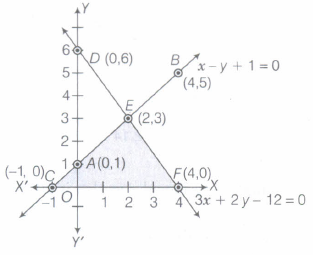
Clearly, the two lines intersect each other at the point E (2, 3). Hence, x = 2 and y = 3 is the solution of the given pair of equations. The line DE cuts X-axis at the point F (4, 0) and the line AB cuts X-axis at the point C (-1, 0).
Hence, the coordinates of the vertices of the triangle, so formed are E(2, 3), F( 4,0) and C (-1,0).
5.
In \(\triangle OPQ\), \(AB\parallel PQ\) [given]
\(\therefore \quad \frac { OA }{ AP } =\frac { OB }{ BQ } \) ... (i)
[by basic proportionality theorem]
Also, in \(\triangle OPR\), \(AC\parallel PR\) [given]
\(\therefore \quad \frac { OA }{ AP } =\frac { OC }{ CR } \) ... (ii)
From Eqs. (i) and (ii),
\(\frac { OB }{ BQ } =\frac { OC }{ CR } \Rightarrow \quad BC\parallel QR\)
[by converse of basic proportionality theorem]
Hence proved.
6.
False, let A = 600 and B = 300
Then, sin (A + B) = sin (600 + 300) = sin 900 = 1
and sin A+sin B=sin 600 + sin 300
\(=\frac { \sqrt { 3 } }{ 2 } +\frac { 1 }{ 2 } =\frac { \sqrt { 3 } +1 }{ 2 } \)
So, sin (A + B) \(\ne\) sin A + sin B
7.
RS.145.20
3 Marks
8.
AB2=(-2-7)2+(5-10)2 = (-9)2+(-5)2 =81+25 =106
BC2=(3-(-2))2+(-4-5)2=(5)2+(-9)2=25+81=106
AC2=(3-7)2+(-4-10)2=(4)2+(14)2=16+196=212
Since AB2+BC2=AC2
∴ ABC is a right triangle.
AB = \(\sqrt { 106 } \) and BC = \(\sqrt { 106 } \)
∵ AB = BC
∴ ABC is an isosceles right triangle.
9.
P(3,-1)
10.
Given capacities of two tankers are 850 L and 680 L.
Here, 850 > 680
Now, 850 = (680 x 1) + 170
[by Euclid's division lemma]
Here, remainder = 170 \(\neq \) 0. So, new dividend is 680 and divisor is 170.
Now, 680 = (170 x 4) + 0
[by Euclid's division lemma]
Here, remainder is zero and divisor is 170.
So, the HCF of 850 and 680 is 170.
Hence, the maximum capacity of the required container is 170 L.
11.
We have, (3 x 5 x 7) + 7 = 105 + 7 = 112
\(\therefore \) Prime factors of 112 = 2 x 2 x 2 x 2 x 7 = 24 x 7
So, it is the product of prime factors 2 and 7.
Hence, it is a composite number.
12.
Here, n is a natural number and let 6n ends with 0.
Hence, 6n is divisible by 5.
But the prime factors of 6 are 2 and 3, so 5 is not a factor.
\(\Rightarrow \) 6n = (2 x 3)n
In the prime factorisation of 6n , 5 is not a factor.
By using the fundamental theorem of arithmetic, every composite number can be expressed as a product of primes and this factorisation is unique apart from the order, in which the prime factors occur.
So, our assumption, 6n ends with 0, is wrong.
Thus, there does not exist any natural number n, for which 6n ends with zero.
13.
Given, f(x)=ax+b
For zero of f(x), put p(x) = 0⇒ ax+b=0
⇒ x=b/a
So, the zero of f(x) is -b/a.
14.
The given system can be written as
ax+by=a-b ...(i)
bx-ay=a+b ...(ii)
From Eq. (i), we get
by=a-b-ax
\(\Rightarrow \quad y=\frac { a-b-ax }{ b } \quad \quad ...(iii)\)
On substituting the value of y in Eq. (ii), we get
\(bx-a\left[ \frac { a-b-ax }{ b } \quad \right] =a+b\)
\(\Rightarrow\) b2x-a(a-b-ax)=b(a+b) [multiplying both sides by b]
\(\Rightarrow\) (b2+a2)x=ab+b2+a2-ab \(\Rightarrow \quad x=\frac { { a }^{ 2 }+{ b }^{ 2 } }{ { a }^{ 2 }+{ b }^{ 2 } } =1\)
On substituting x=1 in Eq. (iii), we get
\(y=\frac { a-b-a }{ b } \quad \Rightarrow \quad y=\frac { -b }{ b } =-1\)
Hence, solution of the given system is x=1 and y=-1
15.
Draw the figure according to the question and get two triangles. Then, show both triangles are similar by AAA similarity criterion and then calculate the required distance.
She is at 9 m from the base of the pole.
16.
Let us join AC to intersect EF at G
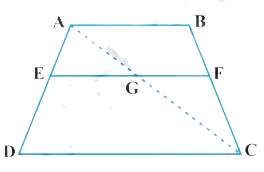
AB || DC and EF || AB (Given)
So, EF || DC (Lines parallel to the same line are parallel to each other)
Now, in \(\Delta\) ADC,
EG || DC (As EF || DC)
So, \(\frac{AE}{ED}=\frac{AG}{GC}\)
Similarly, from \(\Delta\)CAB,
\(\begin{aligned} & \frac{C G}{A G}=\frac{C F}{B F} \\ \end{aligned}\)
\(\begin{aligned} & \frac{A G}{G C}=\frac{B F}{F C} \end{aligned}\)
Therefore, from (1) and (2),
\(\frac{\mathrm{AE}}{\mathrm{ED}}=\frac{\mathrm{BF}}{\mathrm{FC}}\)
17.
Since we will apply the identity involving sec \(\theta\) and tan \(\theta\), let us first convert the LHS (of the identity we need to prove) in terms of sec \(\theta\) and tan \(\theta\) by dividing numerator and denominator by cos \(\theta\).
\(\begin{aligned} \text { LHS } & =\frac{\sin \theta-\cos \theta+1}{\sin \theta+\cos \theta-1}=\frac{\tan \theta-1+\sec \theta}{\tan \theta+1-\sec \theta} \\ \end{aligned}\)
\(\begin{aligned} & =\frac{(\tan \theta+\sec \theta)-1}{(\tan \theta-\sec \theta)+1}=\frac{\{(\tan \theta+\sec \theta)-1\}(\tan \theta-\sec \theta)}{\{(\tan \theta-\sec \theta)+1\}(\tan \theta-\sec \theta)} \\ \end{aligned}\)
\(\begin{aligned} & =\frac{\left(\tan ^2 \theta-\sec ^2 \theta\right)-(\tan \theta-\sec \theta)}{\{\tan \theta-\sec \theta+1\}(\tan \theta-\sec \theta)} \\ \end{aligned}\)
\(\begin{aligned} & =\frac{-1-\tan \theta+\sec \theta}{(\tan \theta-\sec \theta+1)(\tan \theta-\sec \theta)} \end{aligned}\)
\(=\frac{-1}{\tan \theta-\sec \theta}=\frac{1}{\sec \theta-\tan \theta}\)
which is the RHS of the identity, we are required to prove.
18.
Given, a pair of linear equations is :
3x - y = 3 or y = 3x - 3 ....(i)
and 9x-3y = 9 ....(ii)
On substituting y from eqn. (i) in eqn. (ii),
9x - 3(3x- 3) = 9
i.e., 9 = 9
It is a true statement. Hence, eqn. (i) and (ii) have infinitely many solutions.
19.
We have: 6 = 2 \(\times\) 3, 72 = 23 \(\times\) 32, 120 = 23 \(\times\) 3 \(\times\) 5
Here, 21 and 31 are the smallest powers of the common factors 2 and 3, respectively.
So, HCF (6, 72, 120) = 21 \(\times\) 31 = 2 \(\times\) 3 = 6
23, 32 and 51 are the greatest powers of the prime factors 2, 3 and 5 respectively involved in the three numbers.
So, LCM (6, 72, 120) = 23 \(\times\) 32 \(\times\) 51 = 360
Remark : Notice, 6 × 72 × 120 ≠ HCF (6, 72, 120) × LCM (6, 72, 120). So, the product of three numbers is not equal to the product of their HCF and LCM.
20.
Let a = 7\(\sqrt5\) be a rational number.
\(\Rightarrow \frac{a}{7}=\sqrt{5}\)
Now, \(\frac{a}{7}\) is a rational number since product of two rational number is a rational number.
The above will imply that \(\sqrt5\) is a rational number. But \(\sqrt5\) is an irrational number.
his contradicts our assumption. Therefore we can conclude that 7\(\sqrt5\) is an irrational number and hence the result.
21.
Let p(t) = t2 - 15 = t2 - \(\left ( \sqrt{15} \right )^{2}\)
= (t - \(\sqrt{15}\))(t + \(\sqrt{15}\)) [\(\because\) a2 - b2 = (a - b) (a + b)]
To find zeroes, put p(t) = 0
\(\Rightarrow (t-\sqrt{15})(t+\sqrt{15})=0\)
\(\Rightarrow t-\sqrt{15}=0\) or t + \(\sqrt{15}\) = 0 \(\Rightarrow\) t = \(\sqrt{15}\) or t = -\(\sqrt{15}\)
Hence, zeroes of the given polynomial are -\(\sqrt{15}\) and \(\sqrt{15}\).
Verification
Hence, sum of zeroes = -\(\sqrt{15}\) + \(\sqrt{15}\) = 0 = -(0/1)
\(=-\frac{Coefficient \quad of \quad t}{Coefficient \quad of \quad t^{2}}\)
and product of zeroes = -\(\sqrt{15}\) \(\times\)\(\sqrt{15}\)= -15 = \(\frac{-15}{1}\)
\(=\frac{Constant \quad term}{Coefficient \quad of \quad t^{2}}\)
So, the relationship between the zeroes and its coefficients is verified.
22.
Given, pair of linear equations is
x - y = 8 \(\Rightarrow\) x - y - 8 = 0 ....(i)
and 3x - 3y = 16 \(\Rightarrow\) 3x - 3y - 16 = 0 ...(ii)
On comparing with standard form of pair of linear equations, we get
a1= 1, b1 = -1, c1 = -8
and a2 = 3, b2 = -3, c2 = -16
Here, \(\frac{a_{1}}{a_{2}}=\frac{1}{3},\frac{b_{1}}{b_{2}}=\frac{1}{3}\) and \(\frac{c_{1}}{c_{2}}=\frac{-8}{-16}=\frac{1}{2}\)
Thus, \(\frac{1}{3}=\frac{1}{3}\neq \frac{1}{2}\) i.e. \(\frac{a_{1}}{a_{2}}=\frac{b_{1}}{b_{2}}\neq \frac{c_{1}}{c_{2}}\)
So, the pair of linear equations is inconsistent.

10th Standard CBSE Syllabus & Materials
10th Standard CBSE
cbse 10th Standard Social Science HIS - The Making of a Global World Important Questions And Answers Study Material - QB365 Set C
NEW10th Standard CBSE
cbse 10th Standard Social Science HIS - The Making of a Global World Important Questions And Answers Study Material - QB365 Set B
NEW10th Standard CBSE
cbse 10th Standard Social Science HIS - The Making of a Global World Important Questions And Answers Study Material - QB365 Set A
NEW10th Standard CBSE
cbse 10th Standard Social Science ECO - Consumer Rights Important Questions And Answers Study Material - QB365 Set C


NCERT Books

Syllabus

Exam Pattern

Sample Question Papers

Previous year Question Papers

Important Notes

MCQ Practice test

NCERT Exemplers

Case study Questions

Image Based Questions

Passage based Questions

HOT Questions

Value Based Questions

Model Questions Papers
NCERT ( Book Back ) Questions

Assertion and Reason
Important Questions And Answers

CBSE 10th Standard CBSE Subjects
CBSE Standards