10th Standard CBSE Syllabus & Materials
10th Standard CBSE
cbse 10th Standard Social Science HIS - Print Culture and Modern World Important Questions And Answers Study Material - QB365 Set C
NEW10th Standard CBSE
cbse 10th Standard Social Science HIS - Print Culture and Modern World Important Questions And Answers Study Material - QB365 Set B
NEW10th Standard CBSE
cbse 10th Standard Social Science HIS - Print Culture and Modern World Important Questions And Answers Study Material - QB365 Set A
NEW10th Standard CBSE
cbse 10th Standard Social Science HIS - The Age of Industrialization Important Questions And Answers Study Material - QB365 Set C
NEW10th Standard CBSE
cbse 10th Standard Social Science HIS - The Age of Industrialization Important Questions And Answers Study Material - QB365 Set B
NEW10th Standard CBSE
cbse 10th Standard Social Science HIS - The Age of Industrialization Important Questions And Answers Study Material - QB365 Set A

Published on: 21/10/2025
Download CBSE Class 10th Standard CBSE Maths question papers, sample papers, important questions, and previous year solved papers in PDF format. Get free study materials, NCERT solutions, and exam preparation resources for Class 10th Standard CBSE Maths
Questions + Answers key
Take MCQ Maths Test
ANSWER THE FOLLOWING
1.
Show that any positive odd integer is of the form 6q + 1 or 6q + 3 or 6q + 5, where q is some integer.
2.
On dividing polynomial p(x) by 3x+1, the quotient is 2x-3 and the remainder is -2. Find p(x).
3.
Draw the graph of the polynomial -x2+4x-4 and find the zeroes of the polynomial.
4.
State Fundamental theorem of Arithmetic. Is it possible that HCF and LCM of two numbers be 24 and 540 respectively. Justify your answer.
ANSWER THE FOLLOWING
5.
Write the degree of the following polynomials.
\(7q^{ 6 }+4q^{ 2 }+\frac { 3 }{ 2 } +q-8\)
6.
Find a quadratic polynomial, whose sum and product of the zeroes are \(-\frac { 8 }{ 3 } \) and \(\frac { 4 }{ 3 } \), respectively. Also, find the zeroes of this polynomial by factorisation.
7.
Express \(\left( \frac { 15 }{ 4 } +\frac { 5 }{ 40 } \right) \) as a decimal without actual division.
8.
Prove that (\( \sqrt{p} \) + \( \sqrt{q} \) is irrational, where p and q are primes.
9.
Without actually performing the long division, state whether the following rational number will have a terminating decimal expansion or not. Also, write the terminating decimal expansion, if exist
\(\frac{51}{1500}\)
10.
p(x) = ax2 - 8x + 3 where a is a non-zero real number. One zero of p(x) is 3 times the other zero.
(i) Find the value of a. Show your work.
(ii) What is the shape of the graph of p(x) ? Give a reason for your answer.
ANSWER THE FOLLOWING
11.
Divide the polynomial p(x) by the polynomial g(x) and verify the division algorithm in following.
p(x)=2x4-2x3-5x2-x+8, g(x)=2x2+4x+3
12.
If a and b are two positive integers such that a = bq + r. Where q and r are unique integers. If a < b, then find the value of q.
13.
The graph of a polynomialp{x) does not intersects the x-axis but intersects y-axis in one point. Find the number of zeroes of p(x).
14.
Write down the decimal expansions of those rational numbers in which have terminating decimal expansions.
\(\frac { 129 }{ { 2 }^{ 2 }{ 5 }^{ 7 }{ 7 }^{ 5 } } \)
15.
Write down the decimal expansions of those rational numbers in which have terminating decimal expansions.
\(\frac{35}{50}\)
16.
What is the HCF of 161 and 303?
1
11
13
3
17.
What is the HCF of 235 and 395?
25
35
5
13
18.
A number of the form 4n cannot be divisible byGiven that the LCM of 306 and 657 is 22338, what is the LCM of 102, 306 and 657
1
22338
22338 x 102
None of these
19.
Which of the following rational numbers has a denominator that can be expressed as a product of powers of 2 and 5?
0.143245
0.141414
1.34573457
0.23452345
20.
Given that the H.C.F. of 35 and 49 is 7, what is their LCM?
265
245
195
225
21.
Given that HCF (26 , 91) = 13, then LCM of (26 , 91) is :
182
91
364
2366
22.
The number of polynomials having zeroes -2 and 5 is:
1
3
2
more than 3
23.
The graph of the polynomial f(x) = 2x – 5 crosses the X-axis at the point
(1, -3)
(5/2, 0)
(0, 0)
(4, 3)
24.
The graph y= p(x) is shown below. How many zeroes does the polynomial p(x) have?
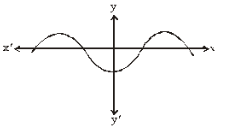
2
4
3
1
25.
A fourth degree polynomial is called
Cubic polynomial
A bi-quadratic polynomial
Binomial
Quadratic polynomial
26.
value of ‘a’ so that (x + 6) is a factor of the polynomial x3 + 5x2 – 4x + a
10
12
13
0
27.
For some integer q, every odd integer is of the form
q
q +1
2q
2q +1
28.
If P = (2)(4)(6)...(20) and Q = (1)(3)(5)...(19),then the HCF of Pand Q is
3357
345
34527
3252
29.
If x andy are odd positive integers, then X2 + y2 is
even and divisible by 4
even and not divisible by 4
odd and divisible by 4
odd and not divisible by 4
30.
if \(\alpha\) and \(\beta\)are zeroes and the polynomial f(x) = x2 - x - 4 value of \(\frac{1}{\alpha}+\frac{1}{\beta}-\alpha \beta\)
\(\frac{15}{4}\)
\(\frac{-15}{4}\)
4
15
31.
The polynomial [(x) = ax3 + bx - c is divisible by the polynomial g(x) = x2 + bx + c, c \(\neq\) 0, if
ab = 2
ab = 1
ac = 2
c = 2b
32.
If a quadratic polynomial curve in the shape of semi-circle is shown below. Then, the equation of this curve.
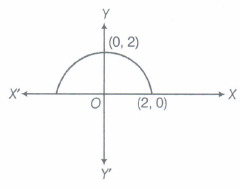
-x2 +2
x2 +2
\(\frac{1}{2}x ^{2}+2\)
\(-\frac{1}{2}x ^{2}+2\)
33.
In the given figure, graph of a polynomial f(x) is shown. The number of zeroes of polynomial f(x) is
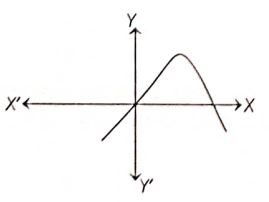
3
1
0
2
34.
If n is a natural number, then 2(5n + 6n) always ends with
0
2
4
6
35.
The zeroes of the quadratic polynomial16x2 - 9 are
\(\frac{3}{4}, \frac{3}{4}\)
\(-\frac{3}{4}, \frac{3}{4}\)
\(\frac{9}{16}, \frac{9}{16}\)
\(-\frac{9}{16}, \frac{9}{16}\)
36.
Decimal form of rational numbers can be classified into two types.
(i) Let x be a rational number whose decimal expansion terminates. Then x can be expressed in the form \(\frac{p}{\sqrt{q}}\) where p and q are co-prime and the prime faetorisation of q is of the form 2n·5m, where n, mare non-negative integers and vice-versa.
(ii) Let x = \(\frac{p}{\sqrt{q}}\) be a rational number, such that the prime faetorisation of q is not of the form 2n 5m, where n and m are non-negative integers. Then x has a non-terminating repeating decimal expansion.
(i) Which of the following rational numbers have a terminating decimal expansion?
| (a) 125/441 | (b) 77/210 | (c) 15/1600 | (d) 129/(22 x 52 x 72) |
(ii) 23/(23 x 52) =
| (a) 0.575 | (b) 0.115 | (c) 0.92 | (d) 1.15 |
(iii) 441/(22 x 57 x 72) is a_________decimal.
| (a) terminating | (b) recurring |
| (c) non-terminating and non-recurring | (d) None of these |
(iv) For which of the following value(s) of p, 251/(23 x p2) is a non-terminating recurring decimal?
| (a) 3 | (b) 7 | (c) 15 | (d) All of these |
(v) 241/(25 x 53) is a _________decimal.
| (a) terminating | (b) recurring |
| (c) non-terminating and non-recurring | (d) None of these |
37.
While playing in garden, Sahiba saw a honeycomb and asked her mother what is that. She replied that it's a honeycomb made by honey bees to store honey. Also, she told her that the shape of the honeycomb formed is parabolic. The mathematical representation of the honeycomb structure is shown in the graph.
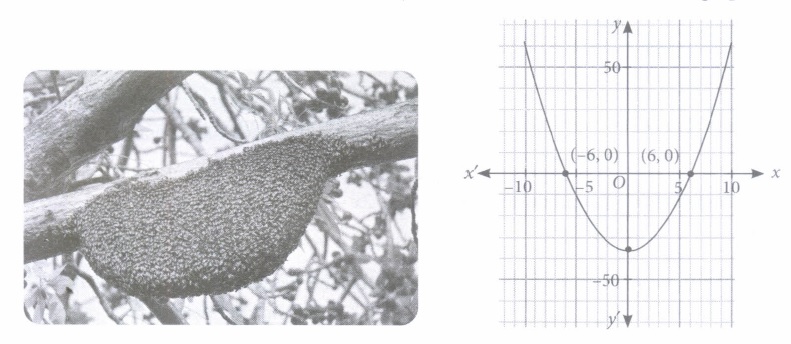
Based on the above information, answer the following questions.
(i) Graph of a quadratic polynomial is in___________shape.
| (a) straight line | (b) parabolic |
| (c) circular | (d) None of these |
(ii) The expression of the polynomial represented by the graph is
| (a) x2-49 | (b) x2-64 | (c) x2-36 | (d) x2-81 |
(iii) Find the value of the polynomial represented by the graph when x = 6.
| (a) -2 | (b) -1 | (c) 0 | (d) 1 |
(iv) The sum of zeroes of the polynomial x2 + 2x - 3 is
| (a) -1 | (b) -2 | (c) 2 | (d) 1 |
(v) If the sum of zeroes of polynomial at2 + 5t + 3a is equal to their product, then find the value of a.
| (a) -5 | (b) -3 | \(\text { (c) } \frac{5}{3}\) | \(\text { (d) } \frac{-5}{3}\) |
38.
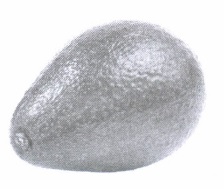
Pankaj's father gave him some money to buy avocado from the market at the rate of p(x) = x2 - 24x + 128. Let a , \(\beta\) are the zeroes of p(x).
Based on the above information, answer the following questions.
(i) Find the value of a and \(\beta\), where a < \(\beta\).
| (a) -8, -16 | (b) 8,16 | (c) 8,15 | (d) 4,9 |
(ii) Find the value of \(\alpha\) + \(\beta\) + \(\alpha\)\(\beta\).
| (a) 151 | (b) 158 | (c) 152 | (d) 155 |
(iii) The value of p(2) is
| (a) 80 | (b) 81 | (c) 83 | (d) 84 |
(iv) If \(\alpha\) and \(\beta\) are zeroes of \(x^{2}+x-2, \text { then } \frac{1}{\alpha}+\frac{1}{\beta}=\)
| (a) 1/2 | (b) 1/3 | (c) 1/4 | (d) 1/5 |
(v) If sum of zeroes of \(q(x)=k x^{2}+2 x+3 k\) is equal to their product, then k =
| (a) 2/3 | (b) 1/3 | (c) -2/3 | (d) -1/3 |
ANSWER THE FOLLOWING
1.
Consider a positive odd integer as a.
On dividing a by b, let q be the quotient and r be the remainder.
Then, a = bq + r,
[by Euclid's division lemma]
On putting b= 6 in Eq.(i) we get
a = 6q + r, \(0\le r<6\) .... (ii)
So, possible values of r = 0, 1, 2, 3, 4, 5
If r = 0, then from Eq.(ii), a = 6q
Here, 6q is divisible by 2, so 6q is even.
If r = 1, then from Eq.(ii), a = 6q + 1
Here, 6q + 1 is not divisible by 2, so 6q + 1 is odd.
If r = 2, then from Eq.(ii), a = 6q + 2
Here, 6q + 2 is divisible by 2, so 6q+ 2 is even.
If r = 3, then from Eq.(ii), a = 6q + 3
Here, 6q + 3 is not divisible by 2, so 6q+ 3 is odd.
If r = 4, then from Eq.(ii), a = 6q + 4
Here, 6q+ 4 is divisible by 2, so 6q + 4 is even.
If r = 5, then from Eq.(ii), a = 6q + 5
Here, 6q + 5 is not divisible by 2, so 6q + 5 is odd.
Since, a is odd, so a cannot be 6q, 6q + 2, 6q + 4
Hence, any positive odd integer is of the form 6q + 1, 6q + 3 and 6q + 5.
2.
By division algorithm, p(x)=g(x).q(x)+r(x)=6x2-7x-5
3.
2, 2
4.
Fundamental theorem of Arithmetic: Every composite number can be expressed as a product of primes and decomposition is unique, apart from the order in which the prime factors occur.
HCF = 24
LCM = 540
Let's calculate \(\frac { LCM }{ HCF } =\frac { 540 }{ 24 } =22.5\) not an integer
Since LCM is always a multiple of HCF, hence, two numbers cannot have HCF and LCM as 44 and 540 respectively.
ANSWER THE FOLLOWING
5.
In the polynomial \(7q^{ 6 }+4q^{ 2 }+\frac { 3 }{ 2 } +q-8\) , the highest power of the variable q is 6.
6.
3x2+8x+4;-2 and \(-\frac { 2 }{ 3 } \)
7.
\(\frac { 15 }{ 4 } +\frac { 5 }{ 40 } =\frac { 15 }{ 4 } \times \frac { 25 }{ 25 } +\frac { 5 }{ 40 } \times \frac { 25 }{ 25 } \)
\(=\frac { 375 }{ 100 } +\frac { 125 }{ 1000 } \)
= 3.75 + 0.125 = 3.875
8.
Hint Let us suppose that \( \sqrt{p} \)+ \( \sqrt{q} \)is a rational
number, Again, let \( \sqrt{p} \)+ \( \sqrt{q} \) = a, where a is rational.
Therefore, \( \sqrt{q} \) = a - \( \sqrt{p} \)
On squaring both sides, we get
\({l} q=a^{2}+p-2 a \sqrt{p}\left[\because(a-b)^{2}=a^{2}+b^{2}-2 a b\right] \)
\(\\ \sqrt {p}=\frac{a^{2}+p-q}{2 a} \)
Since, p and q are primes and a is a rational number, so
\(\frac{a^{2}+p-q}{2 a}\) is rational, therefore \( \sqrt{p} \) is a rational number.
But this contradicts the fact that \( \sqrt{p} \) is irrational
number as p is prime. So, our assumption was incorrect.
Hence, \( \sqrt{p} \) + \( \sqrt{q} \) is irrational
9.
We have, \(\frac{51}{1500}\) \(=\frac{17}{500}\)
Prime factors of 500 = 2 x 2 x 5 x 5 x 5 = 22 x 53
which is in the form 2n x 5m
So, it has terminating decimal expansion.
Now, \(\frac { 51 }{ 1500 } =\frac { 17 }{ { { 2 }^{ 2 }\times 5 }^{ 3 } } \times \frac { { 2 } }{ { 2 } } =\frac { 34 }{ { 10 }^{ 3 } } =0.034\)
which is the required decimal expansion.
10.
(i) Let the zeroes of p(x) be \(\alpha\) and \(\beta\) and \(\alpha=3 \beta\).
Sum of zeroes \(=\alpha+\beta=\frac{-(-8)}{a}\)
\(\Rightarrow 3 \beta+\beta=\frac{8}{a} \Rightarrow \beta=\frac{2}{a}\)
Product of zeroes \(=\alpha \beta=\frac{3}{a} \Rightarrow \beta^2=\frac{1}{a}\)
From Eqs. (i) and (ii), we get
a=4
(ii) Since, a = 4 > 0,
Therefore The graph of $p(x)$ is an open upward parabola.
ANSWER THE FOLLOWING
11.
Quotient, q(x) = x2 - 3x + 2 and remainder, r(x) = 2.
12.
\(\therefore\) a is smaller than b
\(\therefore\) a = b x 0 + a
Comparing with a = bq + r we get q = 0
13.
Number of zeroes of a polynomial p(x) is equal to numbers of the points of intersection of the graph of P(x) with x-axis
∵ the graph of p(x) does not intersects the x-axis
∴ It has no zero
14.
This is non-terminating decimal expansion.
15.
\(\frac{35}{50}=\frac{7}{10}=0.70\)
16.
(a)
1
17.
(c)
5
18.
(b)
22338
19.
(a)
0.143245
20.
(b)
245
21.
(a)
182
22.
(d)
more than 3
23.
(b)
(5/2, 0)
24.
(b)
4
25.
(b)
A bi-quadratic polynomial
26.
(b)
12
27.
(d)
2q +1
28.
(c)
34527
29.
(b)
even and not divisible by 4
30.
(a)
\(\frac{15}{4}\)
31.
(b)
ab = 1
32.
(a)
-x2 +2
33.
(d)
2
34.
(d)
6
35.
(b)
\(-\frac{3}{4}, \frac{3}{4}\)
36.
(i) (c): Here, the simplest form of given options are
125/441 = 53/(32 x 72), 77/210 = 11/(2 x 3 x 5),
15/1600 = 3/(26 x 5) Out of all the given options, the denominator of option (c) alone has only 2 and 5 as factors. So, it is a terminating decimal.
(ii) (b): 23/(23 x 52) = 23/200 = 0.115
(iii) (a): 441/(22 x 57 x 72) = 9/(22 x 57), which is a terminating decimal.
(iv) (d): The fraction form of a non-terminating recurring decimal will have at least one prime number other than 2 and 5 as its factors in denominator. So, p can take either of 3, 7 or 15.
(v) (a): Here denominator has only two prime factors i.e., 2 and 5 and hence it is a terminating decimal.
37.
(i) (b): Graph of a quadratic polynomial is a parabolic in shape.
(ii) (c): Since the graph of the polynomial cuts the
x-axis at (-6,0) and (6, 0). So, the zeroes of polynomial are -6 and 6.
\(\therefore\) Required polynomial is p(x) = x2 - (-6 + 6)x + (-6)(6) = x2 - 36
(iii) (c) : We have, p(x) = x2 - 36
Now, p( 6) = 62 - 36 = 36 - 36 = 0
(iv) (b): Letf (x) = x2 + 2x - 3. Then,
\(\text { Sum of zeroes }=-\frac{\text { coefficient of } x}{\text { coefficient of } x^{2}}=-\frac{(2)}{1}=-2\)
(v) (d): The given polynomial is at2+ 5t + 3a Given, sum of zeroes = product of zeroes.
\(\Rightarrow \quad \frac{-5}{a}=\frac{3 a}{a} \Rightarrow a=\frac{-5}{3}\)
38.
(i) (b): Given, a and \(\beta\) are the zeroes of
\(p(x)=x^{2}-24 x+128\)
\(\text { Putting } p(x)=0 \text { , we get }\)
\( x^{2}-8 x-16 x+128=0 \)
\(\Rightarrow x(x-8)-16(x-8)=0 \)
\(\Rightarrow (x-8)(x-16)=0 \Rightarrow x=8 \text { or } x=16 \)
\(\therefore \alpha=8, \beta=16\)
(ii) (c) : \(\alpha+\beta+\alpha \beta =8+16+(8)(16) =24+128=152 \)
(iii) (d) : \(p(2)=2^{2}-2 4(2)+128=4-48+128=84\)
(iv) (a): Since a and \(\beta\) are zeroes of \(x^{2}+x-2\)
\(\therefore \quad \alpha+\beta=-1 \text { and } \alpha \beta=-2 \)
\(\text { Now, } \frac{1}{\alpha}+\frac{1}{\beta}=\frac{\beta+\alpha}{\alpha \beta}=\frac{-1}{-2}=\frac{1}{2}\)
(v) (c): Sum of zeroes \(=\frac{-2}{k}\)
Product of zeroes \(=\frac{3 k}{k}=3\)
According to question, we have \(\frac{-2}{k}=3\)
\(\Rightarrow \quad k=\frac{-2}{3}\)

10th Standard CBSE Syllabus & Materials
10th Standard CBSE
cbse 10th Standard Social Science HIS - The Making of a Global World Important Questions And Answers Study Material - QB365 Set C
NEW10th Standard CBSE
cbse 10th Standard Social Science HIS - The Making of a Global World Important Questions And Answers Study Material - QB365 Set B
NEW10th Standard CBSE
cbse 10th Standard Social Science HIS - The Making of a Global World Important Questions And Answers Study Material - QB365 Set A
NEW10th Standard CBSE
cbse 10th Standard Social Science ECO - Consumer Rights Important Questions And Answers Study Material - QB365 Set C



NCERT Books

Syllabus

Exam Pattern

Sample Question Papers

Previous year Question Papers

Important Notes

MCQ Practice test

NCERT Exemplers

Case study Questions

Image Based Questions

Passage based Questions

HOT Questions

Value Based Questions

Model Questions Papers
NCERT ( Book Back ) Questions

Assertion and Reason
Important Questions And Answers

CBSE 10th Standard CBSE Subjects
CBSE Standards