10th Standard CBSE Syllabus & Materials
10th Standard CBSE
cbse 10th Standard Social Science HIS - Print Culture and Modern World Important Questions And Answers Study Material - QB365 Set C
NEW10th Standard CBSE
cbse 10th Standard Social Science HIS - Print Culture and Modern World Important Questions And Answers Study Material - QB365 Set B
NEW10th Standard CBSE
cbse 10th Standard Social Science HIS - Print Culture and Modern World Important Questions And Answers Study Material - QB365 Set A
NEW10th Standard CBSE
cbse 10th Standard Social Science HIS - The Age of Industrialization Important Questions And Answers Study Material - QB365 Set C
NEW10th Standard CBSE
cbse 10th Standard Social Science HIS - The Age of Industrialization Important Questions And Answers Study Material - QB365 Set B
NEW10th Standard CBSE
cbse 10th Standard Social Science HIS - The Age of Industrialization Important Questions And Answers Study Material - QB365 Set A

Published on: 21/10/2025
Download CBSE Class 10th Standard CBSE Maths question papers, sample papers, important questions, and previous year solved papers in PDF format. Get free study materials, NCERT solutions, and exam preparation resources for Class 10th Standard CBSE Maths
Questions + Answers key
Take MCQ Maths Test
1.
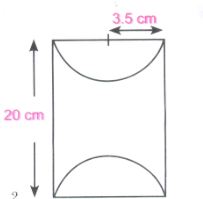
A wooden article was made by scooping out a hemisphere from each end of a solid cylinder.If the height of the cylinder is 20cm and radius of the base is 3.5cm, find the total surface area of the article.
2.
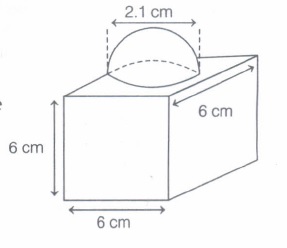
The decorative block shown in the following figure is made of two solids, a cube and a hemisphere.The base of the block is a cube with edge 6 cm and the hemisphere fixed on the top has a diameter of 2.1 cm, then find the total surface area of the block and find the total area to be painted. \(\left[\text { take, } \pi=\frac{22}{7}\right]\)
3.
A solid metallic right circular cone 20 cm high and whose vertical angle is 60o, is cut into two parts at the middle of its height by a plane parallel to its base. If the frustum so obtained be drawn into a wire of diameter \(\frac{1}{12}\) cm, find the length of the wire.
4.
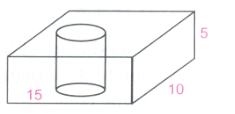
In figure, from a cuboidal solid metallic block of dimensions 15 cm x 10 cm x 5 cm, a cylindrical hole of diameter 7 cm is drilled out. Find the surface area of the remaining block. [Use \(\pi=\frac{22}{7}\)]
5.
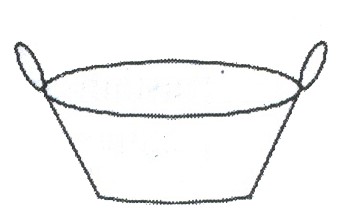
Hanumappa and his wife Gangamma are busy making jaggery out of sugarcane juice. They have processed the sugarcane juice to make the molasses, which is poured into moulds in the shape of a frustum of a cone having the diameters of its two circular faces as 30 cm and 35 cm and the vertical height of the mould is 14 cm (see fig.). If each cm3 of molasses has mass about 1.2 g, find the mass of the molasses that can be poured into each mould.
6.
A cistern, internally measuring 150 cm x 120 cm x 110 cm, has 129600 cm3 of water in it. Porous bricks are placed in the water until the cistern is full to the brim. Each brick absorbs one-seventeenth of its own volume of water. How many bricks can be put in without overflowing the water, each brick being 22.5cm x 7.5 cm x 6.5 cm?
7.
A solid metallic cylinder of radius 3.5 cm and height 14 cm is melted and recast into a number of small solid metallic balls, each of radius \(\frac { 7 }{ 12 } cm\) Find the number of balls so formed.
8.
A drinking glass is in the shape of a frustum of a cone of height 14 cm. The diameters of its two circular ends are 4 cm and 12 cm. Find the capacity of the glass.
9.
Inner dimensions of a closed box are 14 cm, 12 cm and 10 cm. If the thickness of the wood is 1 cm, then find the capacity of the box.
10.
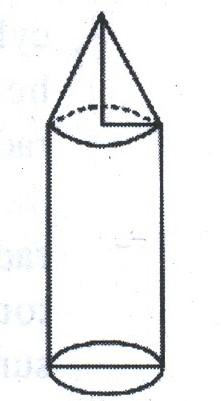
The given figure is a model of rocket consisting of a cylinder surmounted by a cone at one end. The dimensions of the model are : common radius 3 cm, height of cone = 4 cm and the total height is 14 cm. If the model is drawn to a scale of 1 : 500, find the total surface area of the rocket in \(\pi \ { m }^{ 2 }\)
11.
A solid is in the form of right circular cylinder with a hemisphere at one end and a cone at the other end. The radius of the common base is 3.5 cm and the heights of the cylindrical and conical portion are 10 cm and 6 cm respectively. Find the total surface area of the solid.
12.
A rectangular sheet of paper 40 cm x 22 cm is rolled to form a hollow cylinder of height 40 cm. Find the radius of the cylinder.
13.
In the figure, the shape of a solid copper piece (made of two pieces) with dimensions as shown. The face ABCDEFA has uniform cross section. Assume that the angles at A, B, C, D, E and F are right angles. Calculate the volume of the piece.
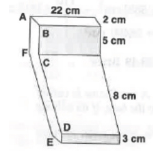
840 cm
880 cm3
876 cm3
890 cm3
14.
If a right angled triangle is revolved about one of the sides containing the right angle it forms a
Right circular cone
Right triangle
Prism
Pyramid
15.
If two identical solid cubes each of volume 64 cm3 are joined end to end, then the total surface area of the resulting cuboid is:
210 cm2
200 cm2
160 cm2
180 cm2
16.
If H and h be the heights of two cylinders, then the ratio of curved surface areas of two cylinders with equal radii is
√H : 2√h
H : h
H2 : h2
2H : h
17.
A toy is in the form of a cone mounted on a hemisphere of diameter 7 cm. The total height of the toy is 14.5 cm. The total surface area of the toy will be
304 .5 cm2
400 cm2
203.94 cm2
231 cm2
18.
A circus tent is cylindrical to a height of 4 m and conical above it. If its diameter is 105 m and its slant height is 40 m, the total area of the canvas required is
7920 m2
2640 m2
1760 m2
3960 m2
19.
If the radius of base of a cylinder is doubled and the height remains unchanged, its curved surface area becomes
No change
Half
Double
three times
20.
One day Rinku was going home from school, saw a carpenter working on wood. He found that he is carving out a cone of same height and same diameter from a cylinder. The height of the cylinder is 24 ern and base radius is 7 cm. While watching this, some questions came into Rinkus mind. Help Rinku to find the answer of the following questions.
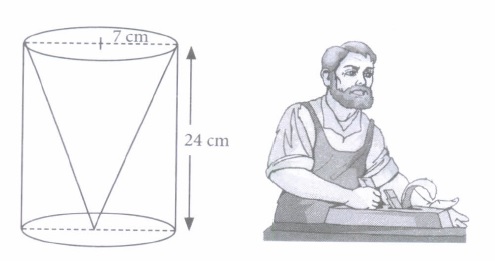
(i) After carving out cone from the cylinder,
| (a) Volume of the cylindrical wood will decrease. |
| (b) Height of the cylindrical wood will increase. |
| (c) Volume of cylindrical wood will increase. |
| (d) Radius of the cylindrical wood will decrease. |
(ii) Find the slant height of the conical cavity so formed.
| (a) 28 cm | (b) 38 cm | (c) 35 cm | (d) 25 cm |
(iii) The curved surface area of the conical cavity so formed is
| (a) 250 cm2 | (b) 550 cm2 | (c) 350 cm2 | (d) 450 cm2 |
(iv) External curved surface area of the cylinder is
| (a) 876 cm2 | (b) 1250 cm2 | (c) 1056 cm2 | (d) 1025 cm2 |
(v) Volume of conical cavity is
| (a) 1232 cm3 | (b) 1248 cm3 | (c) 1380 cm3 | (d) 999 cm3 |
21.
Meera and Dhara have 12 and 8 coins respectively each of radius 3.5 cm and thickness 0.5 cm. They place their coins one above the other to form solid cylinders .
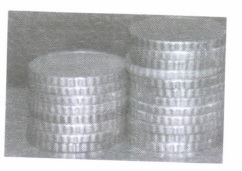
Based on the above information, answer the following questions.
(i) Curved surface area of the cylinder made by Meera is
| (a) 144 cm2 | (b) 132 cm2 | (c) 154 cm2 | (d) 142 cm2 |
(ii) The ratio of curved surface area of the cylinders made by Meera and Dhara is
| (a) 2: 5 | (b) 3: 2 | (c) 1: 2 | (d) 2: 7 |
(iii) The volume of the cylinder made by Dhara is
| (a) 154 cm3 | (b) 144 cm3 | (c) 132 cm3 | (d) 142 cm3 |
(iv) The ratio of the volume of the cylinders made by Meera and Dhara is
| (a) 1:2 | (b) 2: 5 | (c) 3: 2 | (d) 4: 3 |
(v) When two coins are shifted from Meeras cylinder to Dhara's cylinder, then
| (a) Volume of two cylinder become equal |
| (b) Volume of Meera's cylinder> Volume of Dharas cylinder |
| (c) Volume of Dhara's cylinder> Volume of Meeras cylinder |
| (d) None of these |
1.
Height of cylinder = 20 cm
radius of cylinder = 3.5 cm = radius of each hemisphere
Total surface area of the article = 2X C.S.A of a hemisphere
= \(2\times 2\pi r^{ 2 }+2\pi rh\rightleftharpoons 2\pi r(2r+h)\)
= \(2\times \frac { 22 }{ 7 } \times 3.5\left[ 2\times 3.5+20 \right] \)
= 44 x 0.5[7+20] = 44 x 0.5 x 27 cm2 = 594.0 cm2
2.
Here, the decorative block is a combination of a cube and a hemisphere.
For cubical portion,
Each edge = 6 cm
For hemispherical portion,
Diameter = 2.1 cm
\(\therefore \quad \text { Radius, } r=\frac{2.1}{2} \mathrm{~cm}\)
Now, total surface area of the cube = 6 x (£dge)2= 6 x6 x6= 216cm2
Here, the part of the cube where the hemisphere is attached, is not included in the surface area.
So, the total surface area of the decorative block = Total surface area of cube - Area of base of hemisphere + Curved surface area of hemisphere
\(=216-\pi r^{2}+2 \pi r^{2}=216+\pi r^{2}=216+\frac{22}{7} \times \frac{2.1}{2} \times \frac{2.1}{2}\)
=216+3.465 = 219.465cm2
Clearly, the total area to be painted = Total surface area of the decorative block - Area of base of cube
= 219.465 _62 = 219.465 -36 = 183.465 cm2
3.
Cone is cut by plane PB and PQDB is a frustum.
OA = AC = 10 cm, AB = r1, CD = r2
Vertical angle = 60°, so Semi vertical angle = 30°
-S.jpg)
In right-angled triangle OAB,
\({{AB}\over{OA}}\) = tan 30°
\(\Rightarrow\) r1 = \({{10}\over{\sqrt{3}}}\)cm
In right-angled triangle OCD,
\({{CD}\over{OC}}\) = tan 30°
\(\Rightarrow\) r2 = \({{20}\over{\sqrt{3}}}\)cm.
Frustum is drawn into wire of diameter \({{1}\over{12}}\) cm and length x cm ( say )
\(\therefore\) Volume of wire = volume of frustum
\(\Rightarrow\) \({\pi r}^{2}\)x = \({{1}\over{3}}{\pi h}({ r }_{ 1 }^{ 2 } + { r }_{ 2 }^{ 2 }+{ r }_{ 1 }.{ r }_{ 2 })\)
\(\Rightarrow\) \({\pi}\left( {{1}\over{24}} \right)^{2}\times x = {{\pi \times10}\over{3}}\left[ { \left( \frac { 10 }{ \sqrt { 3 } } \right) }^{ 2 }+{ \left( \frac { 20 }{ \sqrt { 3 } } \right) }^{ 2 } +\frac { 10 }{ \sqrt { 3 } } .\frac { 20 }{ \sqrt { 3 } } \right]\)
\(\Rightarrow\) \({{1}\over{576}}\times{x}={{10}\over{3}}\left( {{100}\over{3}}+{{400}\over{3}}+{{200}\over{3}} \right)\)
= \({{10}\over{3}}\times{{700}\over{3}}\)
\(\Rightarrow\) x = \({{79000}\over{9}}\times 576\)
= 7000 X 64 cm
= 448000 cm
\(\Rightarrow\) length of wire = \({{448000}\over{100000}}\) km = 4.48 km
4.
Surface area of remaining block =
surface area of cuboid + curved surface area of cylinder - surface area of two circular end of cylinder hole
= 2[lb + bh + lh] + \(2\pi rh-2\pi r^2\)
= 2[15 x 10 + 10 x 5 + 15 x 5] + 2 x \(\frac{22}{7}\times\frac{7}{2}\) x 5 - 2 x \(\frac{22}{7}\times\frac{7}{2}\times\frac{7}{2}\)
= 2(150 + 50 + 75) + 110 - 77 cm2
= 583 cm2
5.
Since the mould is in the shape of a frustum of a cone, the quantity (volume) of molasses that can be poured into it \(=\frac{\pi}{3} h\left(r_{1}^{2}+r_{2}^{2}+r_{1} r_{2}\right)\)
where r1 is the radius of the larger base and r2 is the radius of the smaller base.
\(=\frac{1}{3} \times \frac{22}{7} \times 14\left[\left(\frac{35}{2}\right)^{2}+\left(\frac{30}{2}\right)^{2}+\left(\frac{35}{2} \times \frac{30}{2}\right)\right] \mathrm{cm}^{3}=11641.7 \mathrm{~cm}^{3} .\)
It is given that 1 cm3 of molasses has mass 1.2g. So, the mass of the molasses that can be poured into each mould = (11641.7 × 1.2) g
= 13970.04 g = 13.97 kg
= 14 kg (approx.)
6.
Given, internally dimensions of cistern
=150 cm x 120 cm x 110 cm
ஃ Volume of cistern = 150 x 120 x 110
=1980000 cm3
Given, volume of water in cistern = 129600 cm3
ஃ Remaining volume of cistern to be filled = 1980000 -129600 = 1850400 cm3
Let required number of bricks be n.
ஃ Volume of each brick = 22.5 x 7.5 x 6.5
= 1096.875 cm3
Water absorbed by 1 brick\(=\frac { 1096.875 }{ 17 } { cm }^{ 3 }\)
Then, water absorbed by n bricks=\(=n\left( \frac { 1096.875 }{ 17 } \right) { cm }^{ 3 }\)
Now, volume of remaining water + Water absorbed by n bricks
= n X Volume of each brick
\(\Rightarrow \ 1850400+n\left( \frac { 1096.875 }{ 17 } \right) =n(1096.875)\\ \Rightarrow \ n\times 1096.875\times \frac { 16 }{ 17 } =1850400\\ \Rightarrow \ n=\frac { 1850400\times 17 }{ 1096.875\times 16 } =1792.4102\approx 1792(approx)\)
Hence, 1792 bricks can be put in a cistern.
7.
Given, radius and height of cylinder, r = 3.5 cm and h = 14cm.
Also, radius of sphere, R=\(\frac { 7 }{ 12 } cm\)
Now, volume of cylinder \(=\pi { r }_{ 1 }^{ 2 }h=\frac { 22 }{ 7 } \times { (3.5) }^{ 2 }\times 14\\ \quad \quad \quad =22\times 12.25\times 2=539\quad { cm }^{ 3 }\)
Now, volume of solid metallic balls \(=\frac { 4 }{ 3 } \pi { r }_{ 2 }^{ 3 }\)
\(=\frac { 4 }{ 3 } \pi { \left( \frac { 7 }{ 12 } \right) }^{ 3 }=\frac { 4 }{ 3 } \times \frac { 22 }{ 7 } \times \frac { 7\times 49 }{ 12\times 12\times 12 } =\frac { 11\times 49 }{ 3\times 3\times 6\times 12 } { cm }^{ 3 }\\ \therefore \quad Number\quad of\quad balls=\frac { Volume\quad of\quad cylinder }{ Volume\quad of\quad solid\quad metallic\quad balls } \\ =\frac { \frac { 539 }{ 11\times 49 } }{ 3\times 3\times 6\times 12 } =\frac { 539\times 3\times 3\times 6\times 12 }{ 11\times 49 } =648\)
Hence, the required number of balls so formed are 648.
8.
Capacity of the glass = \(\frac { 1 }{ 3 } \pi { r }h\left( { R }^{ 2 }+{ r }^{ 2 }+Rr \right) \)
=\(\frac { 1 }{ 3 } \times \frac { 22 }{ 7 } \times 14\left( { 6 }^{ 2 }+{ 2 }^{ 2 }+6\times 2 \right) \)
=\(\frac { 44 }{ 3 } \times 52\)
= 762.67 cm3
9.
Since 14 cm, 12 cm and 10 cm are inner dimensions of the closed box.
Capacity of the box = 14 x 12 x 10
= 1680 cm3
10.
\(2100 \ \pi { m }^{ 2 }\)
11.
373.41 cm2
12.
Here, h=40 cm, circumference = 22 cm
2\(\pi\)r=22
\(\Rightarrow \ r=\frac { 22\times 7 }{ 2\times 22 } \)
\(\Rightarrow \ r=\frac { 7 }{ 2 } \)
= 3.5cm
13.
(b)
880 cm3
14.
(a)
Right circular cone
15.
(c)
160 cm2
16.
(b)
H : h
17.
(c)
203.94 cm2
18.
(a)
7920 m2
19.
(c)
Double
20.
(i) (a)
(ii) (d): Slant height of conical cavity \(l=\sqrt{h^{2}+r^{2}}\)
\(=\sqrt{(24)^{2}+(7)^{2}}=\sqrt{576+49}=\sqrt{625}=25 \mathrm{~cm}\)
(iii) (b): Curved surface area of conical cavity = \(\pi r l\)
\(=\frac{22}{7} \times 7 \times 25=550 \mathrm{~cm}^{2}\)
(iv) (c) : External curved surface area of cylinder
\(=2 \pi r h=2 \times \frac{22}{7} \times 7 \times 24=1056 \mathrm{~cm}^{2}\)
(v) (a): Volume of conical cavity \(=\frac{1}{3} \pi r^{2} h\)
\(=\frac{1}{3} \times \frac{22}{7} \times 7 \times 7 \times 24=1232 \mathrm{~cm}^{3}\)
21.
We have, radius of each coin = 3.5 cm
\(=\frac{35}{10} \mathrm{~cm}=\frac{7}{2} \mathrm{~cm}\)
Thickness of each coin \(=0.5 \mathrm{~cm}=\frac{1}{2} \mathrm{~cm}\)
So,height of cylinder made by Meera (h1) \(=12 \times \frac{1}{2}=6 \mathrm{~cm}\)
and height of cylinder made by Dhara (h2)
\(=8 \times \frac{1}{2}=4 \mathrm{~cm}\)
(i) (b): Curved surface area of cylinder made by Meera \(=2 \times \frac{22}{7} \times \frac{7}{2} \times 6=132 \mathrm{~cm}^{2}\)
(ii) (b): Required ratio
\(=\frac{\text { Curved surface area of cylinder made by Meera }}{\text { Curved surface area of cylinder made by Dhara }}\)
\(=\frac{2 \pi r h_{1}}{2 \pi r h_{2}}=\frac{h_{1}}{h_{2}}=\frac{6}{4}=\frac{3}{2} \text { i.e., } 3: 2\)
(iii) (a): Volume of cylinder made by Dhara \(=\pi r^{2} h_{2}\)
\(=\frac{22}{7} \times \frac{7}{2} \times \frac{7}{2} \times 4=154 \mathrm{~cm}^{3}\)
(iv) (c): Required ratio
\(=\frac{\text { Volume of cylinder made by Meera }}{\text { Volume of cylinder made by Dhara }} \)
\(=\frac{\pi r^{2} h_{1}}{\pi r^{2} h_{2}}=\frac{h_{1}}{h_{2}}=\frac{6}{4}=\frac{3}{2} \text { i.e., } 3: 2\)
(v) (a): When two coins are shifted from Meera's cylinder to Dhara's cylinder, then length of both cylinders become equal. So, volume of both cylinders become equal

10th Standard CBSE Syllabus & Materials
10th Standard CBSE
cbse 10th Standard Social Science HIS - The Making of a Global World Important Questions And Answers Study Material - QB365 Set C
NEW10th Standard CBSE
cbse 10th Standard Social Science HIS - The Making of a Global World Important Questions And Answers Study Material - QB365 Set B
NEW10th Standard CBSE
cbse 10th Standard Social Science HIS - The Making of a Global World Important Questions And Answers Study Material - QB365 Set A
NEW10th Standard CBSE
cbse 10th Standard Social Science ECO - Consumer Rights Important Questions And Answers Study Material - QB365 Set C



NCERT Books

Syllabus

Exam Pattern

Sample Question Papers

Previous year Question Papers

Important Notes

MCQ Practice test

NCERT Exemplers

Case study Questions

Image Based Questions

Passage based Questions

HOT Questions

Value Based Questions

Model Questions Papers
NCERT ( Book Back ) Questions

Assertion and Reason
Important Questions And Answers

CBSE 10th Standard CBSE Subjects
CBSE Standards