
10th Standard CBSE Syllabus & Materials
10th Standard CBSE
cbse 10th Standard Social Science HIS - Print Culture and Modern World Important Questions And Answers Study Material - QB365 Set C
NEW10th Standard CBSE
cbse 10th Standard Social Science HIS - Print Culture and Modern World Important Questions And Answers Study Material - QB365 Set B
NEW10th Standard CBSE
cbse 10th Standard Social Science HIS - Print Culture and Modern World Important Questions And Answers Study Material - QB365 Set A
NEW10th Standard CBSE
cbse 10th Standard Social Science HIS - The Age of Industrialization Important Questions And Answers Study Material - QB365 Set C
NEW10th Standard CBSE
cbse 10th Standard Social Science HIS - The Age of Industrialization Important Questions And Answers Study Material - QB365 Set B
NEW10th Standard CBSE
cbse 10th Standard Social Science HIS - The Age of Industrialization Important Questions And Answers Study Material - QB365 Set A

Published on: 26/10/2025
Download CBSE Class 10th Standard CBSE Science question papers, sample papers, important questions, and previous year solved papers in PDF format. Get free study materials, NCERT solutions, and exam preparation resources for Class 10th Standard CBSE Science
Questions + Answers key
Take MCQ Science Test
1.
A sulphate salt of Group 2 element of the Periodic Table is a white, soft substance. Which can be moulded into different shapes by making its dough. When this compound is left in open for sometime, it becomes a solid mass and cannot be used for moulding purposes. Identify the sulphate salt and why does it show such a behaviour? Give the reaction involved.
2.
Draw an appropriate schematic diagram showing common domestic circuits and discuss the importance of fuse. Why is it that a burnt out fuse should be replaced by another fuse of identical rating?
3.
What are the hydrocarbons? Write the name and general formula of
(i) saturated hydrocarbons,
(ii) unsaturated hydrocarbons and draw the structure of one hydrocarbon of each type. How can an unsaturated hydrocarbon be made saturated?
4.
Does geographical isolation of individuals of a species lead to formation of a new species? Provide a suitable explanation.
5.
How ecosystem is classified? Explain in detail.
6.
What are amphoteric oxides? Give two examples of amphoteric oxides.
7.
How can three resistors of resistances 2\(\Omega \) , 3\(\Omega \), and 6\(\Omega \)be connected to give a total resistance of (a) 4\(\Omega \) (b) 1\(\Omega \)?
8.
Name the part of hind brain which takes part in regulation of respiration.
9.
What is geothermal energy?
10.
After reading about mendel's experiment on sweat pea Kala wanted to repeat the same in his kitchen garden. She bought sweet pea seeds and sowed them. After few months when the plants started flowering she observed that all the plants were tall.
(a) Why all plants were tall?
(b) Under which condition she could have observed both tall and dwarf plants?
(c) If she collects seeds from her garden and sows them, what type of plants she is expected to get?
11.
List the explain in brief method of contraception.
12.
Why are the small numbers of surviving tigers a cause of worry from the point of view of genetics?
13.
Mention one negative effect of our affluent life, style on the environment.
14.
State mirror formula. How does of change when object distance u from the mirror is changed?
15.
State one function of iris in human eye.
16.
State any four personal choices you would like to make to reduce energy consumption without affecting the quality of life or work explaining how each one of them would help you to do so.
17.
Which term is used to indicate the development of unpleasant smell and taste in butter and oil containing food?
18.
Distinguish between voluntary and involuntary actions of our body.
19.
An electric oven of 2kW power rating is operated in a domestic electric circuit (220 v) that has a current rating of 5 A. What result do you expect ? Explain.
20.
(a) State one limitation of solar energy available from solar cells.
(b) What is the minimum wind velocity required to obtain useful energy with a windmill?
(c) Define the term 'nuclear fission'.
21.
From amongst the metals sodium, calcium, aluminium, copper and magnesium, name the metal.
(i) which reacts with water only on boiling and
(ii) another which does not react even with steam.
22.
Name the constituents of blood.Why white blood corpuscles are called 'soldiers of the body'?
23.
Distinguish between an electric motor and generator?
24.
Lithium, sodium and potassium form a Dobereiner's triad. The atomic masses of lithium and potassium are 7 and 39 respectively. Predict the atomic mass of sodium.
25.
What does the high level of total coliform count in river Ganga?
26.
Is water conservation necessary? Give reasons.
27.
(a) In this ladder (Figure) symbols of elements are jumbled up. Rearrange these symbols of elements in the increasing order of their atomic number in the Periodic Table.
(b) Arrange them in the order of their group also.
-q.png)
1.
The Substance which is used for making different shapes is Plaster of Paris. Its chemical name is calcium sulphate hemihydrate \([CaSO_4.1/2H_2O].\) The two formula unit of \(CaSO_4\) share one molecule of water. As a result, it is soft. When it is left open for some time, it absorbs moisture from the atmosphere and forms gypsum, which is a hard solid mass.
\(\underset{Plaster\ of\ Paris}{CaSO_4.{1\over 2}H_2O}+1{1\over2}{H_2O}\rightarrow \underset{Gypsum}{CaSO_4.2H_2O}\)
2.
Importance of Fuse: The electric fuse is an important device in household wiring and also in many electrical appliances. By melting, the fuse wire breaks the circuit and thus helps in saving the wiring or the appliance from damage. A fuse wire works because of its lower melting point which is possible because of its respective rating. If a fuse with larger rating is used with an appliance, the fuse wire shall not melt and hence would fail to serve the required purpose. Due to this, a fuse with defined rating should not be replaced by one with a larger rating.
3.
-s.jpg)
-s.jpg)
4.
(a) Yes.
(b) Geographical isolation prevents gene flow between populations of a species whereas asexual reproduction generally involves only one individual. Slowly the separated individuals will reproduce among themselves and generate new variations. Geographical isolation gradually leads to genetic drift. Continuous accumulation of those variations through a few generations may ultimately lead to the formation of a new species.
5.
(i) Based on the nature, the ecosystem is classified into types namely.
(a) Natural ecosystem: The ecosystem that has been developed in the nature without any human interference is called natural ecosystem. The natural ecosystem is are of two types namely.
(i) Aquatic ecosystem: Aquatic ecosystem occurs in water bodies such as ponds, lakes, rivers, marines, estuaries etc.
(ii) Terrestrial ecosystem: Terrestrial ecosystem: Terrestrial ecosystems occur over land such as forest, grassland, desert etc.
ecosystem: The ecosystem created and maintained by man to maintain the natural balance by the addition of energy and planned manipulations. Hence, the artificial ecosystems are also called man-made or man-engineered or anthropogenic ecosystem. Examples: Aquarium, garden etc. Agro-ecosystem is the largest man-made ecosystem.
(ii) Based on the duration, the ecosystem is classified into two types namely.
(a) Temporary ecosystem: The ecosystem which are short lived are called temporary ecosystem.
(b) Permanent ecosystem: The ecosystem which are self-supporting natural ecosystem that maintain itself for a longer duration are called permanent ecosystem.
(iii) Based on the size, the ecosystem is classified into two types namely,
(a) Small ecosystem: These are small sized ecosystems which are also termed as micro ecosystems.
(b) Large ecosystem: These are very large sized ecosystems which are also termed as macro ecosystems.
6.
The metallic oxides which show the properties of acids as well as bases are called amphoteric oxides. It means that they react with both bases and acids to form salt and water.
e.g. ZnO and Al2O3
ZnO(s) + 2HCl(aq) \(\rightarrow\) ZnCl2 (aq) + H2O(l)
Zinc oxide (As a base) Hydrochloric acid Zinc chloride Water
ZnO(s) + 2NaOH(aq) \(\rightarrow\) Na2ZnO2(aq) + H2O(l)
Zinc oxide (As an acid) Sodium hydroxide Sodium zincare Water
7.
(i) If 3 \(\Omega \) and 6 \(\Omega \) are connected in parallel, thus equivalent resistance of parallel combination
\(=\frac{1}{1/3+1/6}=2\Omega\)
If this combination is connected in series with 2 \(\Omega \) resistance, then total equivalent resistance
= 2\(\Omega \) + 2\(\Omega \) = 4 \(\Omega \)
The resistor connections are as shown below:
(ii) Since, equivalent resistance is less than the least value of resistance (i.e. 2 \(\Omega \)), it means that all three resistors are connected in parallel.
Equivalent resistance \(=\frac{1}{\frac{1}{2}+\frac{1}{3}+\frac{1}{6}}=\)1\(\Omega \)
8.
The part of the hindbrain that takes part in the regulation of respiration is medulla oblongata.
9.
The heat energy obtained in the form of steam from under the earth's crust is called geothermal energy.
10.
(a) Either the seeds bought by her were of pure tall plants (TT) or a hybrid having gene for both tallness and dwarfness (Tt).
(b) If the seeds bought by her had been of pure tall and dwarf type, she would have got both tall and dwarf plants:
(c) In case the seeds are of hybrid tall (Tt) type then 75% of plants will be tall and 25% will be of dwarf type.
11.
Methods of contraception are:
1. Use of condom for penis or for vagina as a mechanical barrier for the sperms to reach the egg.
2. Use of oral pills which change the hormonal balance so that eggs are not released.
3. Surgical method where either the vas deferens of male is blocked or the fallopian tube of female is blocked.
12.
The small number of tigers are causing a worry for the genetics because if they become extinct then the genes of this species will be lost forever. There will be no scope of again getting this species back to life without their genes.
13.
Chlorofluorocarbons (CFCs) are the chemicals which are used in refrigerators and air conditioners as coolant when released into the air react with ozone gas present in the ozone layer and destroy it gradually. If the ozone layer in the atmosphere disappears completely, then all the extremely harmful ultraviolet radiations coming from the sun would reach the earth and cause skin cancer and other ailments in humans, animals and plants.
14.
The mirror formula is \(\frac { 1 }{ v } +\frac { 1 }{ u } =\frac { 1 }{ f } \), where the symbols have standard meaning. When u is changed, v changes, but f remains constant. This is because focal length of mirror depends only on radius of curvature of the mirror.
15.
It regulates the amount of light entering the eye by adjusting the size of the pupil.
16.
(1) By switching off unnecessary lights and fans. This will reduce consumption of coal in production of electricity.
(2) By using public transport such as bus, metro, train etc. as much as possible. This will reduce consumption of petrol and diesel.
(3) By repairing leaked water taps. We can save water by following this method. This will save energy that is spent during treatment and pumping of water.
(4) Reusing used paper, envelopes, etc. This will save the trees from which paper is made; it will also save energy spent on making and recycling papers.
17.
Oxidation
18.
Voluntary actions are under the control of our will, it needs thinking. e.g. talking, walking. Involuntary actions are not under the control of our will, they are automatic. eg. salivation, heart beat.
19.
\(\therefore\) Current, \( I=\frac{P}{V}=\frac{2000 \quad W}{220 \quad V}>5A\)
Since, current drawn by oven is greater than the rated value of current, which may cause overloading and excessive heating of the circuit.
20.
(a) The solar cells are costly and hence the energy available from them expensive.
(b) 15 km/h is the minimum wind velocity required to obtain useful energy with a windmill.
(c) Nuclear fission is the process in which a radioactive atom splits up into smaller nuclei when struck with low energy neutrons.
21.
(i) Magnesium reacts with water only on boiling.
(ii) Copper metal does not react even with steam.
22.
The different constituents of blood are plasma (the fluid part of the bloo(d) and blood corpuscles consisting of RBCs, WBCs, and platelets)
WBCs are known as the soldiers of the body because they fight against the pathogenes that invade our body, thus preventing the occurence of diseases.
23.
The major differences between an electric motor and generator are stated below:
Electric Motor:
1. It converts electrical energy into mechanical energy.
2. It needs electrical energy for its works.
3. They are used as water pumps, marble grinders etc.
Generator:
1. It converts mechanical energy into electrical energy
2. It needs mechanical energy for its working.
3. They are used as water pumps, marble grinders etc.
4. diesel generator, hydro-electric generator are the examples of it.
24.
()
Atomic mass of Na = 7+39 / 2 = 46 / 2 = 23
25.
()
It indicates that water is contaminated by disease-causing micro-organisms.
26.
The total amount of fresh water is more than enough to meet the needs of human beings. But due to its uneven distribution, wide seasonal as well as yearly fluctuation in rainfalls and wastage water shortage is a chronic is a chronic problem in most parts of the world.
27.
(i) The symbols of elements are arranged in increasing order of their atomic number as shown in the below figure
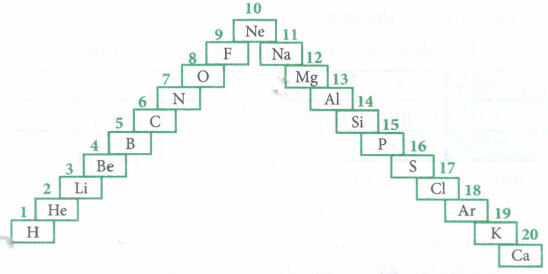
(ii) The symbols of elements are arranged in increasing order of their group numbers as follows:
| 1 | 2 | 13 | 14 | 15 | 16 | 17 | 18 |
| H | He | ||||||
| Li | Be | B | C | N | O | F | Ne |
| Na | Mg | A1 | Si | P | S | C1 | Ne |
| K | Ca |

10th Standard CBSE Syllabus & Materials
10th Standard CBSE
cbse 10th Standard Social Science HIS - The Making of a Global World Important Questions And Answers Study Material - QB365 Set C
NEW10th Standard CBSE
cbse 10th Standard Social Science HIS - The Making of a Global World Important Questions And Answers Study Material - QB365 Set B
NEW10th Standard CBSE
cbse 10th Standard Social Science HIS - The Making of a Global World Important Questions And Answers Study Material - QB365 Set A
NEW10th Standard CBSE
cbse 10th Standard Social Science ECO - Consumer Rights Important Questions And Answers Study Material - QB365 Set C



NCERT Books

Syllabus

Exam Pattern

Sample Question Papers

Previous year Question Papers

Important Notes

MCQ Practice test

NCERT Exemplers

Case study Questions

Image Based Questions

Passage based Questions

HOT Questions

Value Based Questions

Model Questions Papers
NCERT ( Book Back ) Questions

Assertion and Reason
Important Questions And Answers

CBSE 10th Standard CBSE Subjects
CBSE Standards