10th Standard CBSE Syllabus & Materials
10th Standard CBSE
cbse 10th Standard Social Science HIS - Print Culture and Modern World Important Questions And Answers Study Material - QB365 Set C
NEW10th Standard CBSE
cbse 10th Standard Social Science HIS - Print Culture and Modern World Important Questions And Answers Study Material - QB365 Set B
NEW10th Standard CBSE
cbse 10th Standard Social Science HIS - Print Culture and Modern World Important Questions And Answers Study Material - QB365 Set A
NEW10th Standard CBSE
cbse 10th Standard Social Science HIS - The Age of Industrialization Important Questions And Answers Study Material - QB365 Set C
NEW10th Standard CBSE
cbse 10th Standard Social Science HIS - The Age of Industrialization Important Questions And Answers Study Material - QB365 Set B
NEW10th Standard CBSE
cbse 10th Standard Social Science HIS - The Age of Industrialization Important Questions And Answers Study Material - QB365 Set A

Published on: 26/10/2025
Download CBSE Class 10th Standard CBSE Science question papers, sample papers, important questions, and previous year solved papers in PDF format. Get free study materials, NCERT solutions, and exam preparation resources for Class 10th Standard CBSE Science
Questions + Answers key
Take MCQ Science Test
1.
Name two plant hormones that help in stem growth.
2.
Name the following:
(i)The process in plants that links light energy with chemical energy
(ii)Organisms that can prepare their own food
(iii)The cell organelle where photosynthesis occurs
(iv)Cells that surround a stomatal pore
(v)Organisms that cannot prepare their own food
(vi)An enzyme secreted from gastric glands in stomach that acts on proteins.
3.
Name the correct substrates for the following enzymes
(i)Trypsin (ii)Amylase
(iii)Pepsin (iv)Lipase
4.
Which pancreatic enzyme is effective in digesting proteins?
5.
State the method used for growing rose plants.
6.
A woman with blonde curly hair married a man with black soft hair. All of their children in first generation had black soft hair but in next generation children had different combinations in the ratio of 9 : 3 : 3 : 1. State the law that governs this expression.
7.
A pea plant with blue colour flower denoted by BB is cross-bred with a pea plant with white flower denoted by ww.
(a) What is the expected colour of the flowers in their F4 progeny?
(b) What will be the percentage of plants bearing white flower in F2 generation, when the flowers of F4 plants were selfed?
(c) State the expected ratio of the genotype BB and Bw in the F2 progeny.
8.
Write the name and formula of a molecule made up of three atoms of oxygen
9.
Explain with an example for each, how the following provides evidences in favour of evolution in organisms :
(i) Homologous organs
(ii) Analogous organs
(iii) Fossils.
10.
How is ozone formed in the upper atmosphere? Why is the damage of ozone layer a cause of concern to us? State a cause of this damage.
11.
What is meant by "sustainable management"? Why is reuse considered better than recycling?
12.
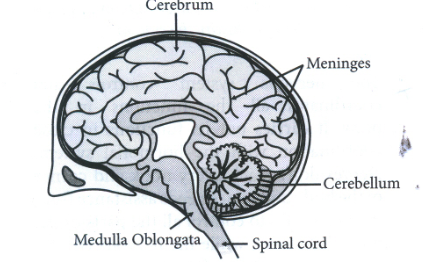
Draw a diagram of human brain and label on it the following of its parts:
(i) Cerebrum
(ii) Meninges
(iii) Medulla Oblongata
(iv) Cerebellum
13.
Cramps caused during sudden activities are due to the formation of
Ethanol
Acetic acid
Lactic acid
Excess of water
14.
In human males, the testes lie in the scrotum because it helps in the
process of mating
formation of sperm
easy transfer of gametes
all the above
15.
Two pea plants one with round green seeds (RRyy) and another with wrinkled yellow (rrYY) seeds produce F1 progeny that have round, yellow (RrYy) seeds. When F1 plants are selfed, the F2 progeny will have new combination of characters. Choose the new combination from the following:
(i) Round, yellow
(ii) Round, green
(iii) Wrinkled, yellow
(iv) Wrinkled, green
(i) and (ii)
(i) and (iv)
(ii) and (iii)
(i) and (iii)
16.
In the following groups of materials, which group(s) contains only non-biodegradable items?
(1) Wood, paper, leather
(2) Polythene, detergent, PVC
(3) Plastic, detergent, grass
(4) Plastic, Bakelite, DDT
3
4
1 and 3
2 and 4
17.
The main cause for abundant coliform bacteria in the river Ganga is
disposal of unburnt corpses into water
discharge of effluents from electroplating industries
washing of clothes
immersion of ashes
18.
(a) Write the functions of the following parts in human female reproductive system:
(i) Ovary (ii) Oviduct (iii) Uterus
(b) Describe the structure and function of placenta.
19.
Define evolution. How does it occur? Describe how fossils provide us evidences in support of evolution.
20.
(a) What is 'environmental pollution'?
(b) Distinguish between biodegradable and non-biodegradable pollutants.
(c) Choose the biodegradable pollutants from the list given below:
Sewage, DDT, radioactive waste, agricultural waste.
21.
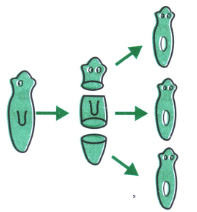
Why are budding, fragmentation and regeneration all considered as asexual types of reproduction? With neat diagrams explain the process of regeneration in Planaria.
1.
Auxin and gibberellin.
2.
(i) Photosynthesis It is a process by which green plants having chlorophyll can synthesise simple sugar (glucosc) from water and CO, using the energy of sunlight, The absorbed encrgy causes splittíng of water molecules into hydrogen and oxygen. During
this process,the light energy gets converted into chemical energy.
(ii) Autotrophs These organisms can synthesise their own food from inorganic substances present in the environment, e.g. green plants, autotrophic bacteria, etc.
(iii) Chloroplast The cells of the leaves contain special organelles called chloroplasts, which are the main sites of photosynthesis.
(iv) Guard cells Each stomatal pore is surrounded by a pair of guard cells that control their opening and closing by the inflow and outflow of water.
(v) Heterotrophs These organisms cannot make their own food from inorganic substances and depend on other organisms for their food, e.g. all animals, yeast, most bacteria, etc.
(vi) Pepsin It is a protein digesting enzyme secreted from the gastric glands present in the walls of stomach.
3.
(i)Protein
(ii)Starch
(iii)Protein
(iv)Fats
4.
Pancreatic trypsin
5.
Artificial method of vegetative propagation like cutting are used to grow rose plants.
6.
According to the Law of independent assortment " the factors of different pairs of contrasting characters do not influence each other. They are independent of one another in their assortment."
7.
-s.png)
-s.png)
8.
Ozone and its chemical formula is O3
9.
(i) Homologous organs. Those organs, which have the same basic structure but different functions are called homologous organs.
For example: The forelimbs of a man, a lizard, a frog, a bird and a bat have the same basic design of bones but they perform different functions.
The presence of homologous organs in different animals provides evidence for evolution that they are derived from the same ancestor who has the basic design of the organ on which all the homologous organs are based.
(ii) Analogous organs. Those organs, which have different basic structure but have similar appearance and perform similar functions are called analogous organs.
For example: The wings of an insect and a bird have different structures but they perform the same function of flying.
Analogous organs provide evidence for evolution that the organisms from different ancestors perform similar functions to survive, flourish and keep on evolving in prevailing environment.
(iii) Fossils. The remains of dead animals or plants that lived in the remote past are known as fossils. The fossils provided evidence for evolution.
For example: A fossil of a bird called Archaeopteryx looks like a bird but it has many other features found in reptiles. Therefore Archaeopteryx is a connecting link between the reptiles and birds and hence suggests that the birds have evolved from the reptiles.
10.
Ozone is formed in upper atmosphere by the reaction of ultraviolet (UV) radiations on oxygen (O2) molecule.
The damage to ozone layer is a cause of concern to us as due to its damage, more ultraviolet rays reach the earth's surface causing various health hazards.
\({ O }_{ 2 }\overset { UV }{ \longrightarrow } O+O\\ { O }_{ 2 }+O\longrightarrow \underset { Ozone }{ { O }_{ 3 } } \)
A cause of this damage is the presence of large amount of chlorofluorocarbons in the atmosphere.
11.
The development and management of resources in such a way which meets the current basic human needs and also preserves the resources for the needs of future generations is called sustainable management.
The process of 'reuse' is considered better than the process of 'recycling' because recycling requires the use of a large amount of energy and money whereas no energy is required for reusing materials.
12.
13.
(b)
Acetic acid
14.
(b)
formation of sperm
15.
(b)
(i) and (iv)
16.
(d)
2 and 4
17.
(a)
disposal of unburnt corpses into water
18.
Functions of:
Ovary - Ovaries are the primary reproductive organs in a woman (or female). The function of ovaries is to produce mature female sex cells called 'ova' or 'eggs' and also to secrete the female sex hormones.
Oviduct - The ovum (or egg cell) released by an ovary goes into the oviduct through its funnel shaped opening . The fertilisation of egg by a sperm takes place in the oviduct.
Uterus - The growth and development of a fertilised ovum (or fertilised egg) into a baby takes place int he uterus.
After fertilisation, zygote is formed which develops into an embryo. The embryo gets nutrition from the mother's blood with the help of a special tissue called placenta. This is a disc which is embedded in the uterine wall. It contains finger-like projections called villi on the embryo's side of the tissue. On the mother's side are blood spaces, which surround the villi. This provides a large surface area for glucose and oxygen to pass from the mother to the embryo. In this way, the embryo gets its nutrition.
19.
Evolution is the sequence of gradual changes which take place in the primitive organisms over millions of years in which new species are produced.
(a)It is through the constant process of evolution taking place in the organisms since the origin of life that such an enormous variety of plants and animals have come to exist on this earth at present.
(b)There is an inbuilt tendency to variation during reproduction due to errors in DNA copying and as a result of sexual reproduction.
(c) Fossils are the remains of impressions of dead plants or animals which died millions of
years ago. They study of fossils helps us to know about the evolution of species. Fossils tell us how new species are developed from the old. Fossils provide evidence of evolution by revealing characteristics of past organisms and the changes that have occurred these organisms to give rise to present organisms. Therefore, fossils have an importance in deciding evolutionary relationship.
20.
(a) Environmental pollution is an undesirable change in the physical, chemical or biological characteristics of the natural environment, brought about by man's activities. This pollution may affect the soil, rivers, seas or the atmosphere.
| Bio-degradable pollutants | Non-biodegradable pollutants |
| (i) These pollutants can broken down into non-poisonous substances in nature by the action of microorganisms. |
(i) These pollutants cannot be broken down into non-poisonous substances by microorganisms. |
| (ii) They get recycled thus, do not need any dumping sites. | (ii) They cannot be recycled thus, require dumping sites. |
| (iii) These are generally obtained from living things. | (iii) These are generally obtained from non-living things. |
| (iv) They cause minimum environmental pollution. | (iv) They cause environmental pollution. |
(c) Biodegradable pollutants are sewage and agricultural waste.
21.
Budding, fragmentation and regeneration are considered as asexual types of reproduction because gamete formation does not happen during these modes of reproduction and a single parent carries out the process of reproduction.
The above figures shows regeneration in planaria:
When the body of planaria is cut off into several part, each part regenerates its complementary part to develop into a new individual.

10th Standard CBSE Syllabus & Materials
10th Standard CBSE
cbse 10th Standard Social Science HIS - The Making of a Global World Important Questions And Answers Study Material - QB365 Set C
NEW10th Standard CBSE
cbse 10th Standard Social Science HIS - The Making of a Global World Important Questions And Answers Study Material - QB365 Set B
NEW10th Standard CBSE
cbse 10th Standard Social Science HIS - The Making of a Global World Important Questions And Answers Study Material - QB365 Set A
NEW10th Standard CBSE
cbse 10th Standard Social Science ECO - Consumer Rights Important Questions And Answers Study Material - QB365 Set C



NCERT Books

Syllabus

Exam Pattern

Sample Question Papers

Previous year Question Papers

Important Notes

MCQ Practice test

NCERT Exemplers

Case study Questions

Image Based Questions

Passage based Questions

HOT Questions

Value Based Questions

Model Questions Papers
NCERT ( Book Back ) Questions

Assertion and Reason
Important Questions And Answers

CBSE 10th Standard CBSE Subjects
CBSE Standards