10th Standard CBSE Syllabus & Materials
10th Standard CBSE
cbse 10th Standard Social Science HIS - Print Culture and Modern World Important Questions And Answers Study Material - QB365 Set C
NEW10th Standard CBSE
cbse 10th Standard Social Science HIS - Print Culture and Modern World Important Questions And Answers Study Material - QB365 Set B
NEW10th Standard CBSE
cbse 10th Standard Social Science HIS - Print Culture and Modern World Important Questions And Answers Study Material - QB365 Set A
NEW10th Standard CBSE
cbse 10th Standard Social Science HIS - The Age of Industrialization Important Questions And Answers Study Material - QB365 Set C
NEW10th Standard CBSE
cbse 10th Standard Social Science HIS - The Age of Industrialization Important Questions And Answers Study Material - QB365 Set B
NEW10th Standard CBSE
cbse 10th Standard Social Science HIS - The Age of Industrialization Important Questions And Answers Study Material - QB365 Set A

Published on: 26/10/2025
Download CBSE Class 10th Standard CBSE Science question papers, sample papers, important questions, and previous year solved papers in PDF format. Get free study materials, NCERT solutions, and exam preparation resources for Class 10th Standard CBSE Science
Questions + Answers key
Take MCQ Science Test
1.
Why is the series arrangement not used for connecting domestic electric appliances in a circuit?
2.
What part of the brain is responsible for precision of voluntary action?
3.
What are photoreceptors?
4.
What does an electric current carrying wire behaves like?
5.
What is the main difference between sperms and eggs of humans? Write the importance of this difference.
6.
Comment on "Green plants are called producers".
7.
Write the molecular formula of the following:
(i) Hexane, (ii) Benzene
8.
Which of the following is not an involuntary action?
Vomiting
Salivation
Heart beat
Chewing
9.
When a person is suffering from severe cold, he or she cannot
Differentiate the taste of an apple from that of an ice cream
differentiate the smell of a perfume from that of an agarbatti
Differentiate red light from green light
Differentiate a hot object from a cold object
10.
A positively charged particle (alpha-particle) projected towards west is deflected towards north by a magnetic field. The direction of magnetic field is
towards south
towards east
downward
upward
11.
The main constituent of biogas is
Methane
Carbon dioxide
Hydrogen
Hydrogen sulphide
12.
The strength of magnetic field inside a long current carrying straight solenoid is
More at the ends than at the centre
Minimum in the middle
Same at all points
Found to increase from one end to the other.
13.
Butanone is a four-carbon compound with the functional group
carboxylic acid
aldehyde
ketone
alcohol
14.
Which of the following gives the correct increasing order of the atomic radii of O, F and N?
O,F,N
N,F,O
O,N,F
F,O,N
15.
Which of the following elements would lose an electron easily?
Mg
Na
K
Ca
16.
The least distance of distinct vision for a young adult with normal vision is about
25 m
2.5 cm
25 cm
2.5 m
17.
18.
In our country, there are attempts to increase the height of several existing dams like Tehri and Almati, dams across Narmada. Choose the correct statements among the following that are a consequence of raising the height of dams
(i) Terrestrial flora and fauna of the area is destroyed completely
(ii) Dislocation of people and domestic animals living in the area
(iii) Valuable agricultural land may be permanently lost
(iv) It will generate permanent employment for people
(i) and (ii)
(i), (ii) and (iii)
(ii) and (iv)
(i), (iii) and (iv)
19.
Identify the circuit in which the electrical components have been properly connected.
-q.png)
-q.png)
-q.png)
-q.png)
20.
In an attempt to demonstrate electrical conductivity through an electrolyte, the following apparatus shown below was set up.
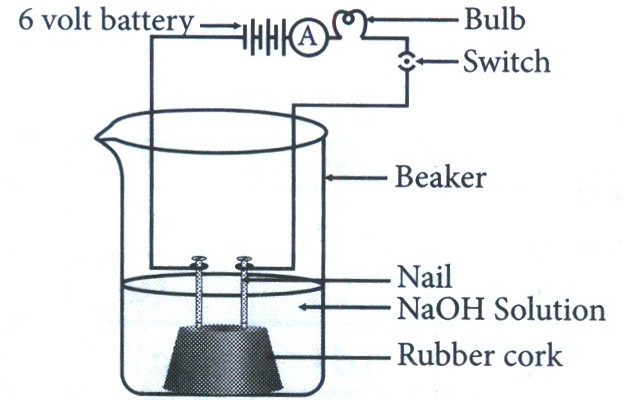
which among the following statement(s) is (are) correct?
(i) Bulb will not glow because electrolyte is not acidic
(ii) Bulb will glow because NaOH is a strong base and furnishes ions for conduction.
(iii) Bulb will not glow because circuit is incomplete.
(iv) Bulb will not glow because it depends upon the type of electrolytic solution.
(i) and (iii)
(ii) and (iv)
(ii) only
(iv) only
21.
Which of the following statement is true for a balanced chemical equation?
Number of atoms of each element are equal on both the sides
Law of conservation of mass holds true
Law of conservation of mass does not hold true
Both A and B
22.
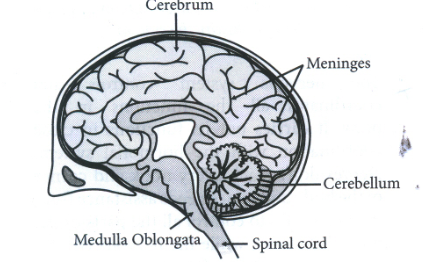
Draw a diagram of human brain and label on it the following of its parts:
(i) Cerebrum
(ii) Meninges
(iii) Medulla Oblongata
(iv) Cerebellum
23.
Give reasons for the following:
(i)The glottis is guarded by epiglottis
(ii)The lung alveoli are covered with blood capillaries.
(iii)The wall of trachea is supported by cartilage rings.
24.
How 'respiration' different from 'breathing'? Explain the processes of 'aerobic' respiration and 'anaerobic' respiration.
25.
Distinguish between an electric motor and generator?
26.
The magnification produced by a plane mirror is +1. What does it mean?
27.
(i) What is meant by the term hydrated salt?
(ii) Give two examples of hydrated salt which are white and state their chemical formula.
28.
When a copper wire was left in silver nitrate solution for sometime, it was observed that the solution turned bluish green.
(i) Explain the observation.
(ii) Write the balanced chemical equation to represent the change taking place.
29.
What happens when the solution of baking soda is heated? Write the chemical equation for the same. Name the product which is responsible for making the bread or cake spongy and fluffy.
30.
What are fossil fuels?
31.
Chlorine, bromine and iodine form a Dobereiner's triad. The atomic masses of chlorine and iodine are 35.5 and 126.9 respectively. Predict the atomic mass of bromine.
32.
List two natural ecosystems
33.
Explain the important of soil for plant growth.
34.
Describe the process of urine formation in kidneys.
35.
What is an alloy? How is an alloy made? List two purpose of making alloys. Mention the constituents and two properties of each of the following alloys.
(i) Stainless steel
(ii) Brass
36.
Distinguish between a gamete and zygote. Explain their roles in sexual reproduction.
37.
What are detergents chemically? List two merits and two demerits of using detergents for cleansing. State the reason for the suitability of detergents for washing, even in the case of water having calcium and magnesium ions.
38.
(a) State the laws of refraction of light. Give an expression to relate the absolute refractive index of a medium with speed of light in vacuum.
(b) The refractive indices of water and glass with respect to air are 4/3 and 3/2 respectively. If the speed of light in glass is \({ 2\times 10 }^{ 8 }\) ms-1, find the speed of light in (i) air, (ii) water.
1.
In a domestic circuit, parallel connection of devices is preferable for several reasons:
a. In series connection, if one of the devices is defective, if one of the devices is defective, then the current of the entire circuit is cut off. As a result, all the devices stop working. In parallel connection, even if one device is defective, the others continue working.
b. In series connection, selective operation of devices is not possible, but this is not so in the case of parallel connection.
c. In series connection, the same current passes through all the devices, regardless of the fact that different devices require different values of current to operate. In parallel connection, different values of current can be obtained for different devices according to their requirements.
2.
Cerebellum.
3.
The receptors present in our eyes are called photoreceptors, as they are light sensitive.
4.
It behaves like a magnet.
5.
The main difference lies in the difference in the sex chromosome of sperm (male gamete) and egg (female gamete). The main difference between sperms and eggs of humans is that half of the sperms of a male (father) will have X chromosomes and the other half will have Y chromosomes. All the eggs of female (mother) will have only X chromosomes.
Importance.
(a) If the father contributes X chromosome, then the baby born will be a girl.
(b) If the father contributes Y chromosome, then the baby born will be a boy. Thus, the sperm determines the sex of a child.
6.
Green plants are called 'producers' because they can produce food by photosynthesis in the presence of sunlight.
7.
(i) Hexane: C6H14
(ii) Benzene: C6H6
8.
(d)
Chewing
9.
(b)
differentiate the smell of a perfume from that of an agarbatti
10.
(d)
upward
11.
(a)
Methane
12.
(c)
Same at all points
13.
(c)
ketone
14.
(d)
F,O,N
15.
(c)
K
16.
(c)
25 cm
17.
(d)
18.
(b)
(i), (ii) and (iii)
19.
(b)
20.
(c)
(ii) only
21.
(d)
Both A and B
22.
23.
(i)The glottis is gaurded by epiglottis because it prevents the entry of food in wind pipe. If the food enters wind pipe, then it chokes it, leading to the death of the person.
(ii)The lung alveoli are covered with blood vessels because the oxygen that we inhale dissolves in the blood, present in these blood capillaries only, as it reaches the lungs.
(iii)The wall of trachea is supported by cartilage rings because these rings prevent the air passage from collapsing.
24.
Breathing is the process by which oxygen is taken in (inhalation) and carbon dioxide is released out (exhalation). Respiration involves the oxidation of the food we eat to release energy. Carbon dioxide produced as a result of this is released out during exhalation.
Aerobic respiration: During aerobic respiration, the oxidation of food takes place in the presence of oxygen. Aerobic respiration can be summarised by the given equation:
\({ C }_{ 6 }{ H }_{ 12 }{ O }_{ 6 }+{ 6O }_{ 2 }\longrightarrow { 6CO }_{ 2 }+{ 6H }_{ 2 }O+Energy\)
Anaerobic respiration: During anaerobic respiration, food is broken down in the absence of oxygen. It is also known as fermentation and is more common in microorganisms such as yeast.
Sometimes pyruvate gets converted into lactic acid in muscles by the process of anaerobic respiration.
\({ C }_{ 6 }{ H }_{ 12 }{ O }_{ 6 }\xrightarrow [ ]{ Absenceofoxygen } Alcohol+{ CO }_{ 2 }+{ H }_{ 2 }O+Energy\)
25.
The major differences between an electric motor and generator are stated below:
Electric Motor:
1. It converts electrical energy into mechanical energy.
2. It needs electrical energy for its works.
3. They are used as water pumps, marble grinders etc.
Generator:
1. It converts mechanical energy into electrical energy
2. It needs mechanical energy for its working.
3. They are used as water pumps, marble grinders etc.
4. diesel generator, hydro-electric generator are the examples of it.
26.
If magnification is 1, the image size is same as that of object size.
Since, magnification is positive, the image is erect and virtual.
27.
(i) Salt that contains water of crystallisation.
(ii)Washing soda - Na2CO3.10H2O
Gypsum - CaSO4.2H2O
Plaster of pans - CaSO4.\(1\over 2\)H2O
28.
(i) Copper is more reactive than silver. Hence, when copper wire is dipped in silver nitrate solution, it displaces silver from AgNO3 solution forming copper nitrate which is bluish green in colour.
\((ii)\quad Cu+2AgN{ O }_{ 3 }\longrightarrow \underset { Copperr\quad (II)\quad nitrate\\ bluish\quad green }{ Cu{ (N{ O }_{ 3 }) }_{ 2 } } +\underset { Silver }{ 2Ag } \)
29.
When baking soda is heated, it decomposes to produce sodium carbonate, water and CO2 gas.
\(2NaHCO_3 \xrightarrow{\Delta} Na_2CO_3 + H_2O+ CO_2\)
CO2 gas produced during the reaction makes the cake or bread spongy and fluffy.
30.
()
Fuels which are formed from the fossil remains of plants and animals and are obtained from under the earth's crust are called fossil fuels. Example coal, petroleum and natural gas.
31.
()
Atomic mass of Br = 35.5 + 126.9 / 2
= 162.4 / 2 = 81.2
32.
()
Lake and pond
33.
(i)Anchoring the plant
(ii)Source of water and minerals
(iii)Availability of oxygen for respiration of root cells
(iv)Symbiotic association with microbes.
34.
The mechanism of urine formation includes three steps namely,
(i) Glomerular ultra-filtration
(ii) Tubular reabsorption
(iii) Tubular secretion
(i)Glomerular Ultrafiltration:
Ultrafiltration of blood takes place inthe Malphighian body which acts as a biological filter. A Malphighian body comprises of Bowman's capsule and glomeruli.
The blood from the kidney flows through the capillaries of glomerulus where the blood pressure, is comparatively high and so brings about effective filtration. The hydrostatic pressure of the blood is always greater than the opposing pressures existing in the plasma protein and renal capillaries. Thus, the available net filtering force is chiefly responsible for glomerular filtration. The fluid in the capsule which is obtained by this process is termed glomerular filtrate. In man it is about 125ml/min. In 24 hours, the total volume of glomerular filtrate is 170 to 180 litres.
(ii) Tubular Reabsorption: Reabsorption takes place in the 'uriniferous tubules. Reabsorption of useful substances is a differential or selective process. The glomerular filtrate contains many useful substances such as glucose, amino acids, mineral salts and vitamins dissolved in large amount of water. Substances such as glucose, sodium and calcium, are actively reabsorbed in large quantities. Substances like urea and uric acid etc are reabsorbed in small quantities by a simple diffusion process or passive reabsorption. Substances like creatinine are not reabsorbed. They are completely eliminated.
Proximal convoluted tubule is responsible for the reabsorption of water, glucose, sodium phosphate and bicarbonates. On entering the distal convoluted tubule, the urine becomes nearly isotonic to the surrounding tissue fluid due to the active transport of sodium and passive transport of water. As urine (isotonic) passes into the collecting tubule it becomes once again hypertonic by the osmotic reabsorption of water under the influence of the hormone ADH. Thus the urine formed contains 96% of water, 2% urea and 2% of the metabolic products.
(iii) Tubular Secretion: This is the final step in the formation of urine during which the walls of tubule actively remove additional waste substances which are harmful to the body from the blood that have escaped filtration.
35.
(i) An alloy is a homogenous mixture of two or more metals. It sometimes contains a non -metal component also.
(ii) It is made by heating the components in a definite proportion and then uniformly mixing them in the molten state and then cooling.
(iii) Two purposes of making alloys are:
(a) To make a substance resistant to corrosion
(b) To make a substance strong and hard
(iv) Constituents of Stainless steel:
Iron, nickel, and chromium
(v) Two properties of stainless steel are:
(a) It is resistant to corrosion.
(b) It is more durable.
(vi) Constituents of Brass:
Copper and Zinc
(vii) Two properties of brass are:
(a) It is resistant to corrosion.
(b) It is more malleable.
36.
Gamete is formed as a result of meiosis in gametogenic cells. Zygote is formed after fusion of two different kinds of gametes. Different types of gametes are formed by different parents. Zygote is formed in the female reproductive part only.
Role of gamete in sexual reproduction: Gamete formation results in halving of number of chromosomes which is necessary to maintain the number of chromosomes in an organism which reproduces sexually.
Role of zygote in sexual reproduction: Zygote formation makes the number of chromosome equal to the somatic cells. further, it is the zygote which undergoes mitosis to develop into an embryo and subsequently into a new individual.
37.
Detergents chemically are sodium or potassium salts of sulphonic acid of benzene or alkene.
Merits:
(i) They work well with hard water.
(ii) They are more effective than soaps.
Demerits:
(i) They are expensive.
(ii) Some of them having branching are non-biodegradable, therefore create water pollution.
Detergents are suitable for hard water having Mg2+ and Ca2+ ions because they do not form insoluble salts with Mg2+ and Ca2+ ions.
38.
(a) Laws of Refraction:
(i) The first law of refraction of light states that the incident ray, the refracted ray and the normal at the point of incidence, all lie in the same plane.
(ii) The second law of refraction of light is the Snell's Law of Refraction. It state that the ratio of sine of the angle of incidence to the sine of angle of refraction is a constant for a given pair of medium.
\(\frac { sin\quad i }{ sin\quad r } =Constant(n)\)
This constant (n) is called refractive index of the medium.
(i) When the light is going from vacuum to another medium, then the value of refractive index is called the absolute refractive index.
(ii) The ratio of speed of light in vacuum to the speed of light in a medium is called the absolute refractive index of that medium,
i.e.
Absolute refractive index (of a medium)
\(=\frac { Speed\quad of\quad light\quad in\quad vacuum(c) }{ Speed\quad of\quad light\quad in\quad medium(v) } \)
(b) \(_{ a }{ { n }_{ w } }=\frac { 4 }{ 3 } ,_{ a }{ { n }_{ g } }=\frac { 3 }{ 2 } \)
Speed of light in glass, vg= 2 x 10⁸ m/s
Speed of light in air, vg= ?
Speed of light in water, vw =?
\(_{ a }{ { n }_{ w } }=\frac { { v }_{ a } }{ { v }_{ w } } \)
\(\Rightarrow \frac { 4 }{ 3 } =\frac { { v }_{ a } }{ { v }_{ w } } \) ...(i)
\(_{ a }{ { n }_{ g } }=\frac { { v }_{ a } }{ { v }_{ g } } \)
\(\Rightarrow \frac { 3 }{ 2 } =\frac { { v }_{ a } }{ 2\times { 10 }^{ 8 } } \)
-S.png)
Putting the value of va in equation (i),
\(\frac { 4 }{ 2 } =\frac { 3\times { 10 }^{ 8 } }{ { v }_{ w } } \)
\(\Rightarrow { v }_{ w }=3\times { 10 }^{ 8 }\times \frac { 3 }{ 4 } =\frac { 9 }{ 4 } \times { 10 }^{ 8 }\)
=2.25x10⁸ m/s.

10th Standard CBSE Syllabus & Materials
10th Standard CBSE
cbse 10th Standard Social Science HIS - The Making of a Global World Important Questions And Answers Study Material - QB365 Set C
NEW10th Standard CBSE
cbse 10th Standard Social Science HIS - The Making of a Global World Important Questions And Answers Study Material - QB365 Set B
NEW10th Standard CBSE
cbse 10th Standard Social Science HIS - The Making of a Global World Important Questions And Answers Study Material - QB365 Set A
NEW10th Standard CBSE
cbse 10th Standard Social Science ECO - Consumer Rights Important Questions And Answers Study Material - QB365 Set C



NCERT Books

Syllabus

Exam Pattern

Sample Question Papers

Previous year Question Papers

Important Notes

MCQ Practice test

NCERT Exemplers

Case study Questions

Image Based Questions

Passage based Questions

HOT Questions

Value Based Questions

Model Questions Papers
NCERT ( Book Back ) Questions

Assertion and Reason
Important Questions And Answers

CBSE 10th Standard CBSE Subjects
CBSE Standards