10th Standard CBSE Syllabus & Materials
10th Standard CBSE
cbse 10th Standard Social Science HIS - Print Culture and Modern World Important Questions And Answers Study Material - QB365 Set C
NEW10th Standard CBSE
cbse 10th Standard Social Science HIS - Print Culture and Modern World Important Questions And Answers Study Material - QB365 Set B
NEW10th Standard CBSE
cbse 10th Standard Social Science HIS - Print Culture and Modern World Important Questions And Answers Study Material - QB365 Set A
NEW10th Standard CBSE
cbse 10th Standard Social Science HIS - The Age of Industrialization Important Questions And Answers Study Material - QB365 Set C
NEW10th Standard CBSE
cbse 10th Standard Social Science HIS - The Age of Industrialization Important Questions And Answers Study Material - QB365 Set B
NEW10th Standard CBSE
cbse 10th Standard Social Science HIS - The Age of Industrialization Important Questions And Answers Study Material - QB365 Set A

Published on: 26/10/2025
Download CBSE Class 10th Standard CBSE Science question papers, sample papers, important questions, and previous year solved papers in PDF format. Get free study materials, NCERT solutions, and exam preparation resources for Class 10th Standard CBSE Science
Questions + Answers key
Take MCQ Science Test
1.
Why does dry HCl gas not change the colour of the dry litmus paper?
2.
How do auxins promote the growth of a tendril around a support?
3.
Explain with help of a labelled diagram, the cause of twinkle of stars.
4.
What are the limitations of electrical impulse?
5.
A student has difficulty in reading the blackboard while sitting in the last row. What could be the defect the child is suffering from? How can it be corrected?
6.
While diluting an acid, why is it recommended that the acid should be added to water and not water to the acid?
7.
Why does distilled water not conduct electricity, whereas rain water does?
8.
How is the movement of leaves of the sensitive plant different from the movement of a shoot towards light?
9.
Observe the following diagram showing an image formation in an eye
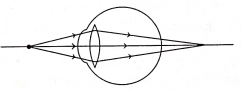
(i) ldentify the defect of vision shown in the figure.
(ii) List its two causes and suggest a suitable Corrective lens to overcome this defect.
10.
In the picture given below, a swimmer Inside the water in a swimming pool looks at an aeroplane flying the sky.
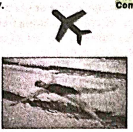
(i) For the swimmer, the aeroplane will appear lower or higher than it actually is? Give reason for the answer.
(ii) Name the phenomena associated with it.
(iii) Name any other phenomena associated with it.
11.
A solution turns red litmus blue; its pH is likely to be?
1
4
5
10
12.
Which of the following statement is not correct?
All metal carbonates react with acid to give a salt, water and carbon dioxide
All metal oxides react with water to give salt and acid
Some metals react with acids to give salt and hydrogen
Some non-metal oxides react with water to form an acid
13.
The gap between two neurons is called as
Dendrite
Synapse
Axon
Impulse
14.
The least distance of distinct vision for a young adult with normal vision is about
25 m
2.5 cm
25 cm
2.5 m
15.
Receptors are specialised tips of
Muscle cells
Glands
Sense organs
Nerve cells
16.
Compounds such as alcohols and glucose also contain hydrogen but are not categorised as acids. Describe an activity to prove it.
17.
State the structural and the functional unit of the nervous system. Draw its neat labelled diagram and write two functions.
18.
Draw the structure of a neuron and explain its function.
19.
Draw a neat labelled diagram of human eye and explain the working of each part of it.
1.
Dry HCl gas does not contain any H+ or H3O+ ions, so it does not show any acidic property. Hence, it does not change the colour of dry litmus paper. To show its acidic behaviour, it needs wet litmus paper.
2.
Auxins promote cell elongation and are present at the shoot tip. When tendril comes in contact with a support, auxin stimulates faster growth of the cells on the opposite sides. Thus, the tendril coils around the support.
3.
(i) The twinkling of a star is due to atmospheric refraction of starlight. The atmospheric refraction occurs in a medium of gradually changing refractive index. Since the atmosphere bends starlight towards the normal, the apparent position of the actual position. This apparent position of the star is not stationary but keeps on changing slightly as the physical conditions of the earth's atmosphere are not stationary.
(ii) Since the stars are very distant, they act as point-sized sources of light. As the path of rays of light coming from the star goes on varying slightly, the apparent position of the star fluctuates and the amount light entering the eyes flickers-the star sometimes appears brighter and at other times appears fainter, which is the twinkling effect.
4.
It reaches only to target organs and it cannot recreate the signal again
5.
Since, the child cannot see distant objects, it means that he is suffering from myopia. The image is formed before the retina in case of myopic eye. It can be corrected by using concave lens of suitable focal length.
6.
Dilution of a concentrated acid is a highly exothermic reaction and a lot of heat is generated. Care must be taken while mixing concentrated acid with water. The acid must always be added slowly to water with constant stirring. If water is added to the concentrated acid, the heat generated may cause the mixture to splash out and cause burns. The glass container may also break due to excessive local heating.
7.
Distilled water does not contain any ions and have no electrolytes. Hence, it does not conduct electricity. But in rain water, a small amount of electrolyte is present in the form of acids. These acids are produced due to dissolution of acidic oxides (e.g. SO2, NO2) in rain water and make it a better conductor of electricity.
8.
Differences between movement of leaves and movement of shoot towards light are as follows:
| Movement of Leaves(Sensitive Plant) | Movement of Shoot |
| This movement is independent of growth | This movement is dependent on growth. |
| Stimulus is touch. | Stimulus is light. |
| Movement is not directional. | Movement is directional. |
| Movement is neither away nor towards the stimulus. | Movement is towards the stimulus. |
9.
(1) Since the light rays from a nearby object are focused at a point behind the retina, the defect shown in the ray diagram is hypermetropia.
(2) This defect arises either because the focal length of the eye lens is too long or the eyeball has become too small.
(3) To correct this defect of vision, a convex lens is used, which has the ability to converge incoming rays for forming the image on the retina.
(4) Since a convex lens has the ability to converge incoming rays, it can be used to correct this defect of vision. The ray diagram for the corrective measure for a hypermetropic eye is shown in the given figure:

10.
(i) For the swimmer the aeroplane will appear to be higher than it actually is. As water is a denser medium, so when light travels from water to air, i.e. denser to rarer, it will bend away from the normal as a result of which aeroplane will appear to be higher than its actual position.
(ii) Atmospheric refraction
(iii) Stars seem to be at higher distance than they actually are.
11.
(d)
10
12.
(b)
All metal oxides react with water to give salt and acid
13.
(b)
Synapse
14.
(c)
25 cm
15.
(d)
Nerve cells
16.
Alcohols and glucose contain hydrogen but are not categorised as acids because they do not ionise in the solution to produce H+ (aq) ions and hence can't conduct electricity.
Activity Set the apparatus as shown below and test for the solution of HCI, alcohol and glucose.
Observation
(i) The bulb glows when dil. HCI was added to beaker.
(ii) The bulb did not glow when alcohol and glucose solution was added to the beaker.
Conclusion
(i) Alcohol and glucose cannot form ions in solution and hence, can't conduct electricity.
(ii) Dil. HCl solution forms (aq) H+ ions and hence, can conduct electricity suggesting that electric current is carried through the solution by ions formed by them.
17.
The structural and functional unit of the nervous system is called neuron
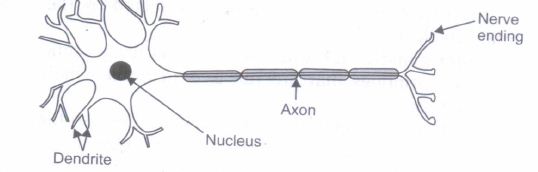
Two functions of neuron: .
(a) Neurons receive signals from a sense organ.
(b) Neurons send signals to a muscle or a gland.
18.
Functions of a neuron
The neuron receives information from receptors as electrical impulse present at its dendritic end. The impulse then travels from dendrite to the cell body and further along axon to its end. At the end of axon, electrical impulse leads to the release of some chemicals.
These chemicals cross the synapse and reach the next neuron. This is how nerve impulses travel through the body. Thus, neurons are important in receiving information from the surroundings and in sending it to the effector.
19.
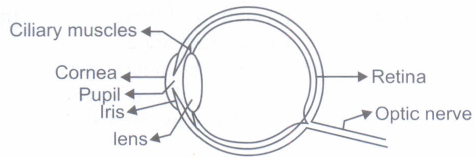
Working of Human eye
Human eye consists of various parts which helps us in seeing the objects, the function of various parts are:
(a) Cornea: It is the transparent membrane which refracts the light entering our eye.
(b) Iris: Iris controls the size of pupil.
(c) Pupil: It allows the light entering our eye to pass through it.
(d) Lens: Refracts the light of the objects at different places on retina.
(e) Ciliary muscles: Helps in changing the focal length of the lens.
(f) Retina: It is the screen of the eye on which image is formed. It consists of rods and cones .
(g) Optic nerve: It carries the electrical signals from retina to brain.

10th Standard CBSE Syllabus & Materials
10th Standard CBSE
cbse 10th Standard Social Science HIS - The Making of a Global World Important Questions And Answers Study Material - QB365 Set C
NEW10th Standard CBSE
cbse 10th Standard Social Science HIS - The Making of a Global World Important Questions And Answers Study Material - QB365 Set B
NEW10th Standard CBSE
cbse 10th Standard Social Science HIS - The Making of a Global World Important Questions And Answers Study Material - QB365 Set A
NEW10th Standard CBSE
cbse 10th Standard Social Science ECO - Consumer Rights Important Questions And Answers Study Material - QB365 Set C


NCERT Books

Syllabus

Exam Pattern

Sample Question Papers

Previous year Question Papers

Important Notes

MCQ Practice test

NCERT Exemplers

Case study Questions

Image Based Questions

Passage based Questions

HOT Questions

Value Based Questions

Model Questions Papers
NCERT ( Book Back ) Questions

Assertion and Reason
Important Questions And Answers

CBSE 10th Standard CBSE Subjects
CBSE Standards