
10th Standard CBSE Syllabus & Materials
10th Standard CBSE
cbse 10th Standard Social Science HIS - Print Culture and Modern World Important Questions And Answers Study Material - QB365 Set C
NEW10th Standard CBSE
cbse 10th Standard Social Science HIS - Print Culture and Modern World Important Questions And Answers Study Material - QB365 Set B
NEW10th Standard CBSE
cbse 10th Standard Social Science HIS - Print Culture and Modern World Important Questions And Answers Study Material - QB365 Set A
NEW10th Standard CBSE
cbse 10th Standard Social Science HIS - The Age of Industrialization Important Questions And Answers Study Material - QB365 Set C
NEW10th Standard CBSE
cbse 10th Standard Social Science HIS - The Age of Industrialization Important Questions And Answers Study Material - QB365 Set B
NEW10th Standard CBSE
cbse 10th Standard Social Science HIS - The Age of Industrialization Important Questions And Answers Study Material - QB365 Set A

Published on: 26/10/2025
Download CBSE Class 10th Standard CBSE Science question papers, sample papers, important questions, and previous year solved papers in PDF format. Get free study materials, NCERT solutions, and exam preparation resources for Class 10th Standard CBSE Science
Questions + Answers key
Take MCQ Science Test
1.
Which of the following are present in a dilute aqueous solution of hydrochloric acid?
\(H_3O^++CH^-\)
\(H_3O^++OH^-\)
\(Cl^-+OH^-\)
unionised HCl
2.
Which of the following is a plant hormone?
Insulin
Thyroxin
Oestrogen
Cytokinin
3.
The substance that triggers the fall of mature leaves and fruits from plants is due to
Auxin
Gibberellin
Abscissic acid
Cytokinin
4.
Which of the following property of a proton can change while it moves freely in a magnetic field ?
mass
speed
velocity
momentum
5.
Choose the incorrect statement
We are encouraged to plant more trees so as to ensure clean environment and also provide biomass fuel.
Gobar-gas is produced when crops. vegetable wastes etc., decomposes in the absence of oxygen.
The main ingredient of biogas is ethane and it gives a lot of smoke and also produces a lot of residual ash.
Biomass is a renewable source of energy
6.
Commercial electric motors do not use
An electromagnet to rotate the armature
Effectively large number of turns of conducting wire in the current carrying coil
A permanent magnet to rotate the armature
A soft iron core on which the coil is wound
7.
What type of oxide would Eka-aluminium form?
EO3
E3O2
E2O3
EO
8.
On moving from left to right in a period in the periodic table, the size of the atom.
increases
decreases
does not change appreciably
first decreases and then increases
9.
The danger signals installed at the top of tall buildings are red in colour. These can be easily seen from a distance because among all other colours, the red light
is scattered the most by smoke or fog
is scattered the least by smoke or fog
is absorbed the most by smoke or fog
moves faster in air
10.
The pH range most conductive for life of fresh water plants and animals is
6.5 - 7.5
2.0 - 3.5
3.5 - 5.0
9.0 - 10.5
11.
Select the incorrect statement
Economic development is linked to environmental conservation
Sustainable development encourages development for current generation and conservation of resources for future generations
Sustainable development does not consider the viewpoints of stakeholders
Sustainable development is a long planned and persistent development
12.
A student carries out an experiment and plots the V-I graph of three samples of nichrome wire with resistances R1, R2 and R3 respectively. Which of the following is true?
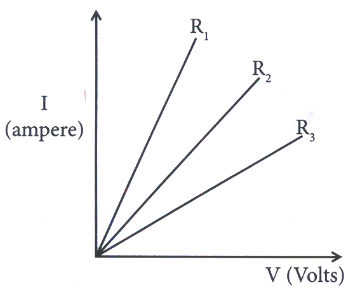
R1 = R2 = R3
R1 > R2 > R3
R3 > R2 > R1
R2 > R3 > R1
13.
The correct electron dot structure of a water molecule is
-q.jpg)
-q.jpg)
-q.jpg)
-q.jpg)
14.
During an exothermic reaction
Heat is absorbed
There is no heat transfer
Heat can either be absorbed or evolved
Heat is evolved.
15.
What is the S.I. unit of electric potential?
16.
Name the part of hind brain which takes part in regulation of respiration.
17.
Write the components of central nervous system.
18.
Who discovered that mechanical motion can produce current?
19.
Write the name and formula of the 2nd member of homologous series having general formula CnH2n .
20.
A new born has an XX pair of chromosomes. What is the sex of the new born baby?
21.
Write down three main differences between auxin and cytokinin.
22.
How are oxygen and carbon dioxide transported in human beings? How are lungs designed to maximize the area for exchange of gases?
23.
What is 'translocation'? Why is it essential for plants?Where in plants are the following synthesized:
(i)Sugar (ii)Hormones
24.
Distinguish between permanent magnet and electromagnet.
25.
Give any two ways in which non-biodegradable substances would affect the environment.
26.
15 mL of water and 10 mL of sulphuric acid are to be mixed in a beaker
(i) State the method that should be followed with reason.
(ii) What is this process called?
27.
A student takes three beakers A, B and C filled with aqueous solution of glucose, alcohol and hydrochloric acid respectively as shown in the following figure:
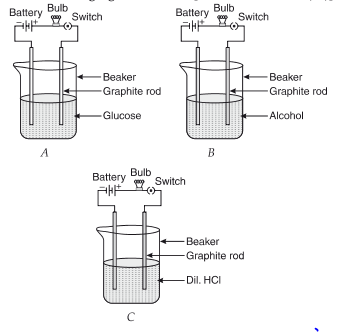
(i) State your observation in terms of glowing of the bulb when the switch is on.
(ii) Justify your observations by giving a reason in each case.
(iii) Mention the change noticed with appropriate reason if the content of beaker B is replaced by sodium hydroxide solution.
28.
When a copper wire was left in silver nitrate solution for sometime, it was observed that the solution turned bluish green.
(i) Explain the observation.
(ii) Write the balanced chemical equation to represent the change taking place.
29.
How will you infer with the help of an experiment that the same current flows through every part of the circuit containing three resistances in series connected to a battery?
30.
How do carbohydrates, proteins and fats get digested in human beings?
31.
Explain the mechanism of photosymthesis.
32.
An element A burns with golden flame in air. It reacts with another element B, atomic number 17 to give a product C. An aqueous solution of product C on electrolysis gives a compound D and liberates hydrogen. Identify A, B, C and D. Also write down the equations for the reactions involved.
33.
(a) What is an 'activity series' of metals? Arrange the metals Zn, Mg, Al, Cu and Fe in a decreasing order of reactivity.
(b) What would you observe when you put
(i) Some zinc pieces into blue copper sulphate solution?
(ii) Some copper pieces into green ferrous sulphate solution?
(c) Name a metal which combines with hydrogen gas. Name the compound formed.
34.
Draw the possible isomers of the compound it molecular formula C3H6O and also give their electron dot structures.
35.
Distinguish between a gamete and zygote. Explain their roles in sexual reproduction.
36.
(a) Draw ray diagram to show the refraction of light through a glass slab and mark angle of refraction and the lateral shift suffered by the ray of the light while passing through the slab.
(b) If the refractive index of glass for light going from air to glass is 3/2, find the refractive index of air for light going from glass to air.
37.
What is energy?
38.
Why was the system of classification of elements into triads not found suitable?
39.
State an instance where human intervention saved the forests from destruction.
1.
(a)
\(H_3O^++CH^-\)
2.
(d)
Cytokinin
3.
(c)
Abscissic acid
4.
(d)
momentum
5.
(c)
The main ingredient of biogas is ethane and it gives a lot of smoke and also produces a lot of residual ash.
6.
(a)
An electromagnet to rotate the armature
7.
(c)
E2O3
8.
(b)
decreases
9.
(b)
is scattered the least by smoke or fog
10.
(a)
6.5 - 7.5
11.
(c)
Sustainable development does not consider the viewpoints of stakeholders
12.
(c)
R3 > R2 > R1
13.
(c)
14.
(d)
Heat is evolved.
15.
The S.I. unit od electric potential is volt. It is denoted by V.(Volt)
16.
The part of the hindbrain that takes part in the regulation of respiration is medulla oblongata.
17.
Brain and spinal cord.
18.
Michael Faraday in 1831 discovered that mechanical motion can produce current.
19.
CnH2n = Alkene
2nd member = C3H6 (Propene)
20.
Female baby
21.
| Auxin | Cytokinin |
| 1. It promotes cell elongation. | It promotes cell division. |
| 2. It promotes the growth of stem and roots. | It promotes the growth of lateral buds. |
| 3. It can cause formation of seedless fruits. | It can retard ageing of plants. |
22.
(i) Oxygen enters the human body through the nasal passage and reaches the lungs.
(ii) Numerous alveoli are present in the lungs. These alveoli are surrounded by many blood capillaries. From the alveoli, 02 is taken up by the red blood cells present in the blood capillaries.
(iii) Similarly, the CO2 from the various tissues is transported to the alveoli.
(iv) This CO2 is then released through the nasal passage during exhalation. Alveoli are the sites of exchange of gases. Each lung contains 300- 350 million alveoli.
These alveoli increase the surface area for gaseous exchange, making the process of respiration more efficient.
23.
The transport of soluble products of photosynthesis is known as translocation. Translocation in plants occurs by means of the vascular tissue known as phloem. Translocation is necessary because without it, the food prepared by the leaves cannot reach other parts of the plant.
(i)In plants, the synthesis of sugars takes place in the leaves by the process of photosynthesis.
(ii)Hormones are synthesised away from their targrt site.
24.
| Electromagnet | Permanent Magnet |
| 1. It is temporary magnet and can be demagnetized | 1. It is a permanent magnet and cannot be demagnetized |
| 2. Magnetic strength can be changed. | 2. its strength is fixed. |
| 3. Its polarity can also be changed. | 3. Its polarity is fixed. |
| 4. It is prepared from soft iron. | 4. It is prepared from hard steel. |
25.
The two ways in which non-biodegradable substances would affect the environment are
(i) They make the environment poisonous and unfit for survival of living forms of life.
(ii) They block the transfer of energy and minerals in the ecosystem.
26.
(i) The acid is to be added slowly in water to prevent the mixture to be splashed. The reaction is highly exothermic, therefore, constant cooling should be done.
(ii) The process is called dilution.
27.
(i) Bulb A and B do not glow but bulb C glows.
(ii) Glucose and alcohol solutions do not conduct electricity as they do not have ions. Dil. HCI contains ions so the flow of ions is responsible for the flow of current
(iii) After replacement, bulb glows in B as NaOH solution contains ions (Na+ and OH- ions).
28.
(i) Copper is more reactive than silver. Hence, when copper wire is dipped in silver nitrate solution, it displaces silver from AgNO3 solution forming copper nitrate which is bluish green in colour.
\((ii)\quad Cu+2AgN{ O }_{ 3 }\longrightarrow \underset { Copperr\quad (II)\quad nitrate\\ bluish\quad green }{ Cu{ (N{ O }_{ 3 }) }_{ 2 } } +\underset { Silver }{ 2Ag } \)
29.
A number of resistors are said to be connected in series, if these are joined end to end and the same, current flows through each one of them when a potential difference is applied across the combination. If we connect ammeter first between the point A and R1, then between R1 and R2:R2 and R3 and lastly between R3 and the point B; it is same as current.
30.
The salivary glands secrete saliva. The saliva contains water, salts, mucus and an enzyme ptyalin. The enzyme ptyalin, also glycogen and convert them into maltose. The mucus and water makes the food soft and slippery for the formation of bolus and also protects soft lining of alimentary canal. Thus the digestion of starch i.e., carbohydrate begins in the mouth. Since,the food remains in the mouth only for a short time and so, the digestion of food remains incomplete.
\(Starch(Carbohydrates)+Glycogen\overset { Ptyalin }{ \longrightarrow } Maltose\)
The partially digested food is further digested in the stomach. The food is broken down into smaller pieces and churned to form a semi-solid paste. The wall of the stomach contains three tubular glands. These glands secrete gastric juice. The gastric juice contains hydrochloric acid, mucus, pepsin, gastric lipase and rennin.
Hydrochloric acid:
It softens the food
It makes food acidic for the function of pepsin
It stops the action of salivary amylase
It kills germs and bacteria to disinfect the food
It converts inactive pepsinogen and prorennin into active pepsin and rennin.
\(InactivePepsinogen\overset { HCI }{ \longrightarrow } ActivePepsin\\ InactivePro-rennin\overset { HCI }{ \longrightarrow } Activerenin\)
Pepsin: It hydrolyses proteins into soluble proteoses and peptones only in presence of hydrochloric acid.
\(Protein\overset { Pepsin }{ \longrightarrow } Peptones+Proteoses\)
Rennin: It is active only in infants. The main function of rennin is that it converts soluble milk protein casein into insoluble protein called paracasein. Due to this, milk stays in stomach for longer duration.
\(\underset { (solublemilkprotein) }{ Casein } \overset { Rennin }{ \longrightarrow } \underset { (Insoluble) }{ Paracasein } \)
Mucus: The main function of mucus is to protect the inner lining of stomach from corroding action of hydrochloric acid as well as from pepsin enzyme.
Small Intestine: It is the seat of major digestion and absorption. Small intestine receives the secretion of two glands namely,
(i) Liver, (ii) Pancreas
Liver: It is the largest gland of the body. It is reddish brown in colour. It has soft pear - shaped sac called gall bladder. The gall bladder secretes bile juice. Bile is alkaline containing bile pigment. Thus, bile is stored in the gall bladder. It helps to emulsify or break the fats or lipids present in the food.
The bile performs the following functions:
(i) It breaks the larger globules of fat into small globules to make the enzyme to act and digest them.
(ii) It prevents putrefaction of food.
(iii) The bile creates a medium for the pancreatic juice to act on food by neutralizing the acidity in the food.
Pancreas: Pancreas secretes a digestive fluid called pancreatic juice. This juice contains digestive enzymes such as trypsin, nucleases, pancreatic lipase and pancreatic amylase. The enzyme trypsin digests the proteins, the enzyme pancreatic amylase breaks down the starch and the enzyme lipase breaks down the emulsified
facts. Pancreas produces two important hormones namely,
(i) Insulin, (ii) Glucagon
Insulin is essential for using glucose and storing it into glycogen. Glucagon is essential for conversion of glycogen into glucose. The alkaline medium is favourable
for the action of pancreatic enzymes.
\(Starch\xrightarrow [ ]{ Pancreaticamylase } Maltose\\ Fat\xrightarrow [ ]{ Lipase } Fattyacids+Glycerol\\ Proteins\xrightarrow [ ]{ Trypsin } Peptides\)
Secretion of intestinal juice by liver and pancreatic glands
The intestinal juice contains a number of enzymes which complete the digestion process. Here, the complex carbohydrates are converted into glucose, proteins are converted into amino acids and fats are converted into fatty acids and glycerol. All these end products i.e., amino acids, glucose, fatty acids and glycerol are small
and water soluble molecules. This complete digestion of food takes place by biological catalysts called enzymes. The intestinal juice includes - maltase, invertase, lactase etc.
\(Peptides\xrightarrow [ ]{ Trypsin } Aminoacids\\ Sucrose\xrightarrow [ ]{ Invertase } Glucose+Fructose\\ Maltose\xrightarrow [ ]{ Maltose } Glucose+Glucose\\ Lactose\xrightarrow [ ]{ lactose } Glucose+Galactose\)
31.
Food is prepared in the green leaves of the plant by combining carbon dioxide and water in presence of sunlight and chlorophyll. The carbon dioxide required for photosynthesis is taken by the plants from air. The carbon dioxide enters the leaves through tiny pores called stomata. The water required is taken from soil. The sunlight provides the energy required to carry out the preparation of food. The green pigment called chlorophyll present in green leaves help to absorb energy from sunlight. The oxygen produced as a by-product goes into the air.
The food prepared by the green leaves is in the form of glucose. This glucose is sent to different parts of the plant. The excess glucose is changed into starch and is stored in the leaves of the plant. The food prepared by photosynthesis provides all the energy to a plant which it needs to grow. Thus, it is clear that the green plants convert sunlight energy into chemical energy. by making food. When we eat plant foods such as fruits, vegetables, food grains etc., the chemical energy stored in them is released in our body during respiration.
During the process of photosynthesis, the following three steps take place:
(i) Absorption of sunlight energy by chlorophyll.
(ii) Conversion of sunlight energy into chemical energy and splitting of water into hydrogen and oxygen using sunlight energy.
(iii) Reduction of carbon dioxide to form carbohydrates using the chemical energy.
32.
Since the element B belongs to atomic number 17, it must be chlorine.
The element which burns golden flame in air is sodium. Therefore, the element A must be sodium.
When element sodium and chlorine reacts, it forms sodium chloride, the compound C. The compound C on electrolysis gives sodium hydroxide and hydrogen gas.
Thus, A = Na; B = CI2; C = NaCI; D = NaOH.
Chemical Reactions involved:
\(2Na+{ CI }_{ 2 }\rightarrow 2NaCI\)
\(2NaCI(aq)+{ 2H }_{ 2 }O(I)\rightarrow 2NaOH(aq)+{ CI }_{ 2 }(g)+{ H }_{ 2 }(g)\)
33.
(a) The arrangement of metals in a vertical column in the order of decreasing reactivity is called the 'activity series' of metals.
Following is the order of decreasing order of reactivity:
Cu> Fe> Zn> AI> Mg
(b) (i) When some zinc is put into blue copper sulphate solution, the blue colour of the copper sulphate solution fades gradually due to the formation of colourless zinc sulphate and red-brown copper metal is deposited on the zinc strip.
\(\underset { Coppersulphate\\ \quad (blue) }{ { CuSO }_{ 4 }(aq) } +\underset { Zinc }{ Zn } \rightarrow \underset { Zincsulphate\\ (Colourless) }{ { ZnSO }_{ 4 }(aq) } +\underset { \quad Copper\\ (Red-brown) }{ Cu(s) } \)
(ii) No reaction will take place since copper is less reactive than iron and hence will not displace it from ferrous sulphate solution.
(c) Sodium metal combines with hydrogen gas to form sodium hydride.
\(\underset { Sodiummetal }{ 2Na(s) } +\underset { Hydrogengas }{ { H }_{ 2 }(g) } \rightarrow \underset { Sodiumhydride }{ 2NaH(s) } \)
34.
-s.jpg)
-s.jpg)
35.
Gamete is formed as a result of meiosis in gametogenic cells. Zygote is formed after fusion of two different kinds of gametes. Different types of gametes are formed by different parents. Zygote is formed in the female reproductive part only.
Role of gamete in sexual reproduction: Gamete formation results in halving of number of chromosomes which is necessary to maintain the number of chromosomes in an organism which reproduces sexually.
Role of zygote in sexual reproduction: Zygote formation makes the number of chromosome equal to the somatic cells. further, it is the zygote which undergoes mitosis to develop into an embryo and subsequently into a new individual.
36.
-S.png)
(b) Refractive index of glass from air
\(_{ a }{ { n }_{ g } }=\frac { 3 }{ 2 } \)
Refractive index of air from glass:
\(_{ g }{ { n }_{ a } }=\frac { 1 }{ _{ a }{ { n }_{ g } } } \)
\(\Rightarrow \frac { 1 }{ 3/2 } =\frac { 2 }{ 3 } \)
37.
()
Energy is the capability to do work.
38.
()
It is because all the elements discovered at that time could not be classified into triads.
39.
()
Human intervention saved the Arabari forest range of West Bengal from destruction with active and willing participation of local community. TheSal forest of Arabari underwent a remarkable recovery.

10th Standard CBSE Syllabus & Materials
10th Standard CBSE
cbse 10th Standard Social Science HIS - The Making of a Global World Important Questions And Answers Study Material - QB365 Set C
NEW10th Standard CBSE
cbse 10th Standard Social Science HIS - The Making of a Global World Important Questions And Answers Study Material - QB365 Set B
NEW10th Standard CBSE
cbse 10th Standard Social Science HIS - The Making of a Global World Important Questions And Answers Study Material - QB365 Set A
NEW10th Standard CBSE
cbse 10th Standard Social Science ECO - Consumer Rights Important Questions And Answers Study Material - QB365 Set C



NCERT Books

Syllabus

Exam Pattern

Sample Question Papers

Previous year Question Papers

Important Notes

MCQ Practice test

NCERT Exemplers

Case study Questions

Image Based Questions

Passage based Questions

HOT Questions

Value Based Questions

Model Questions Papers
NCERT ( Book Back ) Questions

Assertion and Reason
Important Questions And Answers

CBSE 10th Standard CBSE Subjects
CBSE Standards