10th Standard CBSE Syllabus & Materials
10th Standard CBSE
cbse 10th Standard Social Science HIS - Print Culture and Modern World Important Questions And Answers Study Material - QB365 Set C
NEW10th Standard CBSE
cbse 10th Standard Social Science HIS - Print Culture and Modern World Important Questions And Answers Study Material - QB365 Set B
NEW10th Standard CBSE
cbse 10th Standard Social Science HIS - Print Culture and Modern World Important Questions And Answers Study Material - QB365 Set A
NEW10th Standard CBSE
cbse 10th Standard Social Science HIS - The Age of Industrialization Important Questions And Answers Study Material - QB365 Set C
NEW10th Standard CBSE
cbse 10th Standard Social Science HIS - The Age of Industrialization Important Questions And Answers Study Material - QB365 Set B
NEW10th Standard CBSE
cbse 10th Standard Social Science HIS - The Age of Industrialization Important Questions And Answers Study Material - QB365 Set A

Published on: 26/10/2025
Download CBSE Class 10th Standard CBSE Science question papers, sample papers, important questions, and previous year solved papers in PDF format. Get free study materials, NCERT solutions, and exam preparation resources for Class 10th Standard CBSE Science
Questions + Answers key
Take MCQ Science Test
1.
Given below are the pH values of four different liquids : 7.0, 14.0, 4.0, 2.0
Which of these could be that of
(i) lemon juice,
(ii) distilled water,
(iii) 1 M sodium hydroxide solution,
(iv) tomato juice
2.
Metallic oxides of zinc, magnesium and copper were heated with the following metals.
| Metal | Zinc | Magnesium | Copper |
| Zinc Oxide | |||
| Magnesium Oxide | |||
| Copper Oxide |
In which cases will you find displacement reactions taking place?
3.
Which part of the brain is concerned with memory?
4.
State Fleming's Left hand Rule.
5.
Discuss one limitation each for the extracting of energy from
(a) wind
(b) tide
6.
Mention the major event during photosynthesis.
7.
The yeast cells fail to multiply in water, but multiply rapidly in sugar solution. Why?
8.
Study the following cross and showing self-pollination in F1, fill in the blank answer the question that follows
\(\underset { Round,yellow }{ RRYY } \times \underset { Wrinkled,green }{ rryy } F1-\underset { Round,yellow }{ Rr\quad Yy\times } \)
9.
What is the percentage possibility a couple of having daughters?
10.
DDT has entered food chain. Which food habit is safer - vegetarian or non - vegetarian?
11.
Why do stars twinkle?
12.
Why do different colours deviate through different angles on passing through a prism?
13.
The refractive indices of glass and water with respect to air are 3/2 and 4/3 respectively. If speed of light in glass is \({ 2\times 10 }^{ 8 }\) m/s, find the speed of light in water.
14.
Suggest three ways to maintain a balance between environment and development to survive.
15.
Which uses more energy, a 250 W TV set in 1 h or a 1200 W toaster in 10 min?
16.
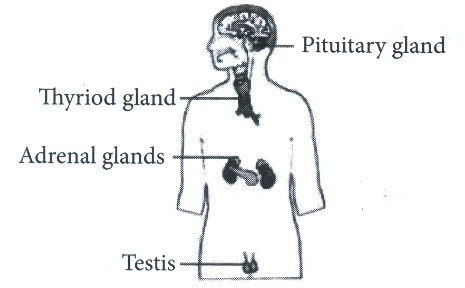
Draw a diagram showing endocrine glands in a male body. Label the following glands on it:
(i) Pituitary
(ii) Thyroid
(iii) Adrenal
(iv) Testes
17.
(a) Why is the Solar Cooker box covered with a plane glass plate?
(b) Why is energy of water flowering in a river considered to be an indirect form of solar energy?
(c) How is the fission of nucleus brought about?
18.
How are oxygen and carbon dioxide transported in human beings? How are lungs designed to maximize the area for exchange of gases?
19.
Give any two ways in which non-biodegradable substances would affect the environment.
20.
What are fossil fuels?
21.
Lithium, sodium and potassium form a Dobereiner's triad. The atomic masses of lithium and potassium are 7 and 39 respectively. Predict the atomic mass of sodium.
22.
What is the measure of biodiversity?
23.
Explain the phenomenon of electromagnetic induction. Describe an experiment to show that a current is set up in a closed loop when an external magnetic field passing through the loop increases or decreases.
24.
(a) In tabular form, differentiate between ethanol and ethanoic acid under the following heads;
(i) Physical state
(ii) Taste
(iii) NaHCO3 test
(iv) Ester test
(b) Write a chemical reaction to show the dehydration of ethanol.
25.
What are the characteristics of food web?
26.
Account for the following:
(i) State the relation between hydrogen ion concentration of an aqueous solution and its pH.
(ii) An aqueous solution has a pH value of 7.0. Is this solution acidic, basic or neutral?
(iii) Which has a higher pH value, 1MHCl or 1MNaOH solution?
(iv) Tooth enamel is one of the hardest substances in our body. How does it undergo damage due to eating chocolates and sweets? What should we do to prevent it?
(v)How do [H+] ions exist in water?
27.
Mendeleev' predicted the existence of certain elements not known at that time and named two of them as Eka-silicon and Eka-aluminium.
(a) Name the elements which have taken the place of these elements.
(b) Mention the group and the period of these elements in the Modern Periodic Table.
(c) Classify these elements as metals, non-metals or metalloid.
(d) How many valence electrons are present in each one of them?
28.
Suggest a few useful ways of utilising waste water.
1.
| pH | Liquid |
| 7.0 | Distilled Water |
| 14.0 | 1 M sodium hydroxide solution |
| 4.0 | Tomato juice |
| 2.0 | Lemon juice |
2.
Zinc will react with copper oxide to displace copper. Magnesium will also displace zinc from zinc oxide and copper fromn copper oxide. Copper, being least reactive will not react with any of the given oxides.
| Metal | Zinc | Magnesium | Copper |
| Zinc oxide | - | ✓ | - |
| Magnesium oxide | - | - | - |
| Copper oxide | ✓ | ✓ | - |
3.
Fore brain
4.
According to this rule, stretch the thumb, forefinger and middle finger of your left hand such that they are mutually perpendicular. If the first finger points in the direction of magnetic field and the second finger in the direction of current, then the thumb will point in the direction of motion or the force acting on the conductor.
5.
(a) Limitation of wind energy:
Wind energy cannot be harnessed at places where wind speed is not at least 15 km/h.
(b) Limitation of tidal energy:
The rise and fall in sea water during a high tide or a low tide is not good enough to generate electricity on a large scale.
6.
The major events during photosynthesis are
(i)absorption of light energy by chlorophyll
(ii)Conversion of light energy to chemical energy
(iii)splitinh of H2,O2 and e-
(iv)reducing of CO2 to carbohydrates
7.
This is because, water does not provide energy to multiply whereas sugar provides energy for the yeast to undergo multiplication.
8.
RrYy (Round yellow).
9.
50%
10.
Vegetarian habit is safer. Being closer to producers, less DDT will accumulate in our body. Bio magnification leads to higher level of DDT in higher trophic levels.
11.
Stars twinkle due to atmospheric refraction of starlight. The starlight passes through different layers of atmospheric medium of gradually changing refractive index. So, it is refracted multiple times. As the apparent position of star and the physical condition of the earth's atmosphere are not constant the amount of starlight entering the eye flickers and gives a twinkling effect.
12.
Different colours travel through prism with different speeds and have different refractive index
13.
Given
\(n_g={3\over 2},\ \ \ \ n_w={4\over 3}\)
Speed of light in glass=2 x 10⁸ m/s
Speed of light water = v = ?
\(n_g={Speed\ of\ light\ in\ air\over Speed\ of\ light\ in\ glass}\)
\(\Rightarrow\ \ {3\over2}={Speed\ of\ light\ in\ air\over 2\times10^8\ m/s}\)
Speed of light in air=\({3\over 2}\times2\times10^8=3\times10^8\ m/s\)
\(n_w={Speed\ of\ light\ in\ air\over Speed\ of\ light\ in\ water}\)
\(\Rightarrow\ \ {4\over 3}={3\times10^8\ m/s\over V}\)
\(3\times10^8\times{3\over4}=v\)
⇒ v=2.25 x 10⁸ m/s
14.
(1) Forest resources should be used in an environment friendly and developmentally sound manner.
(2) Instead of using non-renewable natural resources, use of renewable natural resources should be preferred.
(3) Waste water generated by industries should be recycled.
15.
Given, P1 = 250 W, P2 = 1200 W,
t1 = 1h = 3600 s, t2 = 10 min = 600 s
\(\therefore\) Energy
Q1 = P1t1 = 250 \(\times\)3600 = 900000 J = 900 kJ
and Q2 = P2t2 = 1200 \(\times\) 600 = 720000 J = 720 kJ
Thus, TV set uses more energy.
16.
17.
(a) The solar cooker box is covered with a plane glass plate so as to prevent heat from escaping.
(b) Sun is said to be the ultimate and the original source for most of the energy present on the earth. When sun rays fall on oceans and other water bodies, the water present in the water bodies gets evaporated and rises up in the atmosphere. In the upper part of the atmosphere, this water vapour gets condensed and forms douds, which give rain on the high lands. Therefore, the rain water runs over the Sand surface towards the large water bodies. This running water over the land surfaces is called river. Therefore, the energy of running water actually originates from the solar energy. This is why solar energy of water flowing in a river is considered to be an indirect form of solar energy.
(c) The fission of nucleus is brought about by splitting the nucleus of heavy atoms, such as uranium or plutonium, with low-energy neutron bombardment.
18.
(i) Oxygen enters the human body through the nasal passage and reaches the lungs.
(ii) Numerous alveoli are present in the lungs. These alveoli are surrounded by many blood capillaries. From the alveoli, 02 is taken up by the red blood cells present in the blood capillaries.
(iii) Similarly, the CO2 from the various tissues is transported to the alveoli.
(iv) This CO2 is then released through the nasal passage during exhalation. Alveoli are the sites of exchange of gases. Each lung contains 300- 350 million alveoli.
These alveoli increase the surface area for gaseous exchange, making the process of respiration more efficient.
19.
The two ways in which non-biodegradable substances would affect the environment are
(i) They make the environment poisonous and unfit for survival of living forms of life.
(ii) They block the transfer of energy and minerals in the ecosystem.
20.
()
Fuels which are formed from the fossil remains of plants and animals and are obtained from under the earth's crust are called fossil fuels. Example coal, petroleum and natural gas.
21.
()
Atomic mass of Na = 7+39 / 2 = 46 / 2 = 23
22.
()
The measure of biodiversity in an area is the number of species found in that area.
23.
Electromagnetic Induction: When a conductor is set to move inside a magnetic field or a magnetic field is set to be changing around a conductor, electric current is induced in the conductor. This is just opposite to the exertion of force by a current carrying conductor inside a magnetic field. In other words, when a conductor is brought in relative motion vis-a-vis a magnetic field, a potential difference is induced in it. This is known as electromagnetic induction.
Activity:
- To demonstrate electromagnetic induction Materials Required:
- A galvanometer, coil, bar magnet and some wires.
Procedure:
- The coil is inserted over a hollow tube of cardboard.
- With the help of wires, the two ends of the coil are attached to the galvanometer.
- The north pole of the bar magnet is moved towards the end 'B' of the coil.
- It is observed that the galvanometer needle shows deflection to right.
- When the magnet is moved away from the coil, the galvanometer needle shows deflection towards left.
- When the magnet is in static position, no deflection is seen in galvanometer needle.
- Induction of electric current in the coil is the cause of deflection in galvanometer needle.
- If the magnet is kept stationary and coil is moved, then also the galvanometer needle shows deflection.
Conclusion:
- When the coil and the bar magnet are in relative motion, a current is induced in the coil.
24.
(a)
| Properties | Ethanol | Ethanoic acid |
| (i) Physical state | It is liquid with specific smell | It is also liquid with vinegar like smell. |
| (ii)Taste | It has burning taste | It has sour taste |
| (iii)NaHCO3 test | It does not react | It gives brisk effervescence due to CO2 |
| (iv)Ester test | Add acetic acid and con. H2SO4 pleasant fruity smelling compound, ester is formed. |
Add ethyl alcohol and con. H2SO4 pleasant fruity smelling compound, ester is formed. |
(b) \(\underset{Ethanol}{CH_3CH_2OH}\xrightarrow[443k]{conc. H_2SO_4}\underset{Ethene}{CH_2=CH_2}+H_2O\)
25.
(1) A food web is formed by interlinked of food chains and also so it is not straight.
(2) A food web provides alternative pathways of the availability of food.
(3) A food web helps in checking the over-population.
(4) A food web helps in the development of an ecosystem..
26.
(i) If H+ ion concentration is more, pH will be less and vice versa or pH of a solution is inversely proportional to H+ ion concentration or pH 52 log (H+).
(ii) This solution is neutral.
(iii) 1MNaOH solution.
(iv) When the pH in the mouth is below 5.5, bacteria present in the mouth produce acids by degradation of sugar and corrode the tooth enamel. It can be prevented by using tooth pastes which are generally basic.
(v) As hydronium [H3O]+ ion.
27.
(a) Eka-silicon for germanium (Ge) and eka-aluminium for gallium(Ga).
(b) Group number of Ga is 13 and its period is 4th and group number of Ge is 14 and its period is also 4th.
(c) Both Ga and Ge are metalloids.
(d) Ga lies in group 13, therefore, it has 13 - 10 = 3 valence electrons. Similarly, Ge lies in group 14 and hence it has 14 - 10 = 4 valence electrons.
28.
(a) recharging the ground water
(b) can be used for irrigation
(c) treated municipal water can be used for washing cars, watering the gardens
(d) certain pollutants in sewage water can be become fertiliser for various crops.

10th Standard CBSE Syllabus & Materials
10th Standard CBSE
cbse 10th Standard Social Science HIS - The Making of a Global World Important Questions And Answers Study Material - QB365 Set C
NEW10th Standard CBSE
cbse 10th Standard Social Science HIS - The Making of a Global World Important Questions And Answers Study Material - QB365 Set B
NEW10th Standard CBSE
cbse 10th Standard Social Science HIS - The Making of a Global World Important Questions And Answers Study Material - QB365 Set A
NEW10th Standard CBSE
cbse 10th Standard Social Science ECO - Consumer Rights Important Questions And Answers Study Material - QB365 Set C



NCERT Books

Syllabus

Exam Pattern

Sample Question Papers

Previous year Question Papers

Important Notes

MCQ Practice test

NCERT Exemplers

Case study Questions

Image Based Questions

Passage based Questions

HOT Questions

Value Based Questions

Model Questions Papers
NCERT ( Book Back ) Questions

Assertion and Reason
Important Questions And Answers

CBSE 10th Standard CBSE Subjects
CBSE Standards