
7th Standard CBSE Syllabus & Materials
7th Standard CBSE
CBSE 7th Standard Science Wastewater Story Sample Question Papers Study Material - QB365
NEW7th Standard CBSE
CBSE 7th Standard Science Forests: Our Lifeline Sample Question Papers Study Material - QB365
NEW7th Standard CBSE
CBSE 7th Standard Science Water: A Precious Resource Sample Question Papers Study Material - QB365
NEW7th Standard CBSE
CBSE 7th Standard Science Light Sample Question Papers Study Material - QB365
NEW7th Standard CBSE
CBSE 7th Standard Science Electric Current and Effects Sample Question Papers Study Material - QB365 Set C
NEW7th Standard CBSE
CBSE 7th Standard Science Electric Current and Effects Sample Question Papers Study Material - QB365 Set B
Published on: 31/10/2025
Download CBSE Class 7th Standard CBSE Mathematics question papers, sample papers, important questions, and previous year solved papers in PDF format. Get free study materials, NCERT solutions, and exam preparation resources for Class 7th Standard CBSE Mathematics
Questions + Answers key
Take MCQ Mathematics Test
1.
Find the product of 1 and reciprocal of 1
2.
Multiply and express as a mixed fraction.\(3\frac{1}{4}\times 6\)
3.
Multiply and reduce to lowest form and convert into a mixed fraction. \(7\times \frac{3}{5}\)
4.
Solve \(8\frac{1}{2}-3\frac{5}{8}\)
5.
Solve \(\frac{7}{10}+\frac{2}{5}+\frac{3}{2}\)
6.
A car covers a distance of 8.6 km in 1 litre petrol. How far it will go in 36.5 litres of petrol.
7.
Mukul solved \(\frac { 2 }{ 7 } \)part of an exercise while Deeksha solved \(\frac { 4 }{ 5 } \)of it. Who solved less?
8.
Evaluate 7÷3.5
9.
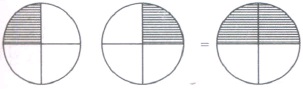
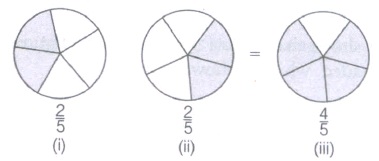
Represent pictorially \(2\times \frac{2}{5}=\frac{4}{5}\)
10.
What should be added to 4\(\frac{1}{5}\) to get \(6\frac{2}{5}\)?
11.
Simplify \(4\frac { 2 }{ 3 } -3\frac { 1 }{ 4 } +2\frac { 1 }{ 6 } \)
12.
Ritika studies for 11\(\frac { 1 }{ 3 } \) hours daily. She devotes 5\(\frac { 3 }{ 5 } \)hours of her time for Hindi and Sanskrit.How much time does she devote for other subjects?
13.
Which is greater? \(\frac{1}{2}\)of\(\frac{6}{7}\) or \(\frac{2}{3}\)of \(\frac{3}{7}\)
14.
Vikram spent \(\frac{1}{4}\) of his money on a Science textbook and \(\frac{2}{3}\)of the remainder on stationary. What fraction of his money did he have left?
15.
Which of the following is the equivalent fraction of \(\frac { 3 }{ 4 } \)with numerator 18?
\(\frac { 18 }{ 12 } \)
\(\frac { 18 }{ 20 } \)
\(\frac { 18 }{ 4 } \)
\(\frac { 18 }{ 24 } \)
16.
\(\frac { 2 }{ 5 } \times 5\frac { 1 }{ 5 } \) is equal to
\(\frac { 26 }{ 25 } \)
\(\frac { 52 }{ 25 } \)
\(\frac { 2 }{ 5 } \)
6
17.
In the year 2014, Shantanu gets Rs 3832.5 as his pocket allowance. Find his pockect allowane per day
Rs 9.5
Rs 10.5
Rs 12.5
Rs 11.5
18.
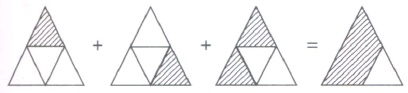
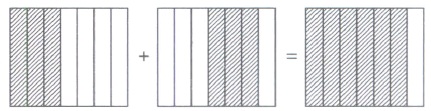
Pictorial representation of \(6\times \frac{1}{7} \) is
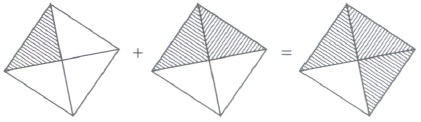
19.
\(\frac{2}{5}\times 5\frac{1}{5}\) is equaI to
\(\frac{26}{25}\)
\(\frac{52}{25}\)
\(\frac{2}{5}\)
6
1.
1 \(\times\) 1 = 1
as reciprocal of 1 is 1
2.
Mixed fraction = 19\(\frac{1}{2}\)
3.
(i) We have, \(7\times \frac{3}{5}\)=\( \frac{7\times3}{5}=\frac{21}{5}\)

This is required lowest form.
Now, dividing 21 (numerator) by 5 (denominator),
we get, quotient = 4 and remainder = 1
∴ Mixed fraction =Quotient \(\frac{Reminder}{Divisor}=4 \frac{1}{5}\)
4.
\(8\frac { 1 }{ 2 } -3\frac { 5 }{ 8 } =\frac { 17 }{ 2 } -\frac { 29 }{ 8 } \)
\(\left[ \because 8\frac { 1 }{ 2 } =\frac { 8\times 2+1 }{ 2 } =\frac { 16+1 }{ 2 } =\frac { 17 }{ 2 } and3\frac { 5 }{ 8 } =\frac { 3\times 8+5 }{ 8 } =\frac { 29 }{ 8 } \right] \)
= \(\frac { 17\times 4 }{ 2\times 4 } -\frac { 29\times 1 }{ 8\times 1 } \)
[L.C.M of 2 and 8 = 8]
= \(\frac { 68 }{ 8 } -\frac { 29 }{ 8 } =\frac { 68-29 }{ 8 } \)
= \(\frac { 39 }{ 8 } =4\frac { 7 }{ 8 } \)
5.
We have, \(\frac{7}{10}+\frac{2}{5}+\frac{3}{2}\)
\(\therefore \frac{7}{10}+\frac{2}{5}+\frac{3}{2}=\frac{7+4+15}{10}\)
=\(\frac{26}{10}=\frac{13}{5}\)
[dividing numerator and denominator by 2]
6.
∵ Car covers in 1 litre = 8.6 km
Car covers in 36.5 litres
= 8.6\(\times\)36.5
= 313.90
= 313.9 km
7.
In order to know who solved less part of the exerci.se, we will compare \(\frac { 2 }{ 7 } \)and\(\frac { 4 }{ 5 } \)
We have,
LCM of denominators (i.e., 7 and 5), 7 \(\times\)5 = 35.
Converting each fraction into an equivalent fraction having 35 as its denominator, we have
\(\frac { 2 }{ 7 } =\frac { 2\times 5 }{ 7\times 5 } =\frac { 10 }{ 35 } \)and\(\frac { 4 }{ 5 } =\frac { 4\times 7 }{ 5\times 7 } =\frac { 28 }{ 35 } \)
∵10 < 28
∴ \(\frac { 10 }{ 35 } <\frac { 28 }{ 35 } \Rightarrow \frac { 2 }{ 7 } <\frac { 4 }{ 5 } \)
Hence, Mukul solved lesser part than Deeksha.
8.
7÷3.5=\(\frac { 7 }{ 3.5 } =\frac { 7\times 10 }{ 35 } \)
=\(\frac { 70 }{ 35 } \)=2
OR
7÷3.5=\(7\div \frac { 35 }{ 10 } \)
= \(7\times \frac { 10 }{ 35 } \)
= \(\frac { 70 }{ 35 } \)
=2
9.
We have, \(2\times \frac{2}{5}=\frac{4}{5}\)
The pictorial representation is shown as below :
10.
\(\frac{11}{5}\)
11.
We have
\(4\frac { 2 }{ 3 } -3\frac { 1 }{ 4 } +2\frac { 1 }{ 6 } \)=\(\frac { 14 }{ 3 } -\frac { 13 }{ 4 } +\frac { 13 }{ 6 } \)
= \(\frac { 14\times 4 }{ 3\times 4 } -\frac { 13\times 3 }{ 4\times 3 } +\frac { 13\times 2 }{ 6\times 2 } \)
∵ LCM of 3, 4 and 6 is 12, so we convert each fraction into an equivalent fraction with denominator 12
i,e \(\frac { 56 }{ 12 } -\frac { 39 }{ 12 } +\frac { 26 }{ 12 } =\frac { 56-39+26 }{ 12 } \)
= \(\frac { 82-39 }{ 12 } =\frac { 43 }{ 12 } =3\frac { 7 }{ 12 } \)
12.
Total hours spend by Ritika for studies =11\(\frac { 1 }{ 3 } \) hours =\(\frac { 34 }{ 3 } \)hours
Total hours devoted by Ritika for Hindi and Sanskrit 5\(\frac { 3 }{ 5 } \)= \(\frac { 28 }{ 5 } \)hours
Total hours devoted by Ritika for other subjects
= \(\frac { 34 }{ 3 } -\frac { 28 }{ 5 } \)
= \(\frac { 170-84 }{ 15 } =\frac { 86 }{ 15 } \)
=5\(\frac { 11 }{ 15 } \) hours
13.
We have
\(\frac { 1 }{ 2 } of\frac { 6 }{ 7 } =\frac { 1 }{ 2 } \times \frac { 6 }{ 7 } =\frac { 1\times 6 }{ 2\times 7 } \)
= \(\frac { 6 }{ 14 } =\frac { 6\div 2 }{ 14\div 2 } =\frac { 3 }{ 7 } \)
and \(\frac { 2 }{ 3 } of\frac { 3 }{ 7 } =\frac { 2 }{ 3 } \times \frac { 3 }{ 7 } =\frac { 2\times 3 }{ 3\times 7 } \)
= \(\frac { 6 }{ 21 } =\frac { 6\div 3 }{ 14\div 2 } =\frac { 2 }{ 7 } \)
We know that, if two fractions have the same denominator but different numerators, the fraction with greater numerator is greater
Since 3>2 ,So,\(\frac { 3 }{ 7 } >\frac { 2 }{ 7 } \)
⇒ \(\left( \frac { 1 }{ 2 } of\frac { 6 }{ 7 } \right) \)of greater than \(\left( \frac { 2 }{ 3 } of\frac { 3 }{ 7 } \right) \)
14.
\(\frac{1}{4}\)
15.
(d)
\(\frac { 18 }{ 24 } \)
16.
(b)
\(\frac { 52 }{ 25 } \)
17.
(b)
Rs 10.5
18.
(c)
19.
(b)
\(\frac{52}{25}\)

7th Standard CBSE Syllabus & Materials
7th Standard CBSE
CBSE 7th Standard Science Electric Current and Effects Sample Question Papers Study Material - QB365 Set A
NEW7th Standard CBSE
CBSE 7th Standard Science Motion and Time Sample Question Papers Study Material - QB365 Set D
NEW7th Standard CBSE
CBSE 7th Standard Science Motion and Time Sample Question Papers Study Material - QB365 Set C
NEW7th Standard CBSE
CBSE 7th Standard Science Motion and Time Sample Question Papers Study Material - QB365 Set B



NCERT Books

Syllabus

Exam Pattern

Sample Question Papers

Previous year Question Papers

Important Notes

MCQ Practice test

NCERT Exemplers

Case study Questions

Image Based Questions

Passage based Questions

HOT Questions

Value Based Questions

Model Questions Papers
NCERT ( Book Back ) Questions

Assertion and Reason
Important Questions And Answers

CBSE 7th Standard CBSE Subjects
CBSE Standards