
7th Standard CBSE Syllabus & Materials
7th Standard CBSE
CBSE 7th Standard Science Wastewater Story Sample Question Papers Study Material - QB365
NEW7th Standard CBSE
CBSE 7th Standard Science Forests: Our Lifeline Sample Question Papers Study Material - QB365
NEW7th Standard CBSE
CBSE 7th Standard Science Water: A Precious Resource Sample Question Papers Study Material - QB365
NEW7th Standard CBSE
CBSE 7th Standard Science Light Sample Question Papers Study Material - QB365
NEW7th Standard CBSE
CBSE 7th Standard Science Electric Current and Effects Sample Question Papers Study Material - QB365 Set C
NEW7th Standard CBSE
CBSE 7th Standard Science Electric Current and Effects Sample Question Papers Study Material - QB365 Set B
Published on: 31/10/2025
Download CBSE Class 7th Standard CBSE Mathematics question papers, sample papers, important questions, and previous year solved papers in PDF format. Get free study materials, NCERT solutions, and exam preparation resources for Class 7th Standard CBSE Mathematics
Questions + Answers key
Take MCQ Mathematics Test
1.
Find \(3\frac{1}{2} \div \frac{8}{3}\)
2.
Find \(\frac{6}{13} \div 7\)
3.
Multiply and reduce to lowest form (if possible).\(\frac{4}{5}\times \frac{12}{7}\)
4.
Can you tell, what is \(\frac{1}{2}\)of 10
5.
Arrange the fractions \(\frac{2}{5},\frac{3}{10},\frac{9}{14} and \frac{16}{35}\) in ascending order.
6.
Simplify \(4\frac { 2 }{ 3 } -3\frac { 1 }{ 4 } +2\frac { 1 }{ 6 } \)
7.
In a class of 40 students, \(\frac { 1 }{ 5 } \)of the total number of students like to study English, \(\frac { 2 }{ 5 } \)of the total number like to study Maths and remaining students likes to study Science
(a) How many students like to study English?
(b) How many students like to study Maths?
(c) What fraction of the total number of students like to study Science?
8.
Ritika studies for 11\(\frac { 1 }{ 3 } \) hours daily. She devotes 5\(\frac { 3 }{ 5 } \)hours of her time for Hindi and Sanskrit.How much time does she devote for other subjects?
9.
In a school, \(\frac{5}{6}\) of the students are boys. If there are 240 girls, then find the number of boys in the school.
10.
Sugar is sold at Rs 17\(\frac{3}{5}\) per kg. Find the cost of 16 kg of sugar.
11.
Vikram spent \(\frac{1}{4}\) of his money on a Science textbook and \(\frac{2}{3}\)of the remainder on stationary. What fraction of his money did he have left?
12.
Apala ate \(\frac{3}{5}\) of an orange. The remaining orange was eaten by Meenu. What part of the orange was eaten by Meenu?
\(\frac{1}{5}\)
\(\frac{2}{5}\)
\(\frac{3}{5}\)
None of these
13.
The product of \(\frac{4}{9}\)and 2\(\frac{1}{4}\)is:
\(\frac{16}{81}\)
\(\frac{81}{16}\)
1
5\(\frac{1}{4}\)
14.
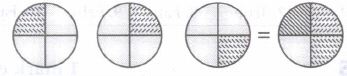
The picture interprets
\(\frac { 1 }{ 4 } \)÷3
\(3\times \frac { 1 }{ 4 } \)
\({3\over4}\times3\)
3÷\(\frac { 1 }{ 4 } \)
15.
One packet of biscuits requires 2\(\frac { 1 }{ 2 } \) cups of flour and 1\(\frac { 2 }{ 3 } \)cups of sugar. Estimated total quantity of both ingredients used in 10 such packets of biscuits will be
less than 30 cups
between 30 cups and 40 cups
between 40 cups and 50 cups
above 50 cups
16.
The ascending arrangement of\(\frac { 2 }{ 3 } ,\frac { 6 }{ 7 } ,\frac { 14 }{ 21 } \)is
\(\frac { 1 }{ 5 } ,\frac { 3 }{ 7 } ,\frac { 7 }{ 10 } \)
\(\frac { 13 }{ 21 } ,\frac { 2 }{ 3 } ,\frac { 6 }{ 7 } \)
\(\frac { 6 }{ 7 } ,\frac { 13 }{ 21 } ,\frac { 2 }{ 3 } \)
\(\frac { 2 }{ 3 } ,\frac { 6 }{ 7 } ,\frac { 13 }{ 21 } \)
17.
Which of the following is the equivalent fraction of \(\frac { 3 }{ 4 } \)with numerator 18?
\(\frac { 18 }{ 12 } \)
\(\frac { 18 }{ 20 } \)
\(\frac { 18 }{ 4 } \)
\(\frac { 18 }{ 24 } \)
18.
\(\frac { 2 }{ 5 } \times 5\frac { 1 }{ 5 } \) is equal to
\(\frac { 26 }{ 25 } \)
\(\frac { 52 }{ 25 } \)
\(\frac { 2 }{ 5 } \)
6
19.
The product of \(\frac{11}{13}\) and 4 is
\(3 \frac{5}{13}\)
\(5\frac{3}{13}\)
\(13\frac{5}{5}\)
\(13\frac{5}{3}\)
20.
Pictorial representation of \(3\times \frac{2}{3} \)is
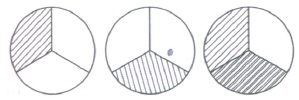
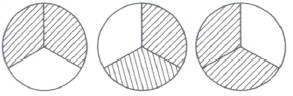
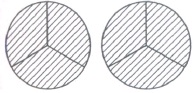
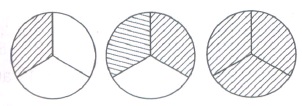
21.
The picture interprets
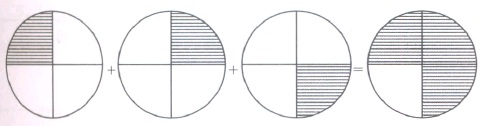
\(\frac{1}{3}\div 4\)
\(3\times \frac{1}{4}\)
\(\frac{3}{4}\times 3\)
\(3 \div \frac{1}{4}\)
1.
We have, \(3\frac{1}{2}\div \frac{8}{3}=(\frac{3\times 2+1}{2})\div \frac{8}{3}=(\frac{6+1}{2})\times \frac{3}{8}\)
=\(\frac{7}{2} \times \frac{3}{8}=\frac{7\times 3}{2\times 8}=\frac{21}{16}\)
2.
We have, \(\frac{6}{13} \div 7=\frac{6}{13}+\frac{7}{1}=\frac{6}{13} \times \frac{7}{1}=\frac{6\times 14}{13\times 7}=\frac{6}{91}\)
3.
We have, \(\frac{4}{5}\times \frac{12}{7}\times \frac{4\times12 }{5\times 7}=\frac{48}{35}=1\frac{13}{35}\)
4.
\(\frac{1}{2}\)of 10=\(\frac{1}{2}\times 10=\frac{10}{2}=5\) [∵ 'of' represents multiplication]
5.
The given frraacctnions are \(\frac{2}{5},\frac{3}{10},\frac{9}{14} , \frac{16}{35}\)
LCM of 5,10, 14,35 = 70
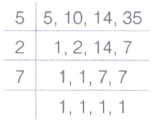
Now, \(\frac{2}{5}=\frac{2\times 14}{5\times 14}=\frac{21}{70},\frac{9}{14}=\frac{9\times5 }{14\times 5}=\frac{45}{70}\) and \(\frac{16}{35}=\frac{16\times 2}{35 \times 2}=\frac{32}{70}\)
Clearly, \(\frac{21}{70}<\frac{28}{70}<\frac{32}{70}<\frac{45}{70}\) So, \(\frac{3}{10}<\frac{2}{5}<\frac{16}{35}<\frac{9}{14}\)
Hence, thee zgiiven firacn..ons in ascendimg order are \(\frac{3}{10}<\frac{2}{5}<\frac{16}{35}<\frac{9}{14}\)
Now, let us change each of the given fractions into an equivalent fraction having 70 as its denominator.
6.
We have
\(4\frac { 2 }{ 3 } -3\frac { 1 }{ 4 } +2\frac { 1 }{ 6 } \)=\(\frac { 14 }{ 3 } -\frac { 13 }{ 4 } +\frac { 13 }{ 6 } \)
= \(\frac { 14\times 4 }{ 3\times 4 } -\frac { 13\times 3 }{ 4\times 3 } +\frac { 13\times 2 }{ 6\times 2 } \)
∵ LCM of 3, 4 and 6 is 12, so we convert each fraction into an equivalent fraction with denominator 12
i,e \(\frac { 56 }{ 12 } -\frac { 39 }{ 12 } +\frac { 26 }{ 12 } =\frac { 56-39+26 }{ 12 } \)
= \(\frac { 82-39 }{ 12 } =\frac { 43 }{ 12 } =3\frac { 7 }{ 12 } \)
7.
(a) No. of students like to study English
= \(\frac { 1 }{ 5 } \times 40\)
= 8
(b) No. of students like to study Maths
= \(\frac { 2 }{ 5 } \times 40\)
= 2\(\times\) 8
= 16
(c) No. of students who like to study Science
=40 - (8 + 16)
= 40-24
= 16
In part (ii), we know
\(\frac { 2 }{ 5 } \times 40\) = 16
So,\(\frac { 2 }{ 5 } \)of the total number of students like to study Science
8.
Total hours spend by Ritika for studies =11\(\frac { 1 }{ 3 } \) hours =\(\frac { 34 }{ 3 } \)hours
Total hours devoted by Ritika for Hindi and Sanskrit 5\(\frac { 3 }{ 5 } \)= \(\frac { 28 }{ 5 } \)hours
Total hours devoted by Ritika for other subjects
= \(\frac { 34 }{ 3 } -\frac { 28 }{ 5 } \)
= \(\frac { 170-84 }{ 15 } =\frac { 86 }{ 15 } \)
=5\(\frac { 11 }{ 15 } \) hours
9.
Given, number of boys in the school \(=\frac{5}{6}\) of the total number of students in the school
ஃ Fraction of boys in the school+ Fraction of girls in the school = 1
i.e. \((\frac{5}{6})+\)[fraction of girls in the school]=1
So, Fraction of girls in the school
\(=1-\frac{5}{6}=\frac{1}{1}-\frac{5}{6}=\frac{6-5}{6}=\frac{1}{6}\)
We know that, the number of girls in the school is equal to 240.
So, \(\frac{1}{6}\)of the total number of students in the school =240
⇒ \(\frac{1}{6}\)x Total number of students = 240
So, Total number of students = \(240 \times \frac{6}{1}\)
=240x6=1440
∴ Total number of students in the school
= Total number of boys students in the school + Total number of girls students in the school
⇒ 1440= Total number of boys students in the school + 240
Hence, total number of boys students in the school
=1440 - 240 =1200
10.
We have
Cost of 1 kg of sugar = Rs.17\(\frac { 3 }{ 4 } \)=Rs\(\frac { 71 }{ 4 } \)k
∴ Cost of 8 kg of sugar = Rs \(\left( \frac { 71 }{ 4 } \times 8\frac { 1 }{ 2 } \right) \)
=Rs \(\left( \frac { 71 }{ 4 } \times \frac { 17 }{ 2 } \right) =Rs.\left( \frac { 71\times 17 }{ 4\times 2 } \right) \)
=Rs\(\left( \frac { 1207 }{ 8 } \right) \) =Rs.150\(\frac { 7 }{ 8 } \)
Hence, the cost of 8\(\frac { 1 }{ 2 } \) kg of sugar is Rs.150\(\frac { 7 }{ 8 } \)
11.
\(\frac{1}{4}\)
12.
\(1-\frac{3}{5}=\frac{5}{5}-\frac{3}{5}=\frac{5-3}{5}=\frac{2}{5}\)
13.
(c)
1
14.
(b)
\(3\times \frac { 1 }{ 4 } \)
15.
(c)
between 40 cups and 50 cups
16.
(b)
\(\frac { 13 }{ 21 } ,\frac { 2 }{ 3 } ,\frac { 6 }{ 7 } \)
17.
(d)
\(\frac { 18 }{ 24 } \)
18.
(b)
\(\frac { 52 }{ 25 } \)
19.
(a)
\(3 \frac{5}{13}\)
20.
(b)
21.
(b)
\(3\times \frac{1}{4}\)

7th Standard CBSE Syllabus & Materials
7th Standard CBSE
CBSE 7th Standard Science Electric Current and Effects Sample Question Papers Study Material - QB365 Set A
NEW7th Standard CBSE
CBSE 7th Standard Science Motion and Time Sample Question Papers Study Material - QB365 Set D
NEW7th Standard CBSE
CBSE 7th Standard Science Motion and Time Sample Question Papers Study Material - QB365 Set C
NEW7th Standard CBSE
CBSE 7th Standard Science Motion and Time Sample Question Papers Study Material - QB365 Set B


NCERT Books

Syllabus

Exam Pattern

Sample Question Papers

Previous year Question Papers

Important Notes

MCQ Practice test

NCERT Exemplers

Case study Questions

Image Based Questions

Passage based Questions

HOT Questions

Value Based Questions

Model Questions Papers
NCERT ( Book Back ) Questions

Assertion and Reason
Important Questions And Answers

CBSE 7th Standard CBSE Subjects
CBSE Standards