
7th Standard CBSE Syllabus & Materials
7th Standard CBSE
CBSE 7th Standard Science Wastewater Story Sample Question Papers Study Material - QB365
NEW7th Standard CBSE
CBSE 7th Standard Science Forests: Our Lifeline Sample Question Papers Study Material - QB365
NEW7th Standard CBSE
CBSE 7th Standard Science Water: A Precious Resource Sample Question Papers Study Material - QB365
NEW7th Standard CBSE
CBSE 7th Standard Science Light Sample Question Papers Study Material - QB365
NEW7th Standard CBSE
CBSE 7th Standard Science Electric Current and Effects Sample Question Papers Study Material - QB365 Set C
NEW7th Standard CBSE
CBSE 7th Standard Science Electric Current and Effects Sample Question Papers Study Material - QB365 Set B
Published on: 31/10/2025
Download CBSE Class 7th Standard CBSE Mathematics question papers, sample papers, important questions, and previous year solved papers in PDF format. Get free study materials, NCERT solutions, and exam preparation resources for Class 7th Standard CBSE Mathematics
Questions + Answers key
Take MCQ Mathematics Test
1.
Multiply :2\(\frac{3}{5}\)by 10
2.
Find \(\frac { 2 }{ 5 } \div \frac { 1 }{ 2 } \)
3.
Solve 4+\(\frac{7}{8}\)
4.
Arrange the fractions \(\frac{2}{5},\frac{3}{10},\frac{9}{14} and \frac{16}{35}\) in ascending order.
5.
Ritika studies for 11\(\frac { 1 }{ 3 } \) hours daily. She devotes 5\(\frac { 3 }{ 5 } \)hours of her time for Hindi and Sanskrit.How much time does she devote for other subjects?
6.
Michael finished colouring a picture in \(\frac{7}{12}\) hr.Vaibhav finished colouring the same picture in \(\frac{3}{4}\)hr.Who worked longer? By what fraction was it longer?
7.
Simplify \(5\times \frac { 3 }{ 20 } \times \frac { 2 }{ 15 } \)
8.
What should be added to 4\(\frac{1}{5}\) to get \(6\frac{2}{5}\)?
9.
A reciprocal of a fraction is obtained by inverting it upside down
10.
The product of two improper fractions is less than both the fractions
11.
The reciprocal of an improper fraction is an improper fraction
12.
The reciprocal of \(\frac { 4 }{ 7 } \) is \(\frac { 4 }{ 7 } \)
13.
\(\frac { 1 }{ 3 } \) of 6 is a same as \(\frac { 1 }{ 3 } +6\)
14.
Which of the following is the equivalent fraction of \(\frac { 3 }{ 4 } \)with numerator 18?
\(\frac { 18 }{ 12 } \)
\(\frac { 18 }{ 20 } \)
\(\frac { 18 }{ 4 } \)
\(\frac { 18 }{ 24 } \)
15.
Which of the following is a proper fraction?
\(\frac { 4 }{ 3 } \)
\(\frac { 1 }{ 2 } \)
\(\frac { 19 }{ 4 } \)
\(\frac { 11 }{ 5 } \)
16.
\(3\frac { 3 }{ 4 } \div \frac { 3 }{ 4 } \) is equal to
3
4
5
\(\frac { 45 }{ 16 } \)
17.
\(\frac { 2 }{ 5 } \times 5\frac { 1 }{ 5 } \) is equal to
\(\frac { 26 }{ 25 } \)
\(\frac { 52 }{ 25 } \)
\(\frac { 2 }{ 5 } \)
6
18.
The largest of the following is
0.0001
\(\frac { 1 }{ 1000 } \)
(0.100)2
\(\frac { 1 }{ 10 } \div 0.1\)
19.
\(\frac{5}{12}\)part of what amount will be equal to 3\(\frac{3}{4}\) part of Rs 100?
Rs 900
Rs 940
Rs 875
Rs 925
20.
How many pieces of 13.2 cm can be cut from a 330 cm long rod?
25
28
21
35
21.
Which of the following represents \(\frac{1}{3}\)of\(\frac{1}{6}\)?
\(\frac{1}{3}+\frac{1}{6}\)
\(\frac{1}{3}-\frac{1}{6}\)
\(\frac{1}{3}\times \frac{1}{6}\)
\(\frac{1}{3}\div \frac{1}{6}\)
22.
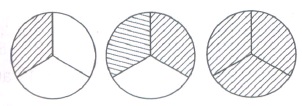
Pictorial representation of \(3\times \frac{2}{3} \)is
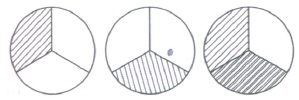
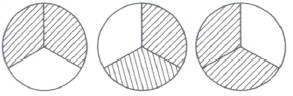
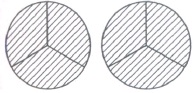
23.
\(\frac{2}{5}\times 5\frac{1}{5}\) is equaI to
\(\frac{26}{25}\)
\(\frac{52}{25}\)
\(\frac{2}{5}\)
6
24.
2.4 \(\times\) 1000 =_____
25.
45 mm =_____m
26.
\(4 \times 6 \frac{1}{3}\) is equal to ______
27.
\(\frac{3}{4}\)of 27 is __________
28.
The reciprocal of \(\frac{2}{7}\) is ________
29.
The value of
123.5 \(\div\) 12.35
30.
The reciprocal of 0
31.
\(81.81 \div 9.9\)
32.
\(2.69\times 12.64\)
33.
\(3\frac{1}{3}\div 14\frac{1}{3} \times \frac{1}{2}\)
34.
Write the number in the expanded form 2.034
35.
Find\(\frac { 3 }{ 4 } \)of 36
36.
Evaluate 2\(\times\)5\(\times\)1.2
1.
2\(\frac{3}{5}\)x10 =\(\frac{13}{5}\)x10 = =\(\frac { 13\times 2 }{ 1 } \)=26
2.
\(\frac { 2 }{ 5 } \div \frac { 1 }{ 2 } \)=\(\frac { 2 }{ 5 } \times \frac { 2 }{ 1 } \)=\(\frac { 4 }{ 5 } \)
3.
We have, 4+\(\frac{7}{8}\)=\(\frac{4}{1}+\frac{7}{8}=\frac{4\times 8+7\times1}{8}\) [∵ LCM of 8and 1=8]
=\(\frac{10-3}{5}=\frac{7}{5}\)
4.
The given frraacctnions are \(\frac{2}{5},\frac{3}{10},\frac{9}{14} , \frac{16}{35}\)
LCM of 5,10, 14,35 = 70
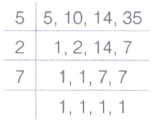
Now, \(\frac{2}{5}=\frac{2\times 14}{5\times 14}=\frac{21}{70},\frac{9}{14}=\frac{9\times5 }{14\times 5}=\frac{45}{70}\) and \(\frac{16}{35}=\frac{16\times 2}{35 \times 2}=\frac{32}{70}\)
Clearly, \(\frac{21}{70}<\frac{28}{70}<\frac{32}{70}<\frac{45}{70}\) So, \(\frac{3}{10}<\frac{2}{5}<\frac{16}{35}<\frac{9}{14}\)
Hence, thee zgiiven firacn..ons in ascendimg order are \(\frac{3}{10}<\frac{2}{5}<\frac{16}{35}<\frac{9}{14}\)
Now, let us change each of the given fractions into an equivalent fraction having 70 as its denominator.
5.
Total hours spend by Ritika for studies =11\(\frac { 1 }{ 3 } \) hours =\(\frac { 34 }{ 3 } \)hours
Total hours devoted by Ritika for Hindi and Sanskrit 5\(\frac { 3 }{ 5 } \)= \(\frac { 28 }{ 5 } \)hours
Total hours devoted by Ritika for other subjects
= \(\frac { 34 }{ 3 } -\frac { 28 }{ 5 } \)
= \(\frac { 170-84 }{ 15 } =\frac { 86 }{ 15 } \)
=5\(\frac { 11 }{ 15 } \) hours
6.
Time taken by Michael to finished colouring the picture \(\frac{7}{12}\)hr
Time taken by Vaibhav to finished colouring the picture = \(\frac{3}{4}\)hr
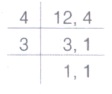
LCM of 12 and 4 = 3 X 4 = 12
On converting these fractions into like fractions, we get
\(\frac{3}{4}=\frac{3\times 3}{4\times 3}=\frac{9}{12} and \frac{7}{12}=\frac{7}{12}\)
It is clear, 9>7 [numerators of fractions]
So, \(\frac{9}{12}>\frac{7}{12} i.e., \frac{3}{4}>\frac{7}{12}\)
So, Vaibhav takes longer time to finish colouring the picture. Difference between time taken by Vaibhav and Michael
\(=\frac{3}{4}-\frac{7}{12}\)
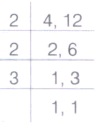
LCM of 4 and 12 = 2 x 2 x3 = 12
\(=\frac{3}{4}-\frac{7}{12}=\frac{3\times 3-7\times 1}{12}\)
=\(\frac{9-7}{12}=\frac{2}{12}=\frac{1}{6}\) [dividing numerator and denominator by 2]
Hence, Vaibhav takes \(\frac{1}{6}\) h more than Michael.
7.
We have
\(5\times \frac { 3 }{ 20 } \times \frac { 2 }{ 15 } \)=\(\frac { 5 }{ 1 } \times \frac { 3 }{ 20 } \times \frac { 2 }{ 15 } =\frac { 5\times 3\times 2 }{ 1\times 20\times 15 } =\frac { 1\times 1\times 2 }{ 1\times 4\times 5 } \)
= \(\frac { 1 }{ 2\times 5 } =\frac { 1 }{ 10 } \)
8.
\(\frac{11}{5}\)
9.
(a)
10.
(b)
11.
(b)
12.
(b)
13.
(b)
14.
(d)
\(\frac { 18 }{ 24 } \)
15.
(b)
\(\frac { 1 }{ 2 } \)
16.
(c)
5
17.
(b)
\(\frac { 52 }{ 25 } \)
18.
(d)
\(\frac { 1 }{ 10 } \div 0.1\)
19.
(a)
Rs 900
20.
(a)
25
21.
(c)
\(\frac{1}{3}\times \frac{1}{6}\)
22.
(b)
23.
(b)
\(\frac{52}{25}\)
24.
()
2400
25.
()
0.045
26.
()
\(25 \frac{1}{3}\)
27.
()
20\(\frac{1}{4}\)
28.
()
\(\frac{7}{2}\)
29.
()
10
30.
()
does not exist
31.
()
8.263
32.
()
34.0016
33.
()
\(\frac{5}{43}\)
34.
()
2.034 = 2\(\times\)1+0 + \(\frac { 3 }{ 100 } +\frac { 4 }{ 1000 } \)
35.
36.

7th Standard CBSE Syllabus & Materials
7th Standard CBSE
CBSE 7th Standard Science Electric Current and Effects Sample Question Papers Study Material - QB365 Set A
NEW7th Standard CBSE
CBSE 7th Standard Science Motion and Time Sample Question Papers Study Material - QB365 Set D
NEW7th Standard CBSE
CBSE 7th Standard Science Motion and Time Sample Question Papers Study Material - QB365 Set C
NEW7th Standard CBSE
CBSE 7th Standard Science Motion and Time Sample Question Papers Study Material - QB365 Set B



NCERT Books

Syllabus

Exam Pattern

Sample Question Papers

Previous year Question Papers

Important Notes

MCQ Practice test

NCERT Exemplers

Case study Questions

Image Based Questions

Passage based Questions

HOT Questions

Value Based Questions

Model Questions Papers
NCERT ( Book Back ) Questions

Assertion and Reason
Important Questions And Answers

CBSE 7th Standard CBSE Subjects
CBSE Standards