7th Standard CBSE Syllabus & Materials
7th Standard CBSE
CBSE 7th Standard Science Wastewater Story Sample Question Papers Study Material - QB365
NEW7th Standard CBSE
CBSE 7th Standard Science Forests: Our Lifeline Sample Question Papers Study Material - QB365
NEW7th Standard CBSE
CBSE 7th Standard Science Water: A Precious Resource Sample Question Papers Study Material - QB365
NEW7th Standard CBSE
CBSE 7th Standard Science Light Sample Question Papers Study Material - QB365
NEW7th Standard CBSE
CBSE 7th Standard Science Electric Current and Effects Sample Question Papers Study Material - QB365 Set C
NEW7th Standard CBSE
CBSE 7th Standard Science Electric Current and Effects Sample Question Papers Study Material - QB365 Set B
Published on: 31/10/2025
Download CBSE Class 7th Standard CBSE Mathematics question papers, sample papers, important questions, and previous year solved papers in PDF format. Get free study materials, NCERT solutions, and exam preparation resources for Class 7th Standard CBSE Mathematics
Questions + Answers key
Take MCQ Mathematics Test
1.
Find the value of the following division: [ 16 \(\div\) 4 ] \(\div\) 4 \(\div\) 0
2.
Write a pair of integers whose difference gives: an integer greater than only one of the integers.
3.
Solve the following addition and subtraction problems and verify the closure property under addition and subtraction:
18 - (-24)
4.
Use the sign of >, < or = in the blank to make the statement true. 39+ (-24) -15 ___ 36 + (-52) - (-36).
5.
Solve 10 + (-4)
6.
If the product of two integers is -216 and one of them is -6, then what is the other integer?
7.
Verify (a x b) x c = a x (b x c) for the following values of a,b and c. a = -11. b = -12. c = -3
8.
Following number line shows the temperature in degree Celsius (o C ) at different places on a particular day.

Observe this number line and write the temperature of the places marked on it.
9.
While multiplying a positive integer and a negative integer, we multiply them as ________numbers and put a __________ sign before the product.
10.
(-43) +_______ = -43
11.
Insert the correct sign = or \(\neq\) in the given blank space.
3 x [ 4 x (-5) ] _____ (-3) x (4 x 5)
12.
Using >, < or =.
14 - 6 ____ 2 + 4
13.
(-43) x (-99) + 43 is equal to
4300
-4300
4257
-4214
14.
-35 x 107 is not same as
-35 x (100 + 7)
(-35) x 7 + (-35) x100
-35 x 7 + 100
(-30-5) x 107
15.
If the sum of two integers a and b is zero, then
a=0, b=0
a = -b
Both (a) and (b) are not zero
None of these
16.
If * is an operation such that for integers a and b, we have a * b = a \(\times\) b + (a \(\times\)a + b \(\times\) b). then find
(i) (-3) * (-5)
(ii) (-6) * 2
17.
The highest point measured above sea level is the summit of Mt. Everest, which is 8848 m above sea level and the lowest point is challenger deep at the bottom of Mariana Trench, which is 10911 m below sea level. What is the vertical distance between these two points?
18.
Write five pairs of integers (a, b) such that a \(\div\) b = - 3. One such pair is (6, - 2) as 6 \(\div\) (-2) = (-3).
19.
a\(\div\)b = b\(\div\)a.
20.
Product of two negative integers is a negative integer.
21.
4 - (-7) is same as 4 + 7
1.
We have, [ 16 \(\div\) 4 ] \(\div\) 4 \(\div\) 0
First integer (x) = 16
Second integer (y) = 4
Third integer (z) = 0 \(\Rightarrow\) \(\frac { x }{ y } =\frac { 16 }{ 4 } \) \(\Rightarrow\) \(\frac { { x }/{ y } }{ y } =\frac { 4 }{ 4 } \) = 1 \(\Rightarrow\) \(\frac { { \left( { x }/{ y } \right) }/{ y } }{ z } =\frac { 1 }{ 0 } =\infty \)
2.
Let the pair be 17 and 5.
\(\therefore\) Difference = 17 - 5 = 12, which is greater than only one of the integers.
3.
18 - (-24)
Forsubtraction 18 - (-24) = 18 + 24 [\(\because\) (-)(-) = (+)]
= 42 [\(\because\) higher integer sign is (+)]
Verification First integer (x) = 18 [given]
Second integer (y) = (-24) [given]
For closure property x - y = 18 - (-24) = 18+ 24 = 42 (integer) i.e. subtraction is closed.
4.
We have, LHS = 39 + (-24) -15 = 39 - 39 = 0
and RHS = 36 + (-52) - (-36)
= 36 - 52 + 36 = 72 - 52 = 20
Since, 0 < 20
39 + (-24) -15 < 36 + (-52) - (-36).
5.
10 + (-4) = 10 - 4 = +6 or 6 [\(\because\) difference = 6, higher integer sign is' +']
6.
As per the given information, the product of two integers is -216.
First integer = - 6 and second integer = x (say).
So, their product,
(-6) \(\times\) x = -216
\(\therefore\) x = -216/-6 = 36
Hence, the other integer is 36.
7.
Given, a = -11, b = -12, c = - 3
Taking LHS,
(a x b) x c = [(-11) x (-12)] x (-3)
= [(11 x 12) x (-3)] = 132 x (-3) = - 396
Now, taking RHS
a x (b x c) = (-11) x [( -12) x (-3)]
= (-11) x [(12 x 3)] = (-11) x 36 = - 396
Hence, (a x b) x c=a x (b x c)
8.
Number line with all numbers is shown below:

We know that a place whose temperature is highest, will be the hottest place and the place whose temperature is lowest, will be the coldest place.
Here, the temperature of hottest place (Bangalore) = 22° C and temperature of coldest place (Lahulspiti) = - 8° C
\(\therefore\) Temperature difference between the hottest and coldest places = Temperature of Bangalore - Temperature of Lahulspiti.
= 22 - (- 8) = 22 + 8 = 30
Hence, the temperature difference between the hottest and the coldest places is 30°C.
9.
()
whole, negative
10.
()
0
11.
()
3 x [ 4 x (-5) ] = (-3) x (4 x 5)
12.
()
>
13.
(a)
4300
14.
(c)
-35 x 7 + 100
15.
(b)
a = -b
16.
(i) 49
(ii) 28
17.
As per the given information, we can draw the given diagram.
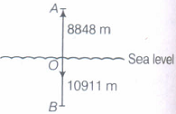
Let A be the point above the sea level and B be the point below the sea level.
\(\therefore\) Vertical distance between points A and B = Distance between point A and sea level + Distance between point B and sea level.
= AO + OB = 8848 + 10911 = 19759 m
18.
(i) We know that, 3 \(\div\) 1= 3, so 3 \(\div\) (- 1)= - 3
On comparing with a \(\div\) b = - 3, we get a = 3 and b = -1
Hence, the required pair of integers is (3, -1).
(ii) We know that, 12 \(\div\) 4 = 3, so 12 \(\div\)(- 4) = - 3
On comparing with a \(\div\) b = - 3, we get a = 12 and b = -4
Hence, the required pair of integers is (12, - 4).
(iii) We know that, 9 \(\div\) 3 = 3, so 9 \(\div\) (- 3) = - 3
On comparing with a \(\div\) b = - 3, we get a = 9 and b = -3
Hence, the required pair of integers is (9, - 3).
(iv) We know that,12 \(\div\) 4 = 3, so (-12) \(\div\) 4 = -3
On comparing with a \(\div\) b = - 3, we get a = -12 and b=4
Hence, the required pair of integers is (-12, 4).
(v) We know that, 15 \(\div\) 5 = 3, so 15 + (- 5) = -3
On comparing with a \(\div\) b = - 3, we get a = 15 and b = -5
Hence, the required pair of integers is (15, - 5).
19.
(b)
20.
(b)
21.
(a)

7th Standard CBSE Syllabus & Materials
7th Standard CBSE
CBSE 7th Standard Science Electric Current and Effects Sample Question Papers Study Material - QB365 Set A
NEW7th Standard CBSE
CBSE 7th Standard Science Motion and Time Sample Question Papers Study Material - QB365 Set D
NEW7th Standard CBSE
CBSE 7th Standard Science Motion and Time Sample Question Papers Study Material - QB365 Set C
NEW7th Standard CBSE
CBSE 7th Standard Science Motion and Time Sample Question Papers Study Material - QB365 Set B



NCERT Books

Syllabus

Exam Pattern

Sample Question Papers

Previous year Question Papers

Important Notes

MCQ Practice test

NCERT Exemplers

Case study Questions

Image Based Questions

Passage based Questions

HOT Questions

Value Based Questions

Model Questions Papers
NCERT ( Book Back ) Questions

Assertion and Reason
Important Questions And Answers

CBSE 7th Standard CBSE Subjects
CBSE Standards