7th Standard CBSE Syllabus & Materials
7th Standard CBSE
CBSE 7th Standard Science Wastewater Story Sample Question Papers Study Material - QB365
NEW7th Standard CBSE
CBSE 7th Standard Science Forests: Our Lifeline Sample Question Papers Study Material - QB365
NEW7th Standard CBSE
CBSE 7th Standard Science Water: A Precious Resource Sample Question Papers Study Material - QB365
NEW7th Standard CBSE
CBSE 7th Standard Science Light Sample Question Papers Study Material - QB365
NEW7th Standard CBSE
CBSE 7th Standard Science Electric Current and Effects Sample Question Papers Study Material - QB365 Set C
NEW7th Standard CBSE
CBSE 7th Standard Science Electric Current and Effects Sample Question Papers Study Material - QB365 Set B

Published on: 31/10/2025
Download CBSE Class 7th Standard CBSE Mathematics question papers, sample papers, important questions, and previous year solved papers in PDF format. Get free study materials, NCERT solutions, and exam preparation resources for Class 7th Standard CBSE Mathematics
Questions + Answers key
Take MCQ Mathematics Test
1.
Find (- 83) x (- 28)
2.
Use the sign of >, < or = in the blank to make the statement true. 39+ (-24) -15 ___ 36 + (-52) - (-36).
3.
Use the sign of >, < or = in the blank to make the statement true. (-3) + 7 - 19 ___ 15 - 8 + (-9)
4.
Use the sign of >, < or = in the blank to make the statement true. -8 + (-4) ___ (-8) - (-4)
5.
State whether the following statement is correct or incorrect. Correct those which are wrong.
Additive inverse of an integer 8 is (-8) and additive inverse of (-8) is 8.
6.
State whether the following statement is correct or incorrect. Correct those which are wrong.
When a positive integer and a negative integer are added, we always get a negative integer.
7.
State whether the following statement is correct or incorrect. Correct those which are wrong.
When two negative integers are added, we get a positive integer
8.
Arrange 7, - 5, 4, 0 and - 4 in ascending order and then mark them on a number line to check your answer.
9.
Solve 10 + (-4)
10.
Add the following integers using number line: -3 and 4
11.
Following number line shows the temperature in degree Celsius (o C ) at different places on a particular day.

Observe this number line and write the temperature of the places marked on it.
12.
Following number line shows the temperature in degree Celsius (oC) at different places on a particular day.
What is the temperature difference between the hottest and the coldest places among the above?
13.
A cement company earns a profit of Rs 8 per bag of white cement sold and a loss of Rs 5 per bag of grey cement sold.
(a) The company sells 3000 bags of white cement and 5000 bags of grey cement in a month. What is its profit or loss?
(b) What is the number of white cement bags it must sell to have neither profit nor loss if the number of grey bags sold is 6400 bags?
14.
A water tank has steps inside it. A monkey is sitting on the topmost step i.e. the first step. The water level is at the ninth step.
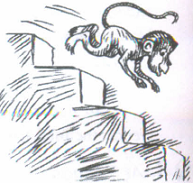
(i) He jumps 3 steps down and then jumps back 2 steps up. In how many jumps will he reach the water level?
(ij) After drinking water, he wants to go back. For this, he jumps 4 steps up and then jumps back 2 steps down in every move. In how many jumps will he reach back the top step?
(iii) If the number of steps moved down is represented by negative integers and the number of steps moved up by positive integers, represent his moves in parts (i) and (ii) by completing the following
(a) -3 + 2- ... = -8
(b) 4 -2 + ... = 8
In part (a), the sum (-8) represents going down by eight steps. What will the sum 8 in part (b) represent?
15.
(-6) + (-6) + (-6) = ________ x (-6).
16.
The following statement true:
[2 + 12] + 6 = 2 + [ 12 + ____ ]
17.
17 + ______ = 0
18.
Using >, < or =.
18 - 16 ____ + 2
19.
Using >, < or =.
4 ___ 3 + 1
20.
(-25) x (6+ 4) is not same as
(-25) x 10
(-25) x 6 + (-25) x 4
(-25) x 6 x 4
-250
21.
The value of (-2) x (-1) x (1) is
1
3
-4
2
22.
If * represents 3 mangoes, then 18 mangoes are represented by
***
****
******
None of these
23.
The value of 1200 x 2 is
600 x 20
2000 + 400
600 + 600
None of these
24.
If the sum of two integers a and b is zero, then
a=0, b=0
a = -b
Both (a) and (b) are not zero
None of these
1.
We have, (- 83) x (- 28) = 83 x 28 = 2324
2.
We have, LHS = 39 + (-24) -15 = 39 - 39 = 0
and RHS = 36 + (-52) - (-36)
= 36 - 52 + 36 = 72 - 52 = 20
Since, 0 < 20
39 + (-24) -15 < 36 + (-52) - (-36).
3.
We have, LHS = -3 + 7 -19 = -3 + 7 -19 = - (19 + 3) + 7 = - 22 + 7 = - 15
and RHS =15 -8 + (-9) = 15 + (-8 -9) = 15 + (-17) = - 2
Since, -15 < - 2
\(\therefore\) -3 + 7 -19 < 15 - 8 + (- 9)
4.
We have, LHS = (-8) + (-4) = - 8 - 4 = -12
and RHS =(-8) - (-4) = -8 + 4= - 4
Since, -12 < -4
\(\therefore\) -8 + (-4) < (-8) - (-4)
5.
Correct, when a number and its opposite add up to give zero, they are called additive inverse of each other. In other words, the additive inverse of a number is the opposite of that number.
e.g.
| Integer | Additive inverse |
| 18 | -18 |
| -18 | 18 |
| 75 | -75 |
| -75 | 75 |
6.
Incorrect, when a positive integer and a negative integer are added, we determine the difference of their absolute values and assign the sign of addend having greater absolute value.
e.g. Let the positive integer be 26 and negative integer be -33.
\(\therefore\) Sum=26+(-33)
= 26 - 33 = - 7 (negative integer)
Again, let the positive integer be 325 and negative integer be - 220.
\(\therefore\) Sum = 325 + (- 220) = 325 - 220 = 105 (positive integer)
Hence, the statement is not correct.
7.
Incorrect, when two negative integers are added, we get a negative integer.
e.g. Let two negative integers be - 46 and - 83.
\(\therefore\) Sum =-46+(-83)=-46-83=-129 (negative integer)
Hence, the statement is not correct.
8.
We have, 7, - 5, 4, 0 and - 4
Since every positive integer is greater than 0 and every negative integer is less than O. So, rearrange the given numbers in ascending order i.e. -5, - 4, 0, 4, 7.
In order to represent the given integers on the number line, we draw a line and mark a point on it almost in the middle (say0) of the line.
Now, starting from 0 and count 4 units on the right of the middle point, we get 4 and further count 3 units from 4 to the right, we obtain 7.
Again, starting from 0 and count 4 units to the left of it, we obtain - 4 and further count 1 unit from its left, we get -5.

9.
10 + (-4) = 10 - 4 = +6 or 6 [\(\because\) difference = 6, higher integer sign is' +']
10.
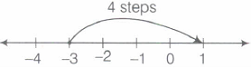
We have, -3 and 4
In this case, firstly we go to (-3) and then move (4) step to the right of (-3).
Thus, we reached to (1), i.e. (-3) + (4) = 1
11.
Number line with all numbers is shown below:

We know that a place whose temperature is highest, will be the hottest place and the place whose temperature is lowest, will be the coldest place.
Here, the temperature of hottest place (Bangalore) = 22° C and temperature of coldest place (Lahulspiti) = - 8° C
\(\therefore\) Temperature difference between the hottest and coldest places = Temperature of Bangalore - Temperature of Lahulspiti.
= 22 - (- 8) = 22 + 8 = 30
Hence, the temperature difference between the hottest and the coldest places is 30°C.
12.
Number line with all numbers is shown below:
From the above number line, the temperature of the indicated places are as follow:
| Places | Temperature |
| Lahulspiti | - 8o C |
| Srinagar | - 2o C |
| Shimla | 5o C |
| Ooty | 14o C |
| Bangalore | 22o C |
13.
(a) Since profit of Rs 8 is earned on a bag of white cement and a loss of Rs 5 on a bag of grey cement.
Number of white cement bags sold = 3000
Number of grey cement bags sold = 5000
\(\therefore\) Profit = Total number of white cement bags X Profit per bag
= 3000 \(\times\) 8 = Rs 24000
Loss =Total number of grey cement bags X Loss per bag
= 5000 \(\times\) 5 = Rs 25000
\(\because\) Loss > Profit, so Loss = Rs 25000 - Rs 24000 = Rs 1000
(b) Let x be the number of white cement bags sold,
According to the question,
Number of white cement bags X Profit per bag = Number of grey cement bags X Loss per bag
\(\Rightarrow\) x \(\times\) 8 = 6400 \(\times\) 5 \(\Rightarrow\) x = 6400 \(\times\) 5 / 8
\(\Rightarrow\) x = 800 \(\times\) 5 = 4000
Hence, 4000 bags of white cement must be sold.
14.
Let the number of steps moved down to be represented by negative integers and number of steps moved up to be represented by positive integers. Given that, the total number of steps to be moved down to reach water level= 9
(i) Number of steps moved down in one jump = - 3
and number of steps moved up in one jump = 2
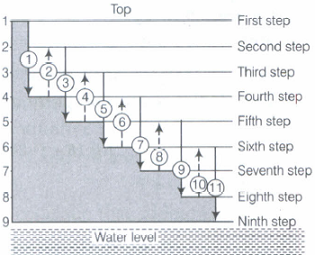
From the above figure, monkey will reach the water level in 11 jumps.
Alternate Method:
The monkey is sitting on the topmost step i.e. the first step. While going down, the monkey jumps 3 steps down and then jumps back 2 steps up. To reach the water level, he has to jump as follows:
-3 + 2 -3 + 2 -3 + 2 -3 + 2 -3 + 2 -3 = -8
Hence, he takes 11 jumps to reach the water level.
ii) In one jump number of steps moved up = 4
In one jump, number of steps moved down = - 2
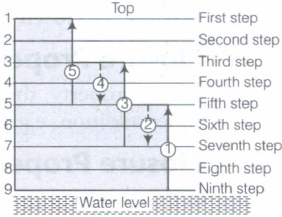
Distance covered in single jump = 4 - 2 =2
Now, total number of steps for top = 9
From the above figure, he will reach back the top step in 5 jumps.
Alternate Method
Afterdrinkingwaters,he has to jump as followsto go back:
4 -2 + 4 - 2 + 4 = 8
Hence, he takes 5 jumps to reach back the top
(iii) (a) We have,
-3 + 2 -3 + 2 - 3 + 2 - 3 + 2 - 3 + 2 -3 = -8
(b) 4 - 2 + 4 - 2 + 4 = 8
According to the question, the sum 8 in part (b) represents going up 8 steps.
15.
()
-12
16.
()
6 (associative property of addition)
17.
()
17 + (-17) = 0 [\(\because\) sum of an integer and its additive inverse is zero]
18.
()
=
19.
()
=
20.
(c)
(-25) x 6 x 4
21.
(d)
2
22.
(c)
******
23.
(b)
2000 + 400
24.
(b)
a = -b

7th Standard CBSE Syllabus & Materials
7th Standard CBSE
CBSE 7th Standard Science Electric Current and Effects Sample Question Papers Study Material - QB365 Set A
NEW7th Standard CBSE
CBSE 7th Standard Science Motion and Time Sample Question Papers Study Material - QB365 Set D
NEW7th Standard CBSE
CBSE 7th Standard Science Motion and Time Sample Question Papers Study Material - QB365 Set C
NEW7th Standard CBSE
CBSE 7th Standard Science Motion and Time Sample Question Papers Study Material - QB365 Set B



NCERT Books

Syllabus

Exam Pattern

Sample Question Papers

Previous year Question Papers

Important Notes

MCQ Practice test

NCERT Exemplers

Case study Questions

Image Based Questions

Passage based Questions

HOT Questions

Value Based Questions

Model Questions Papers
NCERT ( Book Back ) Questions

Assertion and Reason
Important Questions And Answers

CBSE 7th Standard CBSE Subjects
CBSE Standards