
7th Standard CBSE Syllabus & Materials
7th Standard CBSE
CBSE 7th Standard Science Wastewater Story Sample Question Papers Study Material - QB365
NEW7th Standard CBSE
CBSE 7th Standard Science Forests: Our Lifeline Sample Question Papers Study Material - QB365
NEW7th Standard CBSE
CBSE 7th Standard Science Water: A Precious Resource Sample Question Papers Study Material - QB365
NEW7th Standard CBSE
CBSE 7th Standard Science Light Sample Question Papers Study Material - QB365
NEW7th Standard CBSE
CBSE 7th Standard Science Electric Current and Effects Sample Question Papers Study Material - QB365 Set C
NEW7th Standard CBSE
CBSE 7th Standard Science Electric Current and Effects Sample Question Papers Study Material - QB365 Set B

Published on: 31/10/2025
Download CBSE Class 7th Standard CBSE Science question papers, sample papers, important questions, and previous year solved papers in PDF format. Get free study materials, NCERT solutions, and exam preparation resources for Class 7th Standard CBSE Science
Questions + Answers key
Take MCQ Science Test
3 Marks
1.
Which of the following are not correct?
(a) The basic unit of time is second.
(b) Every object moves with a constant speed.
(c) Distances between two cities are measured in kilometres.
(d) The time period of a given pendulum is not constant.
(e) The speed of a train is expressed in m/h.
2.
A simple pendulum takes 32 s to complete 20 oscillations. What is the time period of the pendulum?
3.
The distance between two stations is 240 km. A train takes 4 h to cover this distance. Calculate the speed of the train.
4.
The odometer of a car reads 57321 km when the clock shows the time 08:30 AM. What is the distance moved by the car, if at 08:50 AM, the odometer reading has changed to 57336 km? Calculate the speed of the car in km/min during this time. Express the speed in km/h also.
5.
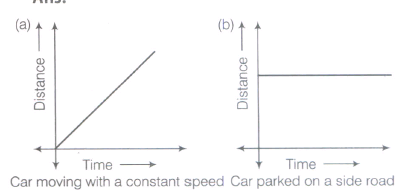
Show the shape of the distance-time graph for the motion in the following cases:
(a) A car moving with a constant speed.
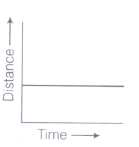
(b) A car parked on a side road.
6.
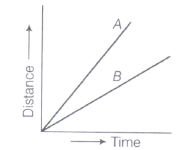
Figure shows the distance-time graph for the motion of two vehicles A and B. Which one of them is moving faster?
Multiple Choice Question
7.
Which of the following relations is correct?
Speed = Distance \(\times\) Time
\(Speed=\frac{Distance}{Time}\)
\(Speed=\frac{Time}{Distance}\)
\(Speed=\frac{1}{Distance\times\ Time}\)
8.
The basic unit of speed is
km/min
m/min
km/h
m/s
9.
A car moves with a speed of 40 km/h for 15 min and then with a speed of 60 km/h for the next 15 min. The total distance covered by the car is
100 km
25 km
15 km
10 km
10.
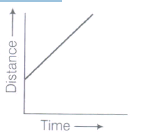
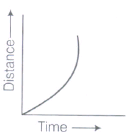
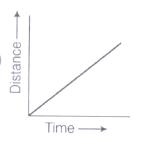
Which of the following distance-time graphs shows a truck moving with speed which is not constant?
11.
What is the relation between distance and speed?
Distance = Speed \(\times\) Time
Distance = Speed/Time
Distance = Time/Speed
None of the above
2 Marks
12.
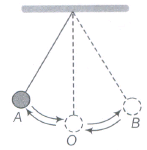
A simple pendulum is oscillating between two points A and B as shown in figure. Is the motion of the bob uniform or non-uniform?
13.
State the characteristic of distance-time graph for the motion of an object moving with a constant speed.
14.
Name the axis that represents dependent variable.
15.
Briefly explain how will decide which object is moving fast and which one is moving slow.
16.
A spaceship travels 36000 km in one hour. Express its speed in km/s.
17.
Rockets, launching satellites into earth's orbit, often attain speeds up to 8 km/s. On the other hand, a tortoise can move only with a speed of about 89 cm/s. Calculate how fast is the rocket compared with the tortoise?
5 Marks
18.
Boojho goes to the football ground to play football. The distance-time graph of his journey from his home to the ground is given as figure.
(a) What does the graph between points B and C indicate about the motion of Boojho?
(b) Is the motion between 0 to 4 min uniform or non-uniform?
(c) What is his speed between 8 to 12 min of his journey.
19.
Distance between Bholu's and Golu's house is 9 km. Bholu has to attend Golu's birthday party at 7 0' clock. He started his journey from his home at 6 0' clock on his bicycle and covered a distance of 6 km in 40 min. At that point, he met Chintu and he spoke to him for 5 min and reached Golu's birthday party at 7 0' clock. With what speed, did he cover the second part of the journey? Calculate his average speed for the entire journey.
20.
The given data regarding the motion of two different objects C and 0 is in a tabular form. Check them carefully and state whether the motion of the objects is uniform or non-uniform.
| Time | Distance travelled bye (in m) | Distance travelled by D (in m) |
| 9:30 AM | 10 | 12 |
| 9:45 AM | 20 | 19 |
| 10:00 AM | 30 | 23 |
| 10:15 AM | 40 | 35 |
| 10:30 AM | 50 | 37 |
| 10:45 AM | 60 | 41 |
| 11:00 AM | 70 | 44 |
3 Marks
1.
(b), (d) and (e) are not correct.
2.
Time period of simple pendulum is given by
\(\frac{Time\ taken}{Number\ of\ oscillations}=\frac{32}{20}s=1.65\)
(i.e. the time to complete one cycle)
3.
As, we know that the speed of a body is given by \(Speed=\frac{Distance\ travelled}{time\ taken}=\frac{240}{4}=60km/h\)
4.
As, we know that
\(Speed=\frac{Distance\ covered}{Time\ taken}\)
Given, distance covered = 57336 - 57321=15km
Time taken = 8: 50 AM- 8: 30 AM= 20min
\(Speed=\frac{15}{20}=\frac{3}{4}km/min\)
Now, speed in km/h is given by \(\frac{3}{4}\times60\)
= 45 km/h \([1min=\frac{1}{60}h]\)
5.
6.
As, from the given graph, slope of A is greater than B, i.e. distance covered by A in same time with respect to B is greater. So, A is moving with faster speed than B.
Multiple Choice Question
7.
(b)
\(Speed=\frac{Distance}{Time}\)
8.
(d)
m/s
9.
(b)
25 km
10.
(c)
11.
(a)
Distance = Speed \(\times\) Time
2 Marks
12.
The motion of bob is non-uniform as it does not cover equal distance in equal intervals of time.
13.
The distance-time graph for the motion of an object moving with a constant speed is a straight line inclined on x-axis at some angles.
14.
y-axis represents the dependent variable.
15.
If an object covers more distance in equal intervals of time with respect to other, then we can say that object is moving faster with respect to the other object.
16.
\(Speed=\frac{Distance}{Time}\)
\(=\frac{36000}{1\times3600}=\) [\(\therefore\) 1 h = 36000 s]
= 10 km/s
17.
Speed or rocket = 8 km/s = 8000m/s
Speed oftortoise = 8 cm/s = \(\frac { 8 }{ 100 } \)
\(\therefore\) \(\frac { speed\quad of\quad rocket }{ speed\quad of\quad tortoise } \) = \(\frac { 8000\quad m/s }{ 8/100\quad m/s } \)
= \(\frac { 8000\times 100 }{ 8 } \)
= 1,00,000
5 Marks
18.
(a) Since, the graph between B and C is parallel to time-axis, so it indicates that Boojho is at rest.
(b) Since, the graph is not straight line, so it is a non-uniform motion.
\(Speed=\frac{Distance}{Time}=\frac{225-150}{12-8}=\frac{75}{4}=18.75\ m/min\)
19.
From the question, Bholu covers 3 km distance in 15 min
speed of Bholu \(=\frac{3}{15}\times60=12\ km/h\) \((1\ min=\frac{1}{60}h)\)
Now, average speed is given by
\(=\frac{Total\ distance\ travelled}{Total\ time\ taken}=\frac{9}{1}=9\ km/h\)
20.
We can check the motion of the objects C and 0 by plotting the distance-time graph for the two objects .
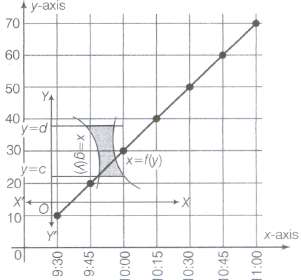
Graph for object C on x-axis
Scale 1 cm = 15 min and on y-axis 1 cm = 10 m
Since, the distance-time graph of the object C is a straight line. Therefore, its motion is uniform.
Graph of object D
Scale On x-axis, 1cm = 15min, On y-axis 1cm =5 m
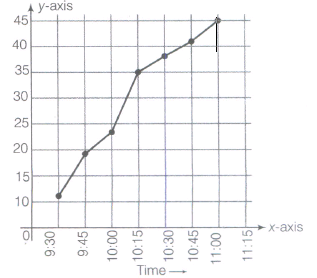
Since, the distance-time graph of the object 0 is not a straight line, therefore, its motion is non-uniform.

7th Standard CBSE Syllabus & Materials
7th Standard CBSE
CBSE 7th Standard Science Electric Current and Effects Sample Question Papers Study Material - QB365 Set A
NEW7th Standard CBSE
CBSE 7th Standard Science Motion and Time Sample Question Papers Study Material - QB365 Set D
NEW7th Standard CBSE
CBSE 7th Standard Science Motion and Time Sample Question Papers Study Material - QB365 Set C
NEW7th Standard CBSE
CBSE 7th Standard Science Motion and Time Sample Question Papers Study Material - QB365 Set B



NCERT Books

Syllabus

Exam Pattern

Sample Question Papers

Previous year Question Papers

Important Notes

MCQ Practice test

NCERT Exemplers

Case study Questions

Image Based Questions

Passage based Questions

HOT Questions

Value Based Questions

Model Questions Papers
NCERT ( Book Back ) Questions

Assertion and Reason
Important Questions And Answers

CBSE 7th Standard CBSE Subjects
CBSE Standards