
7th Standard CBSE Syllabus & Materials
7th Standard CBSE
CBSE 7th Standard Science Wastewater Story Sample Question Papers Study Material - QB365
NEW7th Standard CBSE
CBSE 7th Standard Science Forests: Our Lifeline Sample Question Papers Study Material - QB365
NEW7th Standard CBSE
CBSE 7th Standard Science Water: A Precious Resource Sample Question Papers Study Material - QB365
NEW7th Standard CBSE
CBSE 7th Standard Science Light Sample Question Papers Study Material - QB365
NEW7th Standard CBSE
CBSE 7th Standard Science Electric Current and Effects Sample Question Papers Study Material - QB365 Set C
NEW7th Standard CBSE
CBSE 7th Standard Science Electric Current and Effects Sample Question Papers Study Material - QB365 Set B

Published on: 31/10/2025
Download CBSE Class 7th Standard CBSE Science question papers, sample papers, important questions, and previous year solved papers in PDF format. Get free study materials, NCERT solutions, and exam preparation resources for Class 7th Standard CBSE Science
Questions + Answers key
Take MCQ Science Test
1.
Name some useful products or materials that are carried by blood.
2.
Circulatory system consists of three major organs. Name those organs.
3.
Name the organ which is located in the chest cavity with its lower tip slightly tilted towards the left.
4.
RBC contains a red coloured pigment which carries oxygen with it. What is the pigment called?
5.
Blood is a fluid connective tissue. Justify.
6.
Blood performs various functions including protection against infections. How?
7.
Name the functional units of the major excretory organ of humans.
8.
Exchange of gases, food and other substances occurs between arteries and veins. How does this exchange happen?
9.
Sponges and Hydra do not possess any circulatory system then how do they carry out distribution of food and other substances?
10.
If the heartbeats of a person are more than 72 - 80 beats per minute. What does it signify?
11.
In our heart, there is no mixing of oxygenated and deoxygenated blood. How it is made possible?
12.
What would have been the effect, if no platelets would have been in our blood?
13.
What is the function of valves in veins?
14.
Human excretory system is depicted in the figure.
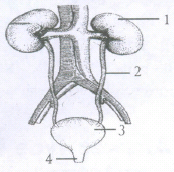
(a) Label the part 1, 2, 3 and 4
(b) Write the function of 1 & 3.
15.
Boojho's uncle was hospitalised and put on dialysis after a severe infection in both of his kidneys.
(a) What is dialysis?
(b) When does it become necessary to take such a treatment?
1.
Food, water and oxygen are the products that are carried by blood to every part of the body.
2.
The circulatory system consists of three major organs, i.e., blood, blood vessels and heart.
3.
The heart is located in the chest cavity with its lower tip slightly tilted towards the left.
4.
The red coloured pigment of RBC that carries oxygen with it is called haemoglobin.
5.
Blood is a fluid tissue which connects all the parts of body with each other.
6.
Blood contains WBC which forms the defense of our body. They eat antigens and fights aganist infections.
7.
Kidney is the major excretory organ and nephrons are its functional units.
8.
Exchange of substances between arteries and veins occurs via capillaries.
9.
The water in which these organisms live brings them food and oxygen as it enters their bodies.
10.
The faster heartbeats signify that heart is pumping more blood to the organs as they need increased oxygen and energy supply.
11.
In our heart, the right side and left side is completely separated by a septum. The septum does not allows oxygenated and deoxygenated blood to mix.
12.
Platelets help in clotting of blood when we get injured and thus bleeding is stopped. In their absence we will bleed excessively which may endanger our life and prove fatal.
13.
Valves in veins maintains flow of blood only in one direction i.e., from body organs to heart.
14.
(a) Part 1: Kidney
Part 2: Ureter
Part 3: Urinary Bladder
Part 4: Urethra
(b) Function of 1 (Kidney): Helps in filtration of blood. Function of 3 (Urinary Bladder): Receives and collects urine from kidneys.
15.
(a) In dialysis blood is filtered periodically through an artificial kidney.
(b) In the event of kidney failure

7th Standard CBSE Syllabus & Materials
7th Standard CBSE
CBSE 7th Standard Science Electric Current and Effects Sample Question Papers Study Material - QB365 Set A
NEW7th Standard CBSE
CBSE 7th Standard Science Motion and Time Sample Question Papers Study Material - QB365 Set D
NEW7th Standard CBSE
CBSE 7th Standard Science Motion and Time Sample Question Papers Study Material - QB365 Set C
NEW7th Standard CBSE
CBSE 7th Standard Science Motion and Time Sample Question Papers Study Material - QB365 Set B



NCERT Books

Syllabus

Exam Pattern

Sample Question Papers

Previous year Question Papers

Important Notes

MCQ Practice test

NCERT Exemplers

Case study Questions

Image Based Questions

Passage based Questions

HOT Questions

Value Based Questions

Model Questions Papers
NCERT ( Book Back ) Questions

Assertion and Reason
Important Questions And Answers

CBSE 7th Standard CBSE Subjects
CBSE Standards